 Add to Chrome
 Add to Firefox
 Add to Edge
Ycb Video
Papers and Code
6DAttack: Backdoor Attacks in the 6DoF Pose Estimation
Dec 22, 2025
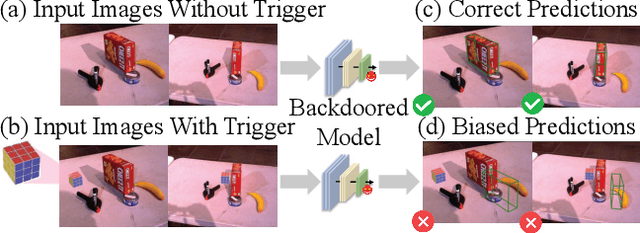
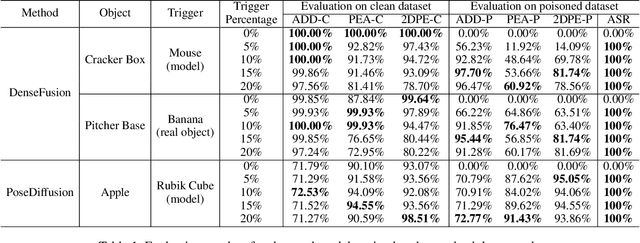
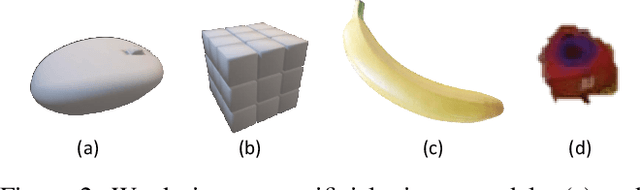
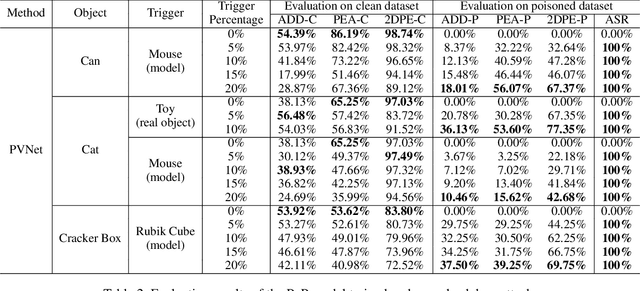
Deep learning advances have enabled accurate six-degree-of-freedom (6DoF) object pose estimation, widely used in robotics, AR/VR, and autonomous systems. However, backdoor attacks pose significant security risks. While most research focuses on 2D vision, 6DoF pose estimation remains largely unexplored. Unlike traditional backdoors that only change classes, 6DoF attacks must control continuous parameters like translation and rotation, rendering 2D methods inapplicable. We propose 6DAttack, a framework using 3D object triggers to induce controlled erroneous poses while maintaining normal behavior. Evaluations on PVNet, DenseFusion, and PoseDiffusion across LINEMOD, YCB-Video, and CO3D show high attack success rates (ASRs) without compromising clean performance. Backdoored models achieve up to 100% clean ADD accuracy and 100% ASR, with triggered samples reaching 97.70% ADD-P. Furthermore, a representative defense remains ineffective. Our findings reveal a serious, underexplored threat to 6DoF pose estimation.

DISF: Disentangled Iterative Surface Fitting for Contact-stable Grasp Planning with Grasp Pose Alignment to the Object Center of Mass
Dec 31, 2025In this work, we address the limitation of surface fitting-based grasp planning algorithm, which primarily focuses on geometric alignment between the gripper and object surface while overlooking the stability of contact point distribution, often resulting in unstable grasps due to inadequate contact configurations. To overcome this limitation, we propose a novel surface fitting algorithm that integrates contact stability while preserving geometric compatibility. Inspired by human grasping behavior, our method disentangles the grasp pose optimization into three sequential steps: (1) rotation optimization to align contact normals, (2) translation refinement to improve the alignment between the gripper frame origin and the object Center of Mass (CoM), and (3) gripper aperture adjustment to optimize contact point distribution. We validate our approach in simulation across 15 objects under both Known-shape (with clean CAD-derived dataset) and Observed-shape (with YCB object dataset) settings, including cross-platform grasp execution on three robot--gripper platforms. We further validate the method in real-world grasp experiments on a UR3e robot. Overall, DISF reduces CoM misalignment while maintaining geometric compatibility, translating into higher grasp success in both simulation and real-world execution compared to baselines. Additional videos and supplementary results are available on our project page: https://tomoya-yamanokuchi.github.io/disf-ras-project-page/
YCB-Ev SD: Synthetic event-vision dataset for 6DoF object pose estimation
Nov 14, 2025We introduce YCB-Ev SD, a synthetic dataset of event-camera data at standard definition (SD) resolution for 6DoF object pose estimation. While synthetic data has become fundamental in frame-based computer vision, event-based vision lacks comparable comprehensive resources. Addressing this gap, we present 50,000 event sequences of 34 ms duration each, synthesized from Physically Based Rendering (PBR) scenes of YCB-Video objects following the Benchmark for 6D Object Pose (BOP) methodology. Our generation framework employs simulated linear camera motion to ensure complete scene coverage, including background activity. Through systematic evaluation of event representations for CNN-based inference, we demonstrate that time-surfaces with linear decay and dual-channel polarity encoding achieve superior pose estimation performance, outperforming exponential decay and single-channel alternatives by significant margins. Our analysis reveals that polarity information contributes most substantially to performance gains, while linear temporal encoding preserves critical motion information more effectively than exponential decay. The dataset is provided in a structured format with both raw event streams and precomputed optimal representations to facilitate immediate research use and reproducible benchmarking. The dataset is publicly available at https://huggingface.co/datasets/paroj/ycbev_sd.
UA-Pose: Uncertainty-Aware 6D Object Pose Estimation and Online Object Completion with Partial References
Jun 09, 2025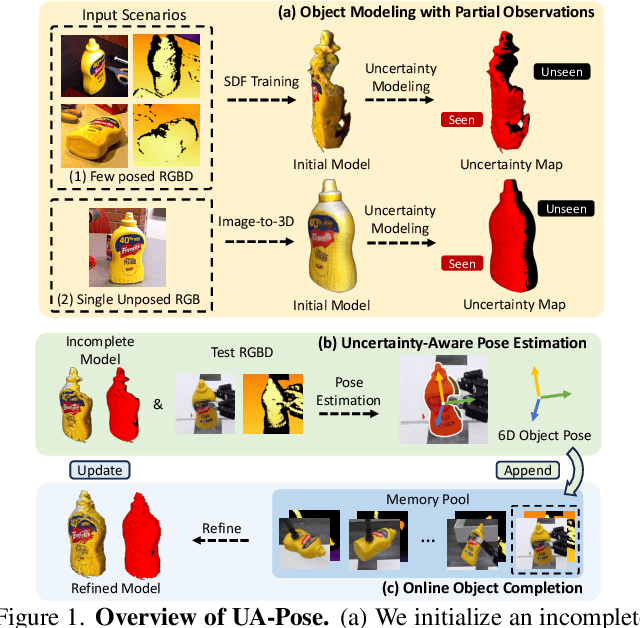
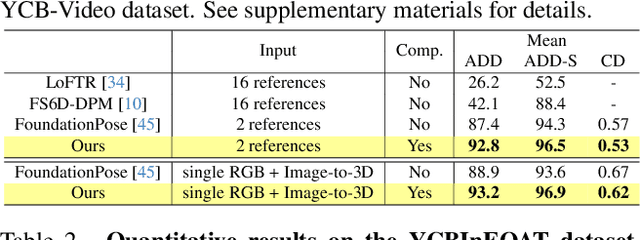
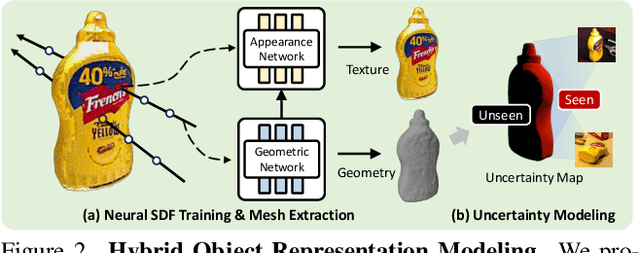
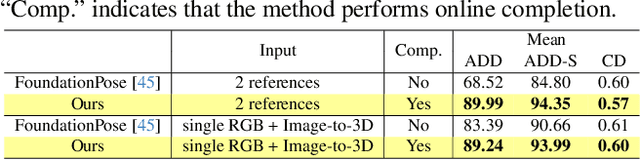
6D object pose estimation has shown strong generalizability to novel objects. However, existing methods often require either a complete, well-reconstructed 3D model or numerous reference images that fully cover the object. Estimating 6D poses from partial references, which capture only fragments of an object's appearance and geometry, remains challenging. To address this, we propose UA-Pose, an uncertainty-aware approach for 6D object pose estimation and online object completion specifically designed for partial references. We assume access to either (1) a limited set of RGBD images with known poses or (2) a single 2D image. For the first case, we initialize a partial object 3D model based on the provided images and poses, while for the second, we use image-to-3D techniques to generate an initial object 3D model. Our method integrates uncertainty into the incomplete 3D model, distinguishing between seen and unseen regions. This uncertainty enables confidence assessment in pose estimation and guides an uncertainty-aware sampling strategy for online object completion, enhancing robustness in pose estimation accuracy and improving object completeness. We evaluate our method on the YCB-Video, YCBInEOAT, and HO3D datasets, including RGBD sequences of YCB objects manipulated by robots and human hands. Experimental results demonstrate significant performance improvements over existing methods, particularly when object observations are incomplete or partially captured. Project page: https://minfenli.github.io/UA-Pose/
GMatch: Geometry-Constrained Feature Matching for RGB-D Object Pose Estimation
May 22, 2025We present GMatch, a learning-free feature matcher designed for robust 6DoF object pose estimation, addressing common local ambiguities in sparse feature matching. Unlike traditional methods that rely solely on descriptor similarity, GMatch performs a guided, incremental search, enforcing SE(3)-invariant geometric consistency throughout the matching process. It leverages a provably complete set of geometric features that uniquely determine 3D keypoint configurations, ensuring globally consistent correspondences without the need for training or GPU support. When combined with classical descriptors such as SIFT, GMatch-SIFT forms a general-purpose pose estimation pipeline that offers strong interpretability and generalization across diverse objects and scenes. Experiments on the HOPE dataset show that GMatch outperforms both traditional and learning-based matchers, with GMatch-SIFT achieving or surpassing the performance of instance-level pose networks. On the YCB-Video dataset, GMatch-SIFT demonstrates high accuracy and low variance on texture-rich objects. These results not only validate the effectiveness of GMatch-SIFT for object pose estimation but also highlight the broader applicability of GMatch as a general-purpose feature matcher. Code will be released upon acceptance.
BoxDreamer: Dreaming Box Corners for Generalizable Object Pose Estimation
Apr 10, 2025This paper presents a generalizable RGB-based approach for object pose estimation, specifically designed to address challenges in sparse-view settings. While existing methods can estimate the poses of unseen objects, their generalization ability remains limited in scenarios involving occlusions and sparse reference views, restricting their real-world applicability. To overcome these limitations, we introduce corner points of the object bounding box as an intermediate representation of the object pose. The 3D object corners can be reliably recovered from sparse input views, while the 2D corner points in the target view are estimated through a novel reference-based point synthesizer, which works well even in scenarios involving occlusions. As object semantic points, object corners naturally establish 2D-3D correspondences for object pose estimation with a PnP algorithm. Extensive experiments on the YCB-Video and Occluded-LINEMOD datasets show that our approach outperforms state-of-the-art methods, highlighting the effectiveness of the proposed representation and significantly enhancing the generalization capabilities of object pose estimation, which is crucial for real-world applications.
DLTPose: 6DoF Pose Estimation From Accurate Dense Surface Point Estimates
Apr 09, 2025We propose DLTPose, a novel method for 6DoF object pose estimation from RGB-D images that combines the accuracy of sparse keypoint methods with the robustness of dense pixel-wise predictions. DLTPose predicts per-pixel radial distances to a set of minimally four keypoints, which are then fed into our novel Direct Linear Transform (DLT) formulation to produce accurate 3D object frame surface estimates, leading to better 6DoF pose estimation. Additionally, we introduce a novel symmetry-aware keypoint ordering approach, designed to handle object symmetries that otherwise cause inconsistencies in keypoint assignments. Previous keypoint-based methods relied on fixed keypoint orderings, which failed to account for the multiple valid configurations exhibited by symmetric objects, which our ordering approach exploits to enhance the model's ability to learn stable keypoint representations. Extensive experiments on the benchmark LINEMOD, Occlusion LINEMOD and YCB-Video datasets show that DLTPose outperforms existing methods, especially for symmetric and occluded objects, demonstrating superior Mean Average Recall values of 86.5% (LM), 79.7% (LM-O) and 89.5% (YCB-V). The code is available at https://anonymous.4open.science/r/DLTPose_/ .
PhysPose: Refining 6D Object Poses with Physical Constraints
Mar 30, 2025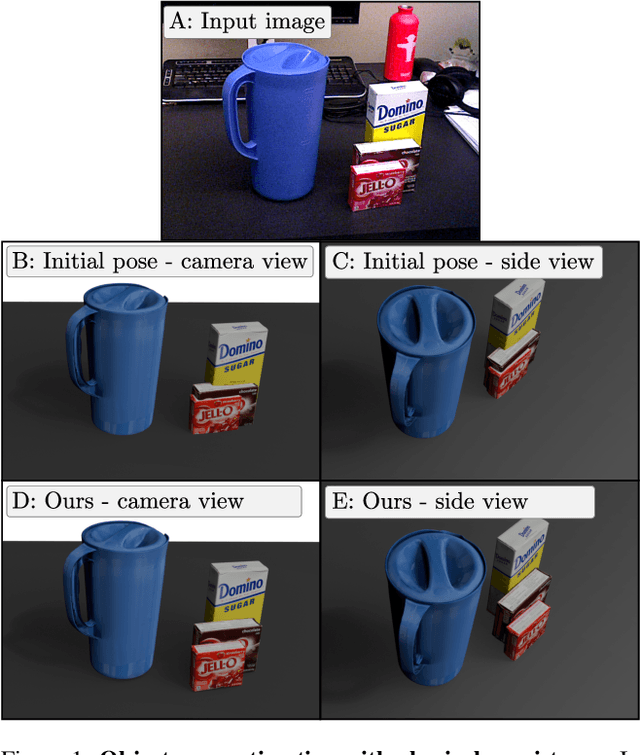
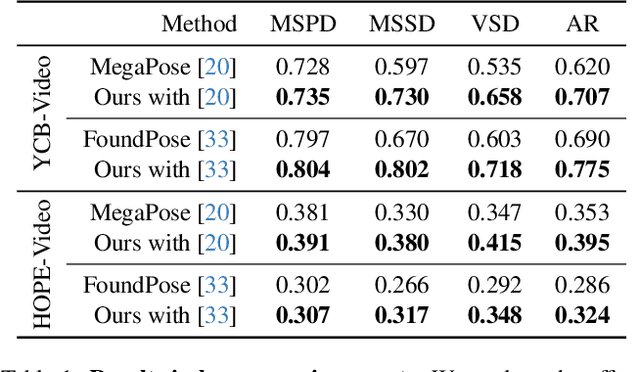
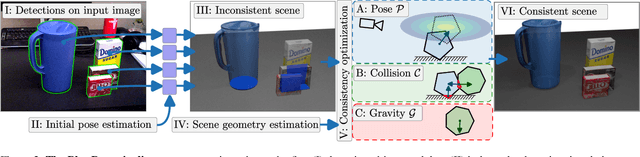
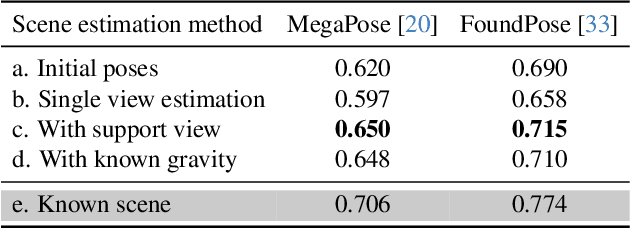
Accurate 6D object pose estimation from images is a key problem in object-centric scene understanding, enabling applications in robotics, augmented reality, and scene reconstruction. Despite recent advances, existing methods often produce physically inconsistent pose estimates, hindering their deployment in real-world scenarios. We introduce PhysPose, a novel approach that integrates physical reasoning into pose estimation through a postprocessing optimization enforcing non-penetration and gravitational constraints. By leveraging scene geometry, PhysPose refines pose estimates to ensure physical plausibility. Our approach achieves state-of-the-art accuracy on the YCB-Video dataset from the BOP benchmark and improves over the state-of-the-art pose estimation methods on the HOPE-Video dataset. Furthermore, we demonstrate its impact in robotics by significantly improving success rates in a challenging pick-and-place task, highlighting the importance of physical consistency in real-world applications.
6D Object Pose Tracking in Internet Videos for Robotic Manipulation
Mar 13, 2025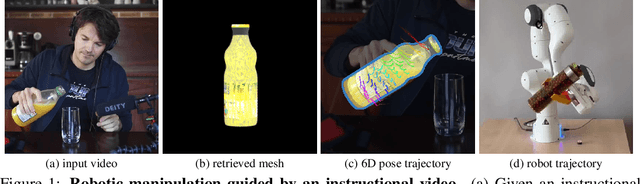
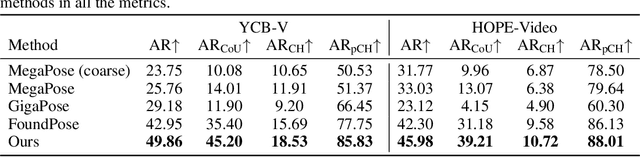
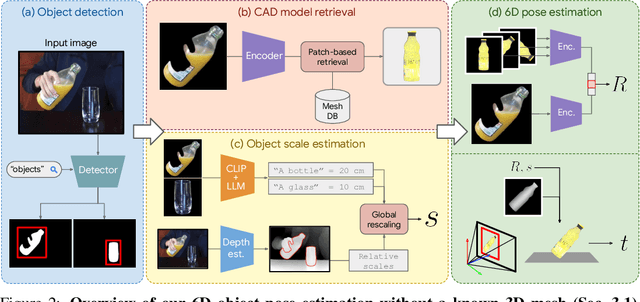

We seek to extract a temporally consistent 6D pose trajectory of a manipulated object from an Internet instructional video. This is a challenging set-up for current 6D pose estimation methods due to uncontrolled capturing conditions, subtle but dynamic object motions, and the fact that the exact mesh of the manipulated object is not known. To address these challenges, we present the following contributions. First, we develop a new method that estimates the 6D pose of any object in the input image without prior knowledge of the object itself. The method proceeds by (i) retrieving a CAD model similar to the depicted object from a large-scale model database, (ii) 6D aligning the retrieved CAD model with the input image, and (iii) grounding the absolute scale of the object with respect to the scene. Second, we extract smooth 6D object trajectories from Internet videos by carefully tracking the detected objects across video frames. The extracted object trajectories are then retargeted via trajectory optimization into the configuration space of a robotic manipulator. Third, we thoroughly evaluate and ablate our 6D pose estimation method on YCB-V and HOPE-Video datasets as well as a new dataset of instructional videos manually annotated with approximate 6D object trajectories. We demonstrate significant improvements over existing state-of-the-art RGB 6D pose estimation methods. Finally, we show that the 6D object motion estimated from Internet videos can be transferred to a 7-axis robotic manipulator both in a virtual simulator as well as in a real world set-up. We also successfully apply our method to egocentric videos taken from the EPIC-KITCHENS dataset, demonstrating potential for Embodied AI applications.
A Novel Convolution and Attention Mechanism-based Model for 6D Object Pose Estimation
Dec 31, 2024

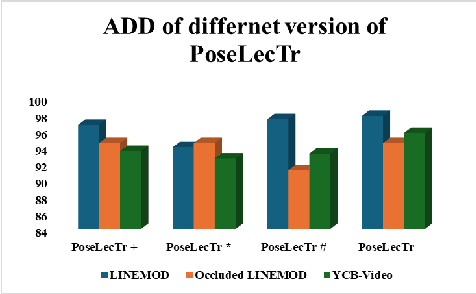

Estimating 6D object poses from RGB images is challenging because the lack of depth information requires inferring a three dimensional structure from 2D projections. Traditional methods often rely on deep learning with grid based data structures but struggle to capture complex dependencies among extracted features. To overcome this, we introduce a graph based representation derived directly from images, where spatial temporal features of each pixel serve as nodes, and relationships between them are defined through node connectivity and spatial interactions. We also employ feature selection mechanisms that use spatial attention and self attention distillation, along with a Legendre convolution layer leveraging the orthogonality of Legendre polynomials for numerical stability. Experiments on the LINEMOD, Occluded LINEMOD, and YCB Video datasets demonstrate that our method outperforms nine existing approaches and achieves state of the art benchmark in object pose estimation.