 Add to Chrome
 Add to Firefox
 Add to Edge
6D Strawberry Pose Estimation: Real-time and Edge AI Solutions Using Purely Synthetic Training Data
Nov 14, 2025
Automated and selective harvesting of fruits has become an important area of research, particularly due to challenges such as high costs and a shortage of seasonal labor in advanced economies. This paper focuses on 6D pose estimation of strawberries using purely synthetic data generated through a procedural pipeline for photorealistic rendering. We employ the YOLOX-6D-Pose algorithm, a single-shot approach that leverages the YOLOX backbone, known for its balance between speed and accuracy, and its support for edge inference. To address the lacking availability of training data, we introduce a robust and flexible pipeline for generating synthetic strawberry data from various 3D models via a procedural Blender pipeline, where we focus on enhancing the realism of the synthesized data in comparison to previous work to make it a valuable resource for training pose estimation algorithms. Quantitative evaluations indicate that our models achieve comparable accuracy on both the NVIDIA RTX 3090 and Jetson Orin Nano across several ADD-S metrics, with the RTX 3090 demonstrating superior processing speed. However, the Jetson Orin Nano is particularly suited for resource-constrained environments, making it an excellent choice for deployment in agricultural robotics. Qualitative assessments further confirm the model's performance, demonstrating its capability to accurately infer the poses of ripe and partially ripe strawberries, while facing challenges in detecting unripe specimens. This suggests opportunities for future improvements, especially in enhancing detection capabilities for unripe strawberries (if desired) by exploring variations in color. Furthermore, the methodology presented could be adapted easily for other fruits such as apples, peaches, and plums, thereby expanding its applicability and impact in the field of agricultural automation.

YCB-Ev SD: Synthetic event-vision dataset for 6DoF object pose estimation
Nov 14, 2025We introduce YCB-Ev SD, a synthetic dataset of event-camera data at standard definition (SD) resolution for 6DoF object pose estimation. While synthetic data has become fundamental in frame-based computer vision, event-based vision lacks comparable comprehensive resources. Addressing this gap, we present 50,000 event sequences of 34 ms duration each, synthesized from Physically Based Rendering (PBR) scenes of YCB-Video objects following the Benchmark for 6D Object Pose (BOP) methodology. Our generation framework employs simulated linear camera motion to ensure complete scene coverage, including background activity. Through systematic evaluation of event representations for CNN-based inference, we demonstrate that time-surfaces with linear decay and dual-channel polarity encoding achieve superior pose estimation performance, outperforming exponential decay and single-channel alternatives by significant margins. Our analysis reveals that polarity information contributes most substantially to performance gains, while linear temporal encoding preserves critical motion information more effectively than exponential decay. The dataset is provided in a structured format with both raw event streams and precomputed optimal representations to facilitate immediate research use and reproducible benchmarking. The dataset is publicly available at https://huggingface.co/datasets/paroj/ycbev_sd.
One-to-many Reconstruction of 3D Geometry of cultural Artifacts using a synthetically trained Generative Model
Feb 13, 2024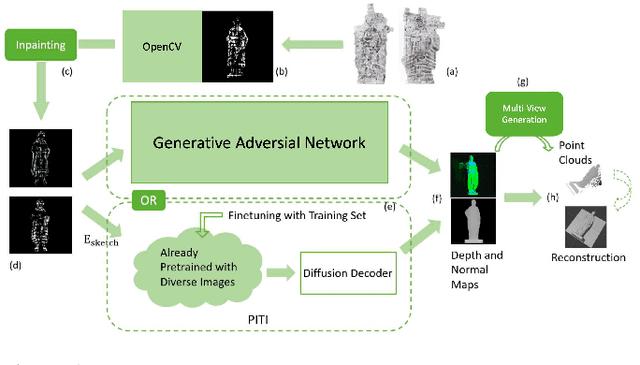
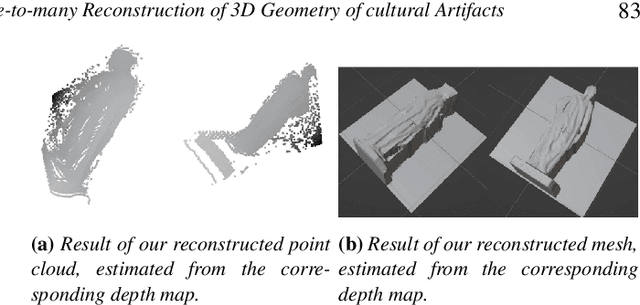
Estimating the 3D shape of an object using a single image is a difficult problem. Modern approaches achieve good results for general objects, based on real photographs, but worse results on less expressive representations such as historic sketches. Our automated approach generates a variety of detailed 3D representation from a single sketch, depicting a medieval statue, and can be guided by multi-modal inputs, such as text prompts. It relies solely on synthetic data for training, making it adoptable even in cases of only small numbers of training examples. Our solution allows domain experts such as a curators to interactively reconstruct potential appearances of lost artifacts.
A Concept for Reconstructing Stucco Statues from historic Sketches using synthetic Data only
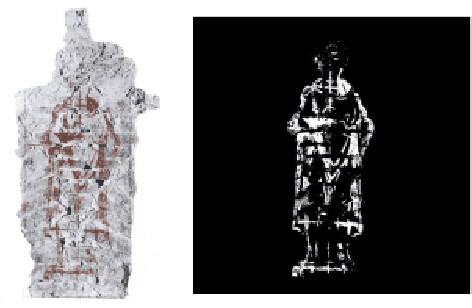
Feb 08, 2024In medieval times, stuccoworkers used a red color, called sinopia, to first create a sketch of the to-be-made statue on the wall. Today, many of these statues are destroyed, but using the original drawings, deriving from the red color also called sinopia, we can reconstruct how the final statue might have looked.We propose a fully-automated approach to reconstruct a point cloud and show preliminary results by generating a color-image, a depth-map, as well as surface normals requiring only a single sketch, and without requiring a collection of other, similar samples. Our proposed solution allows real-time reconstruction on-site, for instance, within an exhibition, or to generate a useful starting point for an expert, trying to manually reconstruct the statue, all while using only synthetic data for training.