 Add to Chrome
 Add to Firefox
 Add to Edge
Starcraft Ii
Papers and Code
Bridging MARL to SARL: An Order-Independent Multi-Agent Transformer via Latent Consensus
Apr 15, 2026
Cooperative multi-agent reinforcement learning (MARL) is widely used to address large joint observation and action spaces by decomposing a centralized control problem into multiple interacting agents. However, such decomposition often introduces additional challenges, including non-stationarity, unstable training, weak coordination, and limited theoretical guarantees. In this paper, we propose the Consensus Multi-Agent Transformer (CMAT), a centralized framework that bridges cooperative MARL to a hierarchical single-agent reinforcement learning (SARL) formulation. CMAT treats all agents as a unified entity and employs a Transformer encoder to process the large joint observation space. To handle the extensive joint action space, we introduce a hierarchical decision-making mechanism in which a Transformer decoder autoregressively generates a high-level consensus vector, simulating the process by which agents reach agreement on their strategies in latent space. Conditioned on this consensus, all agents generate their actions simultaneously, enabling order-independent joint decision making and avoiding the sensitivity to action-generation order in conventional Multi-Agent Transformers (MAT). This factorization allows the joint policy to be optimized using single-agent PPO while preserving expressive coordination through the latent consensus. To evaluate the proposed method, we conduct experiments on benchmark tasks from StarCraft II, Multi-Agent MuJoCo, and Google Research Football. The results show that CMAT achieves superior performance over recent centralized solutions, sequential MARL methods, and conventional MARL baselines. The code for this paper is available at:https://github.com/RS2002/CMAT .

On Emotion-Sensitive Decision Making of Small Language Model Agents
Apr 08, 2026Small language models (SLM) are increasingly used as interactive decision-making agents, yet most decision-oriented evaluations ignore emotion as a causal factor influencing behavior. We study emotion-sensitive decision making by combining representation-level emotion induction with a structured game-theoretic evaluation. Emotional states are induced using activation steering derived from crowd-validated, real-world emotion-eliciting texts, enabling controlled and transferable interventions beyond prompt-based methods. We introduce a benchmark built around canonical decision templates that span cooperative and competitive incentives under both complete and incomplete information. These templates are instantiated using strategic scenarios from \textsc{Diplomacy}, \textsc{StarCraft II}, and diverse real-world personas. Experiments across multiple model families in various architecture and modalities, show that emotional perturbations systematically affect strategic choices, but the resulting behaviors are often unstable and not fully aligned with human expectations. Finally, we outline an approach to improve robustness to emotion-driven perturbations.
Breakthrough the Suboptimal Stable Point in Value-Factorization-Based Multi-Agent Reinforcement Learning
Apr 07, 2026Value factorization, a popular paradigm in MARL, faces significant theoretical and algorithmic bottlenecks: its tendency to converge to suboptimal solutions remains poorly understood and unsolved. Theoretically, existing analyses fail to explain this due to their primary focus on the optimal case. To bridge this gap, we introduce a novel theoretical concept: the stable point, which characterizes the potential convergence of value factorization in general cases. Through an analysis of stable point distributions in existing methods, we reveal that non-optimal stable points are the primary cause of poor performance. However, algorithmically, making the optimal action the unique stable point is nearly infeasible. In contrast, iteratively filtering suboptimal actions by rendering them unstable emerges as a more practical approach for global optimality. Inspired by this, we propose a novel Multi-Round Value Factorization (MRVF) framework. Specifically, by measuring a non-negative payoff increment relative to the previously selected action, MRVF transforms inferior actions into unstable points, thereby driving each iteration toward a stable point with a superior action. Experiments on challenging benchmarks, including predator-prey tasks and StarCraft II Multi-Agent Challenge (SMAC), validate our analysis of stable points and demonstrate the superiority of MRVF over state-of-the-art methods.
GRASP: Gradient Realignment via Active Shared Perception for Multi-Agent Collaborative Optimization
Apr 01, 2026Non-stationarity arises from concurrent policy updates and leads to persistent environmental fluctuations. Existing approaches like Centralized Training with Decentralized Execution (CTDE) and sequential update schemes mitigate this issue. However, since the perception of the policies of other agents remains dependent on sampling environmental interaction data, the agent essentially operates in a passive perception state. This inevitably triggers equilibrium oscillations and significantly slows the convergence speed of the system. To address this issue, we propose Gradient Realignment via Active Shared Perception (GRASP), a novel framework that defines generalized Bellman equilibrium as a stable objective for policy evolution. The core mechanism of GRASP involves utilizing the independent gradients of agents to derive a defined consensus gradient, enabling agents to actively perceive policy updates and optimize team collaboration. Theoretically, we leverage the Kakutani Fixed-Point Theorem to prove that the consensus direction $u^*$ guarantees the existence and attainability of this equilibrium. Extensive experiments on StarCraft II Multi-Agent Challenge (SMAC) and Google Research Football (GRF) demonstrate the scalability and promising performance of the framework.
World Models for Policy Refinement in StarCraft II
Feb 16, 2026Large Language Models (LLMs) have recently shown strong reasoning and generalization capabilities, motivating their use as decision-making policies in complex environments. StarCraft II (SC2), with its massive state-action space and partial observability, is a challenging testbed. However, existing LLM-based SC2 agents primarily focus on improving the policy itself and overlook integrating a learnable, action-conditioned transition model into the decision loop. To bridge this gap, we propose StarWM, the first world model for SC2 that predicts future observations under partial observability. To facilitate learning SC2's hybrid dynamics, we introduce a structured textual representation that factorizes observations into five semantic modules, and construct SC2-Dynamics-50k, the first instruction-tuning dataset for SC2 dynamics prediction. We further develop a multi-dimensional offline evaluation framework for predicted structured observations. Offline results show StarWM's substantial gains over zero-shot baselines, including nearly 60% improvements in resource prediction accuracy and self-side macro-situation consistency. Finally, we propose StarWM-Agent, a world-model-augmented decision system that integrates StarWM into a Generate--Simulate--Refine decision loop for foresight-driven policy refinement. Online evaluation against SC2's built-in AI demonstrates consistent improvements, yielding win-rate gains of 30%, 15%, and 30% against Hard (LV5), Harder (LV6), and VeryHard (LV7), respectively, alongside improved macro-management stability and tactical risk assessment.
Multi-Agent Model-Based Reinforcement Learning with Joint State-Action Learned Embeddings
Feb 13, 2026Learning to coordinate many agents in partially observable and highly dynamic environments requires both informative representations and data-efficient training. To address this challenge, we present a novel model-based multi-agent reinforcement learning framework that unifies joint state-action representation learning with imaginative roll-outs. We design a world model trained with variational auto-encoders and augment the model using the state-action learned embedding (SALE). SALE is injected into both the imagination module that forecasts plausible future roll-outs and the joint agent network whose individual action values are combined through a mixing network to estimate the joint action-value function. By coupling imagined trajectories with SALE-based action values, the agents acquire a richer understanding of how their choices influence collective outcomes, leading to improved long-term planning and optimization under limited real-environment interactions. Empirical studies on well-established multi-agent benchmarks, including StarCraft II Micro-Management, Multi-Agent MuJoCo, and Level-Based Foraging challenges, demonstrate consistent gains of our method over baseline algorithms and highlight the effectiveness of joint state-action learned embeddings within a multi-agent model-based paradigm.
Interpretable Failure Analysis in Multi-Agent Reinforcement Learning Systems
Feb 08, 2026Multi-Agent Reinforcement Learning (MARL) is increasingly deployed in safety-critical domains, yet methods for interpretable failure detection and attribution remain underdeveloped. We introduce a two-stage gradient-based framework that provides interpretable diagnostics for three critical failure analysis tasks: (1) detecting the true initial failure source (Patient-0); (2) validating why non-attacked agents may be flagged first due to domino effects; and (3) tracing how failures propagate through learned coordination pathways. Stage 1 performs interpretable per-agent failure detection via Taylor-remainder analysis of policy-gradient costs, declaring an initial Patient-0 candidate at the first threshold crossing. Stage 2 provides validation through geometric analysis of critic derivatives-first-order sensitivity and directional second-order curvature aggregated over causal windows to construct interpretable contagion graphs. This approach explains "downstream-first" detection anomalies by revealing pathways that amplify upstream deviations. Evaluated across 500 episodes in Simple Spread (3 and 5 agents) and 100 episodes in StarCraft II using MADDPG and HATRPO, our method achieves 88.2-99.4% Patient-0 detection accuracy while providing interpretable geometric evidence for detection decisions. By moving beyond black-box detection to interpretable gradient-level forensics, this framework offers practical tools for diagnosing cascading failures in safety-critical MARL systems.
Distributionally Robust Cooperative Multi-Agent Reinforcement Learning via Robust Value Factorization
Feb 11, 2026Cooperative multi-agent reinforcement learning (MARL) commonly adopts centralized training with decentralized execution, where value-factorization methods enforce the individual-global-maximum (IGM) principle so that decentralized greedy actions recover the team-optimal joint action. However, the reliability of this recipe in real-world settings remains unreliable due to environmental uncertainties arising from the sim-to-real gap, model mismatch, and system noise. We address this gap by introducing Distributionally robust IGM (DrIGM), a principle that requires each agent's robust greedy action to align with the robust team-optimal joint action. We show that DrIGM holds for a novel definition of robust individual action values, which is compatible with decentralized greedy execution and yields a provable robustness guarantee for the whole system. Building on this foundation, we derive DrIGM-compliant robust variants of existing value-factorization architectures (e.g., VDN/QMIX/QTRAN) that (i) train on robust Q-targets, (ii) preserve scalability, and (iii) integrate seamlessly with existing codebases without bespoke per-agent reward shaping. Empirically, on high-fidelity SustainGym simulators and a StarCraft game environment, our methods consistently improve out-of-distribution performance. Code and data are available at https://github.com/crqu/robust-coMARL.
StarCraft+: Benchmarking Multi-agent Algorithms in Adversary Paradigm
Dec 18, 2025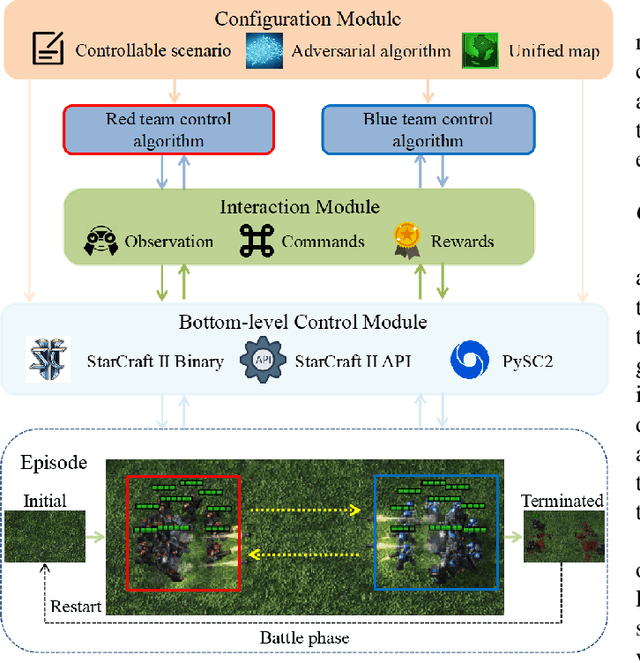
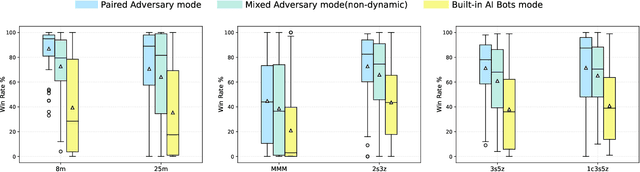
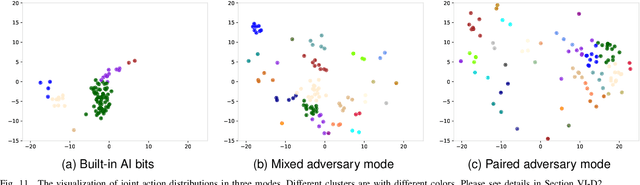
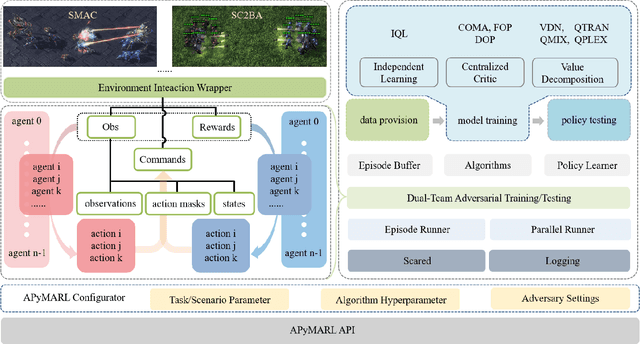
Deep multi-agent reinforcement learning (MARL) algorithms are booming in the field of collaborative intelligence, and StarCraft multi-agent challenge (SMAC) is widely-used as the benchmark therein. However, imaginary opponents of MARL algorithms are practically configured and controlled in a fixed built-in AI mode, which causes less diversity and versatility in algorithm evaluation. To address this issue, in this work, we establish a multi-agent algorithm-vs-algorithm environment, named StarCraft II battle arena (SC2BA), to refresh the benchmarking of MARL algorithms in an adversary paradigm. Taking StarCraft as infrastructure, the SC2BA environment is specifically created for inter-algorithm adversary with the consideration of fairness, usability and customizability, and meantime an adversarial PyMARL (APyMARL) library is developed with easy-to-use interfaces/modules. Grounding in SC2BA, we benchmark those classic MARL algorithms in two types of adversarial modes: dual-algorithm paired adversary and multi-algorithm mixed adversary, where the former conducts the adversary of pairwise algorithms while the latter focuses on the adversary to multiple behaviors from a group of algorithms. The extensive benchmark experiments exhibit some thought-provoking observations/problems in the effectivity, sensibility and scalability of these completed algorithms. The SC2BA environment as well as reproduced experiments are released in \href{https://github.com/dooliu/SC2BA}{Github}, and we believe that this work could mark a new step for the MARL field in the coming years.
HLSMAC: A New StarCraft Multi-Agent Challenge for High-Level Strategic Decision-Making
Sep 16, 2025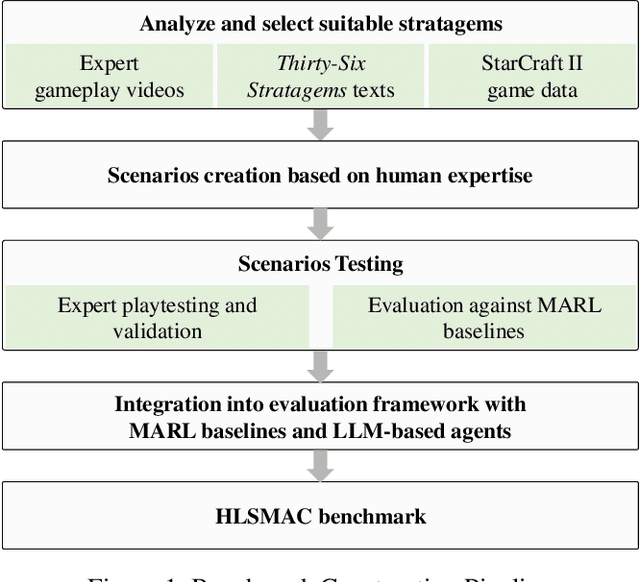
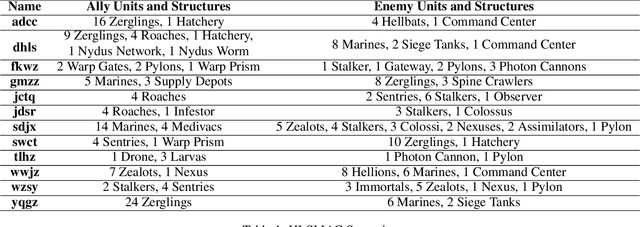
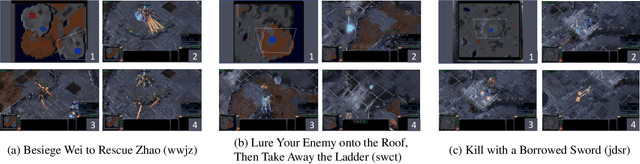
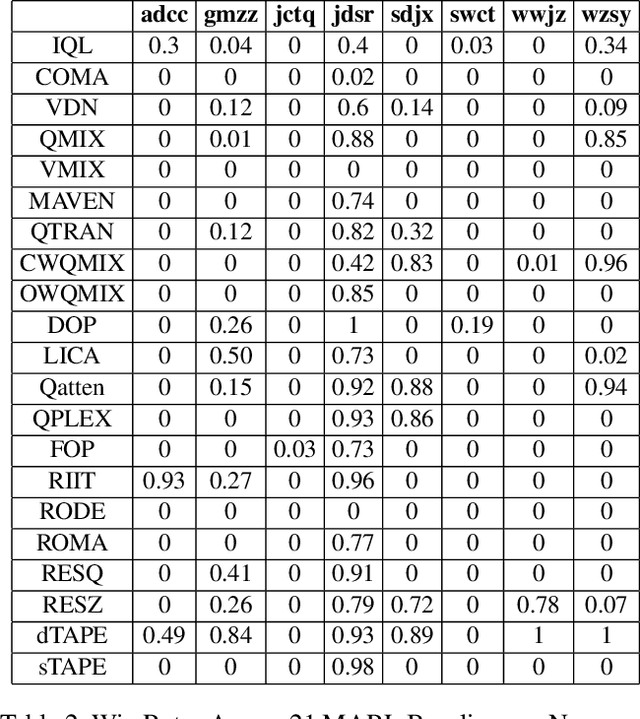
Benchmarks are crucial for assessing multi-agent reinforcement learning (MARL) algorithms. While StarCraft II-related environments have driven significant advances in MARL, existing benchmarks like SMAC focus primarily on micromanagement, limiting comprehensive evaluation of high-level strategic intelligence. To address this, we introduce HLSMAC, a new cooperative MARL benchmark with 12 carefully designed StarCraft II scenarios based on classical stratagems from the Thirty-Six Stratagems. Each scenario corresponds to a specific stratagem and is designed to challenge agents with diverse strategic elements, including tactical maneuvering, timing coordination, and deception, thereby opening up avenues for evaluating high-level strategic decision-making capabilities. We also propose novel metrics across multiple dimensions beyond conventional win rate, such as ability utilization and advancement efficiency, to assess agents' overall performance within the HLSMAC environment. We integrate state-of-the-art MARL algorithms and LLM-based agents with our benchmark and conduct comprehensive experiments. The results demonstrate that HLSMAC serves as a robust testbed for advancing multi-agent strategic decision-making.