 Add to Chrome
 Add to Firefox
 Add to Edge
GLM-OCR Technical Report
Mar 11, 2026
GLM-OCR is an efficient 0.9B-parameter compact multimodal model designed for real-world document understanding. It combines a 0.4B-parameter CogViT visual encoder with a 0.5B-parameter GLM language decoder, achieving a strong balance between computational efficiency and recognition performance. To address the inefficiency of standard autoregressive decoding in deterministic OCR tasks, GLM-OCR introduces a Multi-Token Prediction (MTP) mechanism that predicts multiple tokens per step, significantly improving decoding throughput while keeping memory overhead low through shared parameters. At the system level, a two-stage pipeline is adopted: PP-DocLayout-V3 first performs layout analysis, followed by parallel region-level recognition. Extensive evaluations on public benchmarks and industrial scenarios show that GLM-OCR achieves competitive or state-of-the-art performance in document parsing, text and formula transcription, table structure recovery, and key information extraction. Its compact architecture and structured generation make it suitable for both resource-constrained edge deployment and large-scale production systems.

HLSMAC: A New StarCraft Multi-Agent Challenge for High-Level Strategic Decision-Making
Sep 16, 2025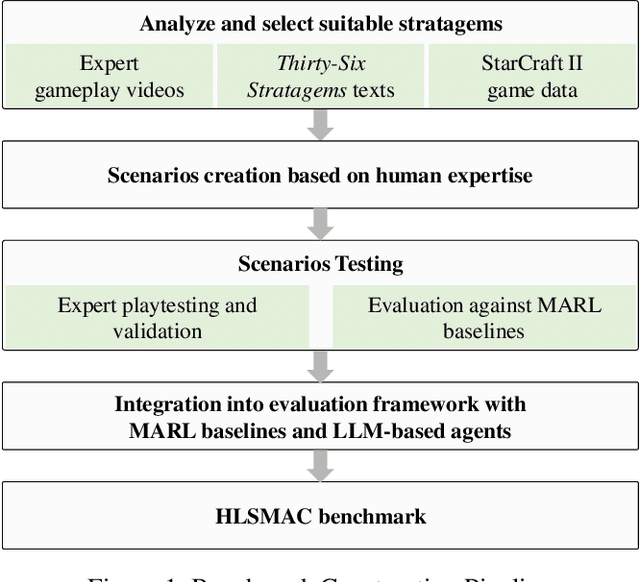
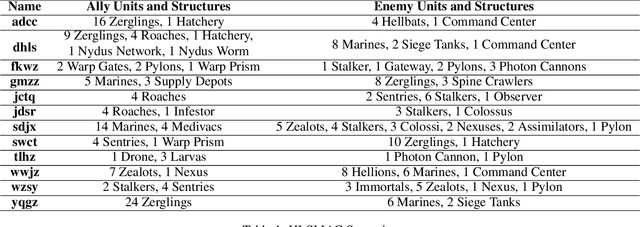
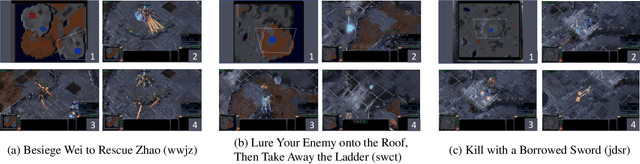
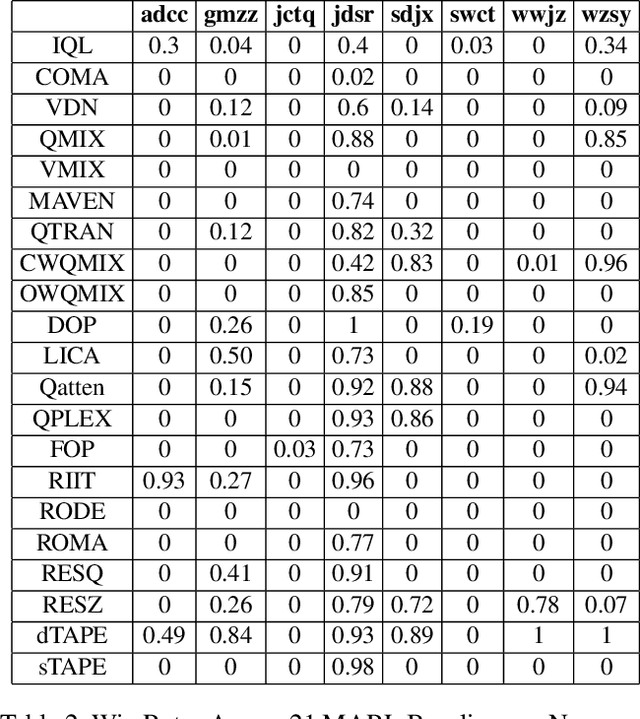
Benchmarks are crucial for assessing multi-agent reinforcement learning (MARL) algorithms. While StarCraft II-related environments have driven significant advances in MARL, existing benchmarks like SMAC focus primarily on micromanagement, limiting comprehensive evaluation of high-level strategic intelligence. To address this, we introduce HLSMAC, a new cooperative MARL benchmark with 12 carefully designed StarCraft II scenarios based on classical stratagems from the Thirty-Six Stratagems. Each scenario corresponds to a specific stratagem and is designed to challenge agents with diverse strategic elements, including tactical maneuvering, timing coordination, and deception, thereby opening up avenues for evaluating high-level strategic decision-making capabilities. We also propose novel metrics across multiple dimensions beyond conventional win rate, such as ability utilization and advancement efficiency, to assess agents' overall performance within the HLSMAC environment. We integrate state-of-the-art MARL algorithms and LLM-based agents with our benchmark and conduct comprehensive experiments. The results demonstrate that HLSMAC serves as a robust testbed for advancing multi-agent strategic decision-making.