 Add to Chrome
 Add to Firefox
 Add to Edge
Robust Bev Map Segmentation
Papers and Code
FIN: Fast Inference Network for Map Segmentation
Oct 01, 2025
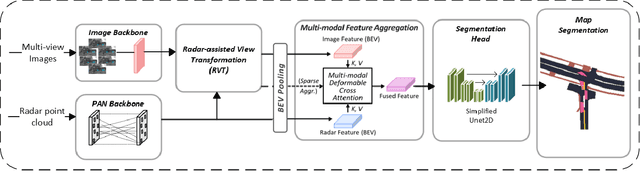
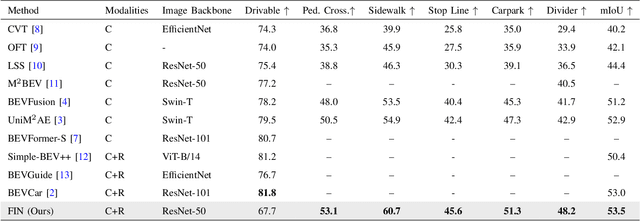
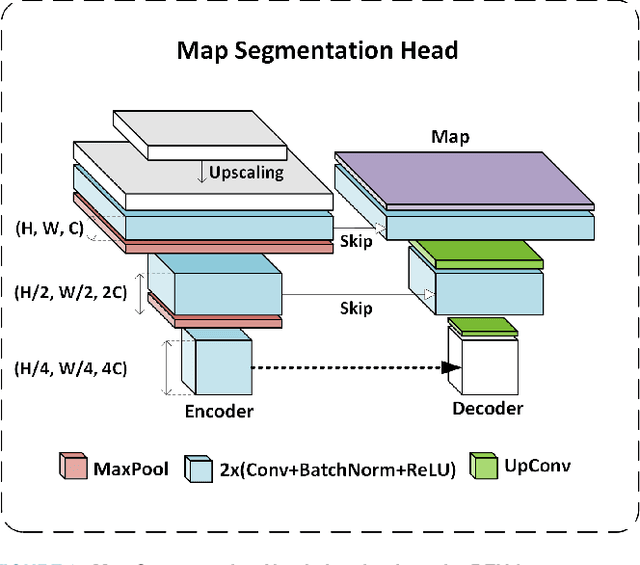
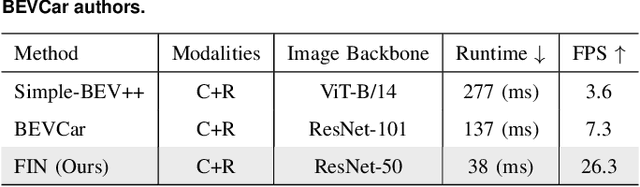
Multi-sensor fusion in autonomous vehicles is becoming more common to offer a more robust alternative for several perception tasks. This need arises from the unique contribution of each sensor in collecting data: camera-radar fusion offers a cost-effective solution by combining rich semantic information from cameras with accurate distance measurements from radar, without incurring excessive financial costs or overwhelming data processing requirements. Map segmentation is a critical task for enabling effective vehicle behaviour in its environment, yet it continues to face significant challenges in achieving high accuracy and meeting real-time performance requirements. Therefore, this work presents a novel and efficient map segmentation architecture, using cameras and radars, in the \acrfull{bev} space. Our model introduces a real-time map segmentation architecture considering aspects such as high accuracy, per-class balancing, and inference time. To accomplish this, we use an advanced loss set together with a new lightweight head to improve the perception results. Our results show that, with these modifications, our approach achieves results comparable to large models, reaching 53.5 mIoU, while also setting a new benchmark for inference time, improving it by 260\% over the strongest baseline models.

4D-ROLLS: 4D Radar Occupancy Learning via LiDAR Supervision
May 20, 2025A comprehensive understanding of 3D scenes is essential for autonomous vehicles (AVs), and among various perception tasks, occupancy estimation plays a central role by providing a general representation of drivable and occupied space. However, most existing occupancy estimation methods rely on LiDAR or cameras, which perform poorly in degraded environments such as smoke, rain, snow, and fog. In this paper, we propose 4D-ROLLS, the first weakly supervised occupancy estimation method for 4D radar using the LiDAR point cloud as the supervisory signal. Specifically, we introduce a method for generating pseudo-LiDAR labels, including occupancy queries and LiDAR height maps, as multi-stage supervision to train the 4D radar occupancy estimation model. Then the model is aligned with the occupancy map produced by LiDAR, fine-tuning its accuracy in occupancy estimation. Extensive comparative experiments validate the exceptional performance of 4D-ROLLS. Its robustness in degraded environments and effectiveness in cross-dataset training are qualitatively demonstrated. The model is also seamlessly transferred to downstream tasks BEV segmentation and point cloud occupancy prediction, highlighting its potential for broader applications. The lightweight network enables 4D-ROLLS model to achieve fast inference speeds at about 30 Hz on a 4060 GPU. The code of 4D-ROLLS will be made available at https://github.com/CLASS-Lab/4D-ROLLS.
InterLoc: LiDAR-based Intersection Localization using Road Segmentation with Automated Evaluation Method
May 01, 2025Intersections are geometric and functional key points in every road network. They offer strong landmarks to correct GNSS dropouts and anchor new sensor data in up-to-date maps. Despite that importance, intersection detectors either ignore the rich semantic information already computed onboard or depend on scarce, hand-labeled intersection datasets. To close that gap, this paper presents a LiDAR-based method for intersection detection that (i) fuses semantic road segmentation with vehicle localization to detect intersection candidates in a bird's eye view (BEV) representation and (ii) refines those candidates by analyzing branch topology with a least squares formulation. To evaluate our method, we introduce an automated benchmarking pipeline that pairs detections with OpenStreetMap (OSM) intersection nodes using precise GNSS/INS ground-truth poses. Tested on eight SemanticKITTI sequences, the approach achieves a mean localization error of 1.9 m, 89% precision, and 77% recall at a 5 m tolerance, outperforming the latest learning-based baseline. Moreover, the method is robust to segmentation errors higher than those of the benchmark model, demonstrating its applicability in the real world.
TS-CGNet: Temporal-Spatial Fusion Meets Centerline-Guided Diffusion for BEV Mapping
Mar 04, 2025Bird's Eye View (BEV) perception technology is crucial for autonomous driving, as it generates top-down 2D maps for environment perception, navigation, and decision-making. Nevertheless, the majority of current BEV map generation studies focusing on visual map generation lack depth-aware reasoning capabilities. They exhibit limited efficacy in managing occlusions and handling complex environments, with a notable decline in perceptual performance under adverse weather conditions or low-light scenarios. Therefore, this paper proposes TS-CGNet, which leverages Temporal-Spatial fusion with Centerline-Guided diffusion. This visual framework, grounded in prior knowledge, is designed for integration into any existing network for building BEV maps. Specifically, this framework is decoupled into three parts: Local mapping system involves the initial generation of semantic maps using purely visual information; The Temporal-Spatial Aligner Module (TSAM) integrates historical information into mapping generation by applying transformation matrices; The Centerline-Guided Diffusion Model (CGDM) is a prediction module based on the diffusion model. CGDM incorporates centerline information through spatial-attention mechanisms to enhance semantic segmentation reconstruction. We construct BEV semantic segmentation maps by our methods on the public nuScenes and the robustness benchmarks under various corruptions. Our method improves 1.90%, 1.73%, and 2.87% for perceived ranges of 60x30m, 120x60m, and 240x60m in the task of BEV HD mapping. TS-CGNet attains an improvement of 1.92% for perceived ranges of 100x100m in the task of BEV semantic mapping. Moreover, TS-CGNet achieves an average improvement of 2.92% in detection accuracy under varying weather conditions and sensor interferences in the perception range of 240x60m. The source code will be publicly available at https://github.com/krabs-H/TS-CGNet.
SegLocNet: Multimodal Localization Network for Autonomous Driving via Bird's-Eye-View Segmentation
Feb 28, 2025Robust and accurate localization is critical for autonomous driving. Traditional GNSS-based localization methods suffer from signal occlusion and multipath effects in urban environments. Meanwhile, methods relying on high-definition (HD) maps are constrained by the high costs associated with the construction and maintenance of HD maps. Standard-definition (SD) maps-based methods, on the other hand, often exhibit unsatisfactory performance or poor generalization ability due to overfitting. To address these challenges, we propose SegLocNet, a multimodal GNSS-free localization network that achieves precise localization using bird's-eye-view (BEV) semantic segmentation. SegLocNet employs a BEV segmentation network to generate semantic maps from multiple sensor inputs, followed by an exhaustive matching process to estimate the vehicle's ego pose. This approach avoids the limitations of regression-based pose estimation and maintains high interpretability and generalization. By introducing a unified map representation, our method can be applied to both HD and SD maps without any modifications to the network architecture, thereby balancing localization accuracy and area coverage. Extensive experiments on the nuScenes and Argoverse datasets demonstrate that our method outperforms the current state-of-the-art methods, and that our method can accurately estimate the ego pose in urban environments without relying on GNSS, while maintaining strong generalization ability. Our code and pre-trained model will be released publicly.
CRT-Fusion: Camera, Radar, Temporal Fusion Using Motion Information for 3D Object Detection
Nov 05, 2024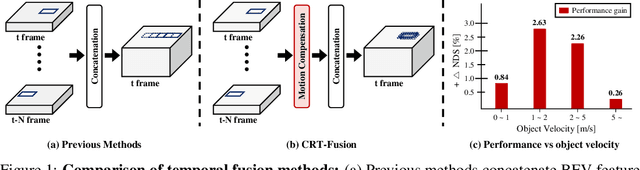
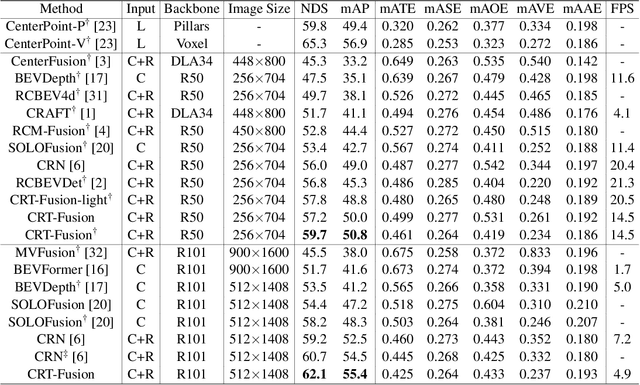
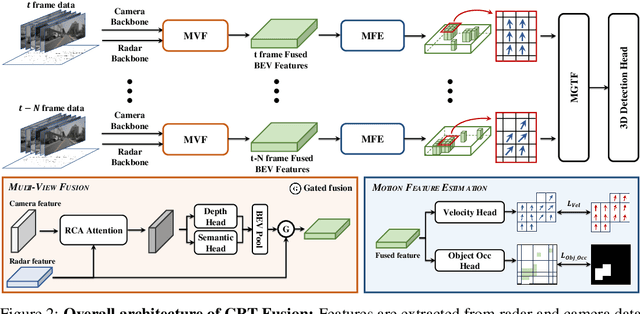
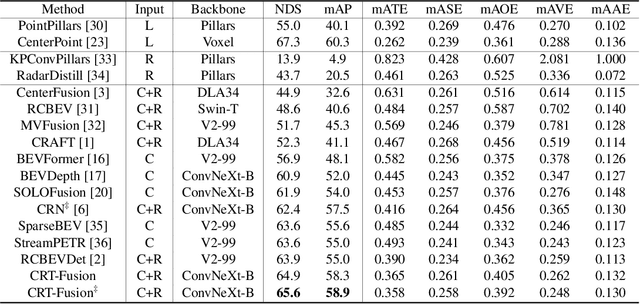
Accurate and robust 3D object detection is a critical component in autonomous vehicles and robotics. While recent radar-camera fusion methods have made significant progress by fusing information in the bird's-eye view (BEV) representation, they often struggle to effectively capture the motion of dynamic objects, leading to limited performance in real-world scenarios. In this paper, we introduce CRT-Fusion, a novel framework that integrates temporal information into radar-camera fusion to address this challenge. Our approach comprises three key modules: Multi-View Fusion (MVF), Motion Feature Estimator (MFE), and Motion Guided Temporal Fusion (MGTF). The MVF module fuses radar and image features within both the camera view and bird's-eye view, thereby generating a more precise unified BEV representation. The MFE module conducts two simultaneous tasks: estimation of pixel-wise velocity information and BEV segmentation. Based on the velocity and the occupancy score map obtained from the MFE module, the MGTF module aligns and fuses feature maps across multiple timestamps in a recurrent manner. By considering the motion of dynamic objects, CRT-Fusion can produce robust BEV feature maps, thereby improving detection accuracy and robustness. Extensive evaluations on the challenging nuScenes dataset demonstrate that CRT-Fusion achieves state-of-the-art performance for radar-camera-based 3D object detection. Our approach outperforms the previous best method in terms of NDS by +1.7%, while also surpassing the leading approach in mAP by +1.4%. These significant improvements in both metrics showcase the effectiveness of our proposed fusion strategy in enhancing the reliability and accuracy of 3D object detection.
MaskBEV: Towards A Unified Framework for BEV Detection and Map Segmentation
Aug 17, 2024
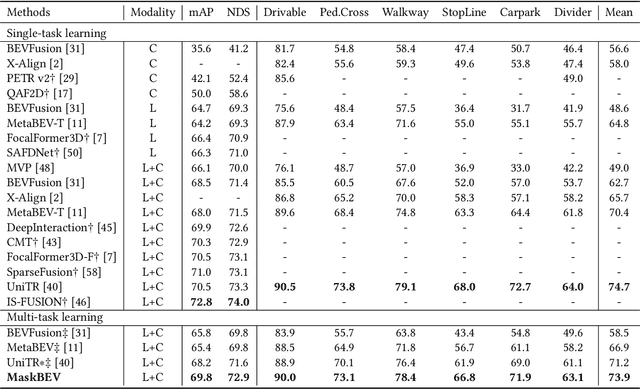

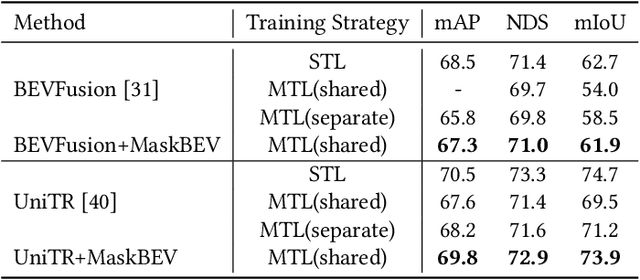
Accurate and robust multimodal multi-task perception is crucial for modern autonomous driving systems. However, current multimodal perception research follows independent paradigms designed for specific perception tasks, leading to a lack of complementary learning among tasks and decreased performance in multi-task learning (MTL) due to joint training. In this paper, we propose MaskBEV, a masked attention-based MTL paradigm that unifies 3D object detection and bird's eye view (BEV) map segmentation. MaskBEV introduces a task-agnostic Transformer decoder to process these diverse tasks, enabling MTL to be completed in a unified decoder without requiring additional design of specific task heads. To fully exploit the complementary information between BEV map segmentation and 3D object detection tasks in BEV space, we propose spatial modulation and scene-level context aggregation strategies. These strategies consider the inherent dependencies between BEV segmentation and 3D detection, naturally boosting MTL performance. Extensive experiments on nuScenes dataset show that compared with previous state-of-the-art MTL methods, MaskBEV achieves 1.3 NDS improvement in 3D object detection and 2.7 mIoU improvement in BEV map segmentation, while also demonstrating slightly leading inference speed.
SynDiff-AD: Improving Semantic Segmentation and End-to-End Autonomous Driving with Synthetic Data from Latent Diffusion Models
Nov 25, 2024In recent years, significant progress has been made in collecting large-scale datasets to improve segmentation and autonomous driving models. These large-scale datasets are often dominated by common environmental conditions such as "Clear and Day" weather, leading to decreased performance in under-represented conditions like "Rainy and Night". To address this issue, we introduce SynDiff-AD, a novel data augmentation pipeline that leverages diffusion models (DMs) to generate realistic images for such subgroups. SynDiff-AD uses ControlNet-a DM that guides data generation conditioned on semantic maps-along with a novel prompting scheme that generates subgroup-specific, semantically dense prompts. By augmenting datasets with SynDiff-AD, we improve the performance of segmentation models like Mask2Former and SegFormer by up to 1.2% and 2.3% on the Waymo dataset, and up to 1.4% and 0.7% on the DeepDrive dataset, respectively. Additionally, we demonstrate that our SynDiff-AD pipeline enhances the driving performance of end-to-end autonomous driving models, like AIM-2D and AIM-BEV, by up to 20% across diverse environmental conditions in the CARLA autonomous driving simulator, providing a more robust model.
TopoSD: Topology-Enhanced Lane Segment Perception with SDMap Prior
Nov 22, 2024



Recent advances in autonomous driving systems have shifted towards reducing reliance on high-definition maps (HDMaps) due to the huge costs of annotation and maintenance. Instead, researchers are focusing on online vectorized HDMap construction using on-board sensors. However, sensor-only approaches still face challenges in long-range perception due to the restricted views imposed by the mounting angles of onboard cameras, just as human drivers also rely on bird's-eye-view navigation maps for a comprehensive understanding of road structures. To address these issues, we propose to train the perception model to "see" standard definition maps (SDMaps). We encode SDMap elements into neural spatial map representations and instance tokens, and then incorporate such complementary features as prior information to improve the bird's eye view (BEV) feature for lane geometry and topology decoding. Based on the lane segment representation framework, the model simultaneously predicts lanes, centrelines and their topology. To further enhance the ability of geometry prediction and topology reasoning, we also use a topology-guided decoder to refine the predictions by exploiting the mutual relationships between topological and geometric features. We perform extensive experiments on OpenLane-V2 datasets to validate the proposed method. The results show that our model outperforms state-of-the-art methods by a large margin, with gains of +6.7 and +9.1 on the mAP and topology metrics. Our analysis also reveals that models trained with SDMap noise augmentation exhibit enhanced robustness.
QuadBEV: An Efficient Quadruple-Task Perception Framework via Bird's-Eye-View Representation
Oct 09, 2024

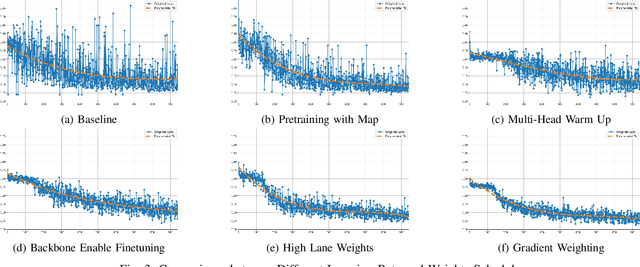

Bird's-Eye-View (BEV) perception has become a vital component of autonomous driving systems due to its ability to integrate multiple sensor inputs into a unified representation, enhancing performance in various downstream tasks. However, the computational demands of BEV models pose challenges for real-world deployment in vehicles with limited resources. To address these limitations, we propose QuadBEV, an efficient multitask perception framework that leverages the shared spatial and contextual information across four key tasks: 3D object detection, lane detection, map segmentation, and occupancy prediction. QuadBEV not only streamlines the integration of these tasks using a shared backbone and task-specific heads but also addresses common multitask learning challenges such as learning rate sensitivity and conflicting task objectives. Our framework reduces redundant computations, thereby enhancing system efficiency, making it particularly suited for embedded systems. We present comprehensive experiments that validate the effectiveness and robustness of QuadBEV, demonstrating its suitability for real-world applications.