 Add to Chrome
 Add to Firefox
 Add to Edge
Optimistic Mirror Descent
Optimistic mirror descent is an optimization algorithm that combines mirror descent with optimism to achieve faster convergence rates.
Papers and Code
Scale-Invariant Regret Matching and Online Learning with Optimal Convergence: Bridging Theory and Practice in Zero-Sum Games
Oct 06, 2025
A considerable chasm has been looming for decades between theory and practice in zero-sum game solving through first-order methods. Although a convergence rate of $T^{-1}$ has long been established since Nemirovski's mirror-prox algorithm and Nesterov's excessive gap technique in the early 2000s, the most effective paradigm in practice is *counterfactual regret minimization*, which is based on *regret matching* and its modern variants. In particular, the state of the art across most benchmarks is *predictive* regret matching$^+$ (PRM$^+$), in conjunction with non-uniform averaging. Yet, such algorithms can exhibit slower $\Omega(T^{-1/2})$ convergence even in self-play. In this paper, we close the gap between theory and practice. We propose a new scale-invariant and parameter-free variant of PRM$^+$, which we call IREG-PRM$^+$. We show that it achieves $T^{-1/2}$ best-iterate and $T^{-1}$ (i.e., optimal) average-iterate convergence guarantees, while also being on par with PRM$^+$ on benchmark games. From a technical standpoint, we draw an analogy between IREG-PRM$^+$ and optimistic gradient descent with *adaptive* learning rate. The basic flaw of PRM$^+$ is that the ($\ell_2$-)norm of the regret vector -- which can be thought of as the inverse of the learning rate -- can decrease. By contrast, we design IREG-PRM$^+$ so as to maintain the invariance that the norm of the regret vector is nondecreasing. This enables us to derive an RVU-type bound for IREG-PRM$^+$, the first such property that does not rely on introducing additional hyperparameters to enforce smoothness. Furthermore, we find that IREG-PRM$^+$ performs on par with an adaptive version of optimistic gradient descent that we introduce whose learning rate depends on the misprediction error, demystifying the effectiveness of the regret matching family *vis-a-vis* more standard optimization techniques.

An Optimistic Algorithm for online CMDPS with Anytime Adversarial Constraints
May 28, 2025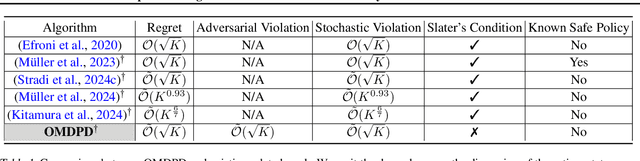
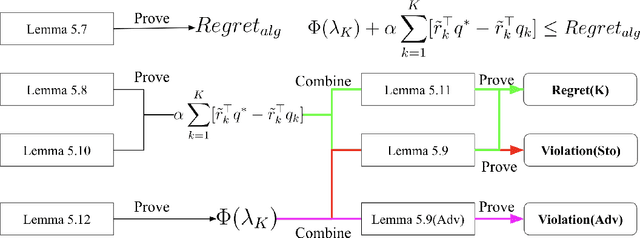
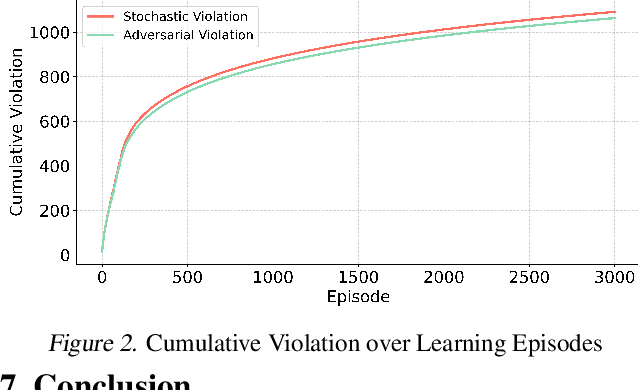
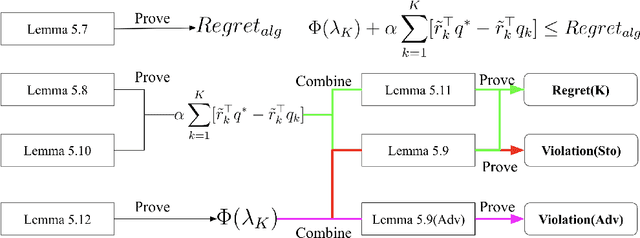
Online safe reinforcement learning (RL) plays a key role in dynamic environments, with applications in autonomous driving, robotics, and cybersecurity. The objective is to learn optimal policies that maximize rewards while satisfying safety constraints modeled by constrained Markov decision processes (CMDPs). Existing methods achieve sublinear regret under stochastic constraints but often fail in adversarial settings, where constraints are unknown, time-varying, and potentially adversarially designed. In this paper, we propose the Optimistic Mirror Descent Primal-Dual (OMDPD) algorithm, the first to address online CMDPs with anytime adversarial constraints. OMDPD achieves optimal regret O(sqrt(K)) and strong constraint violation O(sqrt(K)) without relying on Slater's condition or the existence of a strictly known safe policy. We further show that access to accurate estimates of rewards and transitions can further improve these bounds. Our results offer practical guarantees for safe decision-making in adversarial environments.
Generalized Linear Bandits: Almost Optimal Regret with One-Pass Update
Jul 16, 2025We study the generalized linear bandit (GLB) problem, a contextual multi-armed bandit framework that extends the classical linear model by incorporating a non-linear link function, thereby modeling a broad class of reward distributions such as Bernoulli and Poisson. While GLBs are widely applicable to real-world scenarios, their non-linear nature introduces significant challenges in achieving both computational and statistical efficiency. Existing methods typically trade off between two objectives, either incurring high per-round costs for optimal regret guarantees or compromising statistical efficiency to enable constant-time updates. In this paper, we propose a jointly efficient algorithm that attains a nearly optimal regret bound with $\mathcal{O}(1)$ time and space complexities per round. The core of our method is a tight confidence set for the online mirror descent (OMD) estimator, which is derived through a novel analysis that leverages the notion of mix loss from online prediction. The analysis shows that our OMD estimator, even with its one-pass updates, achieves statistical efficiency comparable to maximum likelihood estimation, thereby leading to a jointly efficient optimistic method.
Improved Impossible Tuning and Lipschitz-Adaptive Universal Online Learning with Gradient Variations
May 27, 2025A central goal in online learning is to achieve adaptivity to unknown problem characteristics, such as environmental changes captured by gradient variation (GV), function curvature (universal online learning, UOL), and gradient scales (Lipschitz adaptivity, LA). Simultaneously achieving these with optimal performance is a major challenge, partly due to limitations in algorithms for prediction with expert advice. These algorithms often serve as meta-algorithms in online ensemble frameworks, and their sub-optimality hinders overall UOL performance. Specifically, existing algorithms addressing the ``impossible tuning'' issue incur an excess $\sqrt{\log T}$ factor in their regret bound compared to the lower bound. To solve this problem, we propose a novel optimistic online mirror descent algorithm with an auxiliary initial round using large learning rates. This design enables a refined analysis where a generated negative term cancels the gap-related factor, resolving the impossible tuning issue up to $\log\log T$ factors. Leveraging our improved algorithm as a meta-algorithm, we develop the first UOL algorithm that simultaneously achieves state-of-the-art GV bounds and LA under standard assumptions. Our UOL result overcomes key limitations of prior works, notably resolving the conflict between LA mechanisms and regret analysis for GV bounds -- an open problem highlighted by Xie et al.
Improving LLM General Preference Alignment via Optimistic Online Mirror Descent
Feb 24, 2025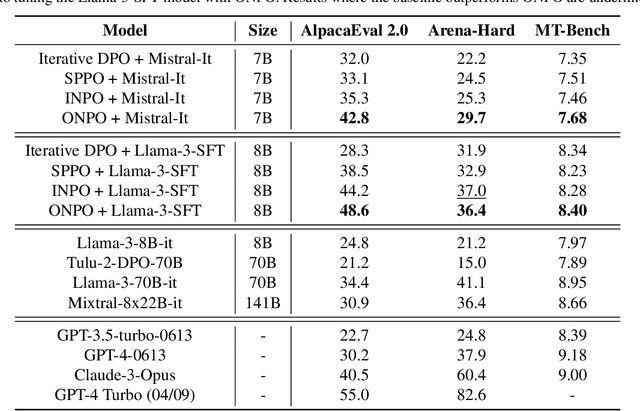
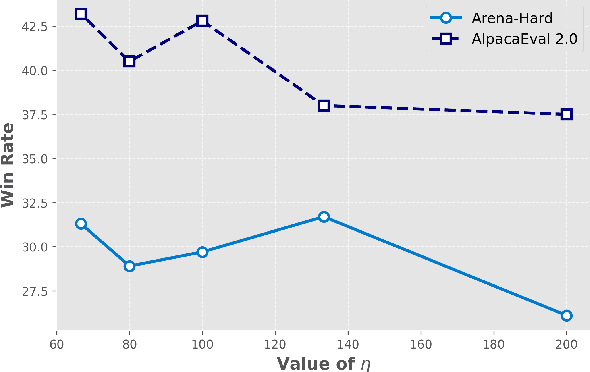

Reinforcement learning from human feedback (RLHF) has demonstrated remarkable effectiveness in aligning large language models (LLMs) with human preferences. Many existing alignment approaches rely on the Bradley-Terry (BT) model assumption, which assumes the existence of a ground-truth reward for each prompt-response pair. However, this assumption can be overly restrictive when modeling complex human preferences. In this paper, we drop the BT model assumption and study LLM alignment under general preferences, formulated as a two-player game. Drawing on theoretical insights from learning in games, we integrate optimistic online mirror descent into our alignment framework to approximate the Nash policy. Theoretically, we demonstrate that our approach achieves an $O(T^{-1})$ bound on the duality gap, improving upon the previous $O(T^{-1/2})$ result. More importantly, we implement our method and show through experiments that it outperforms state-of-the-art RLHF algorithms across multiple representative benchmarks.
Gradient-Variation Online Learning under Generalized Smoothness
Aug 17, 2024Gradient-variation online learning aims to achieve regret guarantees that scale with the variations in the gradients of online functions, which has been shown to be crucial for attaining fast convergence in games and robustness in stochastic optimization, hence receiving increased attention. Existing results often require the smoothness condition by imposing a fixed bound on the gradient Lipschitzness, but this may not hold in practice. Recent efforts in neural network optimization suggest a generalized smoothness condition, allowing smoothness to correlate with gradient norms. In this paper, we systematically study gradient-variation online learning under generalized smoothness. To this end, we extend the classic optimistic mirror descent algorithm to derive gradient-variation bounds by conducting stability analysis over the optimization trajectory and exploiting smoothness locally. Furthermore, we explore universal online learning, designing a single algorithm enjoying optimal gradient-variation regrets for convex and strongly convex functions simultaneously without knowing curvature information. The algorithm adopts a two-layer structure with a meta-algorithm running over a group of base-learners. To ensure favorable guarantees, we have designed a new meta-algorithm that is Lipschitz-adaptive to handle potentially unbounded gradients and meanwhile ensures second-order regret to cooperate with base-learners. Finally, we provide implications of our findings and obtain new results in fast-rate games and stochastic extended adversarial optimization.
Online Optimization for Learning to Communicate over Time-Correlated Channels
Sep 01, 2024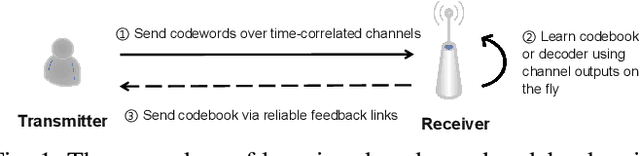


Machine learning techniques have garnered great interest in designing communication systems owing to their capacity in tacking with channel uncertainty. To provide theoretical guarantees for learning-based communication systems, some recent works analyze generalization bounds for devised methods based on the assumption of Independently and Identically Distributed (I.I.D.) channels, a condition rarely met in practical scenarios. In this paper, we drop the I.I.D. channel assumption and study an online optimization problem of learning to communicate over time-correlated channels. To address this issue, we further focus on two specific tasks: optimizing channel decoders for time-correlated fading channels and selecting optimal codebooks for time-correlated additive noise channels. For utilizing temporal dependence of considered channels to better learn communication systems, we develop two online optimization algorithms based on the optimistic online mirror descent framework. Furthermore, we provide theoretical guarantees for proposed algorithms via deriving sub-linear regret bound on the expected error probability of learned systems. Extensive simulation experiments have been conducted to validate that our presented approaches can leverage the channel correlation to achieve a lower average symbol error rate compared to baseline methods, consistent with our theoretical findings.
Minimizing Weighted Counterfactual Regret with Optimistic Online Mirror Descent
Apr 22, 2024Counterfactual regret minimization (CFR) is a family of algorithms for effectively solving imperfect-information games. It decomposes the total regret into counterfactual regrets, utilizing local regret minimization algorithms, such as Regret Matching (RM) or RM+, to minimize them. Recent research establishes a connection between Online Mirror Descent (OMD) and RM+, paving the way for an optimistic variant PRM+ and its extension PCFR+. However, PCFR+ assigns uniform weights for each iteration when determining regrets, leading to substantial regrets when facing dominated actions. This work explores minimizing weighted counterfactual regret with optimistic OMD, resulting in a novel CFR variant PDCFR+. It integrates PCFR+ and Discounted CFR (DCFR) in a principled manner, swiftly mitigating negative effects of dominated actions and consistently leveraging predictions to accelerate convergence. Theoretical analyses prove that PDCFR+ converges to a Nash equilibrium, particularly under distinct weighting schemes for regrets and average strategies. Experimental results demonstrate PDCFR+'s fast convergence in common imperfect-information games. The code is available at https://github.com/rpSebastian/PDCFRPlus.
Online Saddle Point Problem and Online Convex-Concave Optimization
Dec 15, 2023Centered around solving the Online Saddle Point problem, this paper introduces the Online Convex-Concave Optimization (OCCO) framework, which involves a sequence of two-player time-varying convex-concave games. We propose the generalized duality gap (Dual-Gap) as the performance metric and establish the parallel relationship between OCCO with Dual-Gap and Online Convex Optimization (OCO) with regret. To demonstrate the natural extension of OCCO from OCO, we develop two algorithms, the implicit online mirror descent-ascent and its optimistic variant. Analysis reveals that their duality gaps share similar expression forms with the corresponding dynamic regrets arising from implicit updates in OCO. Empirical results further substantiate the effectiveness of our algorithms. Simultaneously, we unveil that the dynamic Nash equilibrium regret, which was initially introduced in a recent paper, has inherent defects.
Optimistic Online Mirror Descent for Bridging Stochastic and Adversarial Online Convex Optimization
Feb 09, 2023Stochastically Extended Adversarial (SEA) model is introduced by Sachs et al. [2022] as an interpolation between stochastic and adversarial online convex optimization. Under the smoothness condition, they demonstrate that the expected regret of optimistic follow-the-regularized-leader (FTRL) depends on the cumulative stochastic variance $\sigma_{1:T}^2$ and the cumulative adversarial variation $\Sigma_{1:T}^2$ for convex functions. They also provide a slightly weaker bound based on the maximal stochastic variance $\sigma_{\max}^2$ and the maximal adversarial variation $\Sigma_{\max}^2$ for strongly convex functions. Inspired by their work, we investigate the theoretical guarantees of optimistic online mirror descent (OMD) for the SEA model. For convex and smooth functions, we obtain the same $\mathcal{O}(\sqrt{\sigma_{1:T}^2}+\sqrt{\Sigma_{1:T}^2})$ regret bound, without the convexity requirement of individual functions. For strongly convex and smooth functions, we establish an $\mathcal{O}(\min\{\log (\sigma_{1:T}^2+\Sigma_{1:T}^2), (\sigma_{\max}^2 + \Sigma_{\max}^2) \log T\})$ bound, better than their $\mathcal{O}((\sigma_{\max}^2 + \Sigma_{\max}^2) \log T)$ bound. For \mbox{exp-concave} and smooth functions, we achieve a new $\mathcal{O}(d\log(\sigma_{1:T}^2+\Sigma_{1:T}^2))$ bound. Owing to the OMD framework, we can further extend our result to obtain dynamic regret guarantees, which are more favorable in non-stationary online scenarios. The attained results allow us to recover excess risk bounds of the stochastic setting and regret bounds of the adversarial setting, and derive new guarantees for many intermediate scenarios.