 Add to Chrome
 Add to Firefox
 Add to Edge
Open World Semi Supervised Learning
Papers and Code
ST-VLA: Enabling 4D-Aware Spatiotemporal Understanding for General Robot Manipulation
Mar 14, 2026
Robotic manipulation in open-world environments requires reasoning across semantics, geometry, and long-horizon action dynamics. Existing hierarchical Vision-Language-Action (VLA) frameworks typically use 2D representations to connect high-level reasoning with low-level control, but lack depth awareness and temporal consistency, limiting robustness in complex 3D scenes. We propose ST-VLA, a hierarchical VLA framework using a unified 3D-4D representation to bridge perception and action. ST-VLA converts 2D guidance into 3D trajectories and generates smooth spatial masks that capture 4D spatio-temporal context, providing a stable interface between semantic reasoning and continuous control. To enable effective learning of such representations, we introduce ST-Human, a large-scale human manipulation dataset with 14 tasks and 300k episodes, annotated with 2D, 3D, and 4D supervision via a semi-automated pipeline. Using ST-Human, we train ST-VLM, a spatio-temporal vision-language model that generates spatially grounded and temporally coherent 3D representations to guide policy execution. The smooth spatial masks focus on task-relevant geometry and stabilize latent representations, enabling online replanning and long-horizon reasoning. Experiments on RLBench and real-world manipulation tasks show that \method significantly outperforms state-of-the-art baselines, improving zero-shot success rates by 44.6% and 30.3%. These results demonstrate that offloading spatio-temporal reasoning to VLMs with unified 3D-4D representations substantially improves robustness and generalization for open-world robotic manipulation. Project website: https://oucx117.github.io/ST-VLA/.

Vision-Language Model Purified Semi-Supervised Semantic Segmentation for Remote Sensing Images
Jan 30, 2026The semi-supervised semantic segmentation (S4) can learn rich visual knowledge from low-cost unlabeled images. However, traditional S4 architectures all face the challenge of low-quality pseudo-labels, especially for the teacher-student framework.We propose a novel SemiEarth model that introduces vision-language models (VLMs) to address the S4 issues for the remote sensing (RS) domain. Specifically, we invent a VLM pseudo-label purifying (VLM-PP) structure to purify the teacher network's pseudo-labels, achieving substantial improvements. Especially in multi-class boundary regions of RS images, the VLM-PP module can significantly improve the quality of pseudo-labels generated by the teacher, thereby correctly guiding the student model's learning. Moreover, since VLM-PP equips VLMs with open-world capabilities and is independent of the S4 architecture, it can correct mispredicted categories in low-confidence pseudo-labels whenever a discrepancy arises between its prediction and the pseudo-label. We conducted extensive experiments on multiple RS datasets, which demonstrate that our SemiEarth achieves SOTA performance. More importantly, unlike previous SOTA RS S4 methods, our model not only achieves excellent performance but also offers good interpretability. The code is released at https://github.com/wangshanwen001/SemiEarth.
Solving Semi-Supervised Few-Shot Learning from an Auto-Annotation Perspective
Dec 11, 2025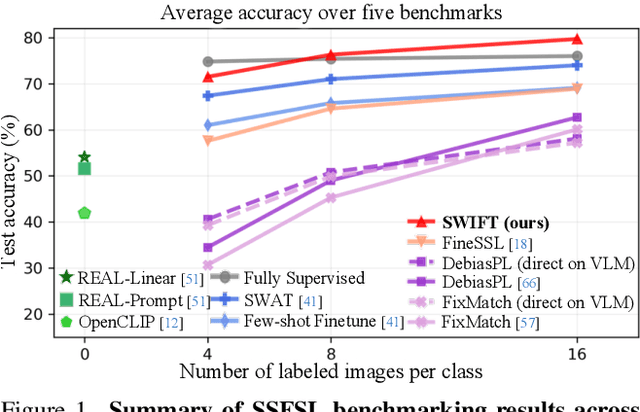
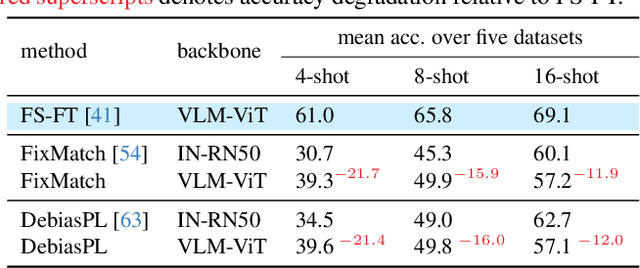
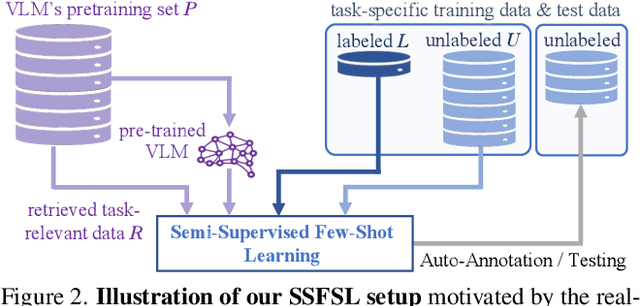
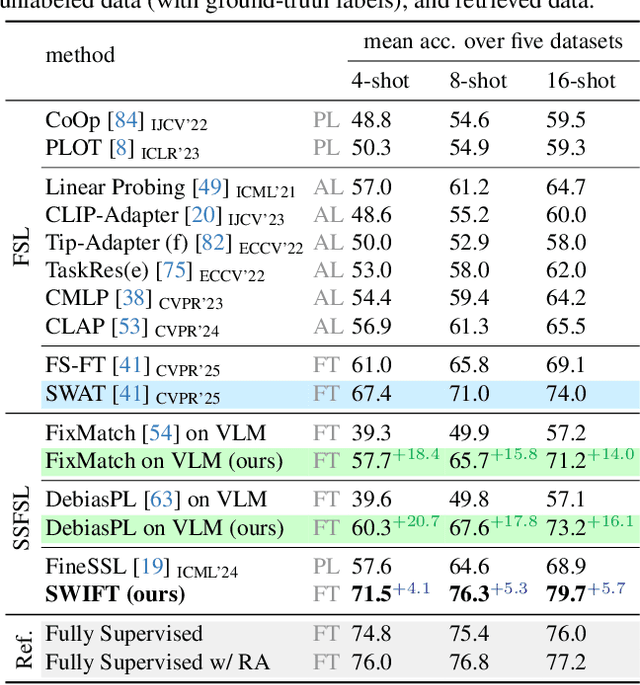
Semi-supervised few-shot learning (SSFSL) formulates real-world applications like ''auto-annotation'', as it aims to learn a model over a few labeled and abundant unlabeled examples to annotate the unlabeled ones. Despite the availability of powerful open-source Vision-Language Models (VLMs) and their pretraining data, the SSFSL literature largely neglects these open-source resources. In contrast, the related area few-shot learning (FSL) has already exploited them to boost performance. Arguably, to achieve auto-annotation in the real world, SSFSL should leverage such open-source resources. To this end, we start by applying established SSL methods to finetune a VLM. Counterintuitively, they significantly underperform FSL baselines. Our in-depth analysis reveals the root cause: VLMs produce rather ''flat'' distributions of softmax probabilities. This results in zero utilization of unlabeled data and weak supervision signals. We address this issue with embarrassingly simple techniques: classifier initialization and temperature tuning. They jointly increase the confidence scores of pseudo-labels, improving the utilization rate of unlabeled data, and strengthening supervision signals. Building on this, we propose: Stage-Wise Finetuning with Temperature Tuning (SWIFT), which enables existing SSL methods to effectively finetune a VLM on limited labeled data, abundant unlabeled data, and task-relevant but noisy data retrieved from the VLM's pretraining set. Extensive experiments on five SSFSL benchmarks show that SWIFT outperforms recent FSL and SSL methods by $\sim$5 accuracy points. SWIFT even rivals supervised learning, which finetunes VLMs with the unlabeled data being labeled with ground truth!
Dimensionally Reduced Open-World Clustering: DROWCULA
Sep 08, 2025Working with annotated data is the cornerstone of supervised learning. Nevertheless, providing labels to instances is a task that requires significant human effort. Several critical real-world applications make things more complicated because no matter how many labels may have been identified in a task of interest, it could be the case that examples corresponding to novel classes may appear in the future. Not unsurprisingly, prior work in this, so-called, `open-world' context has focused a lot on semi-supervised approaches. Focusing on image classification, somehow paradoxically, we propose a fully unsupervised approach to the problem of determining the novel categories in a particular dataset. Our approach relies on estimating the number of clusters using Vision Transformers, which utilize attention mechanisms to generate vector embeddings. Furthermore, we incorporate manifold learning techniques to refine these embeddings by exploiting the intrinsic geometry of the data, thereby enhancing the overall image clustering performance. Overall, we establish new State-of-the-Art results on single-modal clustering and Novel Class Discovery on CIFAR-10, CIFAR-100, ImageNet-100, and Tiny ImageNet. We do so, both when the number of clusters is known or unknown ahead of time. The code is available at: https://github.com/DROWCULA/DROWCULA.
Robust and Label-Efficient Deep Waste Detection
Aug 26, 2025Effective waste sorting is critical for sustainable recycling, yet AI research in this domain continues to lag behind commercial systems due to limited datasets and reliance on legacy object detectors. In this work, we advance AI-driven waste detection by establishing strong baselines and introducing an ensemble-based semi-supervised learning framework. We first benchmark state-of-the-art Open-Vocabulary Object Detection (OVOD) models on the real-world ZeroWaste dataset, demonstrating that while class-only prompts perform poorly, LLM-optimized prompts significantly enhance zero-shot accuracy. Next, to address domain-specific limitations, we fine-tune modern transformer-based detectors, achieving a new baseline of 51.6 mAP. We then propose a soft pseudo-labeling strategy that fuses ensemble predictions using spatial and consensus-aware weighting, enabling robust semi-supervised training. Applied to the unlabeled ZeroWaste-s subset, our pseudo-annotations achieve performance gains that surpass fully supervised training, underscoring the effectiveness of scalable annotation pipelines. Our work contributes to the research community by establishing rigorous baselines, introducing a robust ensemble-based pseudo-labeling pipeline, generating high-quality annotations for the unlabeled ZeroWaste-s subset, and systematically evaluating OVOD models under real-world waste sorting conditions. Our code is available at: https://github.com/h-abid97/robust-waste-detection.
DATA: Multi-Disentanglement based Contrastive Learning for Open-World Semi-Supervised Deepfake Attribution
May 07, 2025Deepfake attribution (DFA) aims to perform multiclassification on different facial manipulation techniques, thereby mitigating the detrimental effects of forgery content on the social order and personal reputations. However, previous methods focus only on method-specific clues, which easily lead to overfitting, while overlooking the crucial role of common forgery features. Additionally, they struggle to distinguish between uncertain novel classes in more practical open-world scenarios. To address these issues, in this paper we propose an innovative multi-DisentAnglement based conTrastive leArning framework, DATA, to enhance the generalization ability on novel classes for the open-world semi-supervised deepfake attribution (OSS-DFA) task. Specifically, since all generation techniques can be abstracted into a similar architecture, DATA defines the concept of 'Orthonormal Deepfake Basis' for the first time and utilizes it to disentangle method-specific features, thereby reducing the overfitting on forgery-irrelevant information. Furthermore, an augmented-memory mechanism is designed to assist in novel class discovery and contrastive learning, which aims to obtain clear class boundaries for the novel classes through instance-level disentanglements. Additionally, to enhance the standardization and discrimination of features, DATA uses bases contrastive loss and center contrastive loss as auxiliaries for the aforementioned modules. Extensive experimental evaluations show that DATA achieves state-of-the-art performance on the OSS-DFA benchmark, e.g., there are notable accuracy improvements in 2.55% / 5.7% under different settings, compared with the existing methods.
Info-Coevolution: An Efficient Framework for Data Model Coevolution
Jun 09, 2025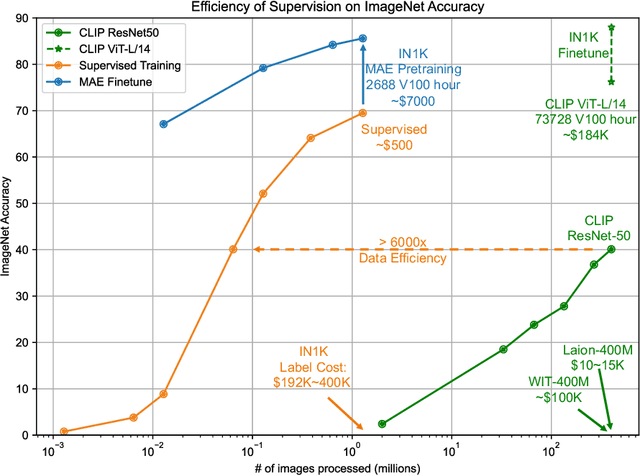
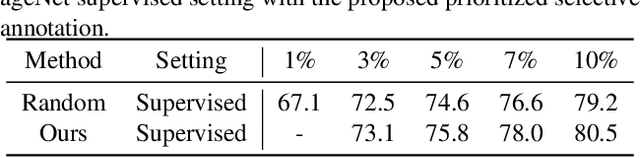
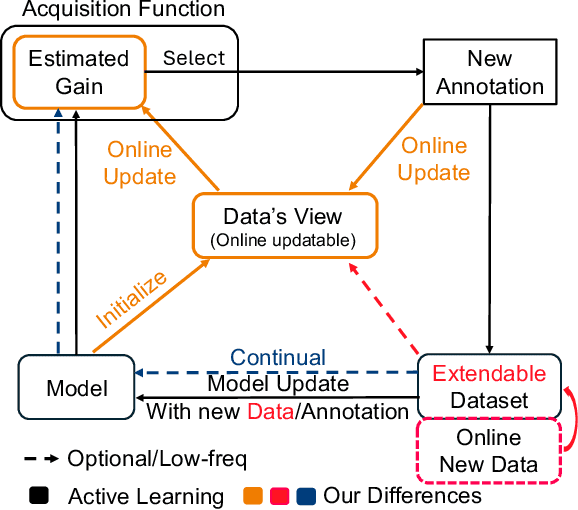
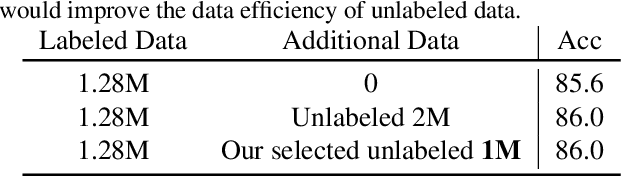
Machine learning relies heavily on data, yet the continuous growth of real-world data poses challenges for efficient dataset construction and training. A fundamental yet unsolved question is: given our current model and data, does a new data (sample/batch) need annotation/learning? Conventional approaches retain all available data, leading to non-optimal data and training efficiency. Active learning aims to reduce data redundancy by selecting a subset of samples to annotate, while it increases pipeline complexity and introduces bias. In this work, we propose Info-Coevolution, a novel framework that efficiently enables models and data to coevolve through online selective annotation with no bias. Leveraging task-specific models (and open-source models), it selectively annotates and integrates online and web data to improve datasets efficiently. For real-world datasets like ImageNet-1K, Info-Coevolution reduces annotation and training costs by 32\% without performance loss. It is able to automatically give the saving ratio without tuning the ratio. It can further reduce the annotation ratio to 50\% with semi-supervised learning. We also explore retrieval-based dataset enhancement using unlabeled open-source data. Code is available at https://github.com/NUS-HPC-AI-Lab/Info-Coevolution/.
* V1
Open-Set Semi-Supervised Learning for Long-Tailed Medical Datasets
May 20, 2025Many practical medical imaging scenarios include categories that are under-represented but still crucial. The relevance of image recognition models to real-world applications lies in their ability to generalize to these rare classes as well as unseen classes. Real-world generalization requires taking into account the various complexities that can be encountered in the real-world. First, training data is highly imbalanced, which may lead to model exhibiting bias toward the more frequently represented classes. Moreover, real-world data may contain unseen classes that need to be identified, and model performance is affected by the data scarcity. While medical image recognition has been extensively addressed in the literature, current methods do not take into account all the intricacies in the real-world scenarios. To this end, we propose an open-set learning method for highly imbalanced medical datasets using a semi-supervised approach. Understanding the adverse impact of long-tail distribution at the inherent model characteristics, we implement a regularization strategy at the feature level complemented by a classifier normalization technique. We conduct extensive experiments on the publicly available datasets, ISIC2018, ISIC2019, and TissueMNIST with various numbers of labelled samples. Our analysis shows that addressing the impact of long-tail data in classification significantly improves the overall performance of the network in terms of closed-set and open-set accuracies on all datasets. Our code and trained models will be made publicly available at https://github.com/Daniyanaj/OpenLTR.
Learning Diverse Natural Behaviors for Enhancing the Agility of Quadrupedal Robots
May 15, 2025Achieving animal-like agility is a longstanding goal in quadrupedal robotics. While recent studies have successfully demonstrated imitation of specific behaviors, enabling robots to replicate a broader range of natural behaviors in real-world environments remains an open challenge. Here we propose an integrated controller comprising a Basic Behavior Controller (BBC) and a Task-Specific Controller (TSC) which can effectively learn diverse natural quadrupedal behaviors in an enhanced simulator and efficiently transfer them to the real world. Specifically, the BBC is trained using a novel semi-supervised generative adversarial imitation learning algorithm to extract diverse behavioral styles from raw motion capture data of real dogs, enabling smooth behavior transitions by adjusting discrete and continuous latent variable inputs. The TSC, trained via privileged learning with depth images as input, coordinates the BBC to efficiently perform various tasks. Additionally, we employ evolutionary adversarial simulator identification to optimize the simulator, aligning it closely with reality. After training, the robot exhibits diverse natural behaviors, successfully completing the quadrupedal agility challenge at an average speed of 1.1 m/s and achieving a peak speed of 3.2 m/s during hurdling. This work represents a substantial step toward animal-like agility in quadrupedal robots, opening avenues for their deployment in increasingly complex real-world environments.
Few-shot Novel Category Discovery
May 13, 2025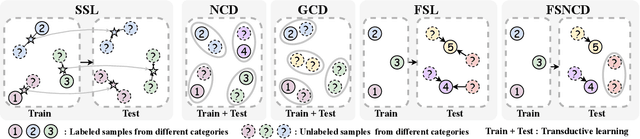
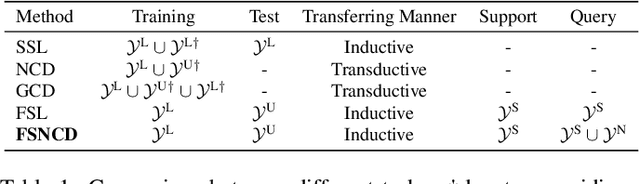
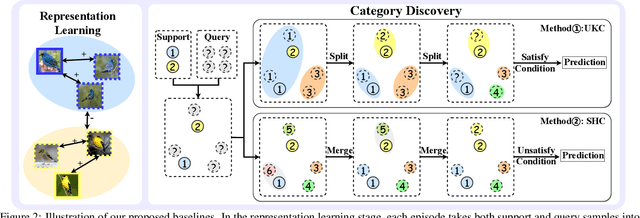
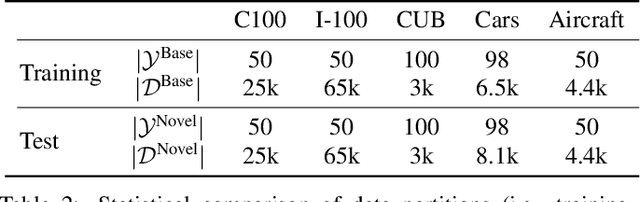
The recently proposed Novel Category Discovery (NCD) adapt paradigm of transductive learning hinders its application in more real-world scenarios. In fact, few labeled data in part of new categories can well alleviate this burden, which coincides with the ease that people can label few of new category data. Therefore, this paper presents a new setting in which a trained agent is able to flexibly switch between the tasks of identifying examples of known (labelled) classes and clustering novel (completely unlabeled) classes as the number of query examples increases by leveraging knowledge learned from only a few (handful) support examples. Drawing inspiration from the discovery of novel categories using prior-based clustering algorithms, we introduce a novel framework that further relaxes its assumptions to the real-world open set level by unifying the concept of model adaptability in few-shot learning. We refer to this setting as Few-Shot Novel Category Discovery (FSNCD) and propose Semi-supervised Hierarchical Clustering (SHC) and Uncertainty-aware K-means Clustering (UKC) to examine the model's reasoning capabilities. Extensive experiments and detailed analysis on five commonly used datasets demonstrate that our methods can achieve leading performance levels across different task settings and scenarios.