 Add to Chrome
 Add to Firefox
 Add to Edge
MLT-Dedup: Efficient Large-Scale Online Video Deduplication via Multi-Level Representations and Spatial-Temporal Matching
Jun 10, 2026
The explosive growth of user-generated video content on online platforms is accompanied by the emergence of numerous near-duplicate videos--videos that are identical or highly similar but differ by partial edits. These duplicates degrade user experience and increase storage and bandwidth costs, making large-scale video deduplication a critical task. Existing video deduplication frameworks face a fundamental challenge in retrieving sufficient high-quality candidates under a limited index budget, as well as trade-offs between efficiency and precision. To address these issues, we propose MLT-Dedup, an efficient large-scale online video deduplication framework with Multi-Level representations and spatial-Temporal matching. Our approach employs a Multi-Level Video Encoder (ML-VE) to extract both fine-grained frame-level and sparse clip-level embeddings: sparse embeddings support efficient candidate retrieval, while fine-grained embeddings are loaded for precise pairwise matching. During matching, we introduce DiF-SiM, a Differential Feature-enhanced Similarity Module capable of locating duplicated temporal segments and providing reliable similarity evidence to support policy-driven deduplication decisions. Extensive experiments on a real-world large-scale platform demonstrate that MLT-Dedup reduces online repetition rates by 91% at 90% precision. Furthermore, our sparse retrieval design achieves a 5x increase in indexing capacity, enabling broader candidate coverage in real-world deployment.

CAMEL: Confidence-Gated Reflection for Reward Modeling
Feb 24, 2026Reward models play a fundamental role in aligning large language models with human preferences. Existing methods predominantly follow two paradigms: scalar discriminative preference models, which are efficient but lack interpretability, and generative judging models, which offer richer reasoning at the cost of higher computational overhead. We observe that the log-probability margin between verdict tokens strongly correlates with prediction correctness, providing a reliable proxy for instance difficulty without additional inference cost. Building on this insight, we propose CAMEL, a confidence-gated reflection framework that performs a lightweight single-token preference decision first and selectively invokes reflection only for low-confidence instances. To induce effective self-correction, we train the model via reinforcement learning with counterfactual prefix augmentation, which exposes the model to diverse initial verdicts and encourages genuine revision. Empirically, CAMEL achieves state-of-the-art performance on three widely used reward-model benchmarks with 82.9% average accuracy, surpassing the best prior model by 3.2% and outperforming 70B-parameter models using only 14B parameters, while establishing a strictly better accuracy-efficiency Pareto frontier.
FOCUS: Efficient Keyframe Selection for Long Video Understanding
Oct 31, 2025Multimodal large language models (MLLMs) represent images and video frames as visual tokens. Scaling from single images to hour-long videos, however, inflates the token budget far beyond practical limits. Popular pipelines therefore either uniformly subsample or apply keyframe selection with retrieval-style scoring using smaller vision-language models. However, these keyframe selection methods still rely on pre-filtering before selection to reduce the inference cost and can miss the most informative moments. We propose FOCUS, Frame-Optimistic Confidence Upper-bound Selection, a training-free, model-agnostic keyframe selection module that selects query-relevant frames under a strict token budget. FOCUS formulates keyframe selection as a combinatorial pure-exploration (CPE) problem in multi-armed bandits: it treats short temporal clips as arms, and uses empirical means and Bernstein confidence radius to identify informative regions while preserving exploration of uncertain areas. The resulting two-stage exploration-exploitation procedure reduces from a sequential policy with theoretical guarantees, first identifying high-value temporal regions, then selecting top-scoring frames within each region On two long-video question-answering benchmarks, FOCUS delivers substantial accuracy improvements while processing less than 2% of video frames. For videos longer than 20 minutes, it achieves an 11.9% gain in accuracy on LongVideoBench, demonstrating its effectiveness as a keyframe selection method and providing a simple and general solution for scalable long-video understanding with MLLMs.
Info-Coevolution: An Efficient Framework for Data Model Coevolution
Jun 09, 2025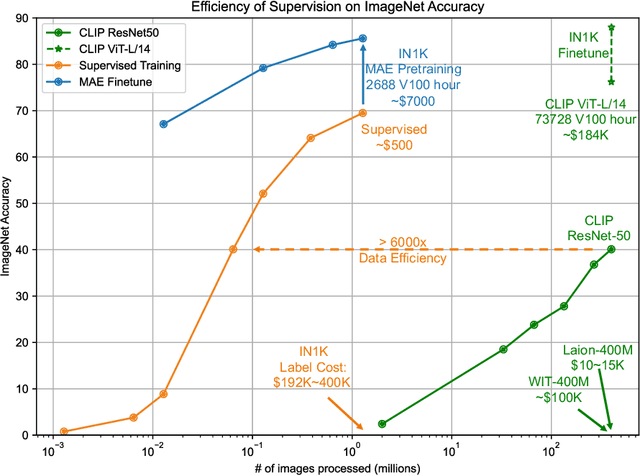
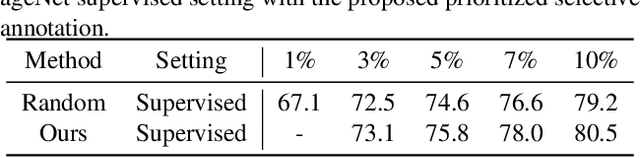
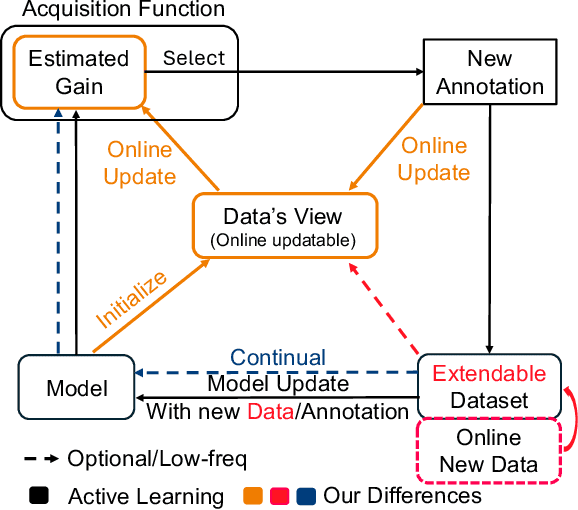
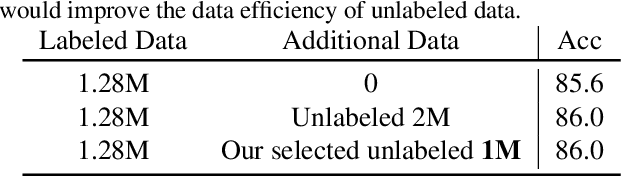
Machine learning relies heavily on data, yet the continuous growth of real-world data poses challenges for efficient dataset construction and training. A fundamental yet unsolved question is: given our current model and data, does a new data (sample/batch) need annotation/learning? Conventional approaches retain all available data, leading to non-optimal data and training efficiency. Active learning aims to reduce data redundancy by selecting a subset of samples to annotate, while it increases pipeline complexity and introduces bias. In this work, we propose Info-Coevolution, a novel framework that efficiently enables models and data to coevolve through online selective annotation with no bias. Leveraging task-specific models (and open-source models), it selectively annotates and integrates online and web data to improve datasets efficiently. For real-world datasets like ImageNet-1K, Info-Coevolution reduces annotation and training costs by 32\% without performance loss. It is able to automatically give the saving ratio without tuning the ratio. It can further reduce the annotation ratio to 50\% with semi-supervised learning. We also explore retrieval-based dataset enhancement using unlabeled open-source data. Code is available at https://github.com/NUS-HPC-AI-Lab/Info-Coevolution/.
* V1