 Add to Chrome
 Add to Firefox
 Add to Edge
Megadepth
Papers and Code
A Streamlined Attention-Based Network for Descriptor Extraction
Jan 19, 2026
We introduce SANDesc, a Streamlined Attention-Based Network for Descriptor extraction that aims to improve on existing architectures for keypoint description. Our descriptor network learns to compute descriptors that improve matching without modifying the underlying keypoint detector. We employ a revised U-Net-like architecture enhanced with Convolutional Block Attention Modules and residual paths, enabling effective local representation while maintaining computational efficiency. We refer to the building blocks of our model as Residual U-Net Blocks with Attention. The model is trained using a modified triplet loss in combination with a curriculum learning-inspired hard negative mining strategy, which improves training stability. Extensive experiments on HPatches, MegaDepth-1500, and the Image Matching Challenge 2021 show that training SANDesc on top of existing keypoint detectors leads to improved results on multiple matching tasks compared to the original keypoint descriptors. At the same time, SANDesc has a model complexity of just 2.4 million parameters. As a further contribution, we introduce a new urban dataset featuring 4K images and pre-calibrated intrinsics, designed to evaluate feature extractors. On this benchmark, SANDesc achieves substantial performance gains over the existing descriptors while operating with limited computational resources.

XRefine: Attention-Guided Keypoint Match Refinement
Jan 18, 2026Sparse keypoint matching is crucial for 3D vision tasks, yet current keypoint detectors often produce spatially inaccurate matches. Existing refinement methods mitigate this issue through alignment of matched keypoint locations, but they are typically detector-specific, requiring retraining for each keypoint detector. We introduce XRefine, a novel, detector-agnostic approach for sub-pixel keypoint refinement that operates solely on image patches centered at matched keypoints. Our cross-attention-based architecture learns to predict refined keypoint coordinates without relying on internal detector representations, enabling generalization across detectors. Furthermore, XRefine can be extended to handle multi-view feature tracks. Experiments on MegaDepth, KITTI, and ScanNet demonstrate that the approach consistently improves geometric estimation accuracy, achieving superior performance compared to existing refinement methods while maintaining runtime efficiency. Our code and trained models can be found at https://github.com/boschresearch/xrefine.
To Glue or Not to Glue? Classical vs Learned Image Matching for Mobile Mapping Cameras to Textured Semantic 3D Building Models
May 23, 2025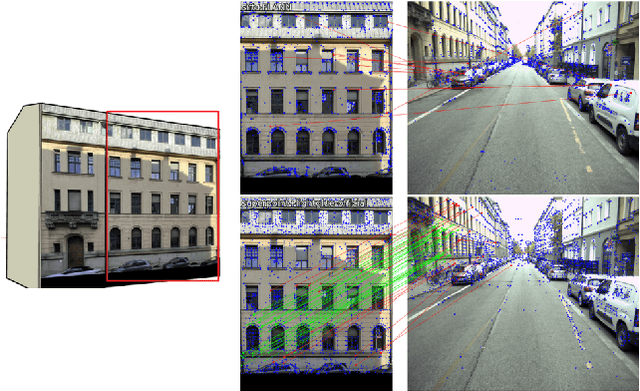
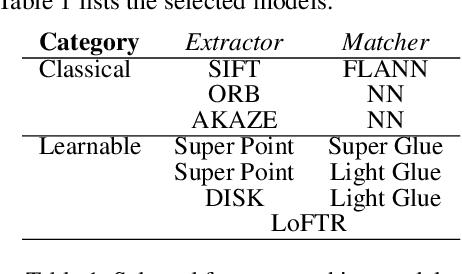
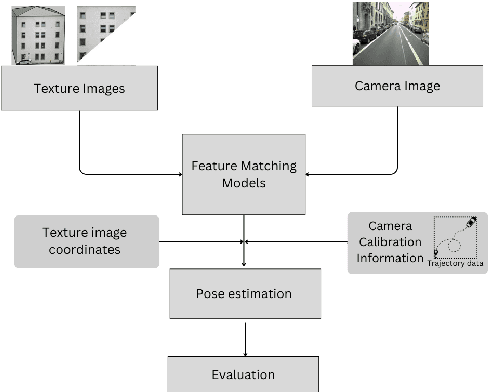
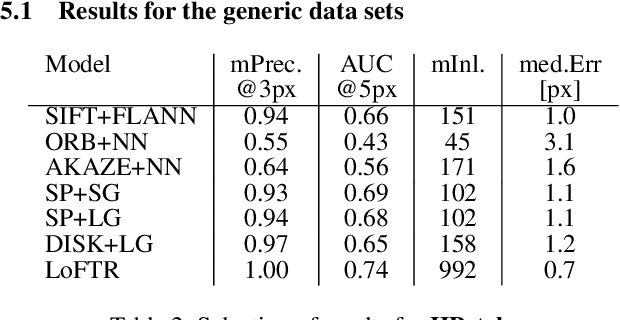
Feature matching is a necessary step for many computer vision and photogrammetry applications such as image registration, structure-from-motion, and visual localization. Classical handcrafted methods such as SIFT feature detection and description combined with nearest neighbour matching and RANSAC outlier removal have been state-of-the-art for mobile mapping cameras. With recent advances in deep learning, learnable methods have been introduced and proven to have better robustness and performance under complex conditions. Despite their growing adoption, a comprehensive comparison between classical and learnable feature matching methods for the specific task of semantic 3D building camera-to-model matching is still missing. This submission systematically evaluates the effectiveness of different feature-matching techniques in visual localization using textured CityGML LoD2 models. We use standard benchmark datasets (HPatches, MegaDepth-1500) and custom datasets consisting of facade textures and corresponding camera images (terrestrial and drone). For the latter, we evaluate the achievable accuracy of the absolute pose estimated using a Perspective-n-Point (PnP) algorithm, with geometric ground truth derived from geo-referenced trajectory data. The results indicate that the learnable feature matching methods vastly outperform traditional approaches regarding accuracy and robustness on our challenging custom datasets with zero to 12 RANSAC-inliers and zero to 0.16 area under the curve. We believe that this work will foster the development of model-based visual localization methods. Link to the code: https://github.com/simBauer/To\_Glue\_or\_not\_to\_Glue
3D Reconstruction from Sketches
May 20, 2025We consider the problem of reconstructing a 3D scene from multiple sketches. We propose a pipeline which involves (1) stitching together multiple sketches through use of correspondence points, (2) converting the stitched sketch into a realistic image using a CycleGAN, and (3) estimating that image's depth-map using a pre-trained convolutional neural network based architecture called MegaDepth. Our contribution includes constructing a dataset of image-sketch pairs, the images for which are from the Zurich Building Database, and sketches have been generated by us. We use this dataset to train a CycleGAN for our pipeline's second step. We end up with a stitching process that does not generalize well to real drawings, but the rest of the pipeline that creates a 3D reconstruction from a single sketch performs quite well on a wide variety of drawings.
RDD: Robust Feature Detector and Descriptor using Deformable Transformer
May 12, 2025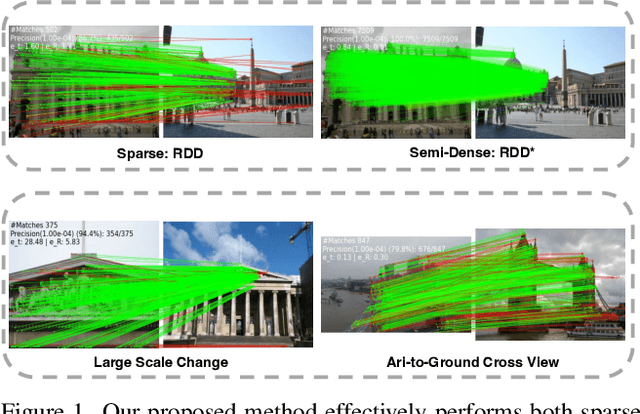
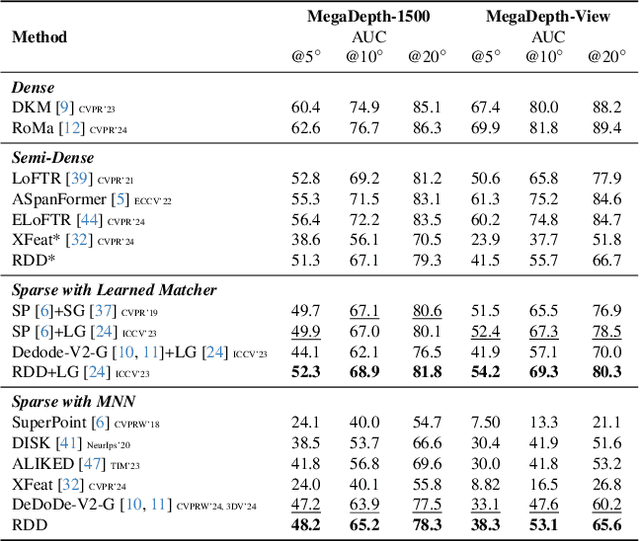
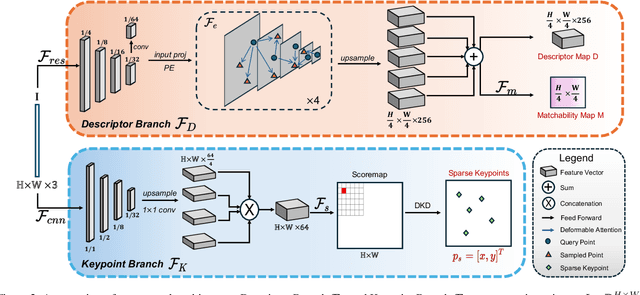
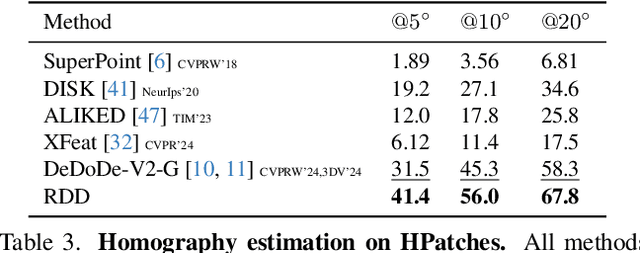
As a core step in structure-from-motion and SLAM, robust feature detection and description under challenging scenarios such as significant viewpoint changes remain unresolved despite their ubiquity. While recent works have identified the importance of local features in modeling geometric transformations, these methods fail to learn the visual cues present in long-range relationships. We present Robust Deformable Detector (RDD), a novel and robust keypoint detector/descriptor leveraging the deformable transformer, which captures global context and geometric invariance through deformable self-attention mechanisms. Specifically, we observed that deformable attention focuses on key locations, effectively reducing the search space complexity and modeling the geometric invariance. Furthermore, we collected an Air-to-Ground dataset for training in addition to the standard MegaDepth dataset. Our proposed method outperforms all state-of-the-art keypoint detection/description methods in sparse matching tasks and is also capable of semi-dense matching. To ensure comprehensive evaluation, we introduce two challenging benchmarks: one emphasizing large viewpoint and scale variations, and the other being an Air-to-Ground benchmark -- an evaluation setting that has recently gaining popularity for 3D reconstruction across different altitudes.
AerialMegaDepth: Learning Aerial-Ground Reconstruction and View Synthesis
Apr 17, 2025We explore the task of geometric reconstruction of images captured from a mixture of ground and aerial views. Current state-of-the-art learning-based approaches fail to handle the extreme viewpoint variation between aerial-ground image pairs. Our hypothesis is that the lack of high-quality, co-registered aerial-ground datasets for training is a key reason for this failure. Such data is difficult to assemble precisely because it is difficult to reconstruct in a scalable way. To overcome this challenge, we propose a scalable framework combining pseudo-synthetic renderings from 3D city-wide meshes (e.g., Google Earth) with real, ground-level crowd-sourced images (e.g., MegaDepth). The pseudo-synthetic data simulates a wide range of aerial viewpoints, while the real, crowd-sourced images help improve visual fidelity for ground-level images where mesh-based renderings lack sufficient detail, effectively bridging the domain gap between real images and pseudo-synthetic renderings. Using this hybrid dataset, we fine-tune several state-of-the-art algorithms and achieve significant improvements on real-world, zero-shot aerial-ground tasks. For example, we observe that baseline DUSt3R localizes fewer than 5% of aerial-ground pairs within 5 degrees of camera rotation error, while fine-tuning with our data raises accuracy to nearly 56%, addressing a major failure point in handling large viewpoint changes. Beyond camera estimation and scene reconstruction, our dataset also improves performance on downstream tasks like novel-view synthesis in challenging aerial-ground scenarios, demonstrating the practical value of our approach in real-world applications.
Monte Carlo Diffusion for Generalizable Learning-Based RANSAC
Mar 12, 2025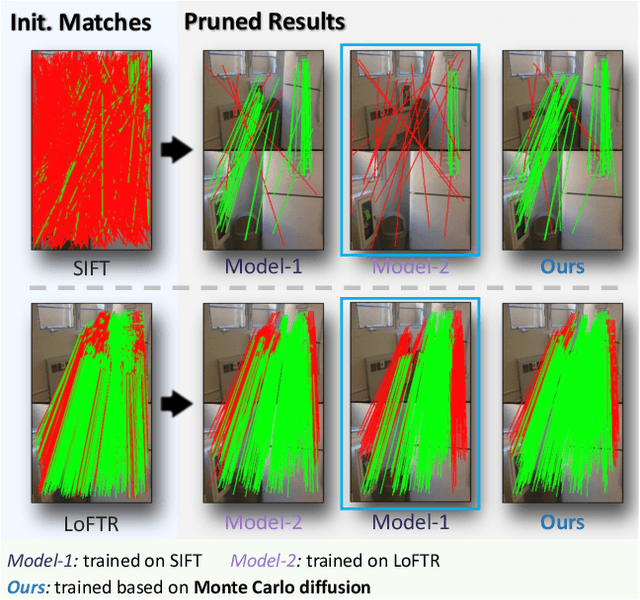
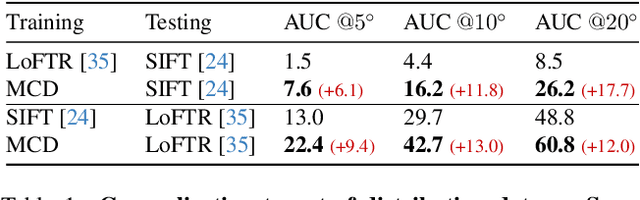
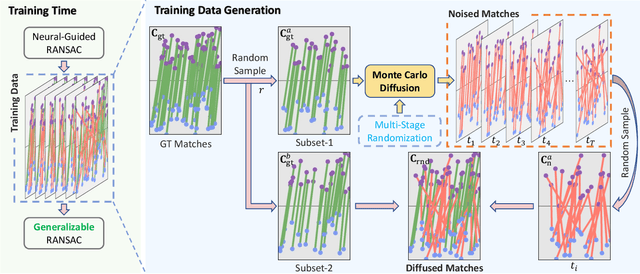
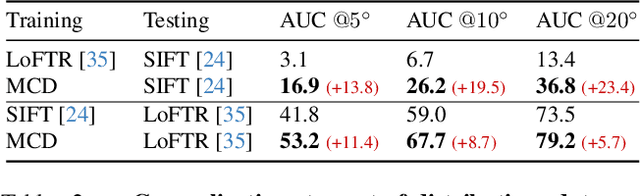
Random Sample Consensus (RANSAC) is a fundamental approach for robustly estimating parametric models from noisy data. Existing learning-based RANSAC methods utilize deep learning to enhance the robustness of RANSAC against outliers. However, these approaches are trained and tested on the data generated by the same algorithms, leading to limited generalization to out-of-distribution data during inference. Therefore, in this paper, we introduce a novel diffusion-based paradigm that progressively injects noise into ground-truth data, simulating the noisy conditions for training learning-based RANSAC. To enhance data diversity, we incorporate Monte Carlo sampling into the diffusion paradigm, approximating diverse data distributions by introducing different types of randomness at multiple stages. We evaluate our approach in the context of feature matching through comprehensive experiments on the ScanNet and MegaDepth datasets. The experimental results demonstrate that our Monte Carlo diffusion mechanism significantly improves the generalization ability of learning-based RANSAC. We also develop extensive ablation studies that highlight the effectiveness of key components in our framework.
ETO:Efficient Transformer-based Local Feature Matching by Organizing Multiple Homography Hypotheses
Oct 31, 2024
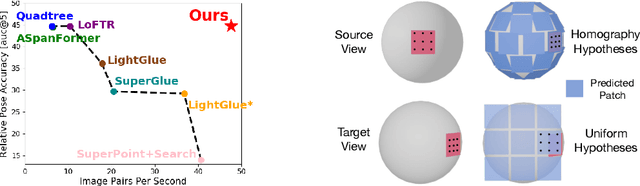


We tackle the efficiency problem of learning local feature matching. Recent advancements have given rise to purely CNN-based and transformer-based approaches, each augmented with deep learning techniques. While CNN-based methods often excel in matching speed, transformer-based methods tend to provide more accurate matches. We propose an efficient transformer-based network architecture for local feature matching. This technique is built on constructing multiple homography hypotheses to approximate the continuous correspondence in the real world and uni-directional cross-attention to accelerate the refinement. On the YFCC100M dataset, our matching accuracy is competitive with LoFTR, a state-of-the-art transformer-based architecture, while the inference speed is boosted to 4 times, even outperforming the CNN-based methods. Comprehensive evaluations on other open datasets such as Megadepth, ScanNet, and HPatches demonstrate our method's efficacy, highlighting its potential to significantly enhance a wide array of downstream applications.
DeDoDe v2: Analyzing and Improving the DeDoDe Keypoint Detector
Apr 13, 2024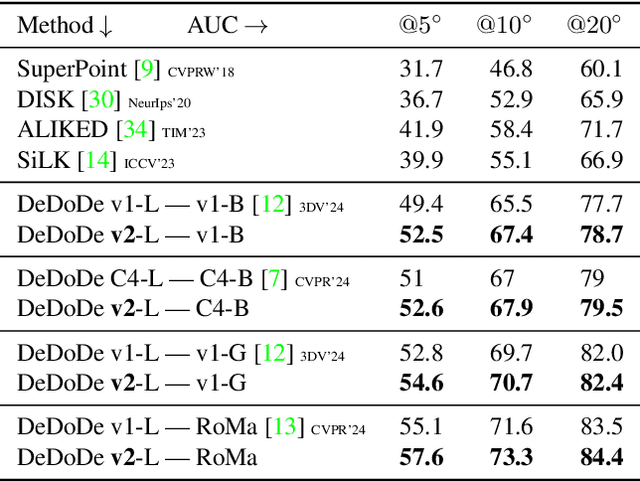
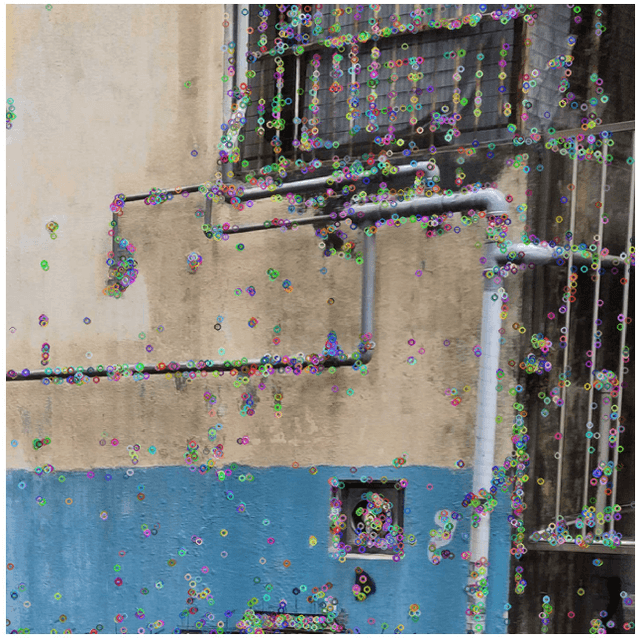
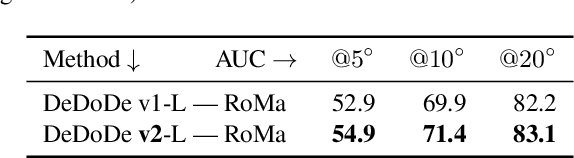
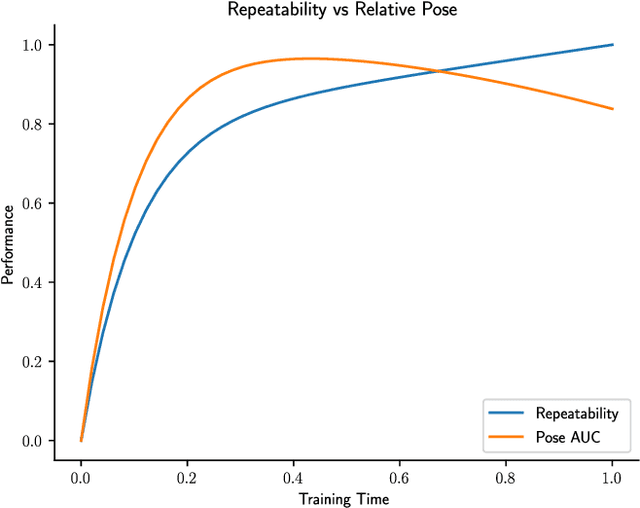
In this paper, we analyze and improve into the recently proposed DeDoDe keypoint detector. We focus our analysis on some key issues. First, we find that DeDoDe keypoints tend to cluster together, which we fix by performing non-max suppression on the target distribution of the detector during training. Second, we address issues related to data augmentation. In particular, the DeDoDe detector is sensitive to large rotations. We fix this by including 90-degree rotations as well as horizontal flips. Finally, the decoupled nature of the DeDoDe detector makes evaluation of downstream usefulness problematic. We fix this by matching the keypoints with a pretrained dense matcher (RoMa) and evaluating two-view pose estimates. We find that the original long training is detrimental to performance, and therefore propose a much shorter training schedule. We integrate all these improvements into our proposed detector DeDoDe v2 and evaluate it with the original DeDoDe descriptor on the MegaDepth-1500 and IMC2022 benchmarks. Our proposed detector significantly increases pose estimation results, notably from 75.9 to 78.3 mAA on the IMC2022 challenge. Code and weights are available at https://github.com/Parskatt/DeDoDe
Are Semi-Dense Detector-Free Methods Good at Matching Local Features?
Feb 13, 2024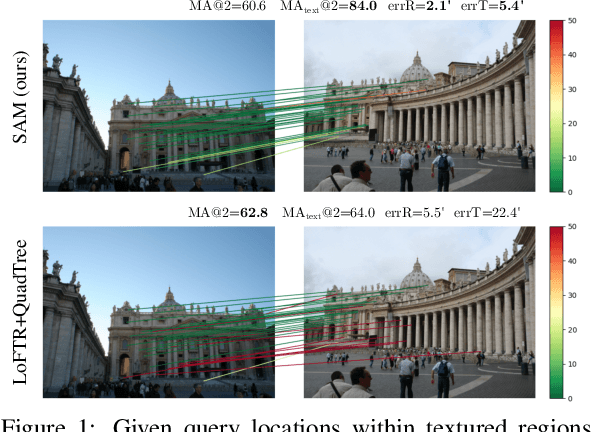
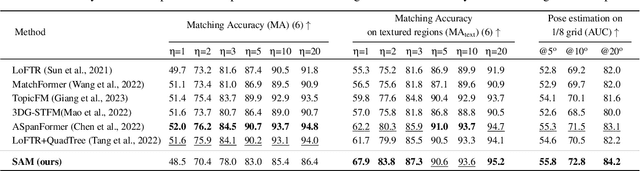
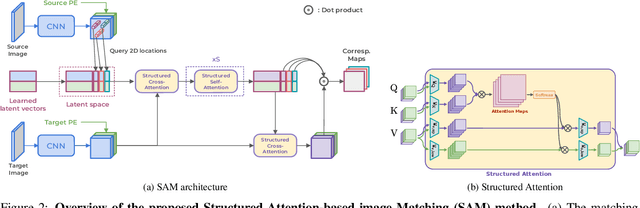
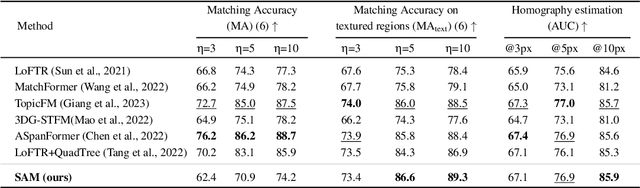
Semi-dense detector-free approaches (SDF), such as LoFTR, are currently among the most popular image matching methods. While SDF methods are trained to establish correspondences between two images, their performances are almost exclusively evaluated using relative pose estimation metrics. Thus, the link between their ability to establish correspondences and the quality of the resulting estimated pose has thus far received little attention. This paper is a first attempt to study this link. We start with proposing a novel structured attention-based image matching architecture (SAM). It allows us to show a counter-intuitive result on two datasets (MegaDepth and HPatches): on the one hand SAM either outperforms or is on par with SDF methods in terms of pose/homography estimation metrics, but on the other hand SDF approaches are significantly better than SAM in terms of matching accuracy. We then propose to limit the computation of the matching accuracy to textured regions, and show that in this case SAM often surpasses SDF methods. Our findings highlight a strong correlation between the ability to establish accurate correspondences in textured regions and the accuracy of the resulting estimated pose/homography. Our code will be made available.