 Add to Chrome
 Add to Firefox
 Add to Edge
Who Handles Orientation? Investigating Invariance in Feature Matching
Apr 13, 2026
Finding matching keypoints between images is a core problem in 3D computer vision. However, modern matchers struggle with large in-plane rotations. A straightforward mitigation is to learn rotation invariance via data augmentation. However, it remains unclear at which stage rotation invariance should be incorporated. In this paper, we study this in the context of a modern sparse matching pipeline. We perform extensive experiments by training on a large collection of 3D vision datasets and evaluating on popular image matching benchmarks. Surprisingly, we find that incorporating rotation invariance already in the descriptor yields similar performance to handling it in the matcher. However, rotation invariance is achieved earlier in the matcher when it is learned in the descriptor, allowing for a faster rotation-invariant matcher. Further, we find that enforcing rotation invariance does not hurt upright performance when trained at scale. Finally, we study the emergence of rotation invariance through scale and find that increasing the training data size substantially improves generalization to rotated images. We release two matchers robust to in-plane rotations that achieve state-of-the-art performance on e.g. multi-modal (WxBS), extreme (HardMatch), and satellite image matching (SatAst). Code is available at https://github.com/davnords/loma.

LoMa: Local Feature Matching Revisited
Apr 06, 2026Local feature matching has long been a fundamental component of 3D vision systems such as Structure-from-Motion (SfM), yet progress has lagged behind the rapid advances of modern data-driven approaches. The newer approaches, such as feed-forward reconstruction models, have benefited extensively from scaling dataset sizes, whereas local feature matching models are still only trained on a few mid-sized datasets. In this paper, we revisit local feature matching from a data-driven perspective. In our approach, which we call LoMa, we combine large and diverse data mixtures, modern training recipes, scaled model capacity, and scaled compute, resulting in remarkable gains in performance. Since current standard benchmarks mainly rely on collecting sparse views from successful 3D reconstructions, the evaluation of progress in feature matching has been limited to relatively easy image pairs. To address the resulting saturation of benchmarks, we collect 1000 highly challenging image pairs from internet data into a new dataset called HardMatch. Ground truth correspondences for HardMatch are obtained via manual annotation by the authors. In our extensive benchmarking suite, we find that LoMa makes outstanding progress across the board, outperforming the state-of-the-art method ALIKED+LightGlue by +18.6 mAA on HardMatch, +29.5 mAA on WxBS, +21.4 (1m, 10$^\circ$) on InLoc, +24.2 AUC on RUBIK, and +12.4 mAA on IMC 2022. We release our code and models publicly at https://github.com/davnords/LoMa.
Identifiable Equivariant Networks are Layerwise Equivariant
Jan 29, 2026We investigate the relation between end-to-end equivariance and layerwise equivariance in deep neural networks. We prove the following: For a network whose end-to-end function is equivariant with respect to group actions on the input and output spaces, there is a parameter choice yielding the same end-to-end function such that its layers are equivariant with respect to some group actions on the latent spaces. Our result assumes that the parameters of the model are identifiable in an appropriate sense. This identifiability property has been established in the literature for a large class of networks, to which our results apply immediately, while it is conjectural for others. The theory we develop is grounded in an abstract formalism, and is therefore architecture-agnostic. Overall, our results provide a mathematical explanation for the emergence of equivariant structures in the weights of neural networks during training -- a phenomenon that is consistently observed in practice.
RoMa v2: Harder Better Faster Denser Feature Matching
Nov 19, 2025Dense feature matching aims to estimate all correspondences between two images of a 3D scene and has recently been established as the gold-standard due to its high accuracy and robustness. However, existing dense matchers still fail or perform poorly for many hard real-world scenarios, and high-precision models are often slow, limiting their applicability. In this paper, we attack these weaknesses on a wide front through a series of systematic improvements that together yield a significantly better model. In particular, we construct a novel matching architecture and loss, which, combined with a curated diverse training distribution, enables our model to solve many complex matching tasks. We further make training faster through a decoupled two-stage matching-then-refinement pipeline, and at the same time, significantly reduce refinement memory usage through a custom CUDA kernel. Finally, we leverage the recent DINOv3 foundation model along with multiple other insights to make the model more robust and unbiased. In our extensive set of experiments we show that the resulting novel matcher sets a new state-of-the-art, being significantly more accurate than its predecessors. Code is available at https://github.com/Parskatt/romav2
Stronger ViTs With Octic Equivariance
May 21, 2025Recent efforts at scaling computer vision models have established Vision Transformers (ViTs) as the leading architecture. ViTs incorporate weight sharing over image patches as an important inductive bias. In this work, we show that ViTs benefit from incorporating equivariance under the octic group, i.e., reflections and 90-degree rotations, as a further inductive bias. We develop new architectures, octic ViTs, that use octic-equivariant layers and put them to the test on both supervised and self-supervised learning. Through extensive experiments on DeiT-III and DINOv2 training on ImageNet-1K, we show that octic ViTs yield more computationally efficient networks while also improving performance. In particular, we achieve approximately 40% reduction in FLOPs for ViT-H while simultaneously improving both classification and segmentation results.
A Framework for Reducing the Complexity of Geometric Vision Problems and its Application to Two-View Triangulation with Approximation Bounds
Mar 11, 2025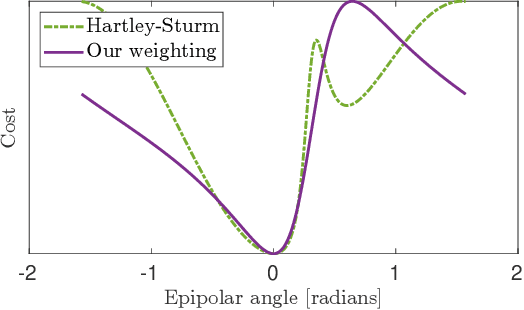
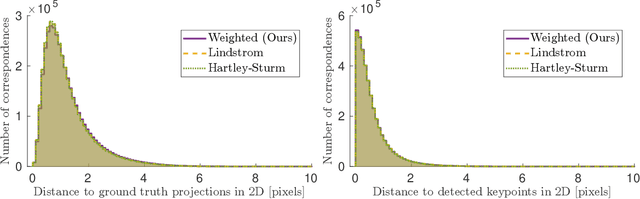
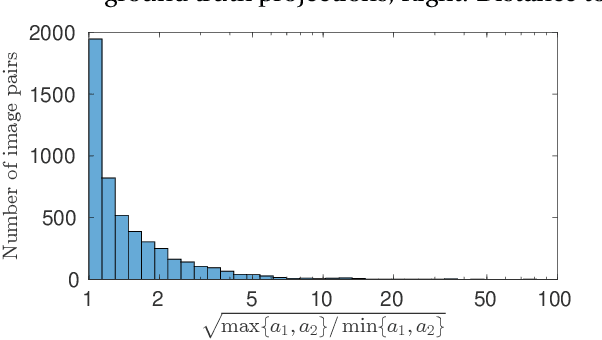
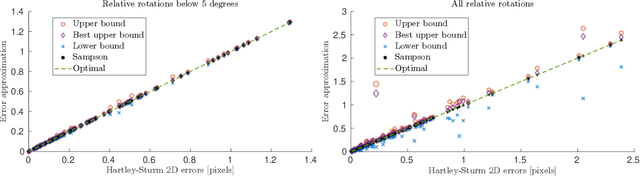
In this paper, we present a new framework for reducing the computational complexity of geometric vision problems through targeted reweighting of the cost functions used to minimize reprojection errors. Triangulation - the task of estimating a 3D point from noisy 2D projections across multiple images - is a fundamental problem in multiview geometry and Structure-from-Motion (SfM) pipelines. We apply our framework to the two-view case and demonstrate that optimal triangulation, which requires solving a univariate polynomial of degree six, can be simplified through cost function reweighting reducing the polynomial degree to two. This reweighting yields a closed-form solution while preserving strong geometric accuracy. We derive optimal weighting strategies, establish theoretical bounds on the approximation error, and provide experimental results on real data demonstrating the effectiveness of the proposed approach compared to standard methods. Although this work focuses on two-view triangulation, the framework generalizes to other geometric vision problems.
DaD: Distilled Reinforcement Learning for Diverse Keypoint Detection
Mar 11, 2025Keypoints are what enable Structure-from-Motion (SfM) systems to scale to thousands of images. However, designing a keypoint detection objective is a non-trivial task, as SfM is non-differentiable. Typically, an auxiliary objective involving a descriptor is optimized. This however induces a dependency on the descriptor, which is undesirable. In this paper we propose a fully self-supervised and descriptor-free objective for keypoint detection, through reinforcement learning. To ensure training does not degenerate, we leverage a balanced top-K sampling strategy. While this already produces competitive models, we find that two qualitatively different types of detectors emerge, which are only able to detect light and dark keypoints respectively. To remedy this, we train a third detector, DaD, that optimizes the Kullback-Leibler divergence of the pointwise maximum of both light and dark detectors. Our approach significantly improve upon SotA across a range of benchmarks. Code and model weights are publicly available at https://github.com/parskatt/dad
Flopping for FLOPs: Leveraging equivariance for computational efficiency
Feb 07, 2025Incorporating geometric invariance into neural networks enhances parameter efficiency but typically increases computational costs. This paper introduces new equivariant neural networks that preserve symmetry while maintaining a comparable number of floating-point operations (FLOPs) per parameter to standard non-equivariant networks. We focus on horizontal mirroring (flopping) invariance, common in many computer vision tasks. The main idea is to parametrize the feature spaces in terms of mirror-symmetric and mirror-antisymmetric features, i.e., irreps of the flopping group. This decomposes the linear layers to be block-diagonal, requiring half the number of FLOPs. Our approach reduces both FLOPs and wall-clock time, providing a practical solution for efficient, scalable symmetry-aware architectures.
Affine steerers for structured keypoint description
Aug 26, 2024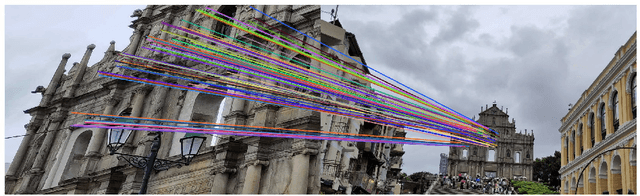
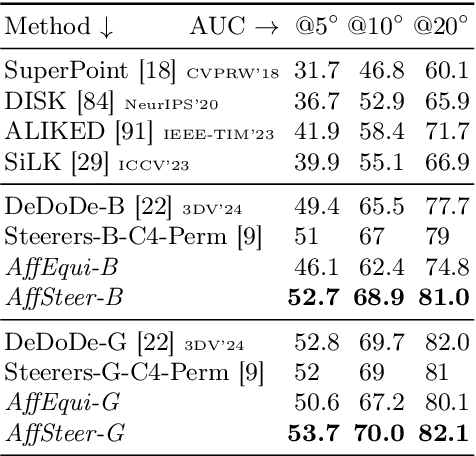
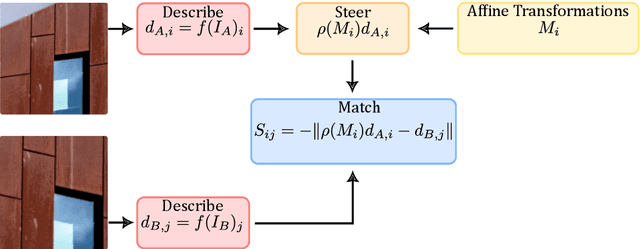
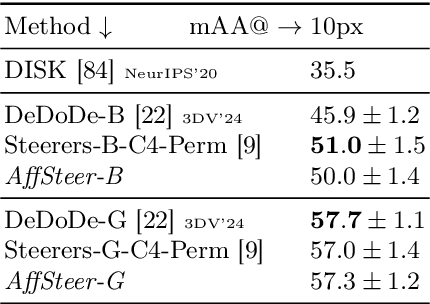
We propose a way to train deep learning based keypoint descriptors that makes them approximately equivariant for locally affine transformations of the image plane. The main idea is to use the representation theory of GL(2) to generalize the recently introduced concept of steerers from rotations to affine transformations. Affine steerers give high control over how keypoint descriptions transform under image transformations. We demonstrate the potential of using this control for image matching. Finally, we propose a way to finetune keypoint descriptors with a set of steerers on upright images and obtain state-of-the-art results on several standard benchmarks. Code will be published at github.com/georg-bn/affine-steerers.
From 2D to 3D: AISG-SLA Visual Localization Challenge
Jul 26, 2024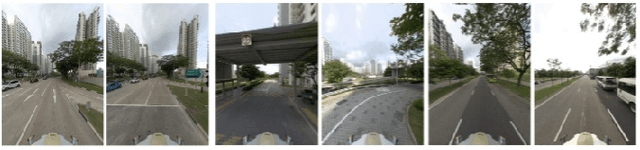
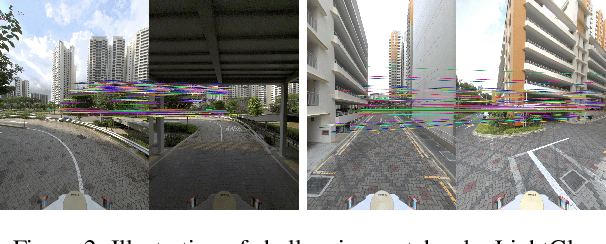

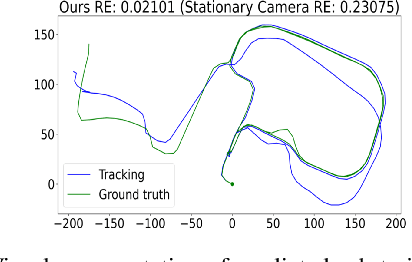
Research in 3D mapping is crucial for smart city applications, yet the cost of acquiring 3D data often hinders progress. Visual localization, particularly monocular camera position estimation, offers a solution by determining the camera's pose solely through visual cues. However, this task is challenging due to limited data from a single camera. To tackle these challenges, we organized the AISG-SLA Visual Localization Challenge (VLC) at IJCAI 2023 to explore how AI can accurately extract camera pose data from 2D images in 3D space. The challenge attracted over 300 participants worldwide, forming 50+ teams. Winning teams achieved high accuracy in pose estimation using images from a car-mounted camera with low frame rates. The VLC dataset is available for research purposes upon request via vlc-dataset@aisingapore.org.