 Add to Chrome
 Add to Firefox
 Add to Edge
Few-Shot 3D Point Cloud Semantic Segmentation
Papers and Code
Rethinking Multimodal Few-Shot 3D Point Cloud Segmentation: From Fused Refinement to Decoupled Arbitration
Jan 04, 2026
In this paper, we revisit multimodal few-shot 3D point cloud semantic segmentation (FS-PCS), identifying a conflict in "Fuse-then-Refine" paradigms: the "Plasticity-Stability Dilemma." In addition, CLIP's inter-class confusion can result in semantic blindness. To address these issues, we present the Decoupled-experts Arbitration Few-Shot SegNet (DA-FSS), a model that effectively distinguishes between semantic and geometric paths and mutually regularizes their gradients to achieve better generalization. DA-FSS employs the same backbone and pre-trained text encoder as MM-FSS to generate text embeddings, which can increase free modalities' utilization rate and better leverage each modality's information space. To achieve this, we propose a Parallel Expert Refinement module to generate each modal correlation. We also propose a Stacked Arbitration Module (SAM) to perform convolutional fusion and arbitrate correlations for each modality pathway. The Parallel Experts decouple two paths: a Geometric Expert maintains plasticity, and a Semantic Expert ensures stability. They are coordinated via a Decoupled Alignment Module (DAM) that transfers knowledge without propagating confusion. Experiments on popular datasets (S3DIS, ScanNet) demonstrate the superiority of DA-FSS over MM-FSS. Meanwhile, geometric boundaries, completeness, and texture differentiation are all superior to the baseline. The code is available at: https://github.com/MoWenQAQ/DA-FSS.

Query-aware Hub Prototype Learning for Few-Shot 3D Point Cloud Semantic Segmentation
Dec 09, 2025Few-shot 3D point cloud semantic segmentation (FS-3DSeg) aims to segment novel classes with only a few labeled samples. However, existing metric-based prototype learning methods generate prototypes solely from the support set, without considering their relevance to query data. This often results in prototype bias, where prototypes overfit support-specific characteristics and fail to generalize to the query distribution, especially in the presence of distribution shifts, which leads to degraded segmentation performance. To address this issue, we propose a novel Query-aware Hub Prototype (QHP) learning method that explicitly models semantic correlations between support and query sets. Specifically, we propose a Hub Prototype Generation (HPG) module that constructs a bipartite graph connecting query and support points, identifies frequently linked support hubs, and generates query-relevant prototypes that better capture cross-set semantics. To further mitigate the influence of bad hubs and ambiguous prototypes near class boundaries, we introduce a Prototype Distribution Optimization (PDO) module, which employs a purity-reweighted contrastive loss to refine prototype representations by pulling bad hubs and outlier prototypes closer to their corresponding class centers. Extensive experiments on S3DIS and ScanNet demonstrate that QHP achieves substantial performance gains over state-of-the-art methods, effectively narrowing the semantic gap between prototypes and query sets in FS-3DSeg.
EPSegFZ: Efficient Point Cloud Semantic Segmentation for Few- and Zero-Shot Scenarios with Language Guidance
Nov 12, 2025Recent approaches for few-shot 3D point cloud semantic segmentation typically require a two-stage learning process, i.e., a pre-training stage followed by a few-shot training stage. While effective, these methods face overreliance on pre-training, which hinders model flexibility and adaptability. Some models tried to avoid pre-training yet failed to capture ample information. In addition, current approaches focus on visual information in the support set and neglect or do not fully exploit other useful data, such as textual annotations. This inadequate utilization of support information impairs the performance of the model and restricts its zero-shot ability. To address these limitations, we present a novel pre-training-free network, named Efficient Point Cloud Semantic Segmentation for Few- and Zero-shot scenarios. Our EPSegFZ incorporates three key components. A Prototype-Enhanced Registers Attention (ProERA) module and a Dual Relative Positional Encoding (DRPE)-based cross-attention mechanism for improved feature extraction and accurate query-prototype correspondence construction without pre-training. A Language-Guided Prototype Embedding (LGPE) module that effectively leverages textual information from the support set to improve few-shot performance and enable zero-shot inference. Extensive experiments show that our method outperforms the state-of-the-art method by 5.68% and 3.82% on the S3DIS and ScanNet benchmarks, respectively.
White Aggregation and Restoration for Few-shot 3D Point Cloud Semantic Segmentation
Sep 17, 2025Few-Shot 3D Point Cloud Segmentation (FS-PCS) aims to predict per-point labels for an unlabeled point cloud, given only a few labeled examples. To extract discriminative representations from the limited support set, existing methods have constructed prototypes using conventional algorithms such as farthest point sampling. However, we point out that its initial randomness significantly affects FS-PCS performance and that the prototype generation process remains underexplored despite its prevalence. This motivates us to investigate an advanced prototype generation method based on attention mechanism. Despite its potential, we found that vanilla module suffers from the distributional gap between learnable prototypical tokens and support features. To overcome this, we propose White Aggregation and Restoration Module (WARM), which resolves the misalignment by sandwiching cross-attention between whitening and coloring transformations. Specifically, whitening aligns the support features to prototypical tokens before attention process, and subsequently coloring restores the original distribution to the attended tokens. This simple yet effective design enables robust attention, thereby generating representative prototypes by capturing the semantic relationships among support features. Our method achieves state-of-the-art performance with a significant margin on multiple FS-PCS benchmarks, demonstrating its effectiveness through extensive experiments.
Few to Big: Prototype Expansion Network via Diffusion Learner for Point Cloud Few-shot Semantic Segmentation
Sep 16, 2025Few-shot 3D point cloud semantic segmentation aims to segment novel categories using a minimal number of annotated support samples. While existing prototype-based methods have shown promise, they are constrained by two critical challenges: (1) Intra-class Diversity, where a prototype's limited representational capacity fails to cover a class's full variations, and (2) Inter-set Inconsistency, where prototypes derived from the support set are misaligned with the query feature space. Motivated by the powerful generative capability of diffusion model, we re-purpose its pre-trained conditional encoder to provide a novel source of generalizable features for expanding the prototype's representational range. Under this setup, we introduce the Prototype Expansion Network (PENet), a framework that constructs big-capacity prototypes from two complementary feature sources. PENet employs a dual-stream learner architecture: it retains a conventional fully supervised Intrinsic Learner (IL) to distill representative features, while introducing a novel Diffusion Learner (DL) to provide rich generalizable features. The resulting dual prototypes are then processed by a Prototype Assimilation Module (PAM), which adopts a novel push-pull cross-guidance attention block to iteratively align the prototypes with the query space. Furthermore, a Prototype Calibration Mechanism (PCM) regularizes the final big capacity prototype to prevent semantic drift. Extensive experiments on the S3DIS and ScanNet datasets demonstrate that PENet significantly outperforms state-of-the-art methods across various few-shot settings.
Multimodality Helps Few-Shot 3D Point Cloud Semantic Segmentation
Oct 29, 2024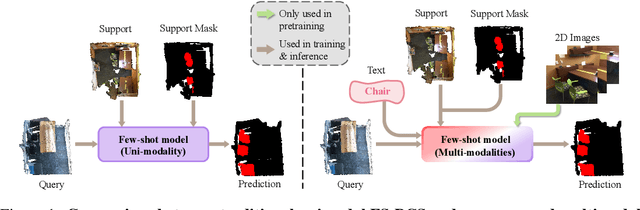
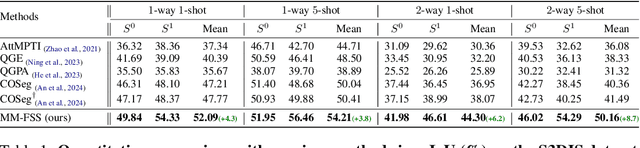
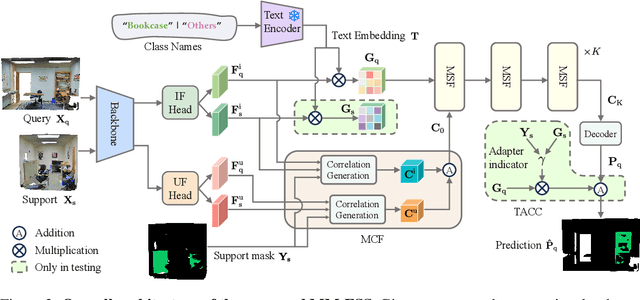
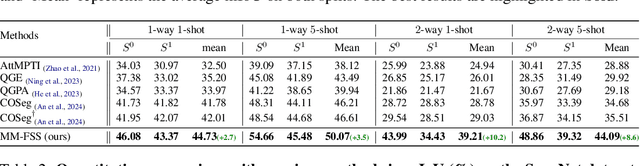
Few-shot 3D point cloud segmentation (FS-PCS) aims at generalizing models to segment novel categories with minimal annotated support samples. While existing FS-PCS methods have shown promise, they primarily focus on unimodal point cloud inputs, overlooking the potential benefits of leveraging multimodal information. In this paper, we address this gap by introducing a cost-free multimodal FS-PCS setup, utilizing textual labels and the potentially available 2D image modality. Under this easy-to-achieve setup, we present the MultiModal Few-Shot SegNet (MM-FSS), a model effectively harnessing complementary information from multiple modalities. MM-FSS employs a shared backbone with two heads to extract intermodal and unimodal visual features, and a pretrained text encoder to generate text embeddings. To fully exploit the multimodal information, we propose a Multimodal Correlation Fusion (MCF) module to generate multimodal correlations, and a Multimodal Semantic Fusion (MSF) module to refine the correlations using text-aware semantic guidance. Additionally, we propose a simple yet effective Test-time Adaptive Cross-modal Calibration (TACC) technique to mitigate training bias, further improving generalization. Experimental results on S3DIS and ScanNet datasets demonstrate significant performance improvements achieved by our method. The efficacy of our approach indicates the benefits of leveraging commonly-ignored free modalities for FS-PCS, providing valuable insights for future research. The code is available at https://github.com/ZhaochongAn/Multimodality-3D-Few-Shot .
Unified Few-shot Crack Segmentation and its Precise 3D Automatic Measurement in Concrete Structures
Jan 15, 2025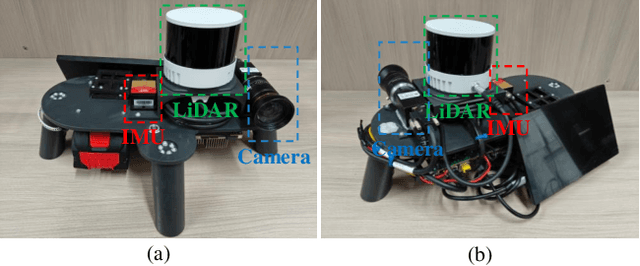
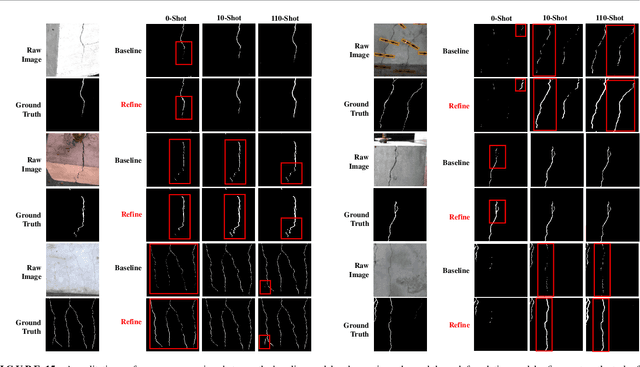
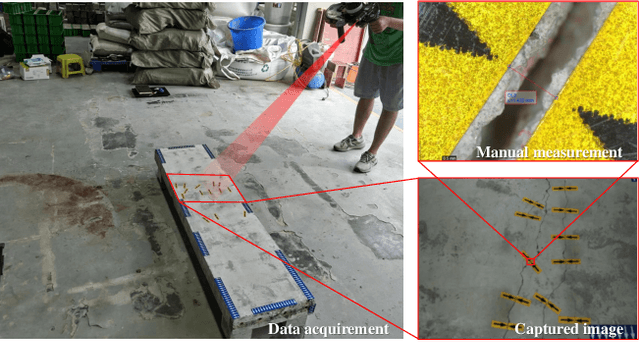
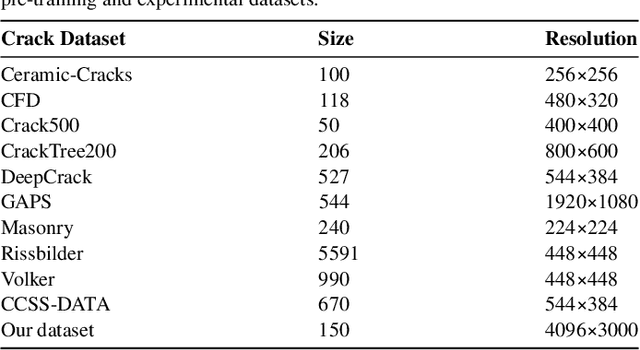
Visual-Spatial Systems has become increasingly essential in concrete crack inspection. However, existing methods often lacks adaptability to diverse scenarios, exhibits limited robustness in image-based approaches, and struggles with curved or complex geometries. To address these limitations, an innovative framework for two-dimensional (2D) crack detection, three-dimensional (3D) reconstruction, and 3D automatic crack measurement was proposed by integrating computer vision technologies and multi-modal Simultaneous localization and mapping (SLAM) in this study. Firstly, building on a base DeepLabv3+ segmentation model, and incorporating specific refinements utilizing foundation model Segment Anything Model (SAM), we developed a crack segmentation method with strong generalization across unfamiliar scenarios, enabling the generation of precise 2D crack masks. To enhance the accuracy and robustness of 3D reconstruction, Light Detection and Ranging (LiDAR) point clouds were utilized together with image data and segmentation masks. By leveraging both image- and LiDAR-SLAM, we developed a multi-frame and multi-modal fusion framework that produces dense, colorized point clouds, effectively capturing crack semantics at a 3D real-world scale. Furthermore, the crack geometric attributions were measured automatically and directly within 3D dense point cloud space, surpassing the limitations of conventional 2D image-based measurements. This advancement makes the method suitable for structural components with curved and complex 3D geometries. Experimental results across various concrete structures highlight the significant improvements and unique advantages of the proposed method, demonstrating its effectiveness, accuracy, and robustness in real-world applications.
Rethinking Few-shot 3D Point Cloud Semantic Segmentation
Mar 01, 2024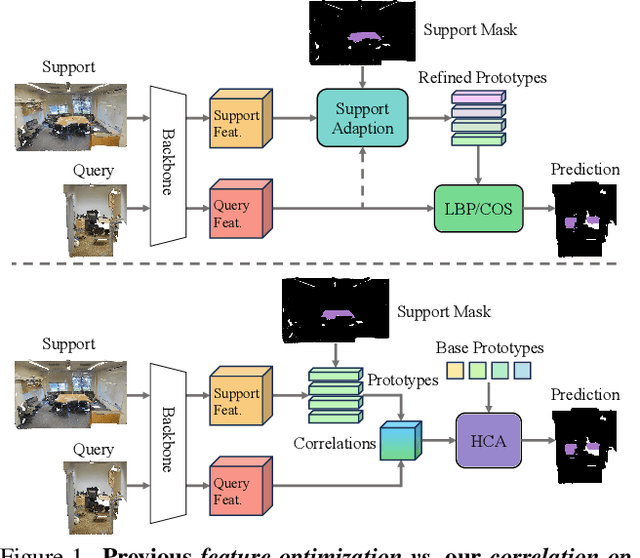


This paper revisits few-shot 3D point cloud semantic segmentation (FS-PCS), with a focus on two significant issues in the state-of-the-art: foreground leakage and sparse point distribution. The former arises from non-uniform point sampling, allowing models to distinguish the density disparities between foreground and background for easier segmentation. The latter results from sampling only 2,048 points, limiting semantic information and deviating from the real-world practice. To address these issues, we introduce a standardized FS-PCS setting, upon which a new benchmark is built. Moreover, we propose a novel FS-PCS model. While previous methods are based on feature optimization by mainly refining support features to enhance prototypes, our method is based on correlation optimization, referred to as Correlation Optimization Segmentation (COSeg). Specifically, we compute Class-specific Multi-prototypical Correlation (CMC) for each query point, representing its correlations to category prototypes. Then, we propose the Hyper Correlation Augmentation (HCA) module to enhance CMC. Furthermore, tackling the inherent property of few-shot training to incur base susceptibility for models, we propose to learn non-parametric prototypes for the base classes during training. The learned base prototypes are used to calibrate correlations for the background class through a Base Prototypes Calibration (BPC) module. Experiments on popular datasets demonstrate the superiority of COSeg over existing methods. The code is available at: https://github.com/ZhaochongAn/COSeg
Image-to-Lidar Relational Distillation for Autonomous Driving Data
Sep 01, 2024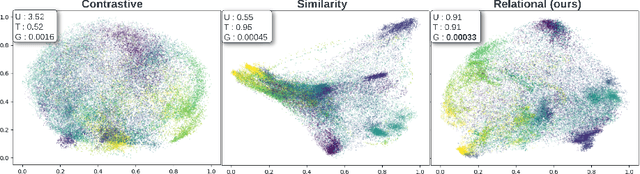
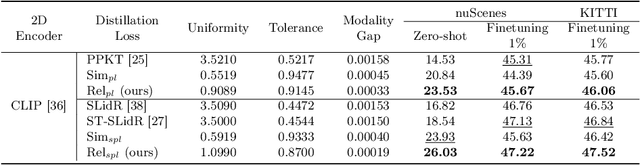


Pre-trained on extensive and diverse multi-modal datasets, 2D foundation models excel at addressing 2D tasks with little or no downstream supervision, owing to their robust representations. The emergence of 2D-to-3D distillation frameworks has extended these capabilities to 3D models. However, distilling 3D representations for autonomous driving datasets presents challenges like self-similarity, class imbalance, and point cloud sparsity, hindering the effectiveness of contrastive distillation, especially in zero-shot learning contexts. Whereas other methodologies, such as similarity-based distillation, enhance zero-shot performance, they tend to yield less discriminative representations, diminishing few-shot performance. We investigate the gap in structure between the 2D and the 3D representations that result from state-of-the-art distillation frameworks and reveal a significant mismatch between the two. Additionally, we demonstrate that the observed structural gap is negatively correlated with the efficacy of the distilled representations on zero-shot and few-shot 3D semantic segmentation. To bridge this gap, we propose a relational distillation framework enforcing intra-modal and cross-modal constraints, resulting in distilled 3D representations that closely capture the structure of the 2D representation. This alignment significantly enhances 3D representation performance over those learned through contrastive distillation in zero-shot segmentation tasks. Furthermore, our relational loss consistently improves the quality of 3D representations in both in-distribution and out-of-distribution few-shot segmentation tasks, outperforming approaches that rely on the similarity loss.
Masked Generative Extractor for Synergistic Representation and 3D Generation of Point Clouds
Jun 25, 2024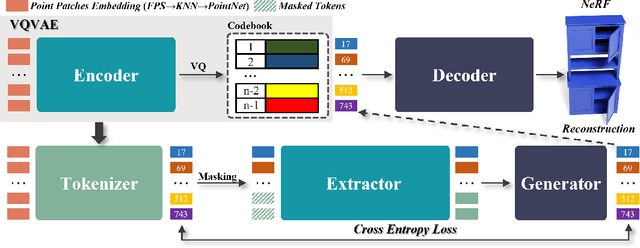
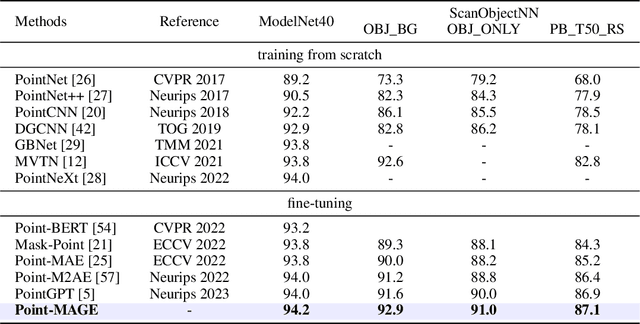
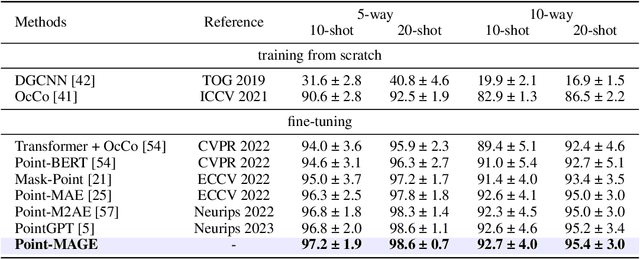
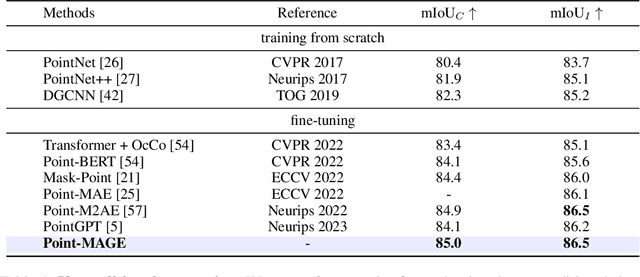
In the field of 2D image generation modeling and representation learning, Masked Generative Encoder (MAGE) has demonstrated the synergistic potential between generative modeling and representation learning. Inspired by this, we propose Point-MAGE to extend this concept to point cloud data. Specifically, this framework first utilizes a Vector Quantized Variational Autoencoder (VQVAE) to reconstruct a neural field representation of 3D shapes, thereby learning discrete semantic features of point patches. Subsequently, by combining the masking model with variable masking ratios, we achieve synchronous training for both generation and representation learning. Furthermore, our framework seamlessly integrates with existing point cloud self-supervised learning (SSL) models, thereby enhancing their performance. We extensively evaluate the representation learning and generation capabilities of Point-MAGE. In shape classification tasks, Point-MAGE achieved an accuracy of 94.2% on the ModelNet40 dataset and 92.9% (+1.3%) on the ScanObjectNN dataset. Additionally, it achieved new state-of-the-art performance in few-shot learning and part segmentation tasks. Experimental results also confirmed that Point-MAGE can generate detailed and high-quality 3D shapes in both unconditional and conditional settings.