 Add to Chrome
 Add to Firefox
 Add to Edge
Beyond Independence: Learning Correlated Views for Variational Incomplete Multi-View Clustering
Aug 16, 2026
Incomplete multi-view clustering (IMVC) aims to uncover shared cluster structures from data with partially observed views. Although recent imputation-free methods based on variational inference demonstrate robustness to missing views, they commonly rely on a conditional independence assumption across views in the posterior aggregation stage, which fails to capture the inherently structured and potentially correlated nature of multi-view data. In this paper, we propose a variational framework that explicitly goes beyond this assumption by introducing a learnable cross-view correlation structure. Specifically, we explicitly model and learn correlations between views by utilizing the covariance structure of posterior estimation errors during aggregation. To facilitate robust and efficient learning, the correlation matrix is parameterized through a normalized Cholesky decomposition, ensuring positive definiteness and enabling the entire model to be trained jointly through a unified variational objective. Extensive experiments on multiple IMVC benchmarks demonstrate that our method consistently outperforms state-of-the-art approaches across diverse missing-view settings while introducing only a negligible number of learnable parameters. These results highlight the effectiveness of adaptive correlation modeling in variational IMVC, demonstrating the need to go beyond the independence assumption in IMVC. The code is available at https://github.com/zmxu196/ACOVA.

Multi-Agent Forensic Reasoning for Generalizable Deepfake Video Detection
Aug 07, 2026The malicious use of generative artificial intelligence to create highly realistic deepfake videos raises serious ethical concerns and poses substantial challenges to AI safety. However, existing deepfake video benchmarks provide limited coverage of recent synthesis methods and generally lack reliable fine-grained textual annotations. Meanwhile, conventional detectors and multimodal large language models (MLLMs), whether operating as a single model or relying on a single analytical perspective, often fail to capture subtle forgery artifacts, limiting their generalization to emerging AI-generated methods. To address these limitations, we introduce FaceVid-Forensics-100K, a large-scale deepfake video dataset comprising 100,000 videos and spanning 33 synthesis methods across face swapping, face reenactment, and entire-face synthesis, including recent generators such as Seedance 2.0. The dataset provides fine-grained textual annotations of visual observations and verdict-consistent forensic explanations, automatically synthesized through a multi-model aggregation and conflict-resolution pipeline powered by advanced MLLMs. Building on this benchmark, we propose a multi-agent forensic reasoning framework that employs four specialized domain-expert agents to independently analyze forgery cues from four perspectives: texture, lighting, motion, and physics. A judge agent then reconciles their reports to produce a final prediction together with an explanation. Extensive evaluations on out-of-domain test sets show that, despite being composed entirely of small open-source MLLMs, our framework outperforms all methods including closed-source GPT and Gemini models and ranks first across all reported metrics on this benchmark. The project page is available at https://xavierjiezou.github.io/ARGUS/.
Progressive Reasoning with Primitive Correction for Compositional Zero-Shot Learning
Jul 07, 2026Compositional Zero-Shot Learning (CZSL) aims to combine known attributes and objects as primitives for recognizing previously unseen attribute-object pairs. Prior works either predict attributes and objects independently, missing their strong contextual dependency, or use unidirectional conditional modeling (e.g., object-guided attribute prediction), which is prone to error propagation. We propose PRPC, a Progressive Reasoning framework with Primitive Correction, which explicitly models the bidirectional dependency between attributes and objects via step-wise inference. PRPC performs mutual correction of primitives to suppress prediction errors in earlier steps. Specifically, we formulate CZSL as structured, Q&A-style Chain-of-Thought reasoning process and constrain the MLLM to follow predefined semantic steps to generate intermediate decisions. To further enhance the reliability and logical consistency of intermediate reasoning, we introduce reinforcement learning post-training with a GRPO-based objective, providing step-level rewards aligned with the progressive inference procedure. Extensive experiments on three CZSL benchmarks demonstrate that PRPC achieves state-of-the-art performance, validating the effectiveness of progressive reasoning and bidirectional correction for robust compositional generalization.
NG-GS: NeRF-Guided 3D Gaussian Splatting Segmentation
Apr 16, 2026Recent advances in 3D Gaussian Splatting (3DGS) have enabled highly efficient and photorealistic novel view synthesis. However, segmenting objects accurately in 3DGS remains challenging due to the discrete nature of Gaussian representations, which often leads to aliasing and artifacts at object boundaries. In this paper, we introduce NG-GS, a novel framework for high-quality object segmentation in 3DGS that explicitly addresses boundary discretization. Our approach begins by automatically identifying ambiguous Gaussians at object boundaries using mask variance analysis. We then apply radial basis function (RBF) interpolation to construct a spatially continuous feature field, enhanced by multi-resolution hash encoding for efficient multi-scale representation. A joint optimization strategy aligns 3DGS with a lightweight NeRF module through alignment and spatial continuity losses, ensuring smooth and consistent segmentation boundaries. Extensive experiments on NVOS, LERF-OVS, and ScanNet benchmarks demonstrate that our method achieves state-of-the-art performance, with significant gains in boundary mIoU. Code is available at https://github.com/BJTU-KD3D/NG-GS.
Toward Stable Semi-Supervised Remote Sensing Segmentation via Co-Guidance and Co-Fusion
Dec 28, 2025Semi-supervised remote sensing (RS) image semantic segmentation offers a promising solution to alleviate the burden of exhaustive annotation, yet it fundamentally struggles with pseudo-label drift, a phenomenon where confirmation bias leads to the accumulation of errors during training. In this work, we propose Co2S, a stable semi-supervised RS segmentation framework that synergistically fuses priors from vision-language models and self-supervised models. Specifically, we construct a heterogeneous dual-student architecture comprising two distinct ViT-based vision foundation models initialized with pretrained CLIP and DINOv3 to mitigate error accumulation and pseudo-label drift. To effectively incorporate these distinct priors, an explicit-implicit semantic co-guidance mechanism is introduced that utilizes text embeddings and learnable queries to provide explicit and implicit class-level guidance, respectively, thereby jointly enhancing semantic consistency. Furthermore, a global-local feature collaborative fusion strategy is developed to effectively fuse the global contextual information captured by CLIP with the local details produced by DINOv3, enabling the model to generate highly precise segmentation results. Extensive experiments on six popular datasets demonstrate the superiority of the proposed method, which consistently achieves leading performance across various partition protocols and diverse scenarios. Project page is available at https://xavierjiezou.github.io/Co2S/.
Query-aware Hub Prototype Learning for Few-Shot 3D Point Cloud Semantic Segmentation
Dec 09, 2025Few-shot 3D point cloud semantic segmentation (FS-3DSeg) aims to segment novel classes with only a few labeled samples. However, existing metric-based prototype learning methods generate prototypes solely from the support set, without considering their relevance to query data. This often results in prototype bias, where prototypes overfit support-specific characteristics and fail to generalize to the query distribution, especially in the presence of distribution shifts, which leads to degraded segmentation performance. To address this issue, we propose a novel Query-aware Hub Prototype (QHP) learning method that explicitly models semantic correlations between support and query sets. Specifically, we propose a Hub Prototype Generation (HPG) module that constructs a bipartite graph connecting query and support points, identifies frequently linked support hubs, and generates query-relevant prototypes that better capture cross-set semantics. To further mitigate the influence of bad hubs and ambiguous prototypes near class boundaries, we introduce a Prototype Distribution Optimization (PDO) module, which employs a purity-reweighted contrastive loss to refine prototype representations by pulling bad hubs and outlier prototypes closer to their corresponding class centers. Extensive experiments on S3DIS and ScanNet demonstrate that QHP achieves substantial performance gains over state-of-the-art methods, effectively narrowing the semantic gap between prototypes and query sets in FS-3DSeg.
Dynamic Dictionary Learning for Remote Sensing Image Segmentation
Mar 09, 2025Remote sensing image segmentation faces persistent challenges in distinguishing morphologically similar categories and adapting to diverse scene variations. While existing methods rely on implicit representation learning paradigms, they often fail to dynamically adjust semantic embeddings according to contextual cues, leading to suboptimal performance in fine-grained scenarios such as cloud thickness differentiation. This work introduces a dynamic dictionary learning framework that explicitly models class ID embeddings through iterative refinement. The core contribution lies in a novel dictionary construction mechanism, where class-aware semantic embeddings are progressively updated via multi-stage alternating cross-attention querying between image features and dictionary embeddings. This process enables adaptive representation learning tailored to input-specific characteristics, effectively resolving ambiguities in intra-class heterogeneity and inter-class homogeneity. To further enhance discriminability, a contrastive constraint is applied to the dictionary space, ensuring compact intra-class distributions while maximizing inter-class separability. Extensive experiments across both coarse- and fine-grained datasets demonstrate consistent improvements over state-of-the-art methods, particularly in two online test benchmarks (LoveDA and UAVid). Code is available at https://anonymous.4open.science/r/D2LS-8267/.
Knowledge Transfer and Domain Adaptation for Fine-Grained Remote Sensing Image Segmentation
Dec 09, 2024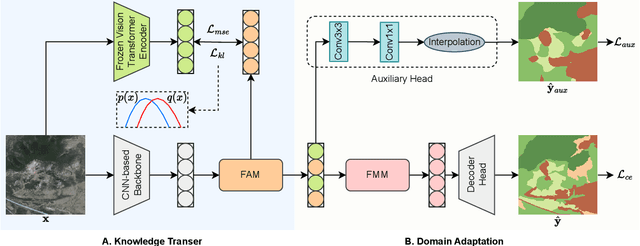
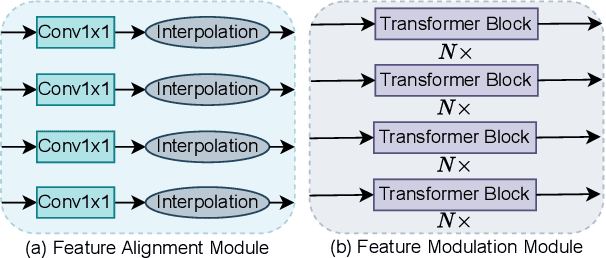
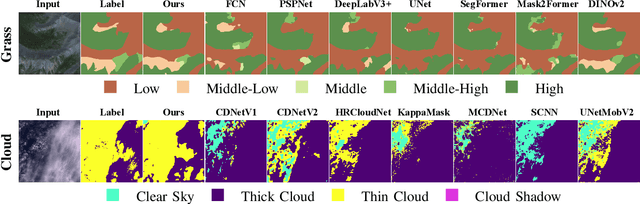
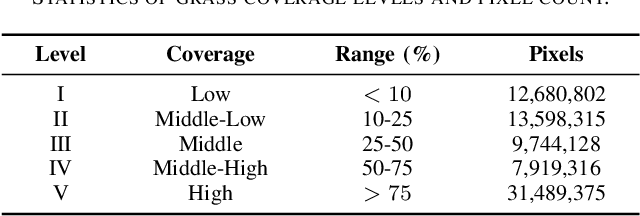
Fine-grained remote sensing image segmentation is essential for accurately identifying detailed objects in remote sensing images. Recently, vision transformer models (VTM) pretrained on large-scale datasets have shown strong zero-shot generalization, indicating that they have learned the general knowledge of object understanding. We introduce a novel end-to-end learning paradigm combining knowledge guidance with domain refinement to enhance performance. We present two key components: the Feature Alignment Module (FAM) and the Feature Modulation Module (FMM). FAM aligns features from a CNN-based backbone with those from the pretrained VTM's encoder using channel transformation and spatial interpolation, and transfers knowledge via KL divergence and L2 normalization constraint. FMM further adapts the knowledge to the specific domain to address domain shift. We also introduce a fine-grained grass segmentation dataset and demonstrate, through experiments on two datasets, that our method achieves a significant improvement of 2.57 mIoU on the grass dataset and 3.73 mIoU on the cloud dataset. The results highlight the potential of combining knowledge transfer and domain adaptation to overcome domain-related challenges and data limitations. The project page is available at https://xavierjiezou.github.io/KTDA/.
Adapting Vision Foundation Models for Robust Cloud Segmentation in Remote Sensing Images
Nov 20, 2024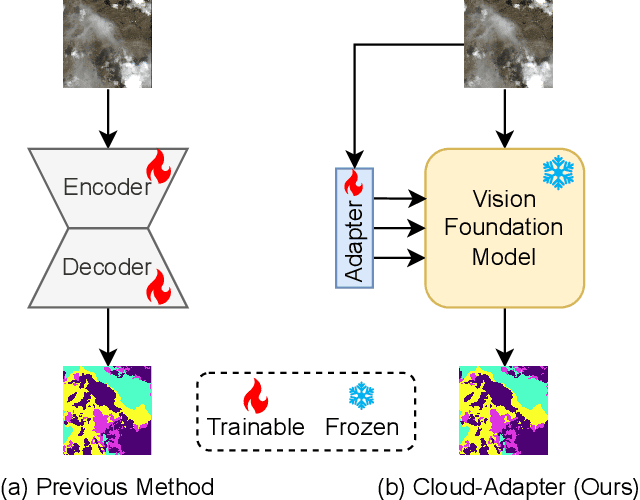
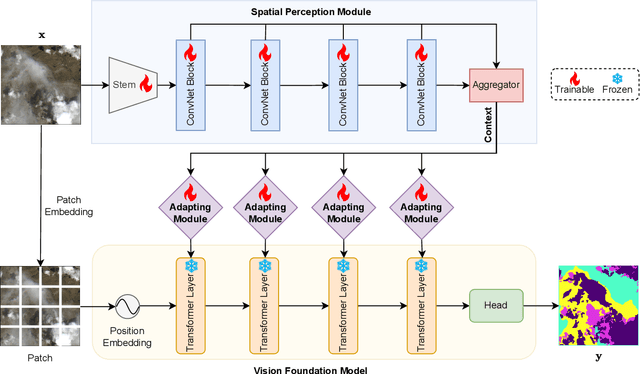
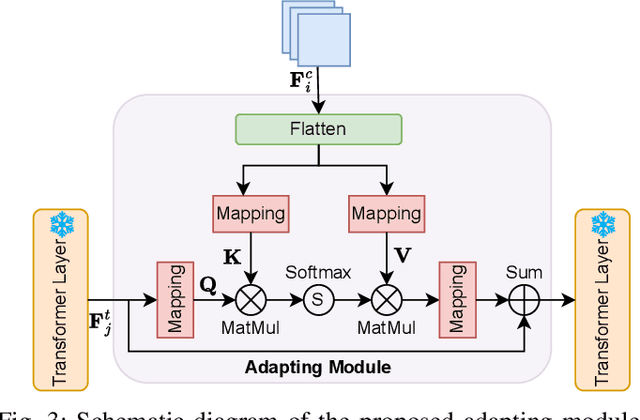
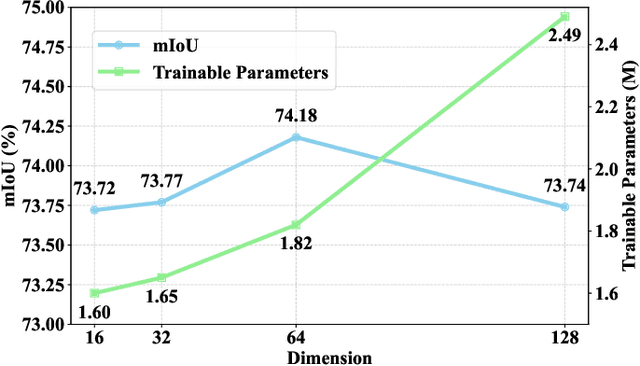
Cloud segmentation is a critical challenge in remote sensing image interpretation, as its accuracy directly impacts the effectiveness of subsequent data processing and analysis. Recently, vision foundation models (VFM) have demonstrated powerful generalization capabilities across various visual tasks. In this paper, we present a parameter-efficient adaptive approach, termed Cloud-Adapter, designed to enhance the accuracy and robustness of cloud segmentation. Our method leverages a VFM pretrained on general domain data, which remains frozen, eliminating the need for additional training. Cloud-Adapter incorporates a lightweight spatial perception module that initially utilizes a convolutional neural network (ConvNet) to extract dense spatial representations. These multi-scale features are then aggregated and serve as contextual inputs to an adapting module, which modulates the frozen transformer layers within the VFM. Experimental results demonstrate that the Cloud-Adapter approach, utilizing only 0.6% of the trainable parameters of the frozen backbone, achieves substantial performance gains. Cloud-Adapter consistently attains state-of-the-art (SOTA) performance across a wide variety of cloud segmentation datasets from multiple satellite sources, sensor series, data processing levels, land cover scenarios, and annotation granularities. We have released the source code and pretrained models at https://github.com/XavierJiezou/Cloud-Adapter to support further research.
GrassNet: State Space Model Meets Graph Neural Network
Aug 16, 2024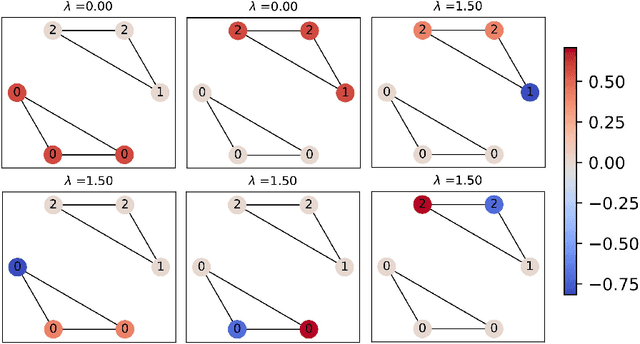
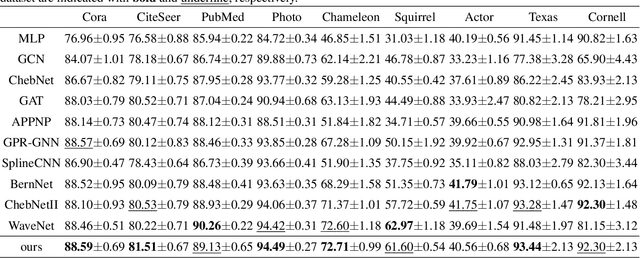
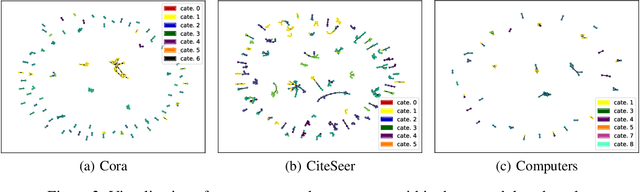
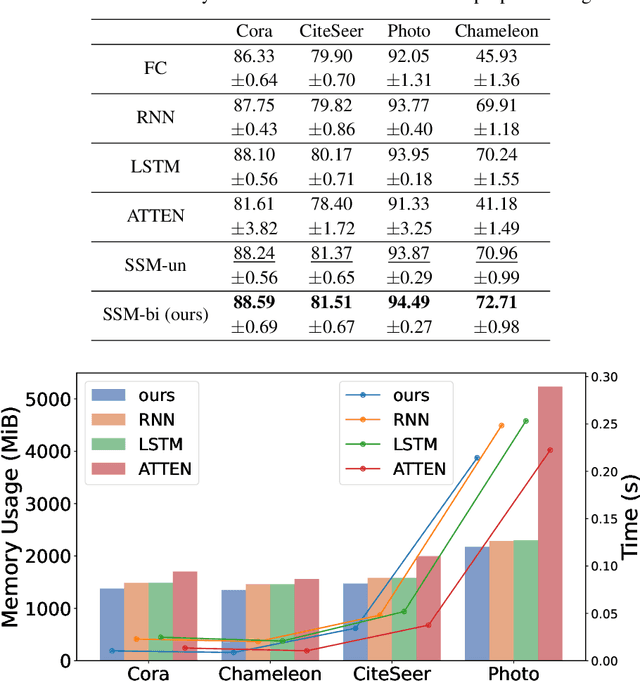
Designing spectral convolutional networks is a formidable task in graph learning. In traditional spectral graph neural networks (GNNs), polynomial-based methods are commonly used to design filters via the Laplacian matrix. In practical applications, however, these polynomial methods encounter inherent limitations, which primarily arise from the the low-order truncation of polynomial filters and the lack of overall modeling of the graph spectrum. This leads to poor performance of existing spectral approaches on real-world graph data, especially when the spectrum is highly concentrated or contains many numerically identical values, as they tend to apply the exact same modulation to signals with the same frequencies. To overcome these issues, in this paper, we propose Graph State Space Network (GrassNet), a novel graph neural network with theoretical support that provides a simple yet effective scheme for designing and learning arbitrary graph spectral filters. In particular, our GrassNet introduces structured state space models (SSMs) to model the correlations of graph signals at different frequencies and derives a unique rectification for each frequency in the graph spectrum. To the best of our knowledge, our work is the first to employ SSMs for the design of GNN spectral filters, and it theoretically offers greater expressive power compared with polynomial filters. Extensive experiments on nine public benchmarks reveal that GrassNet achieves superior performance in real-world graph modeling tasks.