 Add to Chrome
 Add to Firefox
 Add to Edge
Does RAG Know When Retrieval Is Wrong? Diagnosing Context Compliance under Knowledge Conflict
May 14, 2026
The Context-Compliance Regime in Retrieval-Augmented Generation (RAG) occurs when retrieved context dominates the final answer even when it conflicts with the model's parametric knowledge. Accuracy alone does not reveal how retrieved context causally shapes answers under such conflict. We introduce Context-Driven Decomposition (CDD), a belief-decomposition probe that operates at inference time and serves as an intervention mechanism for controlled retrieval conflict. Across Epi-Scale stress tests, TruthfulQA misconception injection, and cross- model reruns, CDD exposes three patterns. P1: context compliance is measurable in an upper-bound adversarial setting, where Standard RAG reaches 15.0% accuracy on TruthfulQA misconception injection (N=500). P2: adversarial accuracy gains transfer across model families: CDD improves accuracy on Gemini-2.5-Flash and on Claude Haiku/Sonnet/Opus, but rationale-answer causal coupling does not transfer. CDD reaches 64.1% mistake- injection causal sensitivity on Gemini-2.5-Flash, while sensitivities for all three Claude variants fall in the [-3%, +7%] range, suggesting that the Claude-side accuracy gains operate through a mechanism distinct from the explicit conflict-resolution trace. P3: explicit conflict decomposition improves robustness under temporal drift and noisy distractors, with CDD reaching 71.3% on temporal shifts and 69.9% on distractor evidence on the full Epi-Scale adversarial benchmark. These three patterns identify context-compliance as a structural axis along which standard RAG can be probed and intervened on, distinct from retrieval-quality or single-method robustness questions, and motivate releasing Epi-Scale for systematic study across model families and retrieval pipelines.

Optimizing Server Placement for Vertical Federated Learning in Dynamic Edge/Fog Networks
May 10, 2026We investigate the control and optimization of vertical federated learning (VFL), a class of distributed machine learning (ML) methods in which edge/fog devices contain separate data features, in dynamic edge/fog networks. Owing to heterogeneous data features and hardware across edge/fog networks, devices' contributions to VFL vary substantially, and, moreover, dynamic edge/fog networks can lead to the permanent exit or entry of select data features. In this setting, our proposed methodology, server controlled VFL in dynamic networks (SC-DN), first establishes the existence of a global first-order stationary point for every global round, and then leverages this result to jointly optimize ML model training and resource consumption based on four key control variables: (i) server placement, (ii) device-to-server transmit power, (iii) local device processor frequency, and (iv) local training iterations per global round. The resulting optimization formulation contains coupled variables as well as numerous forms of logarithmic constraints which we show is a mixed-integer signomial program, an NP-hard problem, and for which we develop a general solver. Finally, via experiments on both image and multi-modal datasets, we show that our methodology demonstrates superior classification/regression performance and resource consumption savings than even greedy methodologies.
DP-DeGauss: Dynamic Probabilistic Gaussian Decomposition for Egocentric 4D Scene Reconstruction
Apr 09, 2026Egocentric video is crucial for next-generation 4D scene reconstruction, with applications in AR/VR and embodied AI. However, reconstructing dynamic first-person scenes is challenging due to complex ego-motion, occlusions, and hand-object interactions. Existing decomposition methods are ill-suited, assuming fixed viewpoints or merging dynamics into a single foreground. To address these limitations, we introduce DP-DeGauss, a dynamic probabilistic Gaussian decomposition framework for egocentric 4D reconstruction. Our method initializes a unified 3D Gaussian set from COLMAP priors, augments each with a learnable category probability, and dynamically routes them into specialized deformation branches for background, hands, or object modeling. We employ category-specific masks for better disentanglement and introduce brightness and motion-flow control to improve static rendering and dynamic reconstruction. Extensive experiments show that DP-DeGauss outperforms baselines by +1.70dB in PSNR on average with SSIM and LPIPS gains. More importantly, our framework achieves the first and state-of-the-art disentanglement of background, hand, and object components, enabling explicit, fine-grained separation, paving the way for more intuitive ego scene understanding and editing.
Unified Few-shot Crack Segmentation and its Precise 3D Automatic Measurement in Concrete Structures
Jan 15, 2025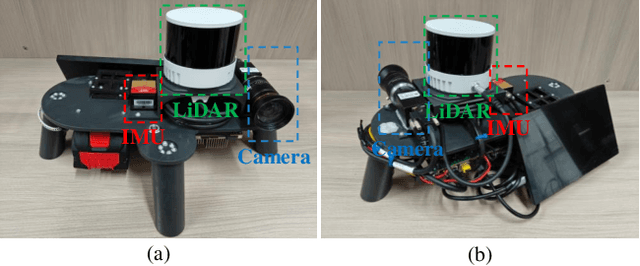
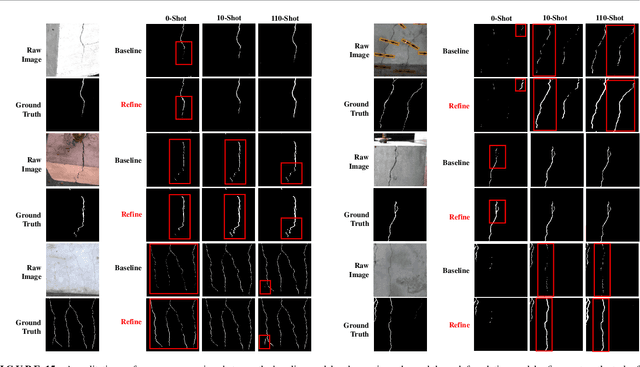
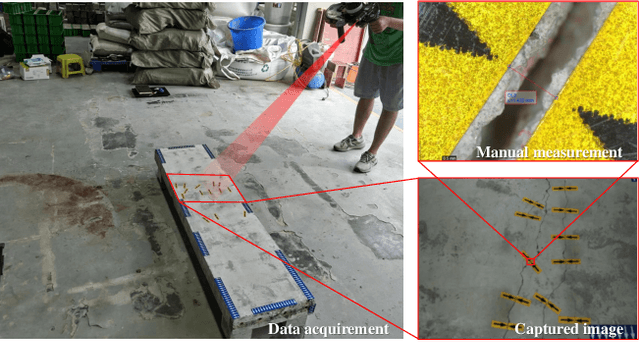
Visual-Spatial Systems has become increasingly essential in concrete crack inspection. However, existing methods often lacks adaptability to diverse scenarios, exhibits limited robustness in image-based approaches, and struggles with curved or complex geometries. To address these limitations, an innovative framework for two-dimensional (2D) crack detection, three-dimensional (3D) reconstruction, and 3D automatic crack measurement was proposed by integrating computer vision technologies and multi-modal Simultaneous localization and mapping (SLAM) in this study. Firstly, building on a base DeepLabv3+ segmentation model, and incorporating specific refinements utilizing foundation model Segment Anything Model (SAM), we developed a crack segmentation method with strong generalization across unfamiliar scenarios, enabling the generation of precise 2D crack masks. To enhance the accuracy and robustness of 3D reconstruction, Light Detection and Ranging (LiDAR) point clouds were utilized together with image data and segmentation masks. By leveraging both image- and LiDAR-SLAM, we developed a multi-frame and multi-modal fusion framework that produces dense, colorized point clouds, effectively capturing crack semantics at a 3D real-world scale. Furthermore, the crack geometric attributions were measured automatically and directly within 3D dense point cloud space, surpassing the limitations of conventional 2D image-based measurements. This advancement makes the method suitable for structural components with curved and complex 3D geometries. Experimental results across various concrete structures highlight the significant improvements and unique advantages of the proposed method, demonstrating its effectiveness, accuracy, and robustness in real-world applications.
Decentralized Federated Learning with Gradient Tracking over Time-Varying Directed Networks
Sep 25, 2024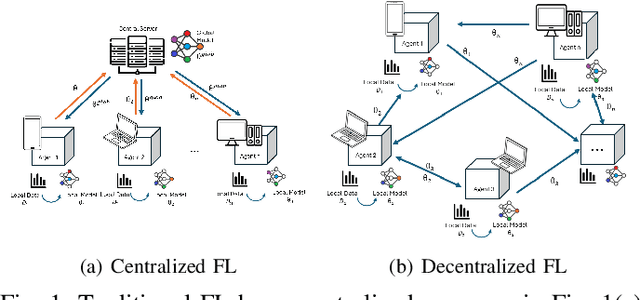
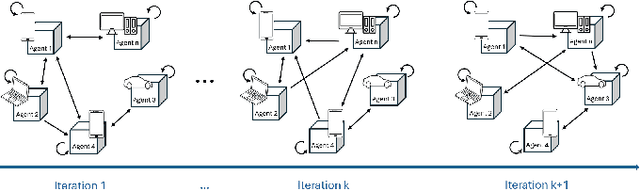
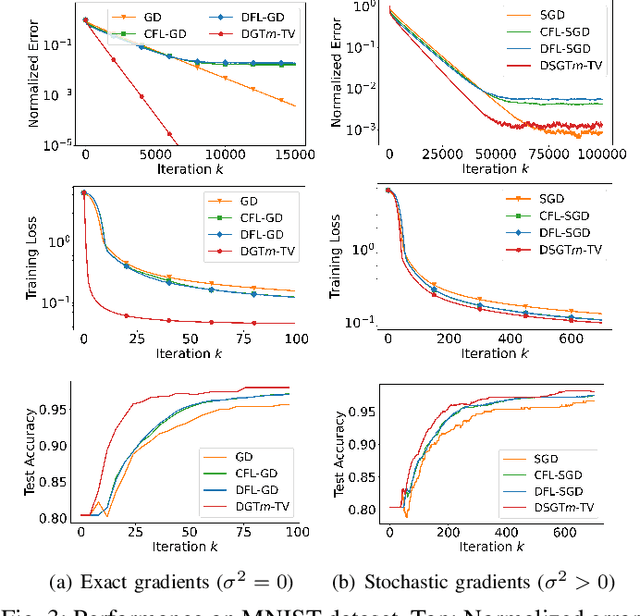
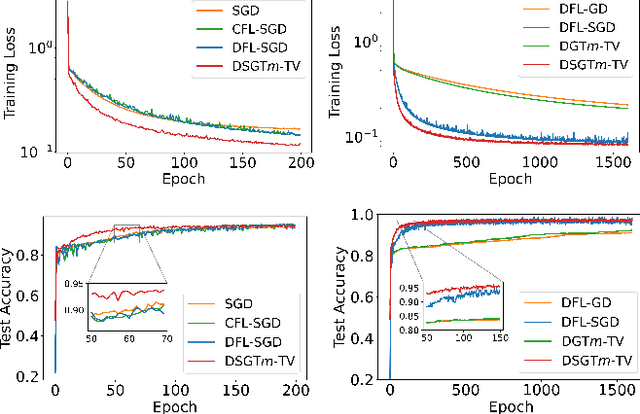
We investigate the problem of agent-to-agent interaction in decentralized (federated) learning over time-varying directed graphs, and, in doing so, propose a consensus-based algorithm called DSGTm-TV. The proposed algorithm incorporates gradient tracking and heavy-ball momentum to distributively optimize a global objective function, while preserving local data privacy. Under DSGTm-TV, agents will update local model parameters and gradient estimates using information exchange with neighboring agents enabled through row- and column-stochastic mixing matrices, which we show guarantee both consensus and optimality. Our analysis establishes that DSGTm-TV exhibits linear convergence to the exact global optimum when exact gradient information is available, and converges in expectation to a neighborhood of the global optimum when employing stochastic gradients. Moreover, in contrast to existing methods, DSGTm-TV preserves convergence for networks with uncoordinated stepsizes and momentum parameters, for which we provide explicit bounds. These results enable agents to operate in a fully decentralized manner, independently optimizing their local hyper-parameters. We demonstrate the efficacy of our approach via comparisons with state-of-the-art baselines on real-world image classification and natural language processing tasks.
Imagen 3
Aug 13, 2024We introduce Imagen 3, a latent diffusion model that generates high quality images from text prompts. We describe our quality and responsibility evaluations. Imagen 3 is preferred over other state-of-the-art (SOTA) models at the time of evaluation. In addition, we discuss issues around safety and representation, as well as methods we used to minimize the potential harm of our models.
Evaluating Numerical Reasoning in Text-to-Image Models
Jun 20, 2024


Text-to-image generative models are capable of producing high-quality images that often faithfully depict concepts described using natural language. In this work, we comprehensively evaluate a range of text-to-image models on numerical reasoning tasks of varying difficulty, and show that even the most advanced models have only rudimentary numerical skills. Specifically, their ability to correctly generate an exact number of objects in an image is limited to small numbers, it is highly dependent on the context the number term appears in, and it deteriorates quickly with each successive number. We also demonstrate that models have poor understanding of linguistic quantifiers (such as "a few" or "as many as"), the concept of zero, and struggle with more advanced concepts such as partial quantities and fractional representations. We bundle prompts, generated images and human annotations into GeckoNum, a novel benchmark for evaluation of numerical reasoning.
Greedy Growing Enables High-Resolution Pixel-Based Diffusion Models
May 27, 2024


We address the long-standing problem of how to learn effective pixel-based image diffusion models at scale, introducing a remarkably simple greedy growing method for stable training of large-scale, high-resolution models. without the needs for cascaded super-resolution components. The key insight stems from careful pre-training of core components, namely, those responsible for text-to-image alignment {\it vs.} high-resolution rendering. We first demonstrate the benefits of scaling a {\it Shallow UNet}, with no down(up)-sampling enc(dec)oder. Scaling its deep core layers is shown to improve alignment, object structure, and composition. Building on this core model, we propose a greedy algorithm that grows the architecture into high-resolution end-to-end models, while preserving the integrity of the pre-trained representation, stabilizing training, and reducing the need for large high-resolution datasets. This enables a single stage model capable of generating high-resolution images without the need of a super-resolution cascade. Our key results rely on public datasets and show that we are able to train non-cascaded models up to 8B parameters with no further regularization schemes. Vermeer, our full pipeline model trained with internal datasets to produce 1024x1024 images, without cascades, is preferred by 44.0% vs. 21.4% human evaluators over SDXL.
DOCCI: Descriptions of Connected and Contrasting Images
Apr 30, 2024

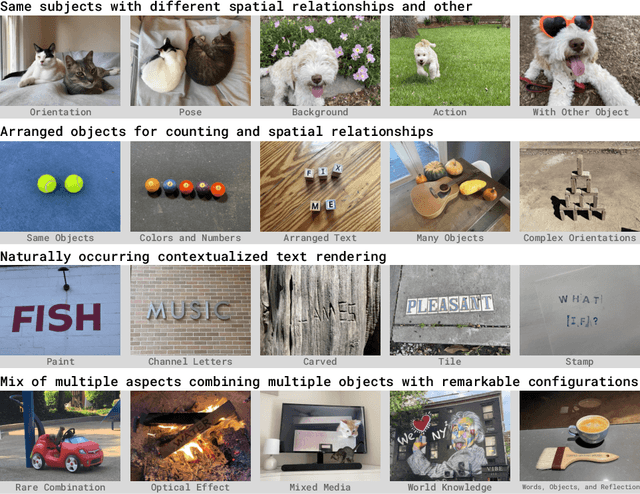

Vision-language datasets are vital for both text-to-image (T2I) and image-to-text (I2T) research. However, current datasets lack descriptions with fine-grained detail that would allow for richer associations to be learned by models. To fill the gap, we introduce Descriptions of Connected and Contrasting Images (DOCCI), a dataset with long, human-annotated English descriptions for 15k images that were taken, curated and donated by a single researcher intent on capturing key challenges such as spatial relations, counting, text rendering, world knowledge, and more. We instruct human annotators to create comprehensive descriptions for each image; these average 136 words in length and are crafted to clearly distinguish each image from those that are related or similar. Each description is highly compositional and typically encompasses multiple challenges. Through both quantitative and qualitative analyses, we demonstrate that DOCCI serves as an effective training resource for image-to-text generation -- a PaLI 5B model finetuned on DOCCI shows equal or superior results compared to highly-performant larger models like LLaVA-1.5 7B and InstructBLIP 7B. Furthermore, we show that DOCCI is a useful testbed for text-to-image generation, highlighting the limitations of current text-to-image models in capturing long descriptions and fine details.
Revisiting Text-to-Image Evaluation with Gecko: On Metrics, Prompts, and Human Ratings
Apr 25, 2024While text-to-image (T2I) generative models have become ubiquitous, they do not necessarily generate images that align with a given prompt. While previous work has evaluated T2I alignment by proposing metrics, benchmarks, and templates for collecting human judgements, the quality of these components is not systematically measured. Human-rated prompt sets are generally small and the reliability of the ratings -- and thereby the prompt set used to compare models -- is not evaluated. We address this gap by performing an extensive study evaluating auto-eval metrics and human templates. We provide three main contributions: (1) We introduce a comprehensive skills-based benchmark that can discriminate models across different human templates. This skills-based benchmark categorises prompts into sub-skills, allowing a practitioner to pinpoint not only which skills are challenging, but at what level of complexity a skill becomes challenging. (2) We gather human ratings across four templates and four T2I models for a total of >100K annotations. This allows us to understand where differences arise due to inherent ambiguity in the prompt and where they arise due to differences in metric and model quality. (3) Finally, we introduce a new QA-based auto-eval metric that is better correlated with human ratings than existing metrics for our new dataset, across different human templates, and on TIFA160.