 Add to Chrome
 Add to Firefox
 Add to Edge
Few Shot Video Object Detection
Papers and Code
SMc2f: Robust Scenario Mining for Robotic Autonomy from Coarse to Fine
Jan 17, 2026
The safety validation of autonomous robotic vehicles hinges on systematically testing their planning and control stacks against rare, safety-critical scenarios. Mining these long-tail events from massive real-world driving logs is therefore a critical step in the robotic development lifecycle. The goal of the Scenario Mining task is to retrieve useful information to enable targeted re-simulation, regression testing, and failure analysis of the robot's decision-making algorithms. RefAV, introduced by the Argoverse team, is an end-to-end framework that uses large language models (LLMs) to spatially and temporally localize scenarios described in natural language. However, this process performs retrieval on trajectory labels, ignoring the direct connection between natural language and raw RGB images, which runs counter to the intuition of video retrieval; it also depends on the quality of upstream 3D object detection and tracking. Further, inaccuracies in trajectory data lead to inaccuracies in downstream spatial and temporal localization. To address these issues, we propose Robust Scenario Mining for Robotic Autonomy from Coarse to Fine (SMc2f), a coarse-to-fine pipeline that employs vision-language models (VLMs) for coarse image-text filtering, builds a database of successful mining cases on top of RefAV and automatically retrieves exemplars to few-shot condition the LLM for more robust retrieval, and introduces text-trajectory contrastive learning to pull matched pairs together and push mismatched pairs apart in a shared embedding space, yielding a fine-grained matcher that refines the LLM's candidate trajectories. Experiments on public datasets demonstrate substantial gains in both retrieval quality and efficiency.

FMVP: Masked Flow Matching for Adversarial Video Purification
Jan 05, 2026Video recognition models remain vulnerable to adversarial attacks, while existing diffusion-based purification methods suffer from inefficient sampling and curved trajectories. Directly regressing clean videos from adversarial inputs often fails to recover faithful content due to the subtle nature of perturbations; this necessitates physically shattering the adversarial structure. Therefore, we propose Flow Matching for Adversarial Video Purification FMVP. FMVP physically shatters global adversarial structures via a masking strategy and reconstructs clean video dynamics using Conditional Flow Matching (CFM) with an inpainting objective. To further decouple semantic content from adversarial noise, we design a Frequency-Gated Loss (FGL) that explicitly suppresses high-frequency adversarial residuals while preserving low-frequency fidelity. We design Attack-Aware and Generalist training paradigms to handle known and unknown threats, respectively. Extensive experiments on UCF-101 and HMDB-51 demonstrate that FMVP outperforms state-of-the-art methods (DiffPure, Defense Patterns (DP), Temporal Shuffling (TS) and FlowPure), achieving robust accuracy exceeding 87% against PGD and 89% against CW attacks. Furthermore, FMVP demonstrates superior robustness against adaptive attacks (DiffHammer) and functions as a zero-shot adversarial detector, attaining detection accuracies of 98% for PGD and 79% for highly imperceptible CW attacks.
Pushing the Frontier of Audiovisual Perception with Large-Scale Multimodal Correspondence Learning
Dec 22, 2025We introduce Perception Encoder Audiovisual, PE-AV, a new family of encoders for audio and video understanding trained with scaled contrastive learning. Built on PE, PE-AV makes several key contributions to extend representations to audio, and natively support joint embeddings across audio-video, audio-text, and video-text modalities. PE-AV's unified cross-modal embeddings enable novel tasks such as speech retrieval, and set a new state of the art across standard audio and video benchmarks. We unlock this by building a strong audiovisual data engine that synthesizes high-quality captions for O(100M) audio-video pairs, enabling large-scale supervision consistent across modalities. Our audio data includes speech, music, and general sound effects-avoiding single-domain limitations common in prior work. We exploit ten pairwise contrastive objectives, showing that scaling cross-modality and caption-type pairs strengthens alignment and improves zero-shot performance. We further develop PE-A-Frame by fine-tuning PE-AV with frame-level contrastive objectives, enabling fine-grained audio-frame-to-text alignment for tasks such as sound event detection.
Temporal Object-Aware Vision Transformer for Few-Shot Video Object Detection
Nov 16, 2025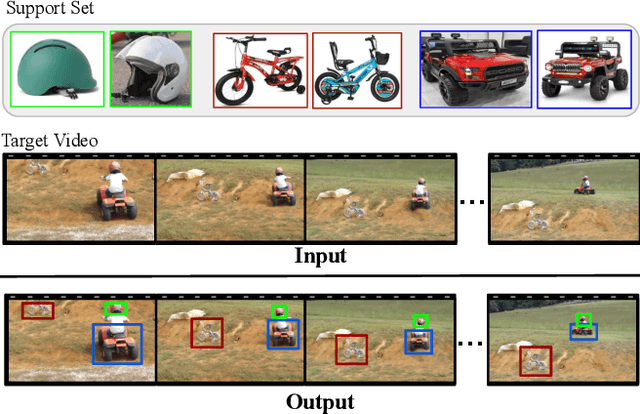
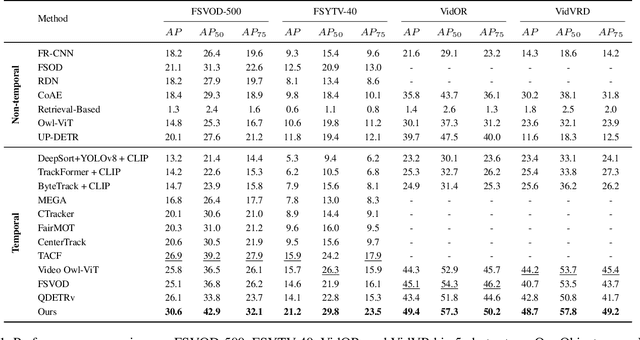
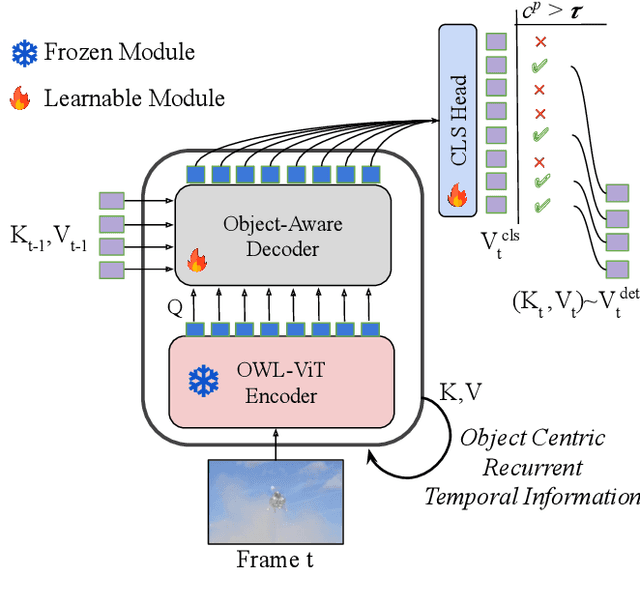
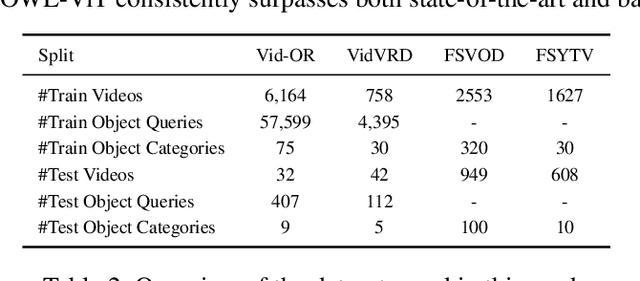
Few-shot Video Object Detection (FSVOD) addresses the challenge of detecting novel objects in videos with limited labeled examples, overcoming the constraints of traditional detection methods that require extensive training data. This task presents key challenges, including maintaining temporal consistency across frames affected by occlusion and appearance variations, and achieving novel object generalization without relying on complex region proposals, which are often computationally expensive and require task-specific training. Our novel object-aware temporal modeling approach addresses these challenges by incorporating a filtering mechanism that selectively propagates high-confidence object features across frames. This enables efficient feature progression, reduces noise accumulation, and enhances detection accuracy in a few-shot setting. By utilizing few-shot trained detection and classification heads with focused feature propagation, we achieve robust temporal consistency without depending on explicit object tube proposals. Our approach achieves performance gains, with AP improvements of 3.7% (FSVOD-500), 5.3% (FSYTV-40), 4.3% (VidOR), and 4.5 (VidVRD) in the 5-shot setting. Further results demonstrate improvements in 1-shot, 3-shot, and 10-shot configurations. We make the code public at: https://github.com/yogesh-iitj/fs-video-vit
Segment Anything Across Shots: A Method and Benchmark
Nov 17, 2025This work focuses on multi-shot semi-supervised video object segmentation (MVOS), which aims at segmenting the target object indicated by an initial mask throughout a video with multiple shots. The existing VOS methods mainly focus on single-shot videos and struggle with shot discontinuities, thereby limiting their real-world applicability. We propose a transition mimicking data augmentation strategy (TMA) which enables cross-shot generalization with single-shot data to alleviate the severe annotated multi-shot data sparsity, and the Segment Anything Across Shots (SAAS) model, which can detect and comprehend shot transitions effectively. To support evaluation and future study in MVOS, we introduce Cut-VOS, a new MVOS benchmark with dense mask annotations, diverse object categories, and high-frequency transitions. Extensive experiments on YouMVOS and Cut-VOS demonstrate that the proposed SAAS achieves state-of-the-art performance by effectively mimicking, understanding, and segmenting across complex transitions. The code and datasets are released at https://henghuiding.com/SAAS/.
Few-Shot Learning in Video and 3D Object Detection: A Survey
Jul 22, 2025Few-shot learning (FSL) enables object detection models to recognize novel classes given only a few annotated examples, thereby reducing expensive manual data labeling. This survey examines recent FSL advances for video and 3D object detection. For video, FSL is especially valuable since annotating objects across frames is more laborious than for static images. By propagating information across frames, techniques like tube proposals and temporal matching networks can detect new classes from a couple examples, efficiently leveraging spatiotemporal structure. FSL for 3D detection from LiDAR or depth data faces challenges like sparsity and lack of texture. Solutions integrate FSL with specialized point cloud networks and losses tailored for class imbalance. Few-shot 3D detection enables practical autonomous driving deployment by minimizing costly 3D annotation needs. Core issues in both domains include balancing generalization and overfitting, integrating prototype matching, and handling data modality properties. In summary, FSL shows promise for reducing annotation requirements and enabling real-world video, 3D, and other applications by efficiently leveraging information across feature, temporal, and data modalities. By comprehensively surveying recent advancements, this paper illuminates FSL's potential to minimize supervision needs and enable deployment across video, 3D, and other real-world applications.
EgoLoc: A Generalizable Solution for Temporal Interaction Localization in Egocentric Videos
Aug 17, 2025Analyzing hand-object interaction in egocentric vision facilitates VR/AR applications and human-robot policy transfer. Existing research has mostly focused on modeling the behavior paradigm of interactive actions (i.e., ``how to interact''). However, the more challenging and fine-grained problem of capturing the critical moments of contact and separation between the hand and the target object (i.e., ``when to interact'') is still underexplored, which is crucial for immersive interactive experiences in mixed reality and robotic motion planning. Therefore, we formulate this problem as temporal interaction localization (TIL). Some recent works extract semantic masks as TIL references, but suffer from inaccurate object grounding and cluttered scenarios. Although current temporal action localization (TAL) methods perform well in detecting verb-noun action segments, they rely on category annotations during training and exhibit limited precision in localizing hand-object contact/separation moments. To address these issues, we propose a novel zero-shot approach dubbed EgoLoc to localize hand-object contact and separation timestamps in egocentric videos. EgoLoc introduces hand-dynamics-guided sampling to generate high-quality visual prompts. It exploits the vision-language model to identify contact/separation attributes, localize specific timestamps, and provide closed-loop feedback for further refinement. EgoLoc eliminates the need for object masks and verb-noun taxonomies, leading to generalizable zero-shot implementation. Comprehensive experiments on the public dataset and our novel benchmarks demonstrate that EgoLoc achieves plausible TIL for egocentric videos. It is also validated to effectively facilitate multiple downstream applications in egocentric vision and robotic manipulation tasks. Code and relevant data will be released at https://github.com/IRMVLab/EgoLoc.
JVLGS: Joint Vision-Language Gas Leak Segmentation
Aug 27, 2025Gas leaks pose serious threats to human health and contribute significantly to atmospheric pollution, drawing increasing public concern. However, the lack of effective detection methods hampers timely and accurate identification of gas leaks. While some vision-based techniques leverage infrared videos for leak detection, the blurry and non-rigid nature of gas clouds often limits their effectiveness. To address these challenges, we propose a novel framework called Joint Vision-Language Gas leak Segmentation (JVLGS), which integrates the complementary strengths of visual and textual modalities to enhance gas leak representation and segmentation. Recognizing that gas leaks are sporadic and many video frames may contain no leak at all, our method incorporates a post-processing step to reduce false positives caused by noise and non-target objects, an issue that affects many existing approaches. Extensive experiments conducted across diverse scenarios show that JVLGS significantly outperforms state-of-the-art gas leak segmentation methods. We evaluate our model under both supervised and few-shot learning settings, and it consistently achieves strong performance in both, whereas competing methods tend to perform well in only one setting or poorly in both. Code available at: https://github.com/GeekEagle/JVLGS
OpenNav: Open-World Navigation with Multimodal Large Language Models
Jul 24, 2025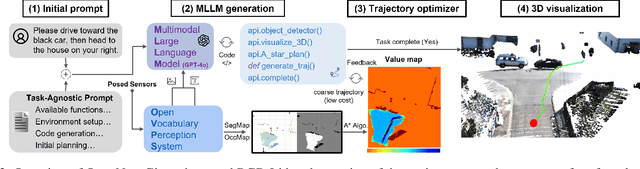
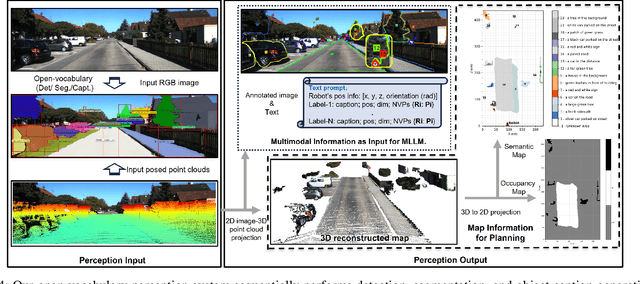
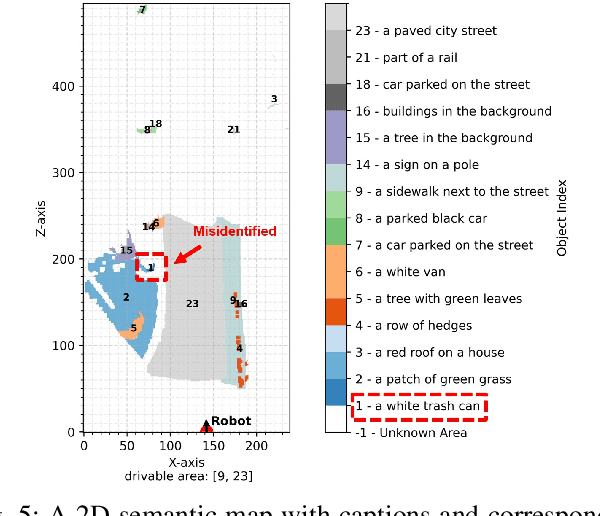
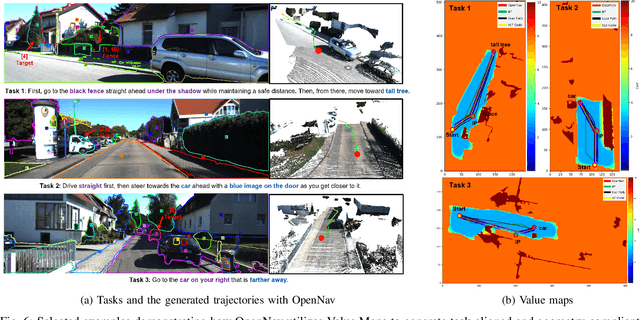
Pre-trained large language models (LLMs) have demonstrated strong common-sense reasoning abilities, making them promising for robotic navigation and planning tasks. However, despite recent progress, bridging the gap between language descriptions and actual robot actions in the open-world, beyond merely invoking limited predefined motion primitives, remains an open challenge. In this work, we aim to enable robots to interpret and decompose complex language instructions, ultimately synthesizing a sequence of trajectory points to complete diverse navigation tasks given open-set instructions and open-set objects. We observe that multi-modal large language models (MLLMs) exhibit strong cross-modal understanding when processing free-form language instructions, demonstrating robust scene comprehension. More importantly, leveraging their code-generation capability, MLLMs can interact with vision-language perception models to generate compositional 2D bird-eye-view value maps, effectively integrating semantic knowledge from MLLMs with spatial information from maps to reinforce the robot's spatial understanding. To further validate our approach, we effectively leverage large-scale autonomous vehicle datasets (AVDs) to validate our proposed zero-shot vision-language navigation framework in outdoor navigation tasks, demonstrating its capability to execute a diverse range of free-form natural language navigation instructions while maintaining robustness against object detection errors and linguistic ambiguities. Furthermore, we validate our system on a Husky robot in both indoor and outdoor scenes, demonstrating its real-world robustness and applicability. Supplementary videos are available at https://trailab.github.io/OpenNav-website/
An Overview of Arithmetic Adaptations for Inference of Convolutional Neural Networks on Re-configurable Hardware
May 19, 2025Convolutional Neural Networks (CNNs) have gained high popularity as a tool for computer vision tasks and for that reason are used in various applications. There are many different concepts, like single shot detectors, that have been published for detecting objects in images or video streams. However, CNNs suffer from disadvantages regarding the deployment on embedded platforms such as re-configurable hardware like Field Programmable Gate Arrays (FPGAs). Due to the high computational intensity, memory requirements and arithmetic conditions, a variety of strategies for running CNNs on FPGAs have been developed. The following methods showcase our best practice approaches for a TinyYOLOv3 detector network on a XILINX Artix-7 FPGA using techniques like fusion of batch normalization, filter pruning and post training network quantization.