 Add to Chrome
 Add to Firefox
 Add to Edge
IRIS: An Intelligent Vision-Language System for Ocular Surface Diseases via Topic Tree and Scene-Driven VQA Generation
Jul 05, 2026
While Large Vision-Language Models (VLMs) demonstrate remarkable generic capabilities, their clinical reasoning in specialized domains like ocular surface diseases (OSDs) is severely hindered by a paucity of high-fidelity, multimodal instruction-tuning data. To dismantle this data bottleneck, we introduce IRIS, an Intelligent Recognition and Interaction System tailored for fine-grained OSD understanding via external eye photography. First, we curate IRIS-120K, the largest and most comprehensive OSD visual question-answering (VQA) dataset to date. Crucially, to overcome the semantic shallowness of conventional image-caption pairs, we propose a synergistic data generation paradigm to explicitly inject clinical priors. Our data engine operates via a dual-branch framework: 1) a Topic Finding Tree (TFT) that hierarchically anchors visual features to precise anatomical and pathological concepts, enforcing rigorous medical deduction logic; and 2) a Scene-driven strategy that synthesizes role-adaptive clinical dialogues to ensure pragmatic generalization. By explicitly aligning a compact 4B-parameter VLM on this structurally enriched corpus, IRIS achieves state-of-the-art performance, comprehensively outperforming both generalist and specialized medical VLMs with up to 34B parameters. Our findings underscore that structured knowledge injection profoundly prevails over sheer parameter scaling, unlocking the potential for resource-efficient, expert-level AI deployment on mobile edge devices for scalable OSD screening. Code, datasets, and model weights will be publicly released by this repo.

ReMAP-PET: Beyond Visual Understanding -- Learning Region-Guided Metabolic Alignment Semantics from Brain PET
Jun 28, 2026Positron Emission Tomography (PET) reveals brain metabolism and is clinically central to neurodegenerative disease assessment, yet existing 3D brain foundation models treat PET as generic volumetric data, missing the structured regional metabolic information that distinguishes it from structural neuroimaging. To address these limitations, we propose ReMAP-PET, a framework that moves beyond visual encoding by supervising a partially-tuned MedicalNet 3D ResNet-50 with brain regional standardized uptake value ratio (SUVR) profiles through joint regression and contrastive objectives, enabling the encoder to learn the metabolic semantics underlying PET modality. On 1015 paired PET--SUVR samples, ReMAP-PET achieves 0.070 SUVR MAE and 77.8% PET SUVR Recall@1, substantially outperforming five frozen pretrained baselines. We further connect the metabolic embedding to clinical language via contrastive alignment with frozen BioClinicalBERT and demonstrate end-to-end PET-to-report generation through SUVR-constrained verbalization. Linear probing on diagnostic classification and cognitive regression tasks confirms that the embeddings retain clinically relevant information without task-specific fine-tuning. Our results show that grounding PET encoders in regional metabolic semantics -- rather than treating PET as generic volumetric data -- yields representations that are structured, interpretable, and language-compatible, pointing to a new direction for metabolic-aware PET understanding.
I-WebGenBench : Evaluating Interactivity in LLM-Generated Scientific Web Applications
May 30, 2026Recent advances in visual language models have enabled autonomous agents for complex reasoning, tool use, and document understanding. However, existing document agents mainly transform papers into static artifacts such as summaries, webpages, or slides, which are insufficient for technical papers involving dynamic mechanisms and state transitions. In this work, we propose a Paper-to-Interactive-System Agent that converts research papers into executable interactive web systems. Given a PDF paper, the agent performs end-to-end processing without human intervention, including paper understanding, system modeling, and interactive webpage synthesis, enabling users to manipulate inputs and observe dynamic behaviors. To evaluate this task, we introduce a benchmark of 19 research papers paired with expert-built interactive systems as ground truth. We further propose PaperVoyager, a structured generation framework that explicitly models mechanisms and interaction logic during synthesis. Experiments show that PaperVoyager significantly improves the quality of generated interactive systems, offering a new paradigm for interactive scientific paper understanding.
OpenSearch-VL: An Open Recipe for Frontier Multimodal Search Agents
May 06, 2026Deep search has become a crucial capability for frontier multimodal agents, enabling models to solve complex questions through active search, evidence verification, and multi-step reasoning. Despite rapid progress, top-tier multimodal search agents remain difficult to reproduce, largely due to the absence of open high-quality training data, transparent trajectory synthesis pipelines, or detailed training recipes. To this end, we introduce OpenSearch-VL, a fully open-source recipe for training frontier multimodal deep search agents with agentic reinforcement learning. First, we curated a dedicated pipeline to construct high-quality training data through Wikipedia path sampling, fuzzy entity rewriting, and source-anchor visual grounding, which jointly reduce shortcuts and one-step retrieval collapse. Based on this pipeline, we curate two training datasets, SearchVL-SFT-36k for SFT and SearchVL-RL-8k for RL. Besides, we design a diverse tool environment that unifies text search, image search, OCR, cropping, sharpening, super-resolution, and perspective correction, enabling agents to combine active perception with external knowledge acquisition. Finally, we propose a multi-turn fatal-aware GRPO training algorithm that handles cascading tool failures by masking post-failure tokens while preserving useful pre-failure reasoning through one-sided advantage clamping. Built on this recipe, OpenSearch-VL delivers substantial performance gains, with over 10-point average improvements across seven benchmarks, and achieves results comparable to proprietary commercial models on several tasks. We will release all data, code, and models to support open research on multimodal deep search agents.
UIPress: Bringing Optical Token Compression to UI-to-Code Generation
Apr 10, 2026UI-to-Code generation requires vision-language models (VLMs) to produce thousands of tokens of structured HTML/CSS from a single screenshot, making visual token efficiency critical. Existing compression methods either select tokens at inference time using task-agnostic heuristics, or zero out low-attention features without actually shortening the sequence -- neither truly reduces prefill latency or adapts to the non-uniform information density of UI screenshots. Meanwhile, optical (encoder-side learned) compression has shown strong results for document OCR, yet no prior work has adapted this paradigm to UI-to-Code generation. We propose UIPress, a lightweight learned compression module inserted between the frozen ViT encoder and the LLM decoder of Qwen3-VL-8B. UIPress combines depthwise-separable convolutions, element-guided spatial reweighting, and Transformer refinement to compress ${\sim}$6{,}700 visual tokens to a fixed budget of 256. Together with Low-Rank Adaptation (LoRA) on the decoder to bridge the representation gap, the entire system adds only ${\sim}$21.7M trainable parameters (0.26\% of the 8B base model). Under a fair comparison on the same base model against four baselines on Design2Code, UIPress at 256 tokens achieves a CLIP score of 0.8127, outperforming the uncompressed baseline by +7.5\% and the strongest inference-time method by +4.6\%, while delivering 9.1$\times$ time-to-first-token speedup. To the best of our knowledge, UIPress is the first encoder-side learned compression method for the UI-to-Code task.
Unify-Agent: A Unified Multimodal Agent for World-Grounded Image Synthesis
Apr 01, 2026Unified multimodal models provide a natural and promising architecture for understanding diverse and complex real-world knowledge while generating high-quality images. However, they still rely primarily on frozen parametric knowledge, which makes them struggle with real-world image generation involving long-tail and knowledge-intensive concepts. Inspired by the broad success of agents on real-world tasks, we explore agentic modeling to address this limitation. Specifically, we present Unify-Agent, a unified multimodal agent for world-grounded image synthesis, which reframes image generation as an agentic pipeline consisting of prompt understanding, multimodal evidence searching, grounded recaptioning, and final synthesis. To train our model, we construct a tailored multimodal data pipeline and curate 143K high-quality agent trajectories for world-grounded image synthesis, enabling effective supervision over the full agentic generation process. We further introduce FactIP, a benchmark covering 12 categories of culturally significant and long-tail factual concepts that explicitly requires external knowledge grounding. Extensive experiments show that our proposed Unify-Agent substantially improves over its base unified model across diverse benchmarks and real world generation tasks, while approaching the world knowledge capabilities of the strongest closed-source models. As an early exploration of agent-based modeling for world-grounded image synthesis, our work highlights the value of tightly coupling reasoning, searching, and generation for reliable open-world agentic image synthesis.
PaperVoyager : Building Interactive Web with Visual Language Models
Mar 24, 2026Recent advances in visual language models have enabled autonomous agents for complex reasoning, tool use, and document understanding. However, existing document agents mainly transform papers into static artifacts such as summaries, webpages, or slides, which are insufficient for technical papers involving dynamic mechanisms and state transitions. In this work, we propose a Paper-to-Interactive-System Agent that converts research papers into executable interactive web systems. Given a PDF paper, the agent performs end-to-end processing without human intervention, including paper understanding, system modeling, and interactive webpage synthesis, enabling users to manipulate inputs and observe dynamic behaviors. To evaluate this task, we introduce a benchmark of 19 research papers paired with expert-built interactive systems as ground truth. We further propose PaperVoyager, a structured generation framework that explicitly models mechanisms and interaction logic during synthesis. Experiments show that PaperVoyager significantly improves the quality of generated interactive systems, offering a new paradigm for interactive scientific paper understanding.
VidDoS: Universal Denial-of-Service Attack on Video-based Large Language Models
Mar 02, 2026Video-LLMs are increasingly deployed in safety-critical applications but are vulnerable to Energy-Latency Attacks (ELAs) that exhaust computational resources. Current image-centric methods fail because temporal aggregation mechanisms dilute individual frame perturbations. Additionally, real-time demands make instance-wise optimization impractical for continuous video streams. We introduce VidDoS, which is the first universal ELA framework tailored for Video-LLMs. Our method leverages universal optimization to create instance-agnostic triggers that require no inference-time gradient calculation. We achieve this through $\textit{masked teacher forcing}$ to steer models toward expensive target sequences, combined with a $\textit{refusal penalty}$ and $\textit{early-termination suppression}$ to override conciseness priors. Testing across three mainstream Video-LLMs and three video datasets, which include video question answering and autonomous driving scenarios, shows extreme degradation. VidDoS induces a token expansion of more than 205$\times$ and inflates the inference latency by more than 15$\times$ relative to clean baselines. Simulations of real-time autonomous driving streams further reveal that this induced latency leads to critical safety violations. We urge the community to recognize and mitigate these high-hazard ELA in Video-LLMs.
FMVP: Masked Flow Matching for Adversarial Video Purification
Jan 05, 2026Video recognition models remain vulnerable to adversarial attacks, while existing diffusion-based purification methods suffer from inefficient sampling and curved trajectories. Directly regressing clean videos from adversarial inputs often fails to recover faithful content due to the subtle nature of perturbations; this necessitates physically shattering the adversarial structure. Therefore, we propose Flow Matching for Adversarial Video Purification FMVP. FMVP physically shatters global adversarial structures via a masking strategy and reconstructs clean video dynamics using Conditional Flow Matching (CFM) with an inpainting objective. To further decouple semantic content from adversarial noise, we design a Frequency-Gated Loss (FGL) that explicitly suppresses high-frequency adversarial residuals while preserving low-frequency fidelity. We design Attack-Aware and Generalist training paradigms to handle known and unknown threats, respectively. Extensive experiments on UCF-101 and HMDB-51 demonstrate that FMVP outperforms state-of-the-art methods (DiffPure, Defense Patterns (DP), Temporal Shuffling (TS) and FlowPure), achieving robust accuracy exceeding 87% against PGD and 89% against CW attacks. Furthermore, FMVP demonstrates superior robustness against adaptive attacks (DiffHammer) and functions as a zero-shot adversarial detector, attaining detection accuracies of 98% for PGD and 79% for highly imperceptible CW attacks.
VisFactor: Benchmarking Fundamental Visual Cognition in Multimodal Large Language Models
Feb 23, 2025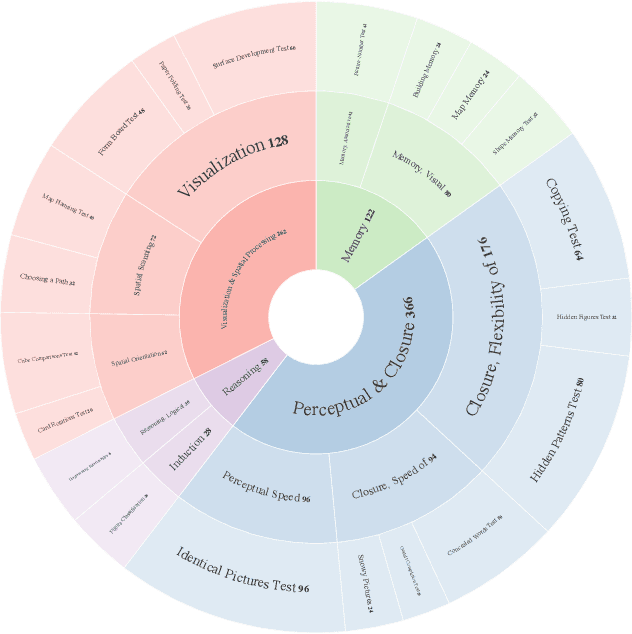
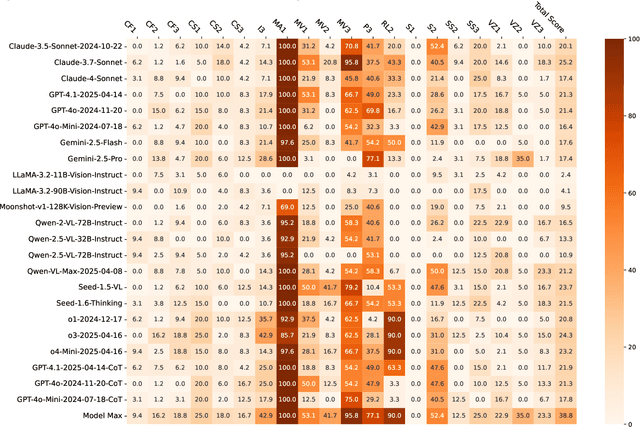
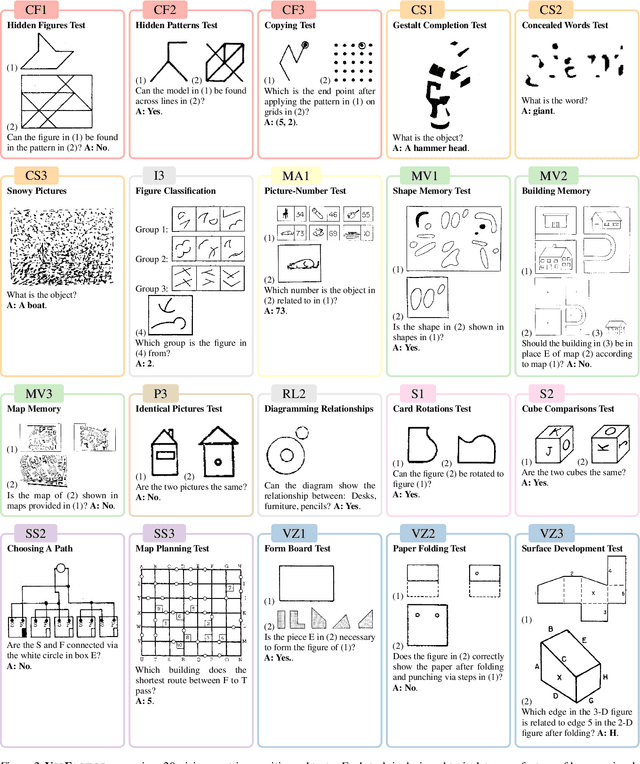

Multimodal Large Language Models (MLLMs) have demonstrated remarkable advancements in multimodal understanding; however, their fundamental visual cognitive abilities remain largely underexplored. To bridge this gap, we introduce VisFactor, a novel benchmark derived from the Factor-Referenced Cognitive Test (FRCT), a well-established psychometric assessment of human cognition. VisFactor digitalizes vision-related FRCT subtests to systematically evaluate MLLMs across essential visual cognitive tasks including spatial reasoning, perceptual speed, and pattern recognition. We present a comprehensive evaluation of state-of-the-art MLLMs, such as GPT-4o, Gemini-Pro, and Qwen-VL, using VisFactor under diverse prompting strategies like Chain-of-Thought and Multi-Agent Debate. Our findings reveal a concerning deficiency in current MLLMs' fundamental visual cognition, with performance frequently approaching random guessing and showing only marginal improvements even with advanced prompting techniques. These results underscore the critical need for focused research to enhance the core visual reasoning capabilities of MLLMs. To foster further investigation in this area, we release our VisFactor benchmark at https://github.com/CUHK-ARISE/VisFactor.