 Add to Chrome
 Add to Firefox
 Add to Edge
Doa Estimation
Papers and Code
Spatial Angular Pseudo-Derivative Searching: A Single Snapshot Super-resolution Sparse DOA Scheme with Potential for Practical Application
Feb 04, 2026
Accurate, high-resolution, and real-time DOA estimation is a cornerstone of environmental perception in automotive radar systems. While sparse signal recovery techniques offer super-resolution and high-precision estimation, their prohibitive computational complexity remains a primary bottleneck for practical deployment. This paper proposes a sparse DOA estimation scheme specifically tailored for the stringent requirements of automotive radar such as limited computational resources, restricted array apertures, and a single snapshot. By introducing the concept of the spatial angular pseudo-derivative and incorporating this property as a constraint into a standard L0-norm minimization problem, we formulate an objective function that more faithfully characterizes the physical properties of the DOA problem. The associated solver, designated as the SAPD search algorithm, naturally transforms the high-dimensional optimization task into an efficient grid-search scheme. The SAPD algorithm circumvents high-order matrix inversions and computationally intensive iterations. We provide an analysis of the computational complexity and convergence properties of the proposed algorithm. Extensive numerical simulations demonstrate that the SAPD method achieves a superior balance of real-time efficiency, high precision, and super-resolution, making it highly suitable for next-generation automotive radar applications.

Uncertainty-Weighted Multi-Task CNN for Joint DoA and Rain-Rate Estimation Under Rain-Induced Array Distortions
Feb 02, 2026We investigate joint direction-of-arrival (DoA) and rain-rate estimation for a uniform linear array operating under rain-induced multiplicative distortions. Building on a wavefront fluctuation model whose spatial correlation is governed by the rain-rate, we derive an angle-dependent covariance formulation and use it to synthesize training data. DoA estimation is cast as a multi-label classification problem on a discretized angular grid, while rain-rate estimation is formulated as a multi-class classification task. We then propose a multi-task deep CNN with a shared feature extractor and two task-specific heads, trained using an uncertainty-weighted objective to automatically balance the two losses. Numerical results in a two-source scenario show that the proposed network achieves lower DoA RMSE than classical baselines and provides accurate rain-rate classification at moderate-to-high SNRs.
Robust Covariance-Based DoA Estimation under Weather-Induced Distortion
Jan 27, 2026We investigate robust direction-of-arrival (DoA) estimation for sensor arrays operating in adverse weather conditions, where weather-induced distortions degrade estimation accuracy. Building on a physics-based $S$-matrix model established in prior work, we adopt a statistical characterization of random phase and amplitude distortions caused by multiple scattering in rain. Based on this model, we develop a measurement framework for uniform linear arrays (ULAs) that explicitly incorporates such distortions. To mitigate their impact, we exploit the Hermitian Toeplitz (HT) structure of the covariance matrix to reduce the number of parameters to be estimated. We then apply a generalized least squares (GLS) approach for calibration. Simulation results show that the proposed method effectively suppresses rain-induced distortions, improves DoA estimation accuracy, and enhances radar sensing performance in challenging weather conditions.
LuSeeL: Language-queried Binaural Universal Sound Event Extraction and Localization
Jan 27, 2026Most universal sound extraction algorithms focus on isolating a target sound event from single-channel audio mixtures. However, the real world is three-dimensional, and binaural audio, which mimics human hearing, can capture richer spatial information, including sound source location. This spatial context is crucial for understanding and modeling complex auditory scenes, as it inherently informs sound detection and extraction. In this work, we propose a language-driven universal sound extraction network that isolates text-described sound events from binaural mixtures by effectively leveraging the spatial cues present in binaural signals. Additionally, we jointly predict the direction of arrival (DoA) of the target sound using spatial features from the extraction network. This dual-task approach exploits complementary location information to improve extraction performance while enabling accurate DoA estimation. Experimental results on the in-the-wild AudioCaps dataset show that our proposed LuSeeL model significantly outperforms single-channel and uni-task baselines.
6G OFDM Communications with High Mobility Transceivers and Scatterers via Angle-Domain Processing and Deep Learning
Jan 19, 2026High-mobility communications, which are crucial for next-generation wireless systems, cause the orthogonal frequency division multiplexing (OFDM) waveform to suffer from strong intercarrier interference (ICI) due to the Doppler effect. In this work, we propose a novel receiver architecture for OFDM that leverages the angular domain to separate multipaths. A block-type pilot is sent to estimate direction-of-arrivals (DoAs), propagation delays, and channel gains of the multipaths. Subsequently, a decision-directed (DD) approach is employed to estimate and iteratively refine the Dopplers. Two different approaches are investigated to provide initial Doppler estimates: an error vector magnitude (EVM)-based method and a deep learning (DL)-based method. Simulation results reveal that the DL-based approach allows for constant bit error rate (BER) performance up to the maximum 6G speed of 1000 km/h.
Joint DOA and Non-circular Phase Estimation of Non-circular Signals for Antenna Arrays: Block Sparse Bayesian Learning Method
Jan 14, 2026This letter proposes a block sparse Bayesian learning (BSBL) algorithm of non-circular (NC) signals for direction-of-arrival (DOA) estimation, which is suitable for arbitrary unknown NC phases. The block sparse NC signal representation model is constructed through a permutation strategy, capturing the available intra-block structure information to enhance recovery performance. After that, we create the sparse probability model and derive the cost function under BSBL framework. Finally, the fast marginal likelihood maximum (FMLM) algorithm is introduced, enabling the rapid implementation of signal recovery by the addition and removal of basis functions. Simulation results demonstrate the effectiveness and the superior performance of our proposed method.
Directional Selective Fixed-Filter Active Noise Control Based on a Convolutional Neural Network in Reverberant Environments
Jan 11, 2026Selective fixed-filter active noise control (SFANC) is a novel approach capable of mitigating noise with varying frequency characteristics. It offers faster response and greater computational efficiency compared to traditional adaptive algorithms. However, spatial factors, particularly the influence of the noise source location, are often overlooked. Some existing studies have explored the impact of the direction-of-arrival (DoA) of the noise source on ANC performance, but they are mostly limited to free-field conditions and do not consider the more complex indoor reverberant environments. To address this gap, this paper proposes a learning-based directional SFANC method that incorporates the DoA of the noise source in reverberant environments. In this framework, multiple reference signals are processed by a convolutional neural network (CNN) to estimate the azimuth and elevation angles of the noise source, as well as to identify the most appropriate control filter for effective noise cancellation. Compared to traditional adaptive algorithms, the proposed approach achieves superior noise reduction with shorter response times, even in the presence of reverberations.
Compressive Toeplitz Covariance Estimation From Few-Bit Quantized Measurements With Applications to DOA Estimation
Dec 27, 2025This paper addresses the problem of estimating the Hermitian Toeplitz covariance matrix under practical hardware constraints of sparse observations and coarse quantization. Within the triangular-dithered quantization framework, we propose an estimator called Toeplitz-projected sample covariance matrix (Q-TSCM) to compensate for the quantization-induced bias, together with its finite-bit counterpart termed the $2k$-bit Toeplitz-projected sample covariance matrix ($2k$-TSCM), obtained by truncating the pre-quantization observations. Under the complex Gaussian assumption, we derive non-asymptotic error bounds of the estimators that reveal a quadratic dependence on the quantization level and capture the effect of sparse sampling patterns through the so-called coverage coefficient. To further improve performance, we propose the quantized sparse and parametric approach (Q-SPA) based on a covariance-fitting criterion, which enforces additionally positive semidefiniteness at the cost of solving a semidefinite program. Numerical experiments are presented that corroborate our theoretical findings and demonstrate the effectiveness of the proposed estimators in the application to direction-of-arrival estimation.
An Fluid Antenna Array-Enabled DOA Estimation Method: End-Fire Effect Suppression
Dec 22, 2025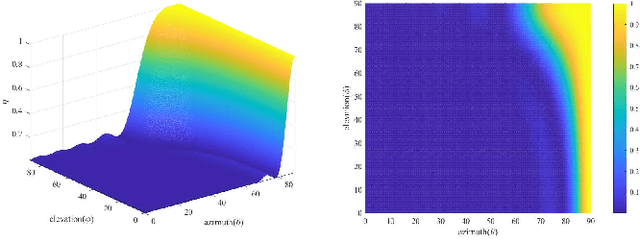
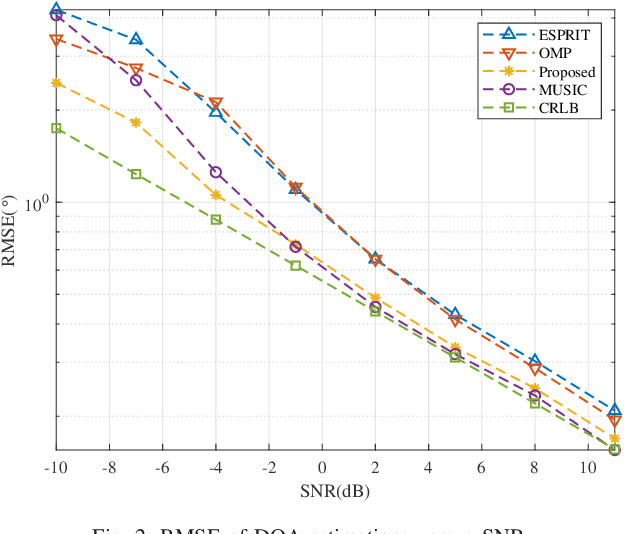
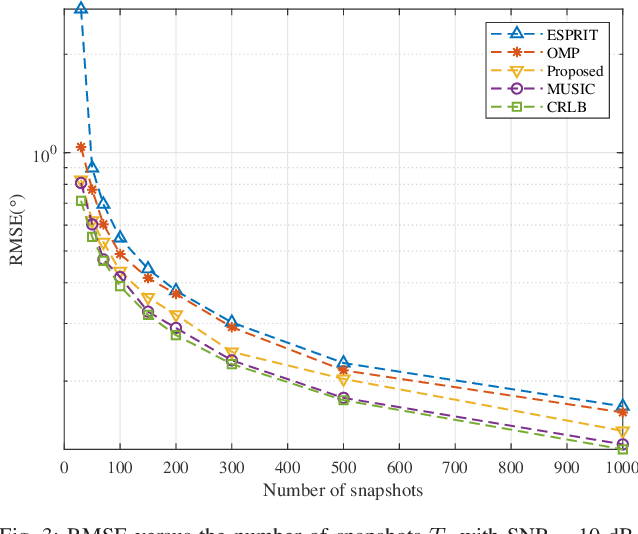
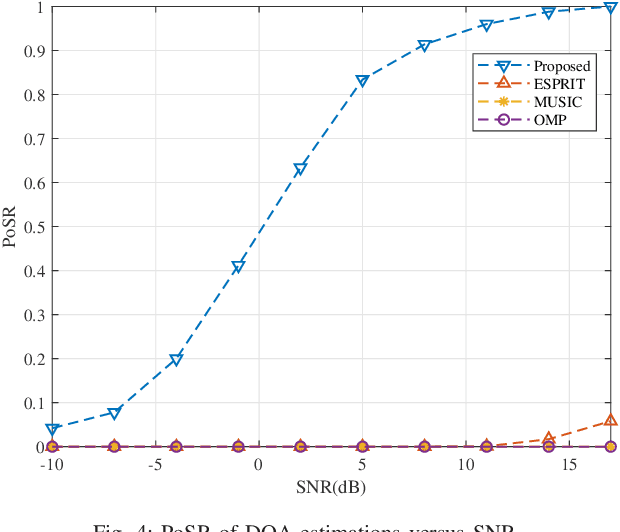
Direction of Arrival (DOA) estimation serves as a critical sensing technology poised to play a vital role in future intelligent and ubiquitous communication systems. Despite the development of numerous mature super-resolution algorithms, the inherent end-fire effect problem in fixed antenna arrays remains inadequately addressed. This work proposed a novel array architecture composed of fluid antennas. By exploiting the spatial reconfigurability of their positions to equivalently modulate the array steering vector and integrating it with the classical MUSIC algorithm, this approach achieved high-precision DOA estimation. Simulation results demonstrated that the proposed method delivers outstanding estimation performance even in highly challenging end-fire regions.
Direction Finding with Sparse Arrays Based on Variable Window Size Spatial Smoothing
Dec 26, 2025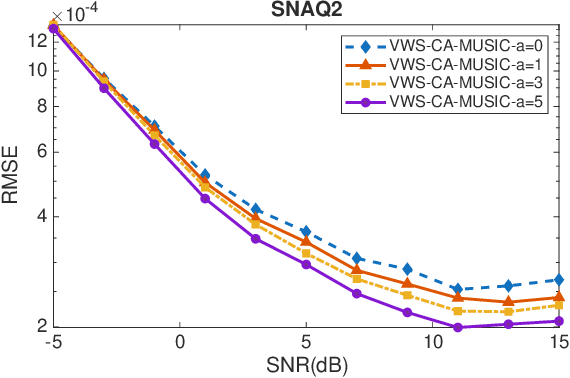
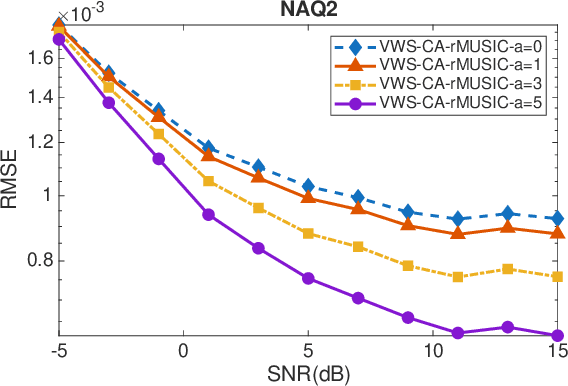
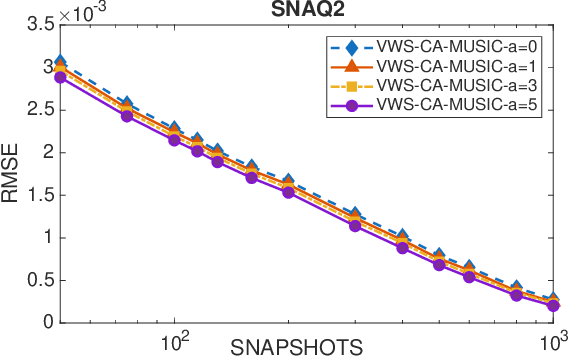
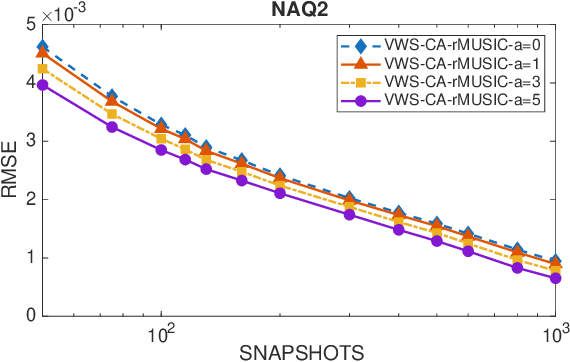
In this work, we introduce a variable window size (VWS) spatial smoothing framework that enhances coarray-based direction of arrival (DOA) estimation for sparse linear arrays. By compressing the smoothing aperture, the proposed VWS Coarray MUSIC (VWS-CA-MUSIC) and VWS Coarray root-MUSIC (VWS-CA-rMUSIC) algorithms replace part of the perturbed rank-one outer products in the smoothed coarray data with unperturbed low-rank additional terms, increasing the separation between signal and noise subspaces, while preserving the signal subspace span. We also derive the bounds that guarantees identifiability, by limiting the values that can be assumed by the compression parameter. Simulations with sparse geometries reveal significant performance improvements and complexity savings relative to the fixed-window coarray MUSIC method.