 Add to Chrome
 Add to Firefox
 Add to Edge
On the Necessity of a Liquid Substrate for Mesh Intelligence
Jun 25, 2026
A mesh of sovereign agents has no center: no shared clock, no shared model, and no coordinator to gather data or retrain. Its competence rests on each agent folding the projections its peers emit into a single internal state, online, from observations that arrive at irregular, unscheduled times, on a substrate whose weights it cannot retrain. Any one of these constraints is tractable on its own; folding optimally under all three at once is not. We ask what such a substrate must be, and prove two necessary conditions from one model of a self-evolving latent observed at irregular, exogenous times. Because the latent changes, its optimal estimator is time-varying: an adaptive timescale is necessary, and every fixed-gain filter is strictly suboptimal. And because arrivals are clock-free, the optimal estimate depends on the elapsed gap between them, which no gap-blind network recovers at any width or depth. This second condition is capacity-independent: scale cannot substitute for the missing dependence. The two conditions intersect in the continuous-time liquid class. An LSTM satisfies the first, a fixed continuous-time filter the second, and a multi-timescale liquid network both. Synthetic experiments confirm each: the network attains the timescale, and the separation is computed exactly. The characterization is necessary, not sufficient, and binds fixed-weight substrates: a network free to retrain reaches the class by other means. Proved per agent, the necessity binds every agent of a mesh, a structural condition on mesh intelligence.

Positivity of a Hadamard Product
Apr 21, 2026A notable difference between the ordinary and Hadamard products is that the Hadamard product of two singular positive semidefinite matrices can be nonsingular, and one of the factors can even be indefinite. We present an eigenvalue lower bound for a Hadamard product that depends on the rank, effective condition number, and diagonal entries of one factor, and the smallest eigenvalues of certain principal submatrices of the other factor. We give numerical examples and discuss its applications in array signal processing and matrix time series analysis.
Mesh Memory Protocol: Semantic Infrastructure for Multi-Agent LLM Systems
Apr 21, 2026Teams of LLM agents increasingly collaborate on tasks spanning days or weeks: multi-day data-generation sprints where generator, reviewer, and auditor agents coordinate in real time on overlapping batches; specialists carrying findings forward across session restarts; product decisions compounding over many review rounds. This requires agents to share, evaluate, and combine each other's cognitive state in real time across sessions. We call this cross-session agent-to-agent cognitive collaboration, distinct from parallel agent execution. To enable it, three problems must be solved together. (P1) Each agent decides field by field what to accept from peers, not accept or reject whole messages. (P2) Every claim is traceable to source, so returning claims are recognised as echoes of the receiver's own prior thinking. (P3) Memory that survives session restarts is relevant because of how it was stored, not how it is retrieved. These are protocol-level properties at the semantic layer of agent communication, distinct from tool-access and task-delegation protocols at lower layers. We call this missing protocol layer "semantic infrastructure," and the Mesh Memory Protocol (MMP) specifies it. Four composable primitives work together: CAT7, a fixed seven-field schema for every Cognitive Memory Block (CMB); SVAF, which evaluates each field against the receiver's role-indexed anchors and realises P1; inter-agent lineage, carried as parents and ancestors of content-hash keys and realising P2; and remix, which stores only the receiver's own role-evaluated understanding of each accepted CMB, never the raw peer signal, realising P3. MMP is specified, shipped, and running in production across three reference deployments, where each session runs an autonomous agent as a mesh peer with its own identity and memory, collaborating with other agents across the network for collective intelligence.
MeloTune: On-Device Arousal Learning and Peer-to-Peer Mood Coupling for Proactive Music Curation
Apr 14, 2026MeloTune is an iPhone-deployed music agent that instantiates the Mesh Memory Protocol (MMP) and Symbolic-Vector Attention Fusion (SVAF) as a production system for affect-aware music curation with peer-to-peer mood coupling. Each device runs two closed-form continuous-time (CfC) networks: a private listener-level CfC that predicts a short-horizon affective trajectory on Russell's circumplex and drives proactive curation, and a shared mesh-runtime CfC at MMP Layer 6 that integrates Cognitive Memory Blocks (CMBs) from co-listening peers. CfC hidden states never cross the wire; only structured CMBs do. A Personal Arousal Function (PAF) replaces the standard linear mapping from audio intensity to psychological arousal with a per-listener learned adjustment, trained from behavioral signals (skip, completion, favorite, volume) and from drift between user-declared mood and machine inference. The same track receives different arousal predictions for different listeners. The model (94,552 parameters) achieves trajectory MAE 0.414, pattern accuracy 96.6%, and intent accuracy 69.4% on held-out validation. PAF evidence from a live deployment session (46 observations across 11 genres) demonstrates that the learning loop operates end-to-end, with pop reaching full confidence after 22 observations. All inference runs on-device via CoreML. To our knowledge, this is the first production deployment of MMP/SVAF on consumer mobile hardware. The accompanying SDK (sym-swift v0.3.78, SYMCore v0.3.7) enforces strict protocol conformance. Music is the case study; the substrate is the contribution.
Symbolic-Vector Attention Fusion for Collective Intelligence
Apr 05, 2026When autonomous agents observe different domains of a shared environment, each signal they exchange mixes relevant and irrelevant dimensions. No existing mechanism lets the receiver evaluate which dimensions to absorb. We introduce Symbolic-Vector Attention Fusion (SVAF), the content-evaluation half of a two-level coupling engine for collective intelligence. SVAF decomposes each inter-agent signal into 7 typed semantic fields, evaluates each through a learned fusion gate, and produces a remix -- new knowledge from the intersection of two domains. A band-pass model yields four outcomes (redundant, aligned, guarded, rejected), solving both selectivity and redundancy. The fusion gate independently discovers a cross-domain relevance hierarchy: mood emerges as the highest-weight field by epoch 1, before accuracy plateaus -- consistent with independent mechanistic evidence that LLM emotion representations are structurally embedded along valence-arousal axes. SVAF forms Layer 4 of the Mesh Memory Protocol (MMP); the other half of the coupling engine is a per-agent Closed-form Continuous-time (CfC) neural network at Layer 6, whose learned per-neuron time constants (tau) create the temporal dynamics from which collective intelligence emerges: fast neurons synchronise affect across agents in seconds, while slow neurons preserve domain expertise indefinitely. SVAF determines what enters each agent's cognitive state; CfC determines how that state evolves. Trained on 237K samples from 273 narrative scenarios, SVAF achieves 78.7% three-class accuracy. We verify the complete mesh cognition loop -- from per-field evaluation through remix, CfC state evolution, tau-modulated peer blending, and autonomous action -- in a live deployment with 7 nodes across macOS, iOS, and web.
Compressive Toeplitz Covariance Estimation From Few-Bit Quantized Measurements With Applications to DOA Estimation
Dec 27, 2025This paper addresses the problem of estimating the Hermitian Toeplitz covariance matrix under practical hardware constraints of sparse observations and coarse quantization. Within the triangular-dithered quantization framework, we propose an estimator called Toeplitz-projected sample covariance matrix (Q-TSCM) to compensate for the quantization-induced bias, together with its finite-bit counterpart termed the $2k$-bit Toeplitz-projected sample covariance matrix ($2k$-TSCM), obtained by truncating the pre-quantization observations. Under the complex Gaussian assumption, we derive non-asymptotic error bounds of the estimators that reveal a quadratic dependence on the quantization level and capture the effect of sparse sampling patterns through the so-called coverage coefficient. To further improve performance, we propose the quantized sparse and parametric approach (Q-SPA) based on a covariance-fitting criterion, which enforces additionally positive semidefiniteness at the cost of solving a semidefinite program. Numerical experiments are presented that corroborate our theoretical findings and demonstrate the effectiveness of the proposed estimators in the application to direction-of-arrival estimation.
NTIRE 2025 challenge on Text to Image Generation Model Quality Assessment
May 22, 2025This paper reports on the NTIRE 2025 challenge on Text to Image (T2I) generation model quality assessment, which will be held in conjunction with the New Trends in Image Restoration and Enhancement Workshop (NTIRE) at CVPR 2025. The aim of this challenge is to address the fine-grained quality assessment of text-to-image generation models. This challenge evaluates text-to-image models from two aspects: image-text alignment and image structural distortion detection, and is divided into the alignment track and the structural track. The alignment track uses the EvalMuse-40K, which contains around 40K AI-Generated Images (AIGIs) generated by 20 popular generative models. The alignment track has a total of 371 registered participants. A total of 1,883 submissions are received in the development phase, and 507 submissions are received in the test phase. Finally, 12 participating teams submitted their models and fact sheets. The structure track uses the EvalMuse-Structure, which contains 10,000 AI-Generated Images (AIGIs) with corresponding structural distortion mask. A total of 211 participants have registered in the structure track. A total of 1155 submissions are received in the development phase, and 487 submissions are received in the test phase. Finally, 8 participating teams submitted their models and fact sheets. Almost all methods have achieved better results than baseline methods, and the winning methods in both tracks have demonstrated superior prediction performance on T2I model quality assessment.
Bit Efficient Toeplitz Covariance Estimation
Dec 17, 2024This paper addresses the challenge of Toeplitz covariance matrix estimation from partial entries of random quantized samples. To balance trade-offs among the number of samples, the number of entries observed per sample, and the data resolution, we propose a ruler-based quantized Toeplitz covariance estimator. We derive non-asymptotic error bounds and analyze the convergence rates of the proposed estimator. Our results show that the estimator is near-optimal and imply that reducing data resolution within a certain range has a limited impact on the estimation accuracy. Numerical experiments are provided that validate our theoretical findings and show effectiveness of the proposed estimator.
MMFace4D: A Large-Scale Multi-Modal 4D Face Dataset for Audio-Driven 3D Face Animation
Mar 17, 2023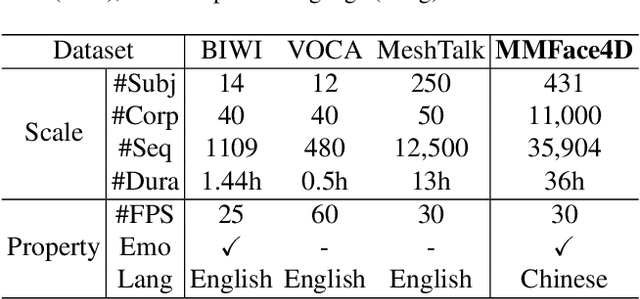
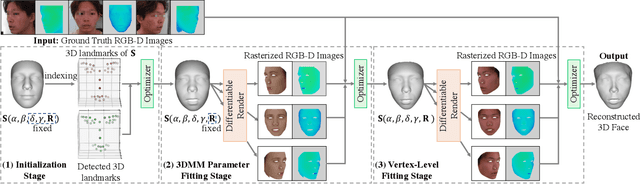
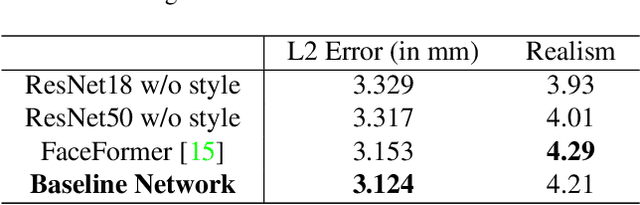
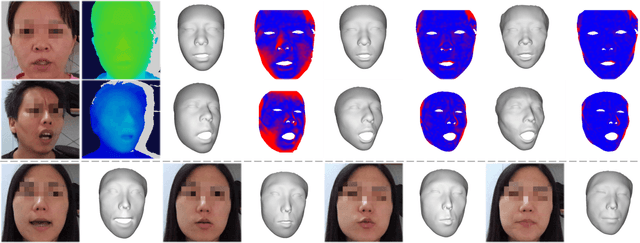
Audio-Driven Face Animation is an eagerly anticipated technique for applications such as VR/AR, games, and movie making. With the rapid development of 3D engines, there is an increasing demand for driving 3D faces with audio. However, currently available 3D face animation datasets are either scale-limited or quality-unsatisfied, which hampers further developments of audio-driven 3D face animation. To address this challenge, we propose MMFace4D, a large-scale multi-modal 4D (3D sequence) face dataset consisting of 431 identities, 35,904 sequences, and 3.9 million frames. MMFace4D has three appealing characteristics: 1) highly diversified subjects and corpus, 2) synchronized audio and 3D mesh sequence with high-resolution face details, and 3) low storage cost with a new efficient compression algorithm on 3D mesh sequences. These characteristics enable the training of high-fidelity, expressive, and generalizable face animation models. Upon MMFace4D, we construct a challenging benchmark of audio-driven 3D face animation with a strong baseline, which enables non-autoregressive generation with fast inference speed and outperforms the state-of-the-art autoregressive method. The whole benchmark will be released.
SubFace: Learning with Softmax Approximation for Face Recognition
Aug 24, 2022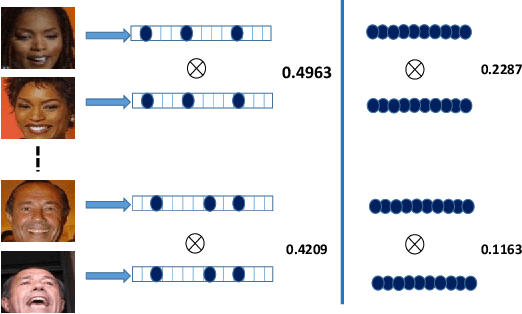
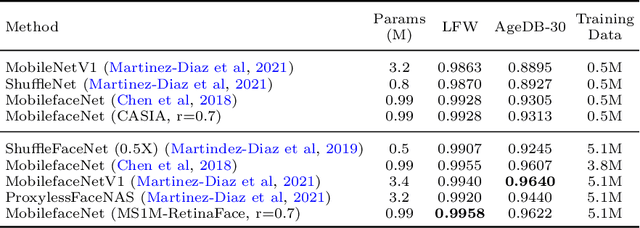
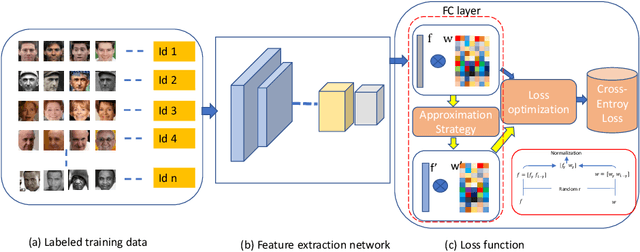
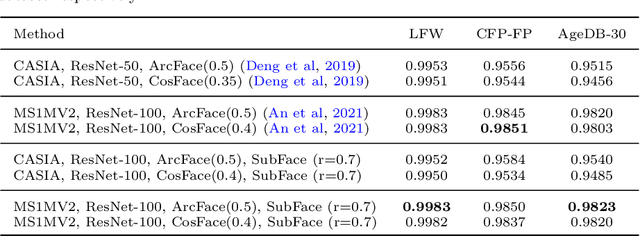
The softmax-based loss functions and its variants (e.g., cosface, sphereface, and arcface) significantly improve the face recognition performance in wild unconstrained scenes. A common practice of these algorithms is to perform optimizations on the multiplication between the embedding features and the linear transformation matrix. However in most cases, the dimension of embedding features is given based on traditional design experience, and there is less-studied on improving performance using the feature itself when giving a fixed size. To address this challenge, this paper presents a softmax approximation method called SubFace, which employs the subspace feature to promote the performance of face recognition. Specifically, we dynamically select the non-overlapping subspace features in each batch during training, and then use the subspace features to approximate full-feature among softmax-based loss, so the discriminability of the deep model can be significantly enhanced for face recognition. Comprehensive experiments conducted on benchmark datasets demonstrate that our method can significantly improve the performance of vanilla CNN baseline, which strongly proves the effectiveness of subspace strategy with the margin-based loss.