 Add to Chrome
 Add to Firefox
 Add to Edge
Hybrid Architecture Gets Fluid: A New Paradigm for Direction-of-arrival Estimation in 6G Networks
Apr 15, 2026
High-precision direction-of-arrival (DOA) estimation, as a key sensing capability for 6G-enabled applications such as autonomous driving and extended reality, is increasingly dependent on the effective exploitation of spatial degrees of freedom (DOFs). This paper integrates two frontier DOFs-oriented paradigms and proposes a fluid antenna-enabled hybrid analog-digital (FA-HAD) architecture, which features an extremely lightweight front-end configuration mechanism and efficient spatial DOFs exploitation. Within this architecture, a collaborative spatial-phase sampling strategy is first developed to enable real-time 2-D DOA estimation under compressive observations, and a single-source CRLB analysis is provided to quantify the achievable performance limit, offering quantitative guidance for accuracy-overhead trade-offs. Furthermore, an efficient virtual-array spatial covariance matrix reconstruction method is proposed to recover a physically meaningful covariance representation, thereby providing a covariance-domain interface that is directly reusable by a broad class of existing covariance-based array processing and array design techniques, which strengthens the scalability and transferability of the proposed architecture. Building upon the reconstructed SCM, a Jacobi-Anger expansion based dimension-reduced MUSIC estimator is further derived for arbitrary planar arrays with a favorable computational cost. Simulation results demonstrate that the proposed FA-HAD framework attains DOA accuracy close to fully digital systems while substantially reducing RF hardware complexity and training overhead.

An Fluid Antenna Array-Enabled DOA Estimation Method: End-Fire Effect Suppression
Dec 22, 2025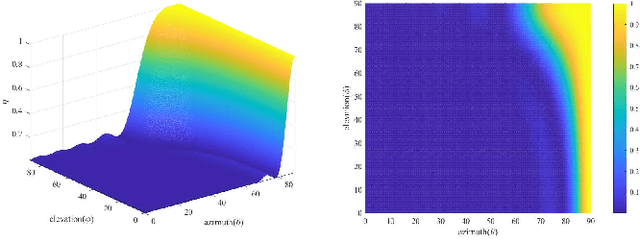
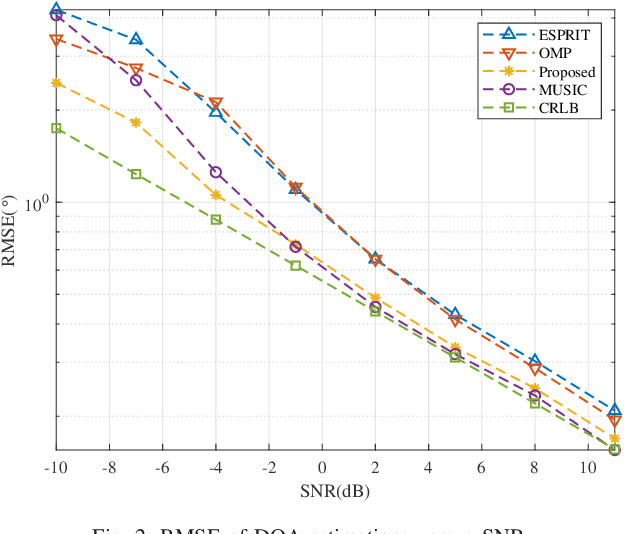
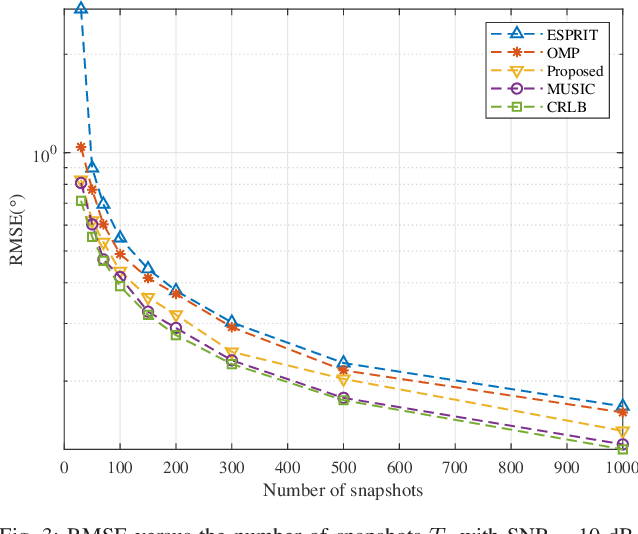
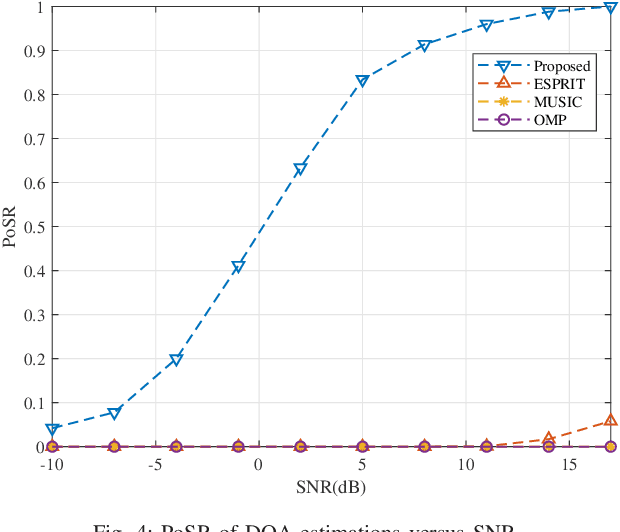
Direction of Arrival (DOA) estimation serves as a critical sensing technology poised to play a vital role in future intelligent and ubiquitous communication systems. Despite the development of numerous mature super-resolution algorithms, the inherent end-fire effect problem in fixed antenna arrays remains inadequately addressed. This work proposed a novel array architecture composed of fluid antennas. By exploiting the spatial reconfigurability of their positions to equivalently modulate the array steering vector and integrating it with the classical MUSIC algorithm, this approach achieved high-precision DOA estimation. Simulation results demonstrated that the proposed method delivers outstanding estimation performance even in highly challenging end-fire regions.
A Hybrid Dynamic Subarray Architecture for Efficient DOA Estimation in THz Ultra-Massive Hybrid MIMO Systems
Jan 30, 2025Terahertz (THz) communication combined with ultra-massive multiple-input multiple-output (UM-MIMO) technology is promising for 6G wireless systems, where fast and precise direction-of-arrival (DOA) estimation is crucial for effective beamforming. However, finding DOAs in THz UM-MIMO systems faces significant challenges: while reducing hardware complexity, the hybrid analog-digital (HAD) architecture introduces inherent difficulties in spatial information acquisition the large-scale antenna array causes significant deviations in eigenvalue decomposition results; and conventional two-dimensional DOA estimation methods incur prohibitively high computational overhead, hindering fast and accurate realization. To address these challenges, we propose a hybrid dynamic subarray (HDS) architecture that strategically divides antenna elements into subarrays, ensuring phase differences between subarrays correlate exclusively with single-dimensional DOAs. Leveraging this architectural innovation, we develop two efficient algorithms for DOA estimation: a reduced-dimension MUSIC (RD-MUSIC) algorithm that enables fast processing by correcting large-scale array estimation bias, and an improved version that further accelerates estimation by exploiting THz channel sparsity to obtain initial closed-form solutions through specialized two-RF-chain configuration. Furthermore, we develop a theoretical framework through Cram\'{e}r-Rao lower bound analysis, providing fundamental insights for different HDS configurations. Extensive simulations demonstrate that our solution achieves both superior estimation accuracy and computational efficiency, making it particularly suitable for practical THz UM-MIMO systems.