 Add to Chrome
 Add to Firefox
 Add to Edge
Adaptive Momentum Enhanced Distributed Multichannel Active Noise Control for Faster Convergence under Communication Delays
Jul 19, 2026
Distributed multichannel active noise control (DMCANC) reduces the computational burden of centralized ANC systems by distributing processing tasks across multiple nodes, while requiring information exchange to achieve satisfactory global noise reduction. To improve robustness under communication delays, the auto-shrink step size mixed-gradients filtered reference LMS (ASSS-MGDFxLMS) algorithm has been proposed. However, the reduced step size inevitably slows convergence. In this work, an adaptive momentum term is introduced to accelerate convergence, where cosine similarity is used to evaluate the alignment between the instantaneous gradient and the momentum component and dynamically adjust the momentum parameter. This design accelerates convergence when the directions are consistent while preserving stability under delayed communication. Simulation results demonstrate that the proposed adaptive momentum ASSS-MGDFxLMS (AMAS-MGDFxLMS) algorithm achieves faster convergence than ASSS-MGDFxLMS while maintaining stable and effective noise reduction performance.

Spatial-Frequency Cued Generative Fixed-Filter Active Noise Control Based on Deep Learning in Reverberant Environments
Jul 14, 2026Generative fixed-filter active noise control (GFANC) effectively attenuates noise with diverse frequency characteristics through the combination of sub control filters. However, it does not incorporate the spatial information of the noise source, which limits its performance, particularly in reverberant environments. To address this limitation, this paper proposes a novel spatial-frequency cued GFANC (SF-GFANC) method that exploits both three-dimensional (3D) spatial and frequency information of the noise source. Specifically, a multi-task convolutional recurrent neural network (CRNN) is designed to estimate the source distance, elevation angle, and azimuth angle as spatial cues, while predicting the combination weights of sub control filters as frequency cues. These spatial-frequency cues jointly guide the generation of the appropriate control filter. In addition, a theoretical analysis of the optimal control filter in reverberant environments is presented, highlighting the importance of 3D spatially conditioned control filter design. Evaluations using both simulated and measured acoustic paths demonstrate that the CRNN is robust to unseen acoustic environments and noise types. Furthermore, the results confirm that SF-GFANC outperforms representative ANC algorithms when handling noise sources across diverse 3D locations and frequency characteristics in reverberant environments.
Predictive Fixed-Filter Active Noise Control (PFANC) Using Convolutional Recurrent Neural Networks for Dynamic Noises
Jun 06, 2026The existing Generative Fixed-Filter Active Noise Control (GFANC) method generates a suitable control filter based on the current noise frame. This reactive design aims to estimate a control filter that is optimal for the present frame rather than the upcoming one. Consequently, it suffers from an inherent tracking lag and lacks the predictive capability to handle rapidly varying noises. To address this limitation, we propose the Predictive Fixed-Filter Active Noise Control (PFANC) method with a proactive control paradigm in this paper. In the PFANC method, multiple consecutive noise frames are processed by a Convolutional Recurrent Neural Network (CRNN) to predict the next-frame control filter. By utilizing temporal correlations across noise frames to anticipate the control filter in advance, the PFANC method can effectively track dynamic noise changes. Furthermore, the theoretical analysis based on a high-order Markov chain shows that incorporating multiple noise frames enhances the prediction of the control filter. Numerical simulations with linear and logarithmic chirp signals, as well as real-world dynamic noises, validate the effectiveness of the PFANC method and its superiority over GFANC and its variations. The PFANC method also exhibits good transferability across different acoustic paths.
Polyphonia: Zero-Shot Timbre Transfer in Polyphonic Music with Acoustic-Informed Attention Calibration
May 11, 2026The advancement of diffusion-based text-to-music generation has opened new avenues for zero-shot music editing. However, existing methods fail to achieve stem-specific timbre transfer, which requires altering specific stems while strictly preserving the background accompaniment. This limitation severely hinders practical application, since real-world production necessitates precise manipulation of components within dense mixtures. Our key finding is that, while vanilla cross-attention captures semantic features of stems, it lacks the spectral resolution to strictly localize targets in dense mixtures, leading to boundary leakage. To resolve this dilemma, we propose Polyphonia, a zero-shot editing framework with Acoustic-Informed Attention Calibration. Rather than relying solely on diffuse semantic attention, Polyphonia leverages a probabilistic acoustic prior to establish coarse boundaries, enabling non-target stems preserved precise semantic synthesis. For evaluation, we propose PolyEvalPrompts, a standardized prompt set with 1,170 timbre transfer tasks in polyphonic music. Specifically, Polyphonia achieves an increase of 15.5% in target alignment compared to baselines, while maintaining competitive music fidelity and non-target integrity.
Distributed Multichannel Active Noise Control with Asynchronous Communication
Jan 22, 2026Distributed multichannel active noise control (DMCANC) offers effective noise reduction across large spatial areas by distributing the computational load of centralized control to multiple low-cost nodes. Conventional DMCANC methods, however, typically assume synchronous communication and require frequent data exchange, resulting in high communication overhead. To enhance efficiency and adaptability, this work proposes an asynchronous communication strategy where each node executes a weight-constrained filtered-x LMS (WCFxLMS) algorithm and independently requests communication only when its local noise reduction performance degrades. Upon request, other nodes transmit the weight difference between their local control filter and the center point in WCFxLMS, which are then integrated to update both the control filter and the center point. This design enables nodes to operate asynchronously while preserving cooperative behavior. Simulation results demonstrate that the proposed asynchronous communication DMCANC (ACDMCANC) system maintains effective noise reduction with significantly reduced communication load, offering improved scalability for heterogeneous networks.
Directional Selective Fixed-Filter Active Noise Control Based on a Convolutional Neural Network in Reverberant Environments
Jan 11, 2026Selective fixed-filter active noise control (SFANC) is a novel approach capable of mitigating noise with varying frequency characteristics. It offers faster response and greater computational efficiency compared to traditional adaptive algorithms. However, spatial factors, particularly the influence of the noise source location, are often overlooked. Some existing studies have explored the impact of the direction-of-arrival (DoA) of the noise source on ANC performance, but they are mostly limited to free-field conditions and do not consider the more complex indoor reverberant environments. To address this gap, this paper proposes a learning-based directional SFANC method that incorporates the DoA of the noise source in reverberant environments. In this framework, multiple reference signals are processed by a convolutional neural network (CNN) to estimate the azimuth and elevation angles of the noise source, as well as to identify the most appropriate control filter for effective noise cancellation. Compared to traditional adaptive algorithms, the proposed approach achieves superior noise reduction with shorter response times, even in the presence of reverberations.
Melodia: Training-Free Music Editing Guided by Attention Probing in Diffusion Models
Nov 18, 2025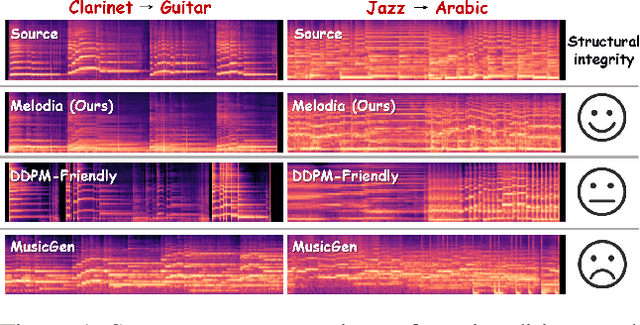
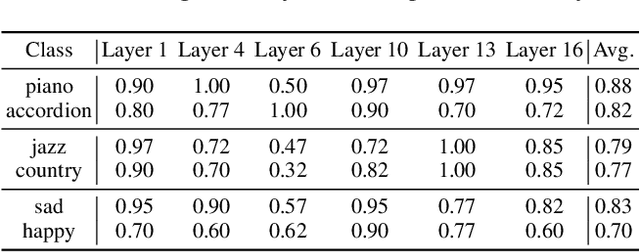
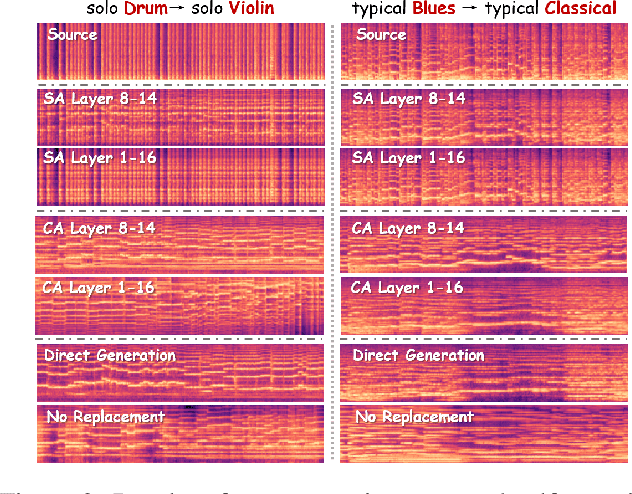
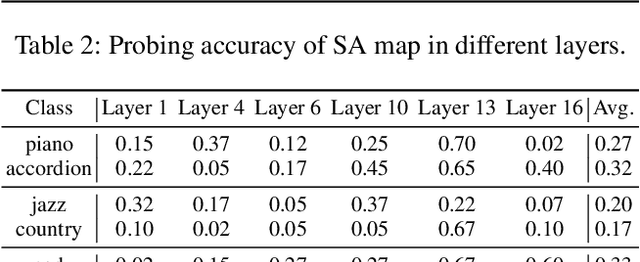
Text-to-music generation technology is progressing rapidly, creating new opportunities for musical composition and editing. However, existing music editing methods often fail to preserve the source music's temporal structure, including melody and rhythm, when altering particular attributes like instrument, genre, and mood. To address this challenge, this paper conducts an in-depth probing analysis on attention maps within AudioLDM 2, a diffusion-based model commonly used as the backbone for existing music editing methods. We reveal a key finding: cross-attention maps encompass details regarding distinct musical characteristics, and interventions on these maps frequently result in ineffective modifications. In contrast, self-attention maps are essential for preserving the temporal structure of the source music during its conversion into the target music. Building upon this understanding, we present Melodia, a training-free technique that selectively manipulates self-attention maps in particular layers during the denoising process and leverages an attention repository to store source music information, achieving accurate modification of musical characteristics while preserving the original structure without requiring textual descriptions of the source music. Additionally, we propose two novel metrics to better evaluate music editing methods. Both objective and subjective experiments demonstrate that our approach achieves superior results in terms of textual adherence and structural integrity across various datasets. This research enhances comprehension of internal mechanisms within music generation models and provides improved control for music creation.
DOA Estimation with Lightweight Network on LLM-Aided Simulated Acoustic Scenes
Nov 11, 2025Direction-of-Arrival (DOA) estimation is critical in spatial audio and acoustic signal processing, with wide-ranging applications in real-world. Most existing DOA models are trained on synthetic data by convolving clean speech with room impulse responses (RIRs), which limits their generalizability due to constrained acoustic diversity. In this paper, we revisit DOA estimation using a recently introduced dataset constructed with the assistance of large language models (LLMs), which provides more realistic and diverse spatial audio scenes. We benchmark several representative neural-based DOA methods on this dataset and propose LightDOA, a lightweight DOA estimation model based on depthwise separable convolutions, specifically designed for mutil-channel input in varying environments. Experimental results show that LightDOA achieves satisfactory accuracy and robustness across various acoustic scenes while maintaining low computational complexity. This study not only highlights the potential of spatial audio synthesized with the assistance of LLMs in advancing robust and efficient DOA estimation research, but also highlights LightDOA as efficient solution for resource-constrained applications.
OpenGuardrails: An Open-Source Context-Aware AI Guardrails Platform
Oct 22, 2025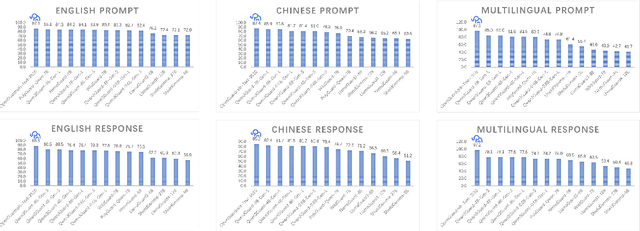

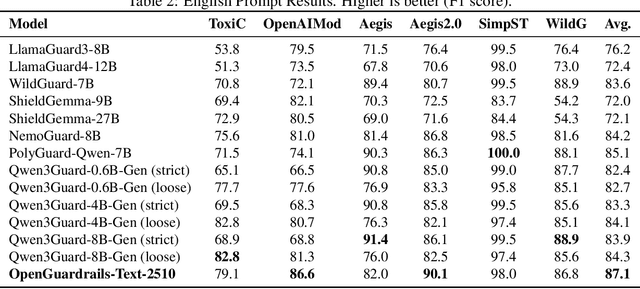
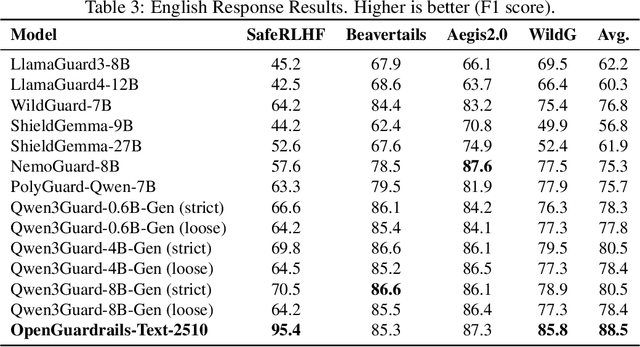
As large language models (LLMs) become increasingly integrated into real-world applications, safeguarding them against unsafe, malicious, or privacy-violating content is critically important. We present OpenGuardrails, the first open-source project to provide both a context-aware safety and manipulation detection model and a deployable platform for comprehensive AI guardrails. OpenGuardrails protects against content-safety risks, model-manipulation attacks (e.g., prompt injection, jailbreaking, code-interpreter abuse, and the generation/execution of malicious code), and data leakage. Content-safety and model-manipulation detection are implemented by a unified large model, while data-leakage identification and redaction are performed by a separate lightweight NER pipeline (e.g., Presidio-style models or regex-based detectors). The system can be deployed as a security gateway or an API-based service, with enterprise-grade, fully private deployment options. OpenGuardrails achieves state-of-the-art (SOTA) performance on safety benchmarks, excelling in both prompt and response classification across English, Chinese, and multilingual tasks. All models are released under the Apache 2.0 license for public use.
AIComposer: Any Style and Content Image Composition via Feature Integration
Jul 28, 2025Image composition has advanced significantly with large-scale pre-trained T2I diffusion models. Despite progress in same-domain composition, cross-domain composition remains under-explored. The main challenges are the stochastic nature of diffusion models and the style gap between input images, leading to failures and artifacts. Additionally, heavy reliance on text prompts limits practical applications. This paper presents the first cross-domain image composition method that does not require text prompts, allowing natural stylization and seamless compositions. Our method is efficient and robust, preserving the diffusion prior, as it involves minor steps for backward inversion and forward denoising without training the diffuser. Our method also uses a simple multilayer perceptron network to integrate CLIP features from foreground and background, manipulating diffusion with a local cross-attention strategy. It effectively preserves foreground content while enabling stable stylization without a pre-stylization network. Finally, we create a benchmark dataset with diverse contents and styles for fair evaluation, addressing the lack of testing datasets for cross-domain image composition. Our method outperforms state-of-the-art techniques in both qualitative and quantitative evaluations, significantly improving the LPIPS score by 30.5% and the CSD metric by 18.1%. We believe our method will advance future research and applications. Code and benchmark at https://github.com/sherlhw/AIComposer.