 Add to Chrome
 Add to Firefox
 Add to Edge
Task-Oriented Sensing and Covert Transmissions for Collaborative Multi-AUV Systems
Jul 15, 2026
In underwater covert cooperative missions, autonomous underwater vehicles (AUVs) often cannot rely on active sonar to continuously obtain complete information, since active sensing and frequent communications increase the risk of exposure. As a result, AUVs primarily rely on passive observation, an approach that yields incomplete local perception and limited task efficiency. Although underwater acoustic communications can mitigate this limitation through information sharing, they are simultaneously constrained by long delays, severe interference, low reliability, and the risk of covert exposure. Existing communications-oriented multi-agent reinforcement learning (MARL) studies often model communication as an ideal information flow, whereas traditional communication optimization primarily focuses on link-level performance. However, both are insufficient to characterize the actual contribution of perceptual information to cooperative tasks under realistic conditions of covert physical communications. This paper proposes a Sensed Information Value Realization Multi-Agent Reinforcement Learning (SVR-MARL) framework that leverages practical information to characterize the utility of information for cooperative tasks and learns distributed cooperative policies under realistic communication and covert constraints. Through a case study of covert multi-AUV cooperative localization and tracking, the potential of the proposed framework to improve collaborative task efficiency while reducing unnecessary communication and exposure risks is demonstrated.

IDSOR: Intensity- and Distance-Aware Statistical Outlier Removal for Weather-Robust LiDAR Point Clouds
Feb 05, 2026LiDAR point clouds captured in rain or snow are often corrupted by weather-induced returns, which can degrade perception and safety-critical scene understanding. This paper proposes Intensity- and Distance-Aware Statistical Outlier Removal (IDSOR), a range-adaptive filtering method that jointly exploits intensity cues and neighborhood sparsity. By incorporating an empirical, range-dependent distribution of weather returns into the threshold design, IDSOR suppresses weather-induced points while preserving fine structural details without cumbersome manual parameter tuning. We also propose a variant that uses a previously proposed method to estimate the weather return distribution from data, and integrates it into IDSOR. Experiments on simulation-augmented level-crossing measurements and on the Winter Adverse Driving dataset (WADS) demonstrate that IDSOR achieves a favorable precision-recall trade-off, maintaining both precision and recall above 90% on WADS.
Obstacle Detection at Level Crossings under Adverse Weather Conditions -- A Survey
Feb 02, 2026Level crossing accidents remain a significant safety concern in modern railway systems, particularly under adverse weather conditions that degrade sensor performance. This review surveys state-of-the-art sensor technologies and fusion strategies for obstacle detection at railway level crossings, with a focus on robustness, detection accuracy, and environmental resilience. Individual sensors such as inductive loops, cameras, radar, and LiDAR offer complementary strengths but involve trade-offs, including material dependence, reduced visibility, and limited resolution in harsh environments. We analyze each modality's working principles, weather-induced vulnerabilities, and mitigation strategies, including signal enhancement and machine-learning-based denoising. We further review multi-sensor fusion approaches, categorized as data-level, feature-level, and decision-level architectures, that integrate complementary information to improve reliability and fault tolerance. The survey concludes with future research directions, including adaptive fusion algorithms, real-time processing pipelines, and weather-resilient datasets to support the deployment of intelligent, fail-safe detection systems for railway safety.
Uncertainty-Weighted Multi-Task CNN for Joint DoA and Rain-Rate Estimation Under Rain-Induced Array Distortions
Feb 02, 2026We investigate joint direction-of-arrival (DoA) and rain-rate estimation for a uniform linear array operating under rain-induced multiplicative distortions. Building on a wavefront fluctuation model whose spatial correlation is governed by the rain-rate, we derive an angle-dependent covariance formulation and use it to synthesize training data. DoA estimation is cast as a multi-label classification problem on a discretized angular grid, while rain-rate estimation is formulated as a multi-class classification task. We then propose a multi-task deep CNN with a shared feature extractor and two task-specific heads, trained using an uncertainty-weighted objective to automatically balance the two losses. Numerical results in a two-source scenario show that the proposed network achieves lower DoA RMSE than classical baselines and provides accurate rain-rate classification at moderate-to-high SNRs.
Robust Covariance-Based DoA Estimation under Weather-Induced Distortion
Jan 27, 2026We investigate robust direction-of-arrival (DoA) estimation for sensor arrays operating in adverse weather conditions, where weather-induced distortions degrade estimation accuracy. Building on a physics-based $S$-matrix model established in prior work, we adopt a statistical characterization of random phase and amplitude distortions caused by multiple scattering in rain. Based on this model, we develop a measurement framework for uniform linear arrays (ULAs) that explicitly incorporates such distortions. To mitigate their impact, we exploit the Hermitian Toeplitz (HT) structure of the covariance matrix to reduce the number of parameters to be estimated. We then apply a generalized least squares (GLS) approach for calibration. Simulation results show that the proposed method effectively suppresses rain-induced distortions, improves DoA estimation accuracy, and enhances radar sensing performance in challenging weather conditions.
CapArena: Benchmarking and Analyzing Detailed Image Captioning in the LLM Era
Mar 16, 2025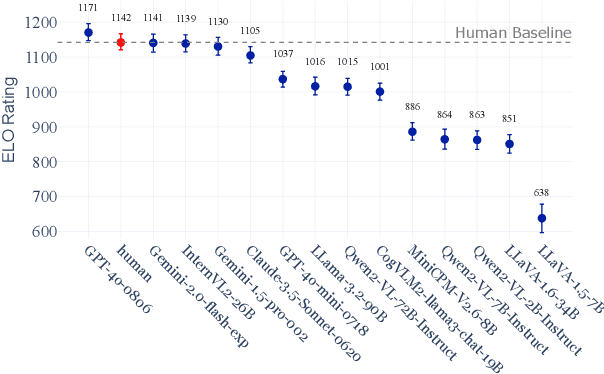
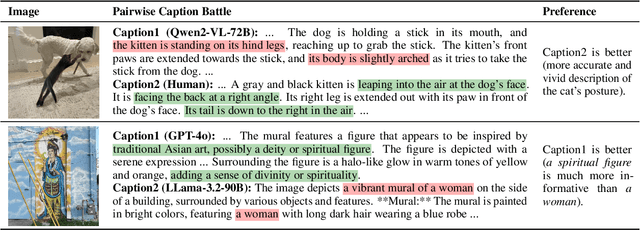
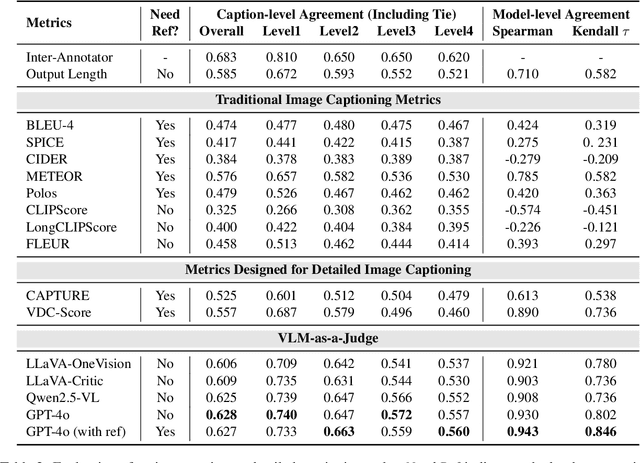
Image captioning has been a longstanding challenge in vision-language research. With the rise of LLMs, modern Vision-Language Models (VLMs) generate detailed and comprehensive image descriptions. However, benchmarking the quality of such captions remains unresolved. This paper addresses two key questions: (1) How well do current VLMs actually perform on image captioning, particularly compared to humans? We built CapArena, a platform with over 6000 pairwise caption battles and high-quality human preference votes. Our arena-style evaluation marks a milestone, showing that leading models like GPT-4o achieve or even surpass human performance, while most open-source models lag behind. (2) Can automated metrics reliably assess detailed caption quality? Using human annotations from CapArena, we evaluate traditional and recent captioning metrics, as well as VLM-as-a-Judge. Our analysis reveals that while some metrics (e.g., METEOR) show decent caption-level agreement with humans, their systematic biases lead to inconsistencies in model ranking. In contrast, VLM-as-a-Judge demonstrates robust discernment at both the caption and model levels. Building on these insights, we release CapArena-Auto, an accurate and efficient automated benchmark for detailed captioning, achieving 94.3% correlation with human rankings at just $4 per test. Data and resources will be open-sourced at https://caparena.github.io.