 Add to Chrome
 Add to Firefox
 Add to Edge
Power Reduction in Heterogeneous Wireless Sensor Networks via Source-Aware Allocation
Jul 13, 2026
Heterogeneous wireless sensor networks (HWSNs) in space and extreme environments must reliably transmit diverse analog physical signals over resource-constrained fading channels, subject to bandwidth limitations, power budgets, and reconstruction quality requirements. This paper addresses two fundamental questions: (i) what is the minimum signal-to-noise ratio (SNR) a sensing link must sustain to reconstruct an analog signal at a prescribed distortion, regardless of the decoder used, and (ii) how can knowledge of the signal's intrinsic structure be exploited to jointly allocate power and bandwidth across an HWSN? Both questions are answered through the Renyi information dimension (RID), which quantifies the intrinsic complexity of an analog source distribution. By combining the RID with rate-distortion theory and Shannon channel capacity, a closed-form SNR lower bound is derived, parameterized solely by the source RID. Building on these foundations, a cross-layer resource allocation framework is introduced that exploits the per-node RID to jointly assign transmit power and bandwidth, achieving strict power saving relative to a Gaussian-assumption baseline while guaranteeing prescribed reconstruction quality and outage constraints at every node.

From Wireless SNNs to SN P Systems: A Low-Energy Rule-Based Conversion
Jul 13, 2026Distributed wireless spiking neural networks (DWSNNs) are a promising paradigm for energy-efficient edge inference in resource-constrained environments such as wireless sensor networks (WSNs). Yet, two limitations persist: their internal decision process is opaque, and their residual energy footprint remains a limiting factor for ultra-low-power deployments. This paper proposes a systematic methodology to convert a trained DWSNN into an equivalent Spiking Neural P (SN P) system, a biologically-inspired, rule-based computational model drawn from membrane computing, by extracting symbolic firing rules from the hidden-layer spike activity. The resulting SN P system provides direct, human-readable decision explanations while consuming three orders of magnitude less energy than its parent SNN. Experiments on the Neuromorphic MNIST (N-MNIST) dataset with a two-layer fully connected SNN using phase encoding and Leaky Integrate-and-Fire (LIF) neurons show that the SN P system retains approximately 84% of the original classification accuracy (73.77% vs. 87.68%) while the output layer connectivity decreases from 1000 to 120 class-specific connections. This complexity reduction is governed by a parameter related to the number of relevant hidden neurons per class that can be chosen according to a trade-off between computational complexity reduction and output accuracy. These results position SN P systems as lightweight, interpretable surrogates for trained distributed wireless SNNs in neuromorphic edge deployments.
Comparative Study of ECG Denoising Methods for Wearable Applications
Jul 13, 2026Reliable electrocardiogram (ECG) monitoring in wearable and space environments requires effective denoising of signals corrupted by non-stationary electromyogram (EMG) interference. This paper presents a comparative evaluation of model-based and DL-based denoising techniques for upper-arm ECG recordings acquired under real conditions. The model-based methods include three empirical mode decomposition (EMD) variants and a discrete wavelet transform (DWT) approach, while the deep learning (DL) side is represented by a stacked denoising autoencoder (SDAE) and a physics-informed neural network (PINN). All methods are evaluated on real acquisitions under both relaxed and voluntary muscle contraction conditions, using root mean squared error (RMSE), Pearson correlation, and peak-to-peak signal-to-noise ratio (PPSNR) as performance metrics. Results reveal a fundamental trade-off: DL methods achieve superior morphological reconstruction, while DWT provides the strongest noise suppression, highlighting complementary strengths for wearable cardiac monitoring applications.
Beyond Legacy OFDM: A Mobility-Adaptive Multi-Gear Framework for 6G
Mar 31, 2026While Third Generation Partnership Project (3GPP) has confirmed orthogonal frequency division multiplexing (OFDM) as the baseline waveform for sixth-generation (6G), its performance is severely compromised in the high-mobility scenarios envisioned for 6G. Building upon the GEARBOX-PHY vision, we present gear-switching OFDM (GS-OFDM): a unified framework in which the base station (BS) adaptively selects among three gears, ranging from legacy OFDM to delay-Doppler domain processing based on the channel mobility conditions experienced by the user equipments (UEs). We illustrate the benefit of adaptive gear switching for communication throughput and, finally, we conclude with an outlook on research challenges and opportunities.
Cross-Pilot Superposition for Fractional Parameter Estimation in DoA-Aided OTFS Receivers
Feb 25, 2026In this letter, a novel superimposed pilot scheme is proposed for channel estimation in multi-antenna orthogonal time frequency space (OTFS) receivers. Under the assumption of a large uniform linear array (ULA) size at the receiver, the multipath components are separated directly in the angular domain. It is then shown that the proposed superimposed pilot scheme enables the computation of integrated delay and Doppler profiles by averaging the received delay-Doppler matrix across the Doppler and delay axes, respectively. This procedure helps reduce data-to-pilot interference through data averaging. Moreover, it is demonstrated that fractional delays and Dopplers of the multipath components can be estimated by correlating the integrated delay and Doppler profiles with the corresponding delay/Doppler terms. Simulation results show that the proposed approach outperforms existing OTFS superimposed pilot schemes, achieving a lower bit error rate (BER) while exhibiting a trade-off between peak-to-average power ratio (PAPR) and communication performance.
Monostatic ISAC Without Full Buffers: Revisiting Spatial Trade-Offs Under Bursty Traffic
Jan 19, 2026This work investigates the spatial trade-offs arising from the design of the transmit beamformer in a monostatic integrated sensing and communication (ISAC) base station (BS) under bursty traffic, a crucial aspect necessitated by the integration of communication and sensing functionalities in next-generation wireless systems. In this setting, the BS does not always have data available for transmission. This study compares different ISAC policies and reveals the presence of multiple effects influencing ISAC performance: signal-to-noise ratio (SNR) boosting of data-aided strategies compared to pilot-based ones, saturation of the probability of detection in data-aided strategies due to the non-full-buffer assumption, and, finally, directional masking of sensing targets due to the relative position between target and user. Simulation results demonstrate varying impact of these effects on ISAC trade-offs under different operating conditions, thus guiding the design of efficient ISAC transmission strategies.
6G OFDM Communications with High Mobility Transceivers and Scatterers via Angle-Domain Processing and Deep Learning
Jan 19, 2026High-mobility communications, which are crucial for next-generation wireless systems, cause the orthogonal frequency division multiplexing (OFDM) waveform to suffer from strong intercarrier interference (ICI) due to the Doppler effect. In this work, we propose a novel receiver architecture for OFDM that leverages the angular domain to separate multipaths. A block-type pilot is sent to estimate direction-of-arrivals (DoAs), propagation delays, and channel gains of the multipaths. Subsequently, a decision-directed (DD) approach is employed to estimate and iteratively refine the Dopplers. Two different approaches are investigated to provide initial Doppler estimates: an error vector magnitude (EVM)-based method and a deep learning (DL)-based method. Simulation results reveal that the DL-based approach allows for constant bit error rate (BER) performance up to the maximum 6G speed of 1000 km/h.
Robust 6G OFDM High-Mobility Communications Using Delay-Doppler Superimposed Pilots
Dec 18, 2025In this work, a novel receiver architecture for orthogonal frequency division multiplexing (OFDM) communications in 6G high-mobility scenarios is developed. In particular, a delay-Doppler superimposed pilot (SP) scheme is used for channel estimation (CE) by adding a single pilot in the delay-Doppler domain. Unlike previous research on delay-Doppler superimposed pilots in OFDM systems, intercarrier interference (ICI) effects, fractional delays, and Doppler shifts are considered. Consequently, a disjoint fractional delay-Doppler estimation algorithm is derived, and a reduced-complexity equalization method based on the Landweber iteration, which exploits intrinsic channel structure, is proposed. Simulation results reveal that the proposed receiver architecture achieves robust communication performance across various mobility conditions, with speeds of up to 1000 km/h, and increases the effective throughput compared to existing methods.
Experimental Evaluation of Joint Clock Recovery and Equalization for Sub-Terahertz Links
Sep 09, 2025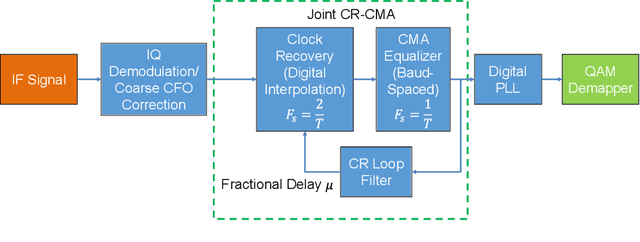
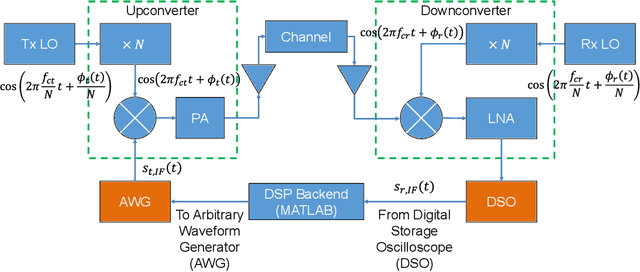
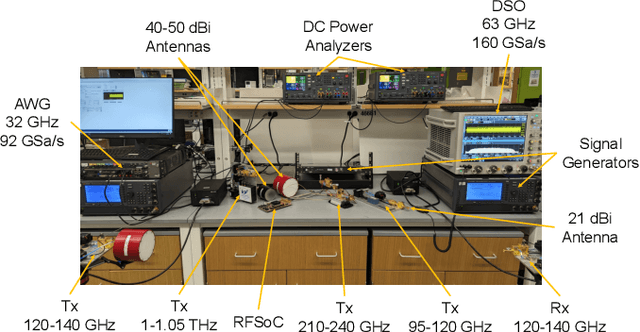
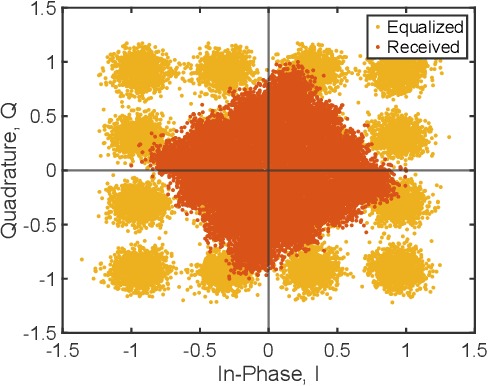
This paper proposes and experimentally evaluates a joint clock recovery (CR) and equalization architecture tailored for high-speed sub-terahertz (sub-THz) wireless communication links. Specifically, a Baud-spaced digital receiver architecture is investigated that combines a constant modulus algorithm (CMA) equalizer with a blind timing error detector (TED), enabling robust symbol timing synchronization without decision-directed (DD) feedback or pilot symbols. The proposed TED leverages the CMA filter coefficients to estimate timing errors, which are then used to drive a Farrow interpolator operating at twice the symbol rate. The system is validated experimentally using a 140~GHz wireless testbed with 16-QAM modulation over a 10~GHz bandwidth. Results show that the proposed TED schemes outperform conventional blind TEDs, such as Gardner and blind implementations of Mueller \& M\"uller, in terms of bit error rate (BER), error vector magnitude (EVM), and intersymbol interference (ISI) suppression. These capabilities are especially relevant to next-generation spaceborne communication systems, where wideband sub-THz links are expected to play a key role in enabling ultra-high-data-rate inter-satellite and deep-space communications under challenging synchronization constraints.
Disjoint Delay-Doppler Estimation in OTFS ISAC with Deep Learning-aided Path Detection
Apr 29, 2025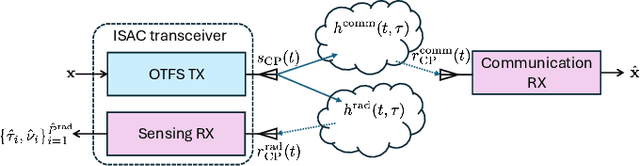
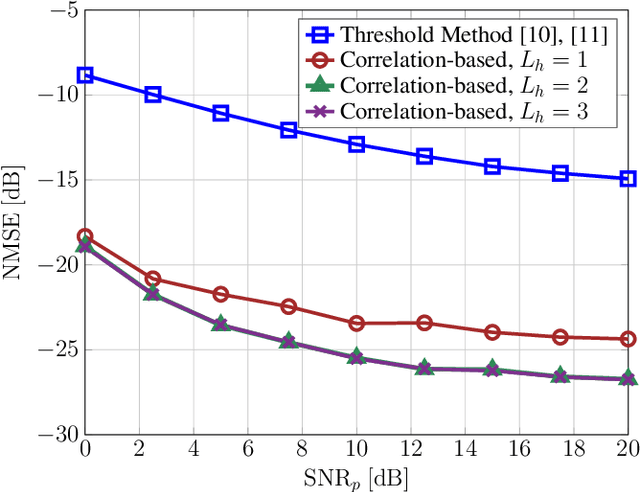
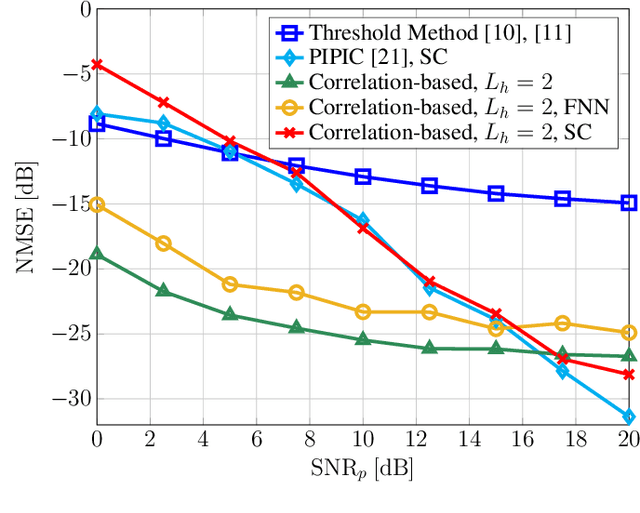
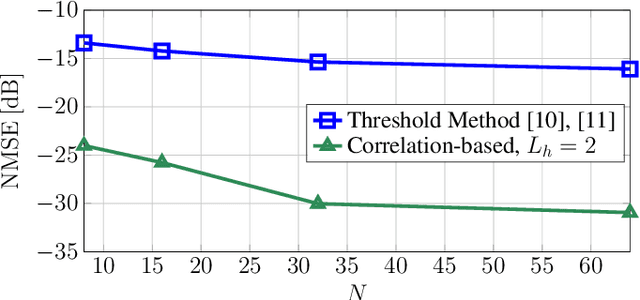
In this work, the problem of communication and radar sensing in orthogonal time frequency space (OTFS) with reduced cyclic prefix (RCP) is addressed. A monostatic integrated sensing and communications (ISAC) system is developed and, it is demonstrated that by leveraging the cyclic shift property inherent in the RCP, a delay-Doppler (DD) channel matrix that encapsulates the effects of propagation delays and Doppler shifts through unitary matrices can be derived. Consequently, a novel low-complexity correlation-based algorithm performing disjoint delay-Doppler estimation is proposed for channel estimation. Subsequently, this estimation approach is adapted to perform radar sensing on backscattered data frames. Moreover, channel estimation is complemented by a deep learning (DL) architecture that improves path detection and accuracy under low signal-to-noise ratio (SNR) conditions, compared to stopping criterion (SC) based multipath detection. Simulation results indicate that the proposed estimation scheme achieves lower normalized mean squared error (NMSE) compared to conventional channel estimation algorithms and sensing performance close to the Cramer-Rao lower bound (CRLB). Furthermore, an iterative data detection algorithm based on matched filter (MF) and combining is developed by exploiting the unitary property of delay-Doppler parameterized matrices. Simulation results reveal that this iterative scheme achieves performance comparable to that of the linear minimum mean squared error (LMMSE) estimator while significantly reducing computational complexity.