 Add to Chrome
 Add to Firefox
 Add to Edge
Aist
Papers and Code
V2M-Zero: Zero-Pair Time-Aligned Video-to-Music Generation
Mar 11, 2026
Generating music that temporally aligns with video events is challenging for existing text-to-music models, which lack fine-grained temporal control. We introduce V2M-Zero, a zero-pair video-to-music generation approach that outputs time-aligned music for video. Our method is motivated by a key observation: temporal synchronization requires matching when and how much change occurs, not what changes. While musical and visual events differ semantically, they exhibit shared temporal structure that can be captured independently within each modality. We capture this structure through event curves computed from intra-modal similarity using pretrained music and video encoders. By measuring temporal change within each modality independently, these curves provide comparable representations across modalities. This enables a simple training strategy: fine-tune a text-to-music model on music-event curves, then substitute video-event curves at inference without cross-modal training or paired data. Across OES-Pub, MovieGenBench-Music, and AIST++, V2M-Zero achieves substantial gains over paired-data baselines: 5-21% higher audio quality, 13-15% better semantic alignment, 21-52% improved temporal synchronization, and 28% higher beat alignment on dance videos. We find similar results via a large crowd-source subjective listening test. Overall, our results validate that temporal alignment through within-modality features, rather than paired cross-modal supervision, is effective for video-to-music generation. Results are available at https://genjib.github.io/v2m_zero/

Not Like Transformers: Drop the Beat Representation for Dance Generation with Mamba-Based Diffusion Model
Mar 09, 2026Dance is a form of human motion characterized by emotional expression and communication, playing a role in various fields such as music, virtual reality, and content creation. Existing methods for dance generation often fail to adequately capture the inherently sequential, rhythmical, and music-synchronized characteristics of dance. In this paper, we propose \emph{MambaDance}, a new dance generation approach that leverages a Mamba-based diffusion model. Mamba, well-suited to handling long and autoregressive sequences, is integrated into our two-stage diffusion architecture, substituting off-the-shelf Transformer. Additionally, considering the critical role of musical beats in dance choreography, we propose a Gaussian-based beat representation to explicitly guide the decoding of dance sequences. Experiments on AIST++ and FineDance datasets for each sequence length show that our proposed method effectively generates plausible dance movements while reflecting essential characteristics, consistently from short to long dances, compared to the previous methods. Additional qualitative results and demo videos are available at \small{https://vision3d-lab.github.io/mambadance}.
AI-Paging: Lease-Based Execution Anchoring for Network-Exposed AI-as-a-Service
Feb 17, 2026With AI-as-a-Service (AIaaS) now deployed across multiple providers and model tiers, selecting the appropriate model instance at run time is increasingly outside the end user's knowledge and operational control. Accordingly, the 6G service providers are envisioned to play a crucial role in exposing AIaaS in a setting where users submit only an intent while the network helps in the intent-to-model matching (resolution) and execution placement under policy, trust, and Quality of Service (QoS) constraints. The network role becomes to discover candidate execution endpoints and selects a suitable model/anchor under policy and QoS constraints in a process referred here to as AI-paging (by analogy to cellular call paging). In the proposed architecture, AI-paging is a control-plane transaction that resolves an intent into an AI service identity (AISI), a scoped session token (AIST), and an expiring admission lease (COMMIT) that authorizes user-plane steering to a selected AI execution anchor (AEXF) under a QoS binding. AI-Paging enforces two invariants: (i) lease-gated steering (without COMMIT, no steering state is installed) and (ii) make-before-break anchoring to support continuity and reliability of AIaaS services under dynamic network conditions. We prototype AI-Paging using existing control- and user-plane mechanisms (service-based control, QoS flows, and policy-based steering) with no new packet headers, ensuring compatibility with existing 3GPP-based exposure and management architectures, and evaluate transaction latency, relocation interruption, enforcement correctness under lease expiry, and audit-evidence overhead under mobility and failures.
QuaMo: Quaternion Motions for Vision-based 3D Human Kinematics Capture
Jan 27, 2026Vision-based 3D human motion capture from videos remains a challenge in computer vision. Traditional 3D pose estimation approaches often ignore the temporal consistency between frames, causing implausible and jittery motion. The emerging field of kinematics-based 3D motion capture addresses these issues by estimating the temporal transitioning between poses instead. A major drawback in current kinematics approaches is their reliance on Euler angles. Despite their simplicity, Euler angles suffer from discontinuity that leads to unstable motion reconstructions, especially in online settings where trajectory refinement is unavailable. Contrarily, quaternions have no discontinuity and can produce continuous transitions between poses. In this paper, we propose QuaMo, a novel Quaternion Motions method using quaternion differential equations (QDE) for human kinematics capture. We utilize the state-space model, an effective system for describing real-time kinematics estimations, with quaternion state and the QDE describing quaternion velocity. The corresponding angular acceleration is computed from a meta-PD controller with a novel acceleration enhancement that adaptively regulates the control signals as the human quickly changes to a new pose. Unlike previous work, our QDE is solved under the quaternion unit-sphere constraint that results in more accurate estimations. Experimental results show that our novel formulation of the QDE with acceleration enhancement accurately estimates 3D human kinematics with no discontinuity and minimal implausibilities. QuaMo outperforms comparable state-of-the-art methods on multiple datasets, namely Human3.6M, Fit3D, SportsPose and AIST. The code is available at https://github.com/cuongle1206/QuaMo
The CMU-AIST submission for the ICME 2025 Audio Encoder Challenge
Jan 22, 2026This technical report describes our submission to the ICME 2025 audio encoder challenge. Our submitted system is built on BEATs, a masked speech token prediction based audio encoder. We extend the BEATs model using 74,000 hours of data derived from various speech, music, and sound corpora and scale its architecture upto 300 million parameters. We experiment with speech-heavy and balanced pre-training mixtures to study the impact of different domains on final performance. Our submitted system consists of an ensemble of the Dasheng 1.2 billion model with two custom scaled-up BEATs models trained on the aforementioned pre-training data mixtures. We also propose a simple ensembling technique that retains the best capabilities of constituent models and surpasses both the baseline and Dasheng 1.2B. For open science, we publicly release our trained checkpoints via huggingface at https://huggingface.co/shikhar7ssu/OpenBEATs-ICME-SOUND and https://huggingface.co/shikhar7ssu/OpenBEATs-ICME.
Reframing Music-Driven 2D Dance Pose Generation as Multi-Channel Image Generation
Dec 12, 2025Recent pose-to-video models can translate 2D pose sequences into photorealistic, identity-preserving dance videos, so the key challenge is to generate temporally coherent, rhythm-aligned 2D poses from music, especially under complex, high-variance in-the-wild distributions. We address this by reframing music-to-dance generation as a music-token-conditioned multi-channel image synthesis problem: 2D pose sequences are encoded as one-hot images, compressed by a pretrained image VAE, and modeled with a DiT-style backbone, allowing us to inherit architectural and training advances from modern text-to-image models and better capture high-variance 2D pose distributions. On top of this formulation, we introduce (i) a time-shared temporal indexing scheme that explicitly synchronizes music tokens and pose latents over time and (ii) a reference-pose conditioning strategy that preserves subject-specific body proportions and on-screen scale while enabling long-horizon segment-and-stitch generation. Experiments on a large in-the-wild 2D dance corpus and the calibrated AIST++2D benchmark show consistent improvements over representative music-to-dance methods in pose- and video-space metrics and human preference, and ablations validate the contributions of the representation, temporal indexing, and reference conditioning. See supplementary videos at https://hot-dance.github.io
DanceChat: Large Language Model-Guided Music-to-Dance Generation
Jun 12, 2025Music-to-dance generation aims to synthesize human dance motion conditioned on musical input. Despite recent progress, significant challenges remain due to the semantic gap between music and dance motion, as music offers only abstract cues, such as melody, groove, and emotion, without explicitly specifying the physical movements. Moreover, a single piece of music can produce multiple plausible dance interpretations. This one-to-many mapping demands additional guidance, as music alone provides limited information for generating diverse dance movements. The challenge is further amplified by the scarcity of paired music and dance data, which restricts the model\^a\u{A}\'Zs ability to learn diverse dance patterns. In this paper, we introduce DanceChat, a Large Language Model (LLM)-guided music-to-dance generation approach. We use an LLM as a choreographer that provides textual motion instructions, offering explicit, high-level guidance for dance generation. This approach goes beyond implicit learning from music alone, enabling the model to generate dance that is both more diverse and better aligned with musical styles. Our approach consists of three components: (1) an LLM-based pseudo instruction generation module that produces textual dance guidance based on music style and structure, (2) a multi-modal feature extraction and fusion module that integrates music, rhythm, and textual guidance into a shared representation, and (3) a diffusion-based motion synthesis module together with a multi-modal alignment loss, which ensures that the generated dance is aligned with both musical and textual cues. Extensive experiments on AIST++ and human evaluations show that DanceChat outperforms state-of-the-art methods both qualitatively and quantitatively.
MEGADance: Mixture-of-Experts Architecture for Genre-Aware 3D Dance Generation
May 23, 2025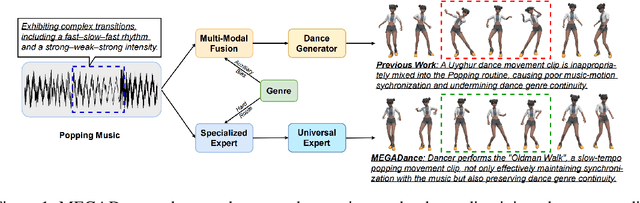
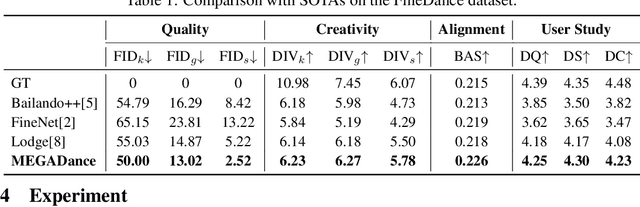
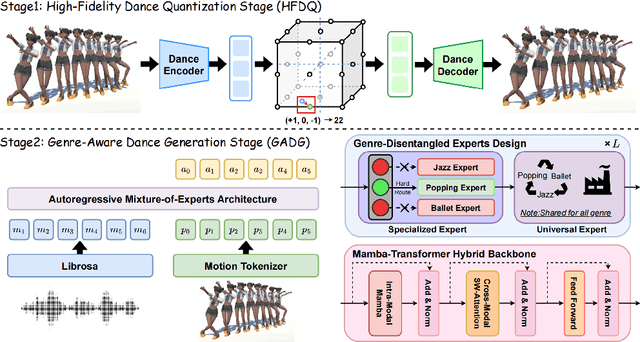
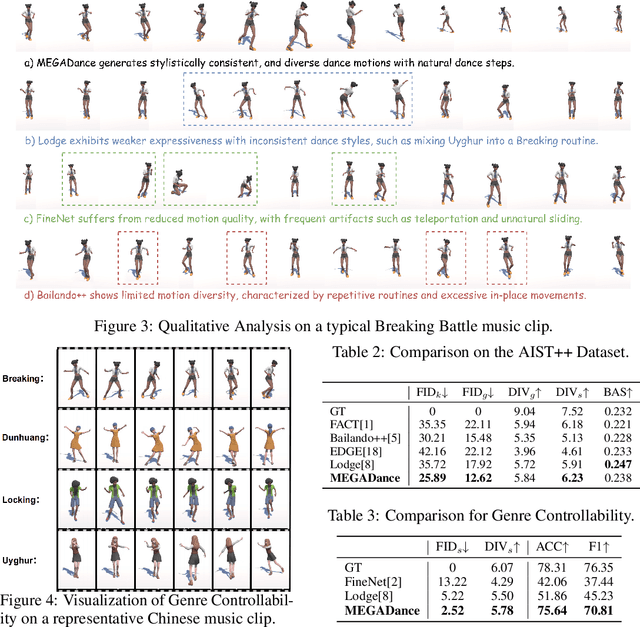
Music-driven 3D dance generation has attracted increasing attention in recent years, with promising applications in choreography, virtual reality, and creative content creation. Previous research has generated promising realistic dance movement from audio signals. However, traditional methods underutilize genre conditioning, often treating it as auxiliary modifiers rather than core semantic drivers. This oversight compromises music-motion synchronization and disrupts dance genre continuity, particularly during complex rhythmic transitions, thereby leading to visually unsatisfactory effects. To address the challenge, we propose MEGADance, a novel architecture for music-driven 3D dance generation. By decoupling choreographic consistency into dance generality and genre specificity, MEGADance demonstrates significant dance quality and strong genre controllability. It consists of two stages: (1) High-Fidelity Dance Quantization Stage (HFDQ), which encodes dance motions into a latent representation by Finite Scalar Quantization (FSQ) and reconstructs them with kinematic-dynamic constraints, and (2) Genre-Aware Dance Generation Stage (GADG), which maps music into the latent representation by synergistic utilization of Mixture-of-Experts (MoE) mechanism with Mamba-Transformer hybrid backbone. Extensive experiments on the FineDance and AIST++ dataset demonstrate the state-of-the-art performance of MEGADance both qualitatively and quantitatively. Code will be released upon acceptance.
Enhancing Dance-to-Music Generation via Negative Conditioning Latent Diffusion Model
Mar 28, 2025Conditional diffusion models have gained increasing attention since their impressive results for cross-modal synthesis, where the strong alignment between conditioning input and generated output can be achieved by training a time-conditioned U-Net augmented with cross-attention mechanism. In this paper, we focus on the problem of generating music synchronized with rhythmic visual cues of the given dance video. Considering that bi-directional guidance is more beneficial for training a diffusion model, we propose to enhance the quality of generated music and its synchronization with dance videos by adopting both positive rhythmic information and negative ones (PN-Diffusion) as conditions, where a dual diffusion and reverse processes is devised. Specifically, to train a sequential multi-modal U-Net structure, PN-Diffusion consists of a noise prediction objective for positive conditioning and an additional noise prediction objective for negative conditioning. To accurately define and select both positive and negative conditioning, we ingeniously utilize temporal correlations in dance videos, capturing positive and negative rhythmic cues by playing them forward and backward, respectively. Through subjective and objective evaluations of input-output correspondence in terms of dance-music beat alignment and the quality of generated music, experimental results on the AIST++ and TikTok dance video datasets demonstrate that our model outperforms SOTA dance-to-music generation models.
AutoComPose: Automatic Generation of Pose Transition Descriptions for Composed Pose Retrieval Using Multimodal LLMs
Mar 28, 2025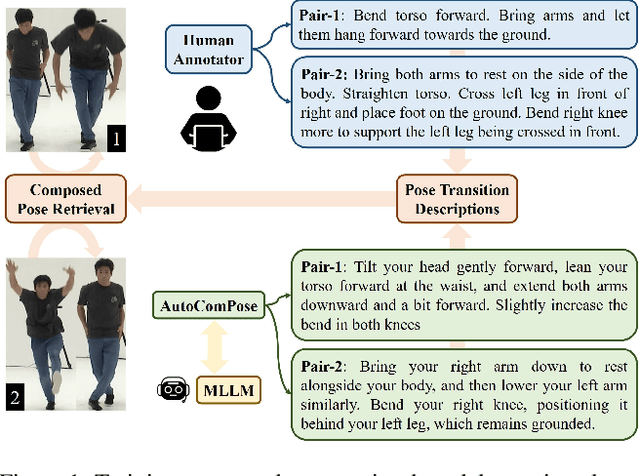
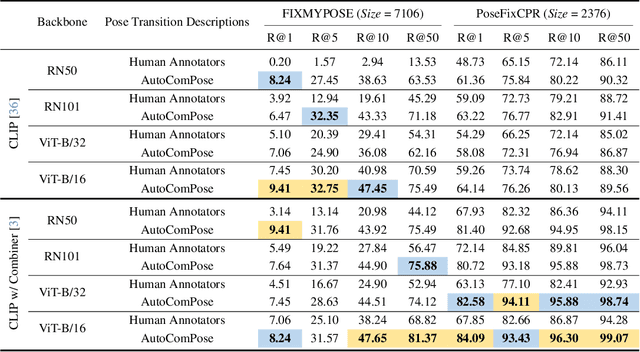
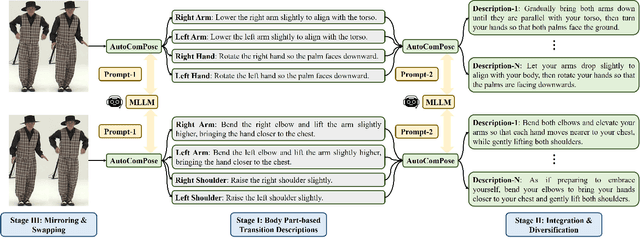
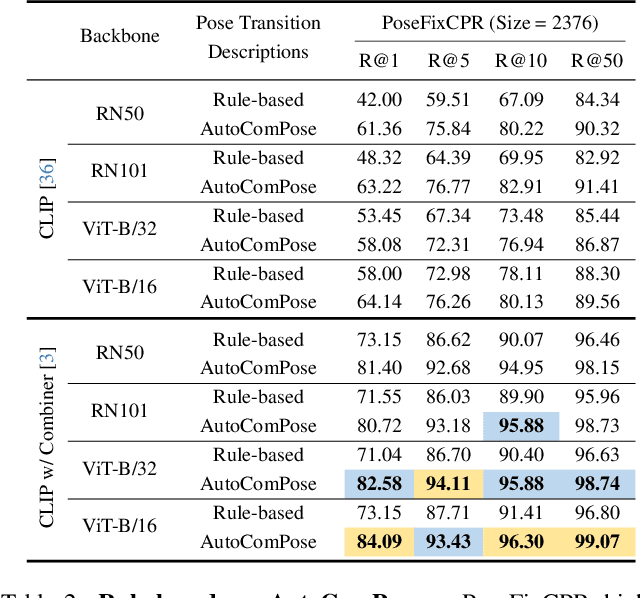
Composed pose retrieval (CPR) enables users to search for human poses by specifying a reference pose and a transition description, but progress in this field is hindered by the scarcity and inconsistency of annotated pose transitions. Existing CPR datasets rely on costly human annotations or heuristic-based rule generation, both of which limit scalability and diversity. In this work, we introduce AutoComPose, the first framework that leverages multimodal large language models (MLLMs) to automatically generate rich and structured pose transition descriptions. Our method enhances annotation quality by structuring transitions into fine-grained body part movements and introducing mirrored/swapped variations, while a cyclic consistency constraint ensures logical coherence between forward and reverse transitions. To advance CPR research, we construct and release two dedicated benchmarks, AIST-CPR and PoseFixCPR, supplementing prior datasets with enhanced attributes. Extensive experiments demonstrate that training retrieval models with AutoComPose yields superior performance over human-annotated and heuristic-based methods, significantly reducing annotation costs while improving retrieval quality. Our work pioneers the automatic annotation of pose transitions, establishing a scalable foundation for future CPR research.