 Add to Chrome
 Add to Firefox
 Add to Edge
The Many Senses of Visual Similarity: A Text-Prompted Image Perceptual Metric
Jul 20, 2026
Human visual similarity judgments are context-dependent. For example, two images may be similar in shape but distinct in color. Existing perceptual similarity metrics, however, collapse these nuances into a single scalar value, offering no mechanism to condition on specific aspects. To bridge this gap, we introduce a large-scale dataset of human similarity judgments over image triplets, where each triplet is annotated across multiple, free-form semantic aspects of similarity. Benchmarking a broad range of frontier vision-language models (VLMs) reveals a considerable performance gap compared to human annotators' consensus. Leveraging our data, we fine-tune a VLM to produce our Text-Prompted Image Perceptual Similarity (TPIPS) metric, capturing multiple senses of visual similarity depending on the specified text prompt. We demonstrate that TPIPS aligns more closely with human perception and generalizes reliably beyond the training distribution. Finally, we show that TPIPS unlocks new capabilities in text-guided retrieval, compositional search, and the fine-grained evaluation of generative models. Our code, data, and trained models are at https://peterwang512.github.io/TPIPS

Improved Baselines with Representation Autoencoders
May 18, 2026Representation Autoencoders (RAE) replace traditional VAE with pretrained vision encoders. In this paper, we systematically investigate several design choices and find three insights which simplify and improve RAE. First, we study a generalized formulation where the representation is defined as sum of the last k encoder layers rather than solely the final layer. This simple change greatly improves reconstruction without encoder finetuning or specialized data (e.g., text, faces). Second, we study the prevalent assumption that RAE (using pretrained representation as encoder) replaces representation alignment (REPA), which distills the same representation to intermediate layers instead. Through large-scale empirical analysis, we uncover a surprising finding: RAE and REPA exhibit complementary working mechanisms, allowing the same representation to be used as both encoder and target for intermediate diffusion layers. Finally, the original RAE struggles with classifier-free guidance (CFG) and requires training a second, weaker diffusion model for AutoGuidance (AG). We show that REPA itself can be viewed as x-prediction in RAE latent space. By simply re-parameterizing the output of the DiT model, it can provide guidance for "free". Overall, RAEv2 leads to more than 10x faster convergence over the original RAE, achieving a state-of-the-art gFID of 1.06 in just 80 epochs on ImageNet-256. On FDr^k, RAEv2 achieves a state-of-the-art 2.17 at just 80 epochs compared to the previous best 3.26 (800 epochs) without any post-training. This motivates EP_FID@k (epochs to reach unguided gFID <= k) as a measure of training efficiency. RAEv2 attains an EP_FID@2 of 35 epochs, versus 177 for the original RAE. We also validate our approach across diverse settings for text-to-image generation and navigation world models, showing consistent improvements. Code is available at https://raev2.github.io.
ID-Sim: An Identity-Focused Similarity Metric
Apr 06, 2026Humans have remarkable selective sensitivity to identities -- easily distinguishing between highly similar identities, even across significantly different contexts such as diverse viewpoints or lighting. Vision models have struggled to match this capability, and progress toward identity-focused tasks such as personalized image generation is slowed by a lack of identity-focused evaluation metrics. To help facilitate progress, we propose ID-Sim, a feed-forward metric designed to faithfully reflect human selective sensitivity. To build ID-Sim, we curate a high-quality training set of images spanning diverse real-world domains, augmented with generative synthetic data that provides controlled, fine-grained identity and contextual variations. We evaluate our metric on a new unified evaluation benchmark for assessing consistency with human annotations across identity-focused recognition, retrieval, and generative tasks.
End-to-End Training for Unified Tokenization and Latent Denoising
Mar 23, 2026Latent diffusion models (LDMs) enable high-fidelity synthesis by operating in learned latent spaces. However, training state-of-the-art LDMs requires complex staging: a tokenizer must be trained first, before the diffusion model can be trained in the frozen latent space. We propose UNITE - an autoencoder architecture for unified tokenization and latent diffusion. UNITE consists of a Generative Encoder that serves as both image tokenizer and latent generator via weight sharing. Our key insight is that tokenization and generation can be viewed as the same latent inference problem under different conditioning regimes: tokenization infers latents from fully observed images, whereas generation infers them from noise together with text or class conditioning. Motivated by this, we introduce a single-stage training procedure that jointly optimizes both tasks via two forward passes through the same Generative Encoder. The shared parameters enable gradients to jointly shape the latent space, encouraging a "common latent language". Across image and molecule modalities, UNITE achieves near state of the art performance without adversarial losses or pretrained encoders (e.g., DINO), reaching FID 2.12 and 1.73 for Base and Large models on ImageNet 256 x 256. We further analyze the Generative Encoder through the lenses of representation alignment and compression. These results show that single stage joint training of tokenization & generation from scratch is feasible.
Beyond Simulations: What 20,000 Real Conversations Reveal About Mental Health AI Safety
Jan 14, 2026Large language models (LLMs) are increasingly used for mental health support, yet existing safety evaluations rely primarily on small, simulation-based test sets that have an unknown relationship to the linguistic distribution of real usage. In this study, we present replications of four published safety test sets targeting suicide risk assessment, harmful content generation, refusal robustness, and adversarial jailbreaks for a leading frontier generic AI model alongside an AI purpose built for mental health support. We then propose and conduct an ecological audit on over 20,000 real-world user conversations with the purpose-built AI designed with layered suicide and non-suicidal self-injury (NSSI) safeguards to compare test set performance to real world performance. While the purpose-built AI was significantly less likely than general-purpose LLMs to produce enabling or harmful content across suicide/NSSI (.4-11.27% vs 29.0-54.4%), eating disorder (8.4% vs 54.0%), and substance use (9.9% vs 45.0%) benchmark prompts, test set failure rates for suicide/NSSI were far higher than in real-world deployment. Clinician review of flagged conversations from the ecological audit identified zero cases of suicide risk that failed to receive crisis resources. Across all 20,000 conversations, three mentions of NSSI risk (.015%) did not trigger a crisis intervention; among sessions flagged by the LLM judge, this corresponds to an end-to-end system false negative rate of .38%, providing a lower bound on real-world safety failures. These findings support a shift toward continuous, deployment-relevant safety assurance for AI mental-health systems rather than limited set benchmark certification.
Self-Evaluation Unlocks Any-Step Text-to-Image Generation
Dec 26, 2025We introduce the Self-Evaluating Model (Self-E), a novel, from-scratch training approach for text-to-image generation that supports any-step inference. Self-E learns from data similarly to a Flow Matching model, while simultaneously employing a novel self-evaluation mechanism: it evaluates its own generated samples using its current score estimates, effectively serving as a dynamic self-teacher. Unlike traditional diffusion or flow models, it does not rely solely on local supervision, which typically necessitates many inference steps. Unlike distillation-based approaches, it does not require a pretrained teacher. This combination of instantaneous local learning and self-driven global matching bridges the gap between the two paradigms, enabling the training of a high-quality text-to-image model from scratch that excels even at very low step counts. Extensive experiments on large-scale text-to-image benchmarks show that Self-E not only excels in few-step generation, but is also competitive with state-of-the-art Flow Matching models at 50 steps. We further find that its performance improves monotonically as inference steps increase, enabling both ultra-fast few-step generation and high-quality long-trajectory sampling within a single unified model. To our knowledge, Self-E is the first from-scratch, any-step text-to-image model, offering a unified framework for efficient and scalable generation.
What matters for Representation Alignment: Global Information or Spatial Structure?
Dec 11, 2025Representation alignment (REPA) guides generative training by distilling representations from a strong, pretrained vision encoder to intermediate diffusion features. We investigate a fundamental question: what aspect of the target representation matters for generation, its \textit{global} \revision{semantic} information (e.g., measured by ImageNet-1K accuracy) or its spatial structure (i.e. pairwise cosine similarity between patch tokens)? Prevalent wisdom holds that stronger global semantic performance leads to better generation as a target representation. To study this, we first perform a large-scale empirical analysis across 27 different vision encoders and different model scales. The results are surprising; spatial structure, rather than global performance, drives the generation performance of a target representation. To further study this, we introduce two straightforward modifications, which specifically accentuate the transfer of \emph{spatial} information. We replace the standard MLP projection layer in REPA with a simple convolution layer and introduce a spatial normalization layer for the external representation. Surprisingly, our simple method (implemented in $<$4 lines of code), termed iREPA, consistently improves convergence speed of REPA, across a diverse set of vision encoders, model sizes, and training variants (such as REPA, REPA-E, Meanflow, JiT etc). %, etc. Our work motivates revisiting the fundamental working mechanism of representational alignment and how it can be leveraged for improved training of generative models. The code and project page are available at https://end2end-diffusion.github.io/irepa
Group Diffusion: Enhancing Image Generation by Unlocking Cross-Sample Collaboration
Dec 11, 2025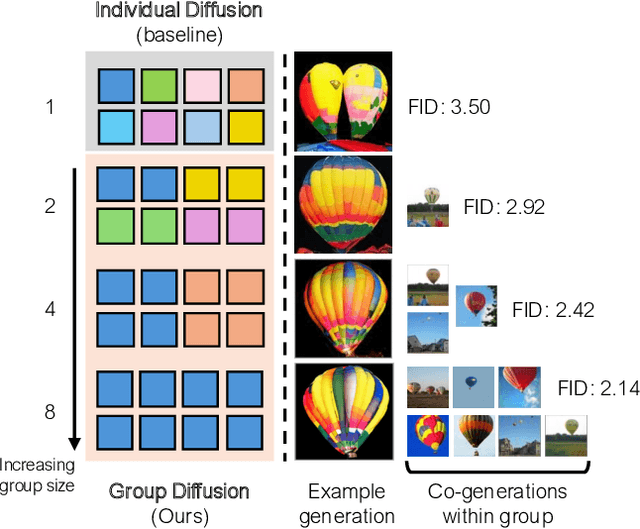
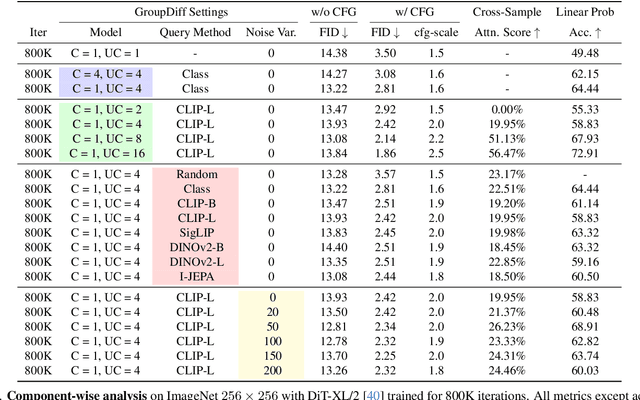
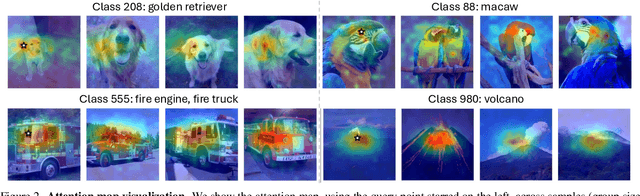
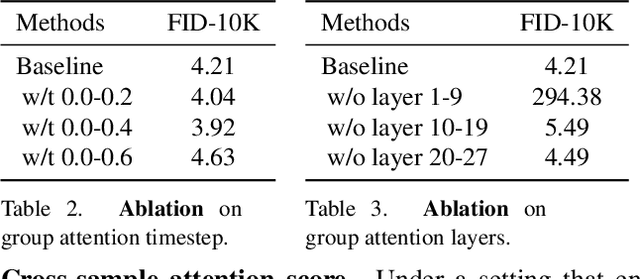
In this work, we explore an untapped signal in diffusion model inference. While all previous methods generate images independently at inference, we instead ask if samples can be generated collaboratively. We propose Group Diffusion, unlocking the attention mechanism to be shared across images, rather than limited to just the patches within an image. This enables images to be jointly denoised at inference time, learning both intra and inter-image correspondence. We observe a clear scaling effect - larger group sizes yield stronger cross-sample attention and better generation quality. Furthermore, we introduce a qualitative measure to capture this behavior and show that its strength closely correlates with FID. Built on standard diffusion transformers, our GroupDiff achieves up to 32.2% FID improvement on ImageNet-256x256. Our work reveals cross-sample inference as an effective, previously unexplored mechanism for generative modeling.
Fast Data Attribution for Text-to-Image Models
Nov 13, 2025Data attribution for text-to-image models aims to identify the training images that most significantly influenced a generated output. Existing attribution methods involve considerable computational resources for each query, making them impractical for real-world applications. We propose a novel approach for scalable and efficient data attribution. Our key idea is to distill a slow, unlearning-based attribution method to a feature embedding space for efficient retrieval of highly influential training images. During deployment, combined with efficient indexing and search methods, our method successfully finds highly influential images without running expensive attribution algorithms. We show extensive results on both medium-scale models trained on MSCOCO and large-scale Stable Diffusion models trained on LAION, demonstrating that our method can achieve better or competitive performance in a few seconds, faster than existing methods by 2,500x - 400,000x. Our work represents a meaningful step towards the large-scale application of data attribution methods on real-world models such as Stable Diffusion.
Learning an Image Editing Model without Image Editing Pairs
Oct 16, 2025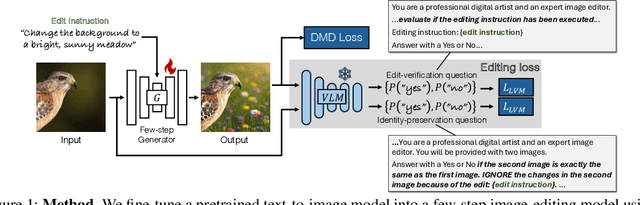
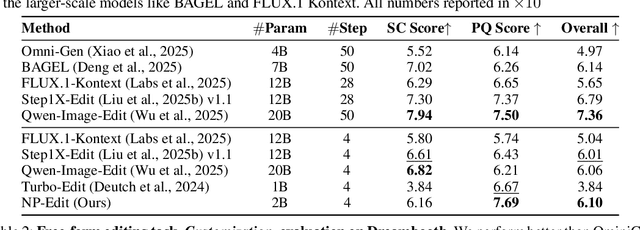
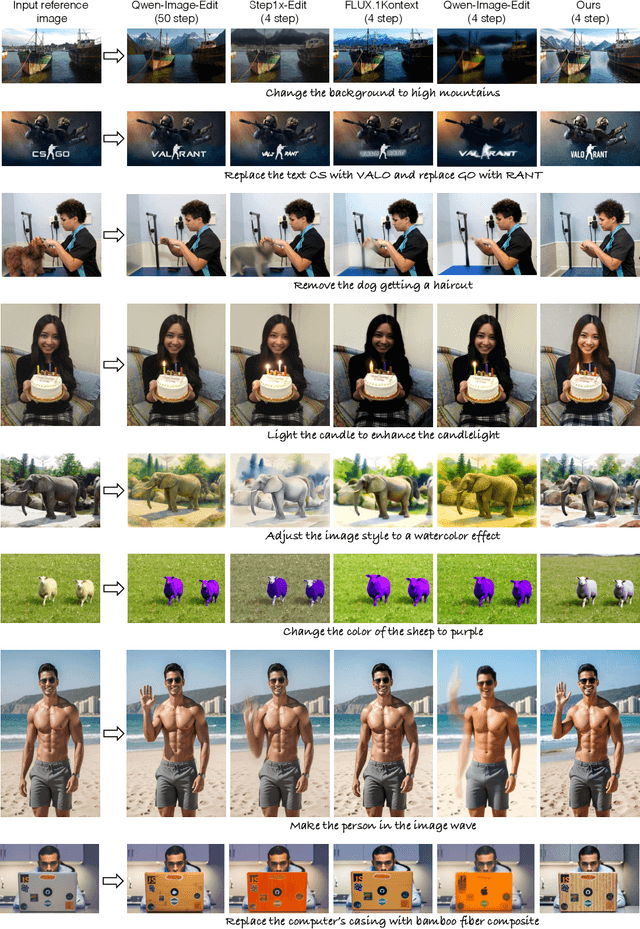
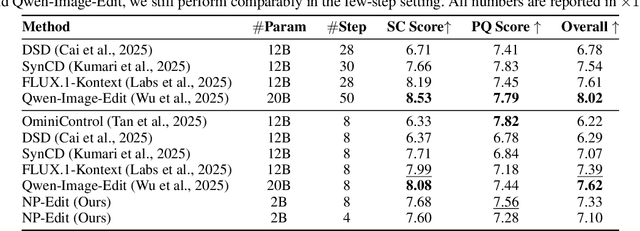
Recent image editing models have achieved impressive results while following natural language editing instructions, but they rely on supervised fine-tuning with large datasets of input-target pairs. This is a critical bottleneck, as such naturally occurring pairs are hard to curate at scale. Current workarounds use synthetic training pairs that leverage the zero-shot capabilities of existing models. However, this can propagate and magnify the artifacts of the pretrained model into the final trained model. In this work, we present a new training paradigm that eliminates the need for paired data entirely. Our approach directly optimizes a few-step diffusion model by unrolling it during training and leveraging feedback from vision-language models (VLMs). For each input and editing instruction, the VLM evaluates if an edit follows the instruction and preserves unchanged content, providing direct gradients for end-to-end optimization. To ensure visual fidelity, we incorporate distribution matching loss (DMD), which constrains generated images to remain within the image manifold learned by pretrained models. We evaluate our method on standard benchmarks and include an extensive ablation study. Without any paired data, our method performs on par with various image editing diffusion models trained on extensive supervised paired data, under the few-step setting. Given the same VLM as the reward model, we also outperform RL-based techniques like Flow-GRPO.