 Add to Chrome
 Add to Firefox
 Add to Edge
CMDS-AD: Cross-Modal Dual-Stream Decoupling for Few-Shot Anomaly Detection
Jun 18, 2026
Few-shot anomaly detection remains challenging due to limited training data. Multi-modal anomaly detection (MAD) offers a viable solution, leveraging 3D geometric cues to enrich 2D RGB representations and compensate for this scarcity. However, existing MAD methods apply spatially uniform feature processing, conflating stable macroscopic structures with high-frequency localized defect signals, exacerbating cross-modal misalignment and inflating false-positive rates. To overcome this, we present CMDS-AD, a Cross-Modal Dual-Stream Anomaly Detection framework. A LoRA-guided diffusion model generates diverse RGB samples to mitigate extreme data scarcity. For 3D normal augmentation, we employ a pre-trained diffusion model as a normal estimator. Crucially, this estimator inherently acts as a non-linear low-pass filter, directly extracting low-frequency normal representations from RGB inputs. This establishes an auxiliary estimated stream of purely low-frequency information, anchoring robust structural templates and assisting the uncompressed real stream, containing coupled high- and low-frequency components, to precisely isolate micro-defects. A Coordinate-Aware Hierarchical Feature Mapper adaptively aligns cross-modal semantics, while a multiplicative scoring mechanism filters modality-specific noise. Under the extreme 1-shot setting, CMDS-AD achieves absolute performance gains of 5.7% (I-AUROC) and 2.0% (AUPRO) on MVTec 3D-AD, alongside 7.7% and 5.6% improvements on EyeCandies, establishing a new state-of-the-art.

ForgeDreamer: Industrial Text-to-3D Generation with Multi-Expert LoRA and Cross-View Hypergraph
Mar 10, 2026Current text-to-3D generation methods excel in natural scenes but struggle with industrial applications due to two critical limitations: domain adaptation challenges where conventional LoRA fusion causes knowledge interference across categories, and geometric reasoning deficiencies where pairwise consistency constraints fail to capture higher-order structural dependencies essential for precision manufacturing. We propose a novel framework named ForgeDreamer addressing both challenges through two key innovations. First, we introduce a Multi-Expert LoRA Ensemble mechanism that consolidates multiple category-specific LoRA models into a unified representation, achieving superior cross-category generalization while eliminating knowledge interference. Second, building on enhanced semantic understanding, we develop a Cross-View Hypergraph Geometric Enhancement approach that captures structural dependencies spanning multiple viewpoints simultaneously. These components work synergistically improved semantic understanding, enables more effective geometric reasoning, while hypergraph modeling ensures manufacturing-level consistency. Extensive experiments on a custom industrial dataset demonstrate superior semantic generalization and enhanced geometric fidelity compared to state-of-the-art approaches. Our code and data are provided in the supplementary material attached in the appendix for review purposes.
Multimodal Task Representation Memory Bank vs. Catastrophic Forgetting in Anomaly Detection
Feb 10, 2025


Unsupervised Continuous Anomaly Detection (UCAD) faces significant challenges in multi-task representation learning, with existing methods suffering from incomplete representation and catastrophic forgetting. Unlike supervised models, unsupervised scenarios lack prior information, making it difficult to effectively distinguish redundant and complementary multimodal features. To address this, we propose the Multimodal Task Representation Memory Bank (MTRMB) method through two key technical innovations: A Key-Prompt-Multimodal Knowledge (KPMK) mechanism that uses concise key prompts to guide cross-modal feature interaction between BERT and ViT. Refined Structure-based Contrastive Learning (RSCL) leveraging Grounding DINO and SAM to generate precise segmentation masks, pulling features of the same structural region closer while pushing different structural regions apart. Experiments on MVtec AD and VisA datasets demonstrate MTRMB's superiority, achieving an average detection accuracy of 0.921 at the lowest forgetting rate, significantly outperforming state-of-the-art methods. We plan to open source on GitHub.
A Survey on RGB, 3D, and Multimodal Approaches for Unsupervised Industrial Anomaly Detection
Oct 29, 2024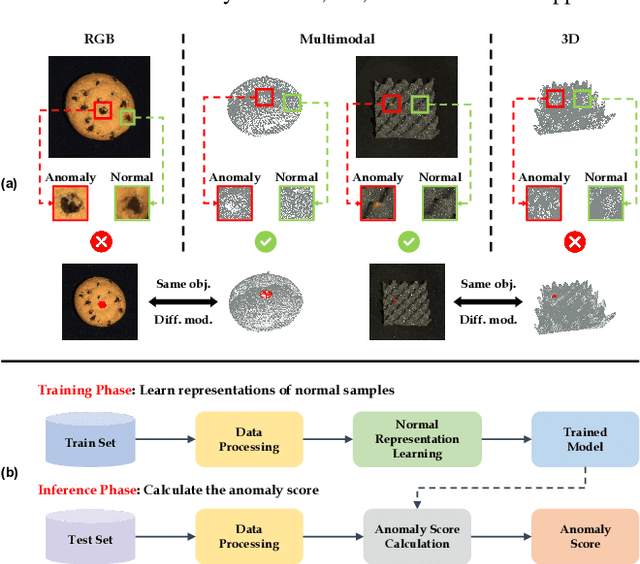
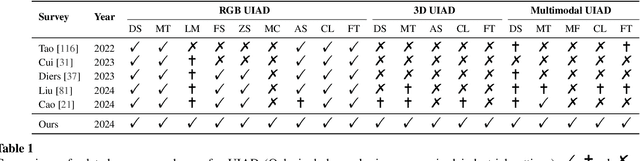
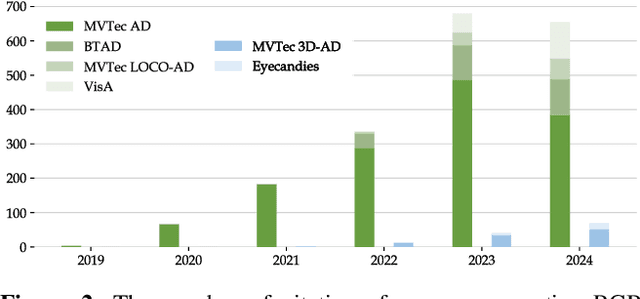
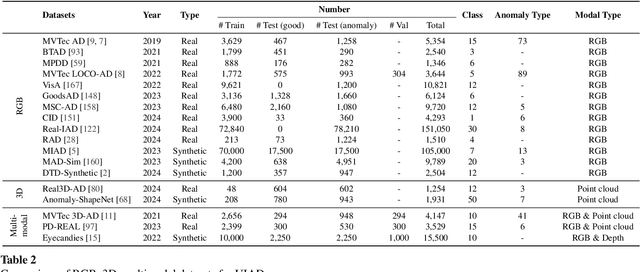
In the advancement of industrial informatization, Unsupervised Industrial Anomaly Detection (UIAD) technology effectively overcomes the scarcity of abnormal samples and significantly enhances the automation and reliability of smart manufacturing. While RGB, 3D, and multimodal anomaly detection have demonstrated comprehensive and robust capabilities within the industrial informatization sector, existing reviews on industrial anomaly detection have not sufficiently classified and discussed methods in 3D and multimodal settings. We focus on 3D UIAD and multimodal UIAD, providing a comprehensive summary of unsupervised industrial anomaly detection in three modal settings. Firstly, we compare our surveys with recent works, introducing commonly used datasets, evaluation metrics, and the definitions of anomaly detection problems. Secondly, we summarize five research paradigms in RGB, 3D and multimodal UIAD and three emerging industrial manufacturing optimization directions in RGB UIAD, and review three multimodal feature fusion strategies in multimodal settings. Finally, we outline the primary challenges currently faced by UIAD in three modal settings, and offer insights into future development directions, aiming to provide researchers with a thorough reference and offer new perspectives for the advancement of industrial informatization. Corresponding resources are available at https://github.com/Sunny5250/Awesome-Multi-Setting-UIAD.