 Add to Chrome
 Add to Firefox
 Add to Edge
Hypergraph-based Multimodal Retrieval-Augmented Generation with Incremental Refinement
Aug 17, 2026
Modern Multimodal Retrieval-Augmented Generation (M-RAG) systems are fundamentally limited by the binary connectivity paradigm of traditional simple graphs, which fails to capture the intricate, high-order correlations among heterogeneous entities, such as the N-ary relationships between a visual chart, its scattered textual descriptions, and underlying numerical data. Furthermore, existing refinement strategies often rely on exhaustive, full-page reconstruction to align cross-modal information, leading to prohibitive computational redundancy and the introduction of contextual noise in long-form document processing. In this paper, we propose Hyper-M2RAG, a novel framework that redefines multimodal document retrieval through High-order Hypergraph Representation Learning. We first formalize the document structure as a Multimodal Hypergraph, utilizing hyperedges as unified semantic containers to encapsulate multi-way associations across text, images, and tables, thereby transcending point-to-point modeling. To mitigate semantic fragmentation caused by physical pagination, we introduce an Anchor-driven Incremental Refinement mechanism. Rather than performing a global sweep, our approach identifies boundary-crossing anchor nodes and reconstructs their local hyper-topology using one-hop neighborhood contexts. This targeted refinement effectively bridges cross-page knowledge gaps with minimal computational footprints. Extensive evaluations on multimodal benchmarking datasets demonstrate that Hyper-M2RAG significantly outperforms state-of-the-art methods in both retrieval precision and generation coherence. Our code is available at https://github.com/ShenAoChen2001/MMHRAG.

SABER: A Semantic-Aligned Brain Network Analysis Framework via Multi-scale Hypergraphs
Jul 02, 2026Effective brain disease diagnosis requires the synergy of brain connectivity patterns and high-level semantic knowledge. Existing methods, however, largely treat semantics from large language models (LLMs) as auxiliary features or supervision, limiting their direct role in decision-making and constraining classification stability and robustness. To overcome this, we propose a semantic-aligned brain network framework that actively integrates LLM-derived semantics into the prediction process. Specifically, ROI-level semantics are first incorporated via global self-attention to enrich node representations and provide whole-brain context. Multi-scale hypergraphs are then constructed to explicitly model functional subnetworks and multi-ROI interactions, addressing the locality limitations of traditional GNNs and capturing high-order dependencies. Finally, a decision-level semantic alignment mechanism selectively injects patient-specific textual embeddings into graph representations, enabling semantics to directly guide predictions without perturbing the underlying network structure. Experiments on public brain network datasets ABIDE and ADHD-200 demonstrate state-of-the-art performance, enhanced stability, and improved interpretability, particularly in small-sample settings.
Hypergraph Foundation Model
Mar 03, 2025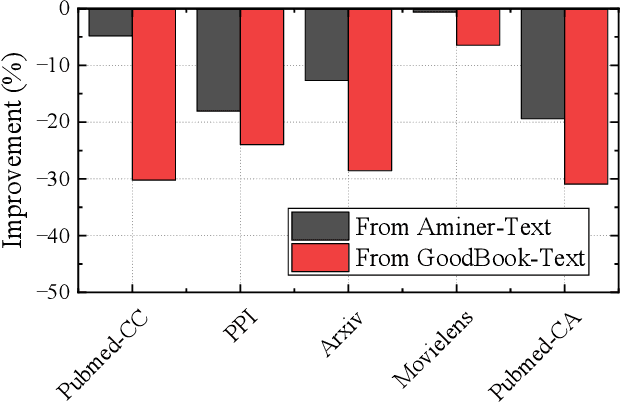
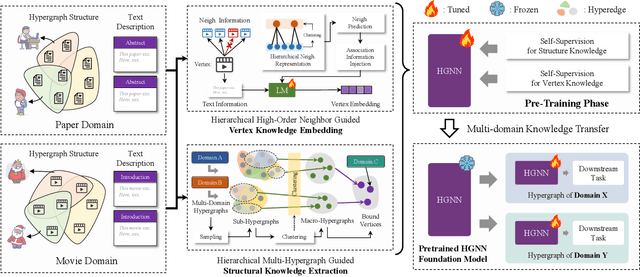

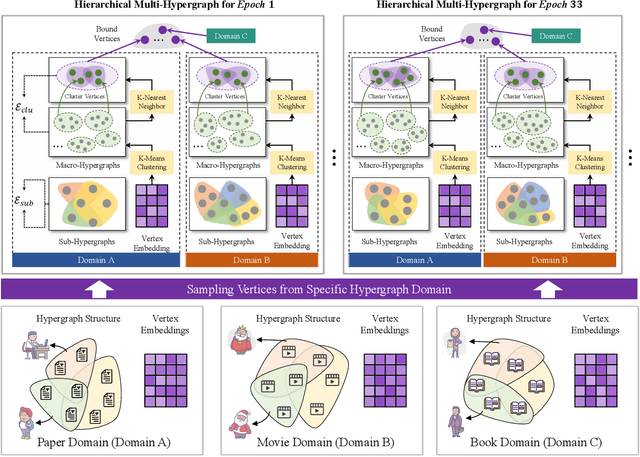
Hypergraph neural networks (HGNNs) effectively model complex high-order relationships in domains like protein interactions and social networks by connecting multiple vertices through hyperedges, enhancing modeling capabilities, and reducing information loss. Developing foundation models for hypergraphs is challenging due to their distinct data, which includes both vertex features and intricate structural information. We present Hyper-FM, a Hypergraph Foundation Model for multi-domain knowledge extraction, featuring Hierarchical High-Order Neighbor Guided Vertex Knowledge Embedding for vertex feature representation and Hierarchical Multi-Hypergraph Guided Structural Knowledge Extraction for structural information. Additionally, we curate 10 text-attributed hypergraph datasets to advance research between HGNNs and LLMs. Experiments on these datasets show that Hyper-FM outperforms baseline methods by approximately 13.3\%, validating our approach. Furthermore, we propose the first scaling law for hypergraph foundation models, demonstrating that increasing domain diversity significantly enhances performance, unlike merely augmenting vertex and hyperedge counts. This underscores the critical role of domain diversity in scaling hypergraph models.
Pseudo-Data based Self-Supervised Federated Learning for Classification of Histopathological Images
May 31, 2022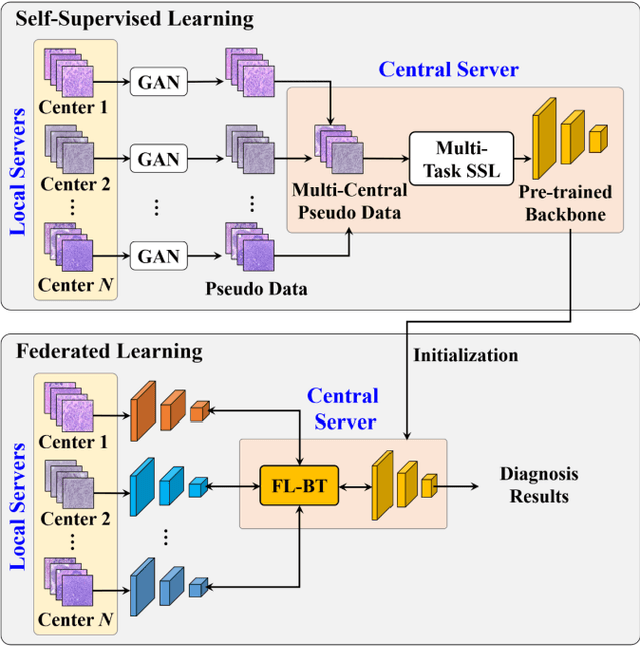
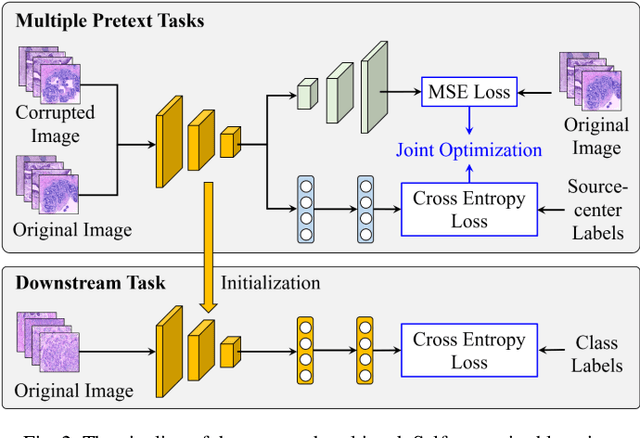
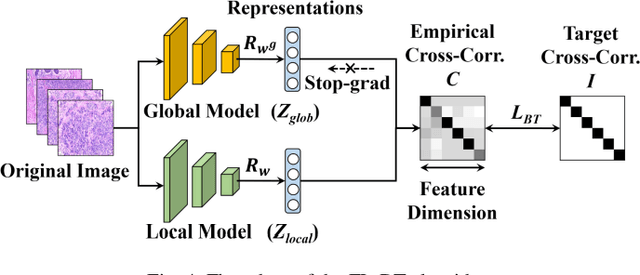
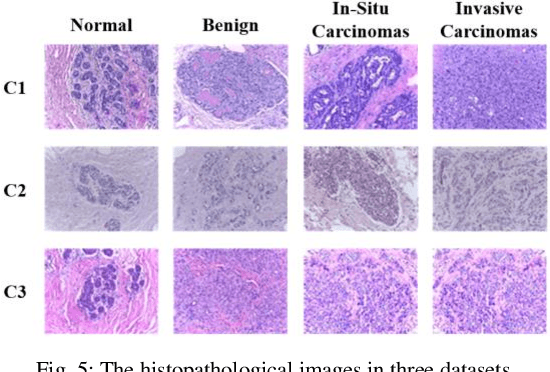
Computer-aided diagnosis (CAD) can help pathologists improve diagnostic accuracy together with consistency and repeatability for cancers. However, the CAD models trained with the histopathological images only from a single center (hospital) generally suffer from the generalization problem due to the straining inconsistencies among different centers. In this work, we propose a pseudo-data based self-supervised federated learning (FL) framework, named SSL-FT-BT, to improve both the diagnostic accuracy and generalization of CAD models. Specifically, the pseudo histopathological images are generated from each center, which contains inherent and specific properties corresponding to the real images in this center, but does not include the privacy information. These pseudo images are then shared in the central server for self-supervised learning (SSL). A multi-task SSL is then designed to fully learn both the center-specific information and common inherent representation according to the data characteristics. Moreover, a novel Barlow Twins based FL (FL-BT) algorithm is proposed to improve the local training for the CAD model in each center by conducting contrastive learning, which benefits the optimization of the global model in the FL procedure. The experimental results on three public histopathological image datasets indicate the effectiveness of the proposed SSL-FL-BT on both diagnostic accuracy and generalization.