 Add to Chrome
 Add to Firefox
 Add to Edge
VizDefender: Unmasking Visualization Tampering through Proactive Localization and Intent Inference
Dec 21, 2025
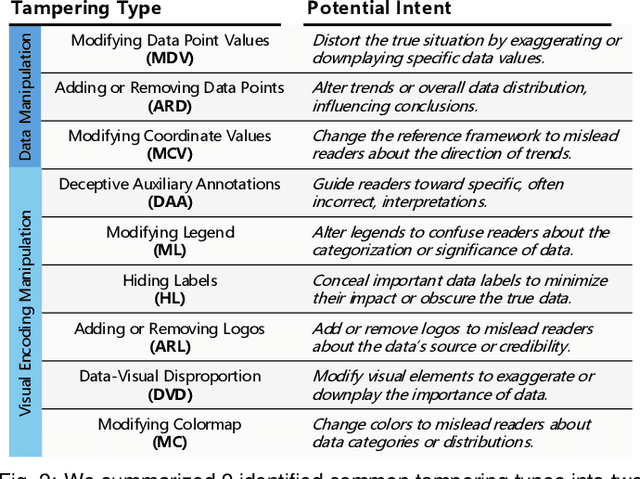
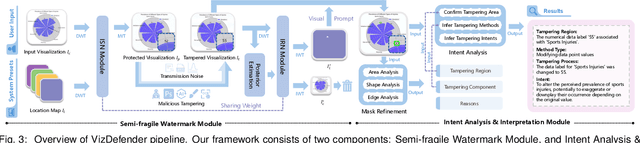
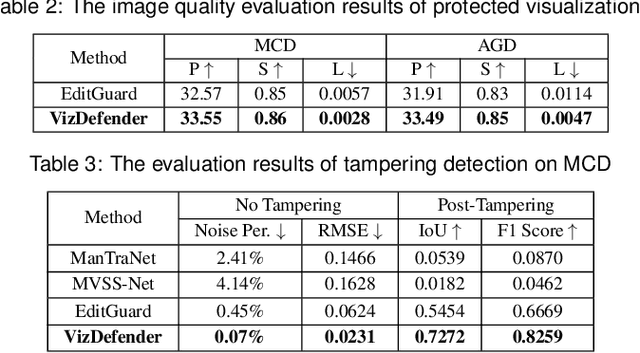
The integrity of data visualizations is increasingly threatened by image editing techniques that enable subtle yet deceptive tampering. Through a formative study, we define this challenge and categorize tampering techniques into two primary types: data manipulation and visual encoding manipulation. To address this, we present VizDefender, a framework for tampering detection and analysis. The framework integrates two core components: 1) a semi-fragile watermark module that protects the visualization by embedding a location map to images, which allows for the precise localization of tampered regions while preserving visual quality, and 2) an intent analysis module that leverages Multimodal Large Language Models (MLLMs) to interpret manipulation, inferring the attacker's intent and misleading effects. Extensive evaluations and user studies demonstrate the effectiveness of our methods.

TextCenGen: Attention-Guided Text-Centric Background Adaptation for Text-to-Image Generation
Apr 18, 2024Recent advancements in Text-to-image (T2I) generation have witnessed a shift from adapting text to fixed backgrounds to creating images around text. Traditional approaches are often limited to generate layouts within static images for effective text placement. Our proposed approach, TextCenGen, introduces a dynamic adaptation of the blank region for text-friendly image generation, emphasizing text-centric design and visual harmony generation. Our method employs force-directed attention guidance in T2I models to generate images that strategically reserve whitespace for pre-defined text areas, even for text or icons at the golden ratio. Observing how cross-attention maps affect object placement, we detect and repel conflicting objects using a force-directed graph approach, combined with a Spatial Excluding Cross-Attention Constraint for smooth attention in whitespace areas. As a novel task in graphic design, experiments indicate that TextCenGen outperforms existing methods with more harmonious compositions. Furthermore, our method significantly enhances T2I model outcomes on our specially collected prompt datasets, catering to varied text positions. These results demonstrate the efficacy of TextCenGen in creating more harmonious and integrated text-image compositions.