 Add to Chrome
 Add to Firefox
 Add to Edge
GraphIR: Architecture-Level Search States for LLM-Guided Neural Architecture Evolution
Aug 03, 2026
Large language models (LLMs) enable neural architecture search (NAS) directly over executable neural network programs. However, code-level flexibility does not provide the architecture state needed for effective mutation: LLMs must infer tensor dependencies, editable components, and compatibility constraints from implementation details. To address this representation mismatch, we propose GraphIR, an architecture-aware intermediate representation that supplements executable programs with a mutation-aligned candidate state. GraphIR organizes each candidate through three complementary views: a computation skeleton describing tensor flow, a mutation surface exposing editable modules and operations, and a validity envelope capturing interface contracts, propagated shapes, and downstream dependencies. To evaluate our method, we construct NAS-Dependency, a 120-question benchmark covering six complementary dependency-reasoning dimensions. The diagnostic shows that GraphIR is particularly effective at identifying exact producer occurrences, tracing dependency propagation, and diagnosing interface and failure risks. Across six downstream benchmarks including CLRS, GraphIR achieves the best overall search performance while maintaining comparable model size and favorable end-to-end NAS efficiency when integrated into OpenEvolve. These results show that a mutation-oriented architecture state provides an effective interface between executable neural programs and LLM-guided architecture evolution.

ToolAnchor: Anchoring Counterfactual Context to Boost Agentic Tool-use Capability
Jul 14, 2026Tool-augmented large language model agents excel at long-horizon tasks, yet they are typically post-trained on fixed toolsets. When tasks demand new tools, these agents struggle to incorporate them effectively, and retraining from scratch is often impractical. We identify the core obstacle in such toolset expansion problem as behavioral inertia: the tendency of agents to fall back on familiar tools and established reasoning patterns despite having access to new ones. We demonstrate that injecting counterfactual anchor contexts at critical decision points can break this inertia, recovering failed trajectories by eliciting suppressed agent capabilities. To scale this insight, we propose ToolAnchor, a framework that uses teacher models to hypothesize these counterfactual contexts, verifies them via student rollouts, and internalizes the successful interventions through agentic post-training. Extensive evaluations across general AI assistant (GAIA), textual search (BrowseComp), and visual search (VDR-Bench) tasks demonstrate that ToolAnchor consistently exhibits competitive performance under expanded toolsets. Our work bridges the gap between static post-training and dynamic adaptation, charting a new path for scalable agentic reinforcement learning.
Hierarchical Attacks for Multi-Modal Multi-Agent Reasoning
May 13, 2026Multi-modal multi-agent systems (MM-MAS) have gained increasing attention for their capacity to enable complex reasoning and coordination across diverse modalities. As these systems continue to expand in scale and functionality, investigating their potential vulnerabilities has become increasingly important. However, existing studies on adversarial attacks in multi-agent systems primarily focus on isolated agents or unimodal settings, leaving the vulnerabilities of MM-MAS largely underexplored. To bridge this gap, we introduce HAM$^{3}$, a Hierarchical Attack framework for multi-modal multi-agent systems that decomposes attacks into three interconnected layers. Specifically, at the perception layer, HAM$^{3}$ mounts attacks by perturbing visual inputs, textual inputs, and their fused visual-textual representations. At the communication layer, it performs communication-level attacks that corrupt message content and interaction topology, such as manipulating shared context or communication links to distort collective information flow. At the reasoning layer, it conducts reasoning-level attacks that interfere with each agent's cognitive pipeline, biasing reasoning trajectories and ultimately compromising final decisions. We evaluate HAM$^{3}$ on the GQA benchmark through multi-agent systems built on distinct reasoning paradigms including ReAct, Plan-and-Solve, and Reflexion. Experiments demonstrate that our framework achieves an Attack Success Rate of up to 78.3%, with reasoning-layer attacks being the most effective. More than half of the successful attacks lead multiple agents to produce consistent errors. These findings offer valuable insights for building more robust and interpretable multi-agent intelligence.
* Accepted to CVPR 2026
HEX: Humanoid-Aligned Experts for Cross-Embodiment Whole-Body Manipulation
Apr 09, 2026Humans achieve complex manipulation through coordinated whole-body control, whereas most Vision-Language-Action (VLA) models treat robot body parts largely independently, making high-DoF humanoid control challenging and often unstable. We present HEX, a state-centric framework for coordinated manipulation on full-sized bipedal humanoid robots. HEX introduces a humanoid-aligned universal state representation for scalable learning across heterogeneous embodiments, and incorporates a Mixture-of-Experts Unified Proprioceptive Predictor to model whole-body coordination and temporal motion dynamics from large-scale multi-embodiment trajectory data. To efficiently capture temporal visual context, HEX uses lightweight history tokens to summarize past observations, avoiding repeated encoding of historical images during inference. It further employs a residual-gated fusion mechanism with a flow-matching action head to adaptively integrate visual-language cues with proprioceptive dynamics for action generation. Experiments on real-world humanoid manipulation tasks show that HEX achieves state-of-the-art performance in task success rate and generalization, particularly in fast-reaction and long-horizon scenarios.
Reshaping Action Error Distributions for Reliable Vision-Language-Action Models
Feb 04, 2026In robotic manipulation, vision-language-action (VLA) models have emerged as a promising paradigm for learning generalizable and scalable robot policies. Most existing VLA frameworks rely on standard supervised objectives, typically cross-entropy for discrete actions and mean squared error (MSE) for continuous action regression, which impose strong pointwise constraints on individual predictions. In this work, we focus on continuous-action VLA models and move beyond conventional MSE-based regression by reshaping action error distributions during training. Drawing on information-theoretic principles, we introduce Minimum Error Entropy (MEE) into modern VLA architectures and propose a trajectory-level MEE objective, together with two weighted variants, combined with MSE for continuous-action VLA training. We evaluate our approaches across standard, few-shot, and noisy settings on multiple representative VLA architectures, using simulation benchmarks such as LIBERO and SimplerEnv as well as real-world robotic manipulation tasks. Experimental results demonstrate consistent improvements in success rates and robustness across these settings. Under imbalanced data regimes, the gains persist within a well-characterized operating range, while incurring negligible additional training cost and no impact on inference efficiency. We further provide theoretical analyses that explain why MEE-based supervision is effective and characterize its practical range. Project Page: https://cognition2actionlab.github.io/VLA-TMEE.github.io/
Latent Reasoning VLA: Latent Thinking and Prediction for Vision-Language-Action Models
Feb 01, 2026Vision-Language-Action (VLA) models benefit from chain-of-thought (CoT) reasoning, but existing approaches incur high inference overhead and rely on discrete reasoning representations that mismatch continuous perception and control. We propose Latent Reasoning VLA (\textbf{LaRA-VLA}), a unified VLA framework that internalizes multi-modal CoT reasoning into continuous latent representations for embodied action. LaRA-VLA performs unified reasoning and prediction in latent space, eliminating explicit CoT generation at inference time and enabling efficient, action-oriented control. To realize latent embodied reasoning, we introduce a curriculum-based training paradigm that progressively transitions from explicit textual and visual CoT supervision to latent reasoning, and finally adapts latent reasoning dynamics to condition action generation. We construct two structured CoT datasets and evaluate LaRA-VLA on both simulation benchmarks and long-horizon real-robot manipulation tasks. Experimental results show that LaRA-VLA consistently outperforms state-of-the-art VLA methods while reducing inference latency by up to 90\% compared to explicit CoT-based approaches, demonstrating latent reasoning as an effective and efficient paradigm for real-time embodied control. Project Page: \href{https://loveju1y.github.io/Latent-Reasoning-VLA/}{LaRA-VLA Website}.
Embodied Robot Manipulation in the Era of Foundation Models: Planning and Learning Perspectives
Dec 28, 2025Recent advances in vision, language, and multimodal learning have substantially accelerated progress in robotic foundation models, with robot manipulation remaining a central and challenging problem. This survey examines robot manipulation from an algorithmic perspective and organizes recent learning-based approaches within a unified abstraction of high-level planning and low-level control. At the high level, we extend the classical notion of task planning to include reasoning over language, code, motion, affordances, and 3D representations, emphasizing their role in structured and long-horizon decision making. At the low level, we propose a training-paradigm-oriented taxonomy for learning-based control, organizing existing methods along input modeling, latent representation learning, and policy learning. Finally, we identify open challenges and prospective research directions related to scalability, data efficiency, multimodal physical interaction, and safety. Together, these analyses aim to clarify the design space of modern foundation models for robotic manipulation.
Dual-Path Stable Soft Prompt Generation for Domain Generalization
May 24, 2025Domain generalization (DG) aims to learn a model using data from one or multiple related but distinct source domains that can generalize well to unseen out-of-distribution target domains. Inspired by the success of large pre-trained vision-language models (VLMs), prompt tuning has emerged as an effective generalization strategy. However, it often struggles to capture domain-specific features due to its reliance on manually or fixed prompt inputs. Recently, some prompt generation methods have addressed this limitation by dynamically generating instance-specific and domain-specific prompts for each input, enriching domain information and demonstrating potential for enhanced generalization. Through further investigation, we identify a notable issue in existing prompt generation methods: the same input often yields significantly different and suboptimal prompts across different random seeds, a phenomenon we term Prompt Variability. To address this, we introduce negative learning into the prompt generation process and propose Dual-Path Stable Soft Prompt Generation (DPSPG), a transformer-based framework designed to improve both the stability and generalization of prompts. Specifically, DPSPG incorporates a complementary prompt generator to produce negative prompts, thereby reducing the risk of introducing misleading information. Both theoretical and empirical analyses demonstrate that negative learning leads to more robust and effective prompts by increasing the effective margin and reducing the upper bound of the gradient norm. Extensive experiments on five DG benchmark datasets show that DPSPG consistently outperforms state-of-the-art methods while maintaining prompt stability.
OpenHelix: A Short Survey, Empirical Analysis, and Open-Source Dual-System VLA Model for Robotic Manipulation
May 06, 2025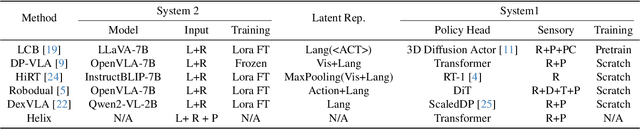
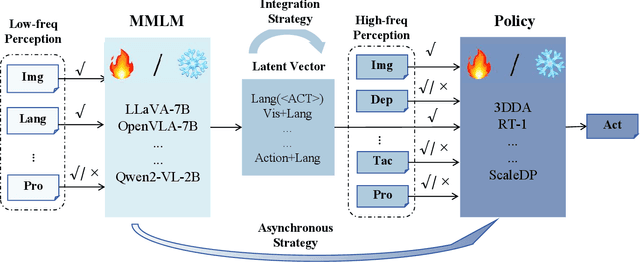
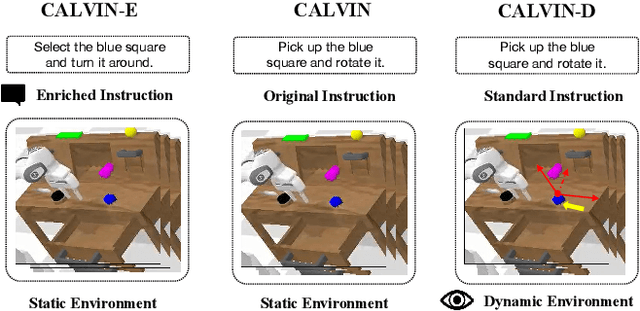
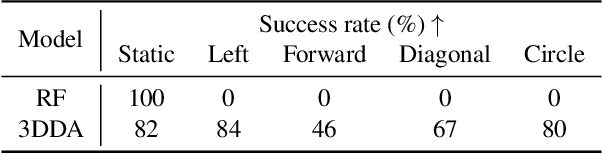
Dual-system VLA (Vision-Language-Action) architectures have become a hot topic in embodied intelligence research, but there is a lack of sufficient open-source work for further performance analysis and optimization. To address this problem, this paper will summarize and compare the structural designs of existing dual-system architectures, and conduct systematic empirical evaluations on the core design elements of existing dual-system architectures. Ultimately, it will provide a low-cost open-source model for further exploration. Of course, this project will continue to update with more experimental conclusions and open-source models with improved performance for everyone to choose from. Project page: https://openhelix-robot.github.io/.
Rethinking Latent Representations in Behavior Cloning: An Information Bottleneck Approach for Robot Manipulation
Feb 05, 2025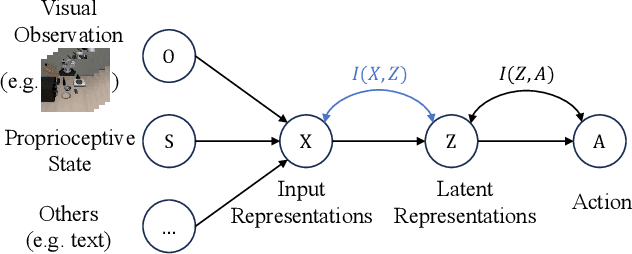
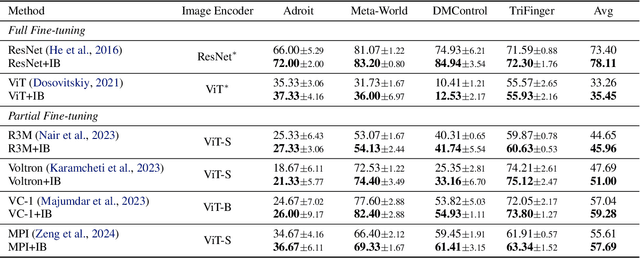
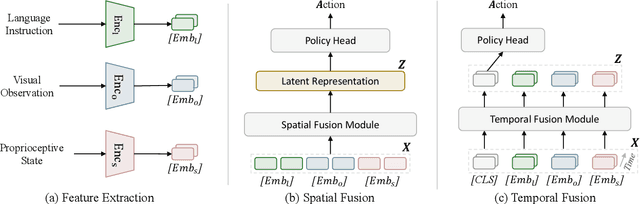
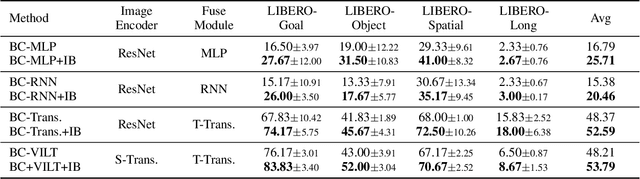
Behavior Cloning (BC) is a widely adopted visual imitation learning method in robot manipulation. Current BC approaches often enhance generalization by leveraging large datasets and incorporating additional visual and textual modalities to capture more diverse information. However, these methods overlook whether the learned representations contain redundant information and lack a solid theoretical foundation to guide the learning process. To address these limitations, we adopt an information-theoretic perspective and introduce mutual information to quantify and mitigate redundancy in latent representations. Building on this, we incorporate the Information Bottleneck (IB) principle into BC, which extends the idea of reducing redundancy by providing a structured framework for compressing irrelevant information while preserving task-relevant features. This work presents the first comprehensive study on redundancy in latent representations across various methods, backbones, and experimental settings, while extending the generalizability of the IB to BC. Extensive experiments and analyses on the CortexBench and LIBERO benchmarks demonstrate significant performance improvements with IB, underscoring the importance of reducing input data redundancy and highlighting its practical value for more practical applications. Project Page: https://baishuanghao.github.io/BC-IB.github.io.