 Add to Chrome
 Add to Firefox
 Add to Edge
HAF: Adapting Generalist VLAs to Humanoid Whole-Body Loco-manipulation via Hierarchical Action Flow and Spectral Latent RL
Aug 17, 2026
Humanoid robots hold great promise as general-purpose agents in human-centered environments, yet generalist vision-language-action (VLA) foundation models are not readily applicable to humanoid whole-body loco-manipulation. The high dimensionality and interdependence of humanoid motions make it challenging for conventional single-stage VLA architectures to coordinate locomotion, waist posture, and dual-arm manipulation effectively. Moreover, policies trained through offline behavior cloning can remain suboptimal during real-world deployment. Although online reinforcement learning can refine policies through real-world interaction, directly tuning large VLA backbones demands excessive computation and may introduce safety risks during real-robot exploration. To address these bottlenecks, we introduce HAF (Humanoid Adaptation Framework), a two-part framework consisting of HAF-VLA and HAF-Steer that transfers off-the-shelf generalist VLA foundation models to humanoid whole-body loco-manipulation. HAF-VLA is a hierarchical action-flow generator built on a pretrained flow-matching VLA. It splits full-body action denoising into three sequential stages with stage embeddings and cross-stage KV caches that retain kinematic dependencies, avoiding incoherent whole-body actions from one-shot generation. On top of the frozen HAF-VLA, HAF-Steer is a latent offline-to-online RL pipeline that leverages flow-matching invertibility and DCT-based dimensionality reduction to restrict RL optimization to a compact noise subspace and train a regularized SAC policy. This avoids updating the large VLA backbone and enables efficient real-world policy refinement. Evaluated on seven real-world humanoid loco-manipulation tasks, HAF surpasses vanilla single-stage VLA baselines and improves whole-body coordination and task performance. Project website: https://grange007.github.io/HAF .

Demo-JEPA: Joint-Embedding Predictive Architecture for One-shot Cross-Embodiment Imitation
May 20, 2026Robotic imitation learning is often treated as reproducing demonstrated actions, but actions are inherently embodiment-specific. When demonstrations come from humans or robots with different morphology, kinematics, or action spaces, this action-centric view requires shared action spaces, heuristic retargeting, or large-scale multi-embodiment co-training. We instead view demonstrations as implicit specifications of future goals: the target agent should infer what state the demonstrator is trying to realize, rather than how the demonstrator executes it. We propose Demo-JEPA, a cross-embodiment imitation framework that decouples demonstration intent from embodiment-specific execution. Built on a JEPA-based world model, Demo-JEPA translates source visual demonstrations into target-compatible future latent trajectories in a shared predictive representation space. The target agent then uses these latent trajectories as subgoals and realizes them through planning under its own learned forward dynamics. Because Demo-JEPA avoids action-level correspondence and requires only visual demonstrations plus the target agent's own interaction experience, it supports flexible imitation across heterogeneous embodiments. Experiments on RLBench and real-world manipulation tasks show that Demo-JEPA matches specialized in-domain planners and generalizes to unseen tasks and embodiment configurations where prior methods fail.
RoboMIND 2.0: A Multimodal, Bimanual Mobile Manipulation Dataset for Generalizable Embodied Intelligence
Dec 31, 2025While data-driven imitation learning has revolutionized robotic manipulation, current approaches remain constrained by the scarcity of large-scale, diverse real-world demonstrations. Consequently, the ability of existing models to generalize across long-horizon bimanual tasks and mobile manipulation in unstructured environments remains limited. To bridge this gap, we present RoboMIND 2.0, a comprehensive real-world dataset comprising over 310K dual-arm manipulation trajectories collected across six distinct robot embodiments and 739 complex tasks. Crucially, to support research in contact-rich and spatially extended tasks, the dataset incorporates 12K tactile-enhanced episodes and 20K mobile manipulation trajectories. Complementing this physical data, we construct high-fidelity digital twins of our real-world environments, releasing an additional 20K-trajectory simulated dataset to facilitate robust sim-to-real transfer. To fully exploit the potential of RoboMIND 2.0, we propose MIND-2 system, a hierarchical dual-system frame-work optimized via offline reinforcement learning. MIND-2 integrates a high-level semantic planner (MIND-2-VLM) to decompose abstract natural language instructions into grounded subgoals, coupled with a low-level Vision-Language-Action executor (MIND-2-VLA), which generates precise, proprioception-aware motor actions.
H2R: A Human-to-Robot Data Augmentation for Robot Pre-training from Videos
May 17, 2025
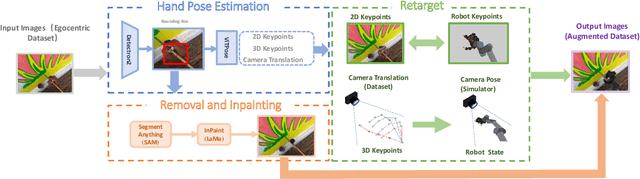
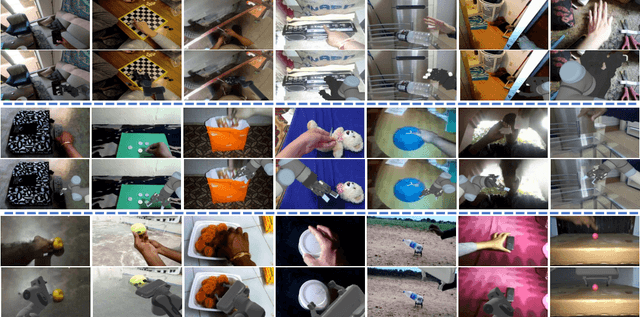

Large-scale pre-training using videos has proven effective for robot learning. However, the models pre-trained on such data can be suboptimal for robot learning due to the significant visual gap between human hands and those of different robots. To remedy this, we propose H2R, a simple data augmentation technique that detects human hand keypoints, synthesizes robot motions in simulation, and composites rendered robots into egocentric videos. This process explicitly bridges the visual gap between human and robot embodiments during pre-training. We apply H2R to augment large-scale egocentric human video datasets such as Ego4D and SSv2, replacing human hands with simulated robotic arms to generate robot-centric training data. Based on this, we construct and release a family of 1M-scale datasets covering multiple robot embodiments (UR5 with gripper/Leaphand, Franka) and data sources (SSv2, Ego4D). To verify the effectiveness of the augmentation pipeline, we introduce a CLIP-based image-text similarity metric that quantitatively evaluates the semantic fidelity of robot-rendered frames to the original human actions. We validate H2R across three simulation benchmarks: Robomimic, RLBench and PushT and real-world manipulation tasks with a UR5 robot equipped with Gripper and Leaphand end-effectors. H2R consistently improves downstream success rates, yielding gains of 5.0%-10.2% in simulation and 6.7%-23.3% in real-world tasks across various visual encoders and policy learning methods. These results indicate that H2R improves the generalization ability of robotic policies by mitigating the visual discrepancies between human and robot domains.