 Add to Chrome
 Add to Firefox
 Add to Edge
Sparrow: Sparse Rollout for Stable and Efficient Long-context RL of Large Language Models
Jun 07, 2026
Despite being powerful, reinforcement learning with verifiable rewards (RLVR) induces extremely long COT, making it computationally expensive. Since RLVR per-step cost is dominated by long-context rollout generation, sparse attention offers a promising way to accelerate dense rollout. However, sparse rollouts require a delicate stability-efficiency tradeoff: overly aggressive sparsity causes collapse, while overly lenient sparsity gives insufficient speedup. In this work, we study this tradeoff through sparse-to-dense actor-policy mismatch. We first observe that sparse rollout collapse is not driven by uniform degradation across tokens: most sparse tokens align perfectly with dense even under aggressive sparsity. Motivated by this, we hypothesize that sparse rollout training remains stable if the lower tail of per-token actor-policy mismatch stays above a critical threshold throughout the trajectory. We introduce a dynamic sparsity schedule that keeps this tail statistic constant during generation and validate our hypothesis. Across Qwen3 thinking-family models, keeping the tail mismatch statistic near a consistent threshold generally enables stable training. We then use a cost model to find the sparsity schedule for maximum speedup under this mismatch threshold, achieving 2.2x, 2.4x, and 2.0x rollout speedups when training Qwen3-1.7B, Qwen3-4B, and Qwen3-8B. Empirically, we show the thresholds generalize to a larger model (Qwen3-14B) and another RL domain (coding). Finally, our analysis naturally motivates DistillSparse: lightweight LoRA-based distillation on sparse rollout lets more aggressive sparsity reach the same sparse-to-dense mismatch threshold, yielding higher speedup.

Vortex: Efficient and Programmable Sparse Attention Serving for AI Agents
Jun 04, 2026Sparse attention is becoming increasingly important for serving large language models (LLMs) as generation lengths continue to grow. However, deploying and evaluating new sparse attention algorithms at scale remains highly engineering-intensive, slowing both human researchers and AI agents in exploring the sparse attention design. To address this challenge, we present Vortex, a system that combines a Python-embedded frontend language atop a page-centric tensor abstraction for expressing a broad range of sparse attention algorithms, with an efficient backend tightly integrated into modern LLM serving stacks. Vortex enables rapid prototyping, deployment, and evaluation of sparse attention algorithms, effectively translating their theoretical efficiency gains into real-world throughput improvements. As a result, Vortex substantially accelerates the design and iteration of sparse attention algorithms. First, AI agents use Vortex to automatically generate and refine diverse algorithms, the best reaching up to $3.46\times$ higher throughput than full attention while preserving accuracy. Second, Vortex extends sparse attention to emerging architectures and very large models that are otherwise hard to experiment with, reaching up to $4.7\times$ higher throughput on the MLA-based GLM-4.7-Flash and $1.37\times$ on the 229B-parameter MiniMax-M2.7 on NVIDIA B200 GPUs.
STEM: Scaling Transformers with Embedding Modules
Jan 15, 2026Fine-grained sparsity promises higher parametric capacity without proportional per-token compute, but often suffers from training instability, load balancing, and communication overhead. We introduce STEM (Scaling Transformers with Embedding Modules), a static, token-indexed approach that replaces the FFN up-projection with a layer-local embedding lookup while keeping the gate and down-projection dense. This removes runtime routing, enables CPU offload with asynchronous prefetch, and decouples capacity from both per-token FLOPs and cross-device communication. Empirically, STEM trains stably despite extreme sparsity. It improves downstream performance over dense baselines while reducing per-token FLOPs and parameter accesses (eliminating roughly one-third of FFN parameters). STEM learns embedding spaces with large angular spread which enhances its knowledge storage capacity. More interestingly, this enhanced knowledge capacity comes with better interpretability. The token-indexed nature of STEM embeddings allows simple ways to perform knowledge editing and knowledge injection in an interpretable manner without any intervention in the input text or additional computation. In addition, STEM strengthens long-context performance: as sequence length grows, more distinct parameters are activated, yielding practical test-time capacity scaling. Across 350M and 1B model scales, STEM delivers up to ~3--4% accuracy improvements overall, with notable gains on knowledge and reasoning-heavy benchmarks (ARC-Challenge, OpenBookQA, GSM8K, MMLU). Overall, STEM is an effective way of scaling parametric memory while providing better interpretability, better training stability and improved efficiency.
Kinetics: Rethinking Test-Time Scaling Laws
Jun 06, 2025We rethink test-time scaling laws from a practical efficiency perspective, revealing that the effectiveness of smaller models is significantly overestimated. Prior work, grounded in compute-optimality, overlooks critical memory access bottlenecks introduced by inference-time strategies (e.g., Best-of-$N$, long CoTs). Our holistic analysis, spanning models from 0.6B to 32B parameters, reveals a new Kinetics Scaling Law that better guides resource allocation by incorporating both computation and memory access costs. Kinetics Scaling Law suggests that test-time compute is more effective when used on models above a threshold than smaller ones. A key reason is that in TTS, attention, rather than parameter count, emerges as the dominant cost factor. Motivated by this, we propose a new scaling paradigm centered on sparse attention, which lowers per-token cost and enables longer generations and more parallel samples within the same resource budget. Empirically, we show that sparse attention models consistently outperform dense counterparts, achieving over 60 points gains in low-cost regimes and over 5 points gains in high-cost regimes for problem-solving accuracy on AIME, encompassing evaluations on state-of-the-art MoEs. These results suggest that sparse attention is essential and increasingly important with more computing invested, for realizing the full potential of test-time scaling where, unlike training, accuracy has yet to saturate as a function of computation, and continues to improve through increased generation. The code is available at https://github.com/Infini-AI-Lab/Kinetics.
MagicPIG: LSH Sampling for Efficient LLM Generation
Oct 21, 2024
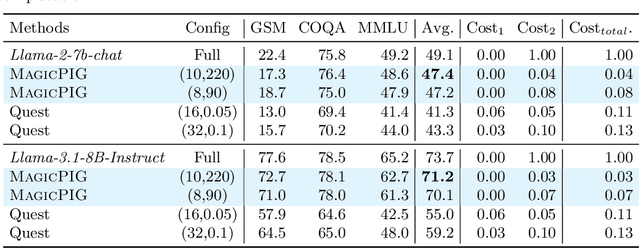

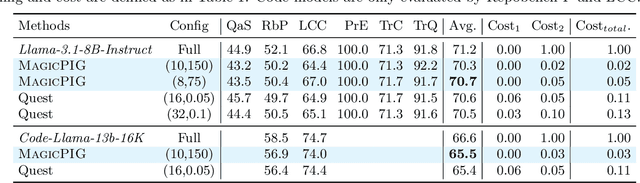
Large language models (LLMs) with long context windows have gained significant attention. However, the KV cache, stored to avoid re-computation, becomes a bottleneck. Various dynamic sparse or TopK-based attention approximation methods have been proposed to leverage the common insight that attention is sparse. In this paper, we first show that TopK attention itself suffers from quality degradation in certain downstream tasks because attention is not always as sparse as expected. Rather than selecting the keys and values with the highest attention scores, sampling with theoretical guarantees can provide a better estimation for attention output. To make the sampling-based approximation practical in LLM generation, we propose MagicPIG, a heterogeneous system based on Locality Sensitive Hashing (LSH). MagicPIG significantly reduces the workload of attention computation while preserving high accuracy for diverse tasks. MagicPIG stores the LSH hash tables and runs the attention computation on the CPU, which allows it to serve longer contexts and larger batch sizes with high approximation accuracy. MagicPIG can improve decoding throughput by $1.9\sim3.9\times$ across various GPU hardware and achieve 110ms decoding latency on a single RTX 4090 for Llama-3.1-8B-Instruct model with a context of 96k tokens. The code is available at \url{https://github.com/Infini-AI-Lab/MagicPIG}.
MagicDec: Breaking the Latency-Throughput Tradeoff for Long Context Generation with Speculative Decoding
Aug 21, 2024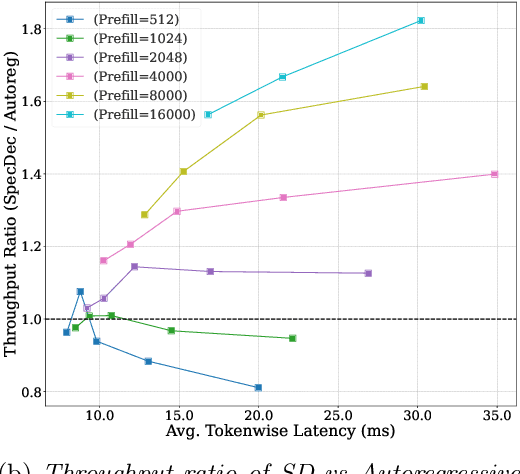


Large Language Models (LLMs) have become more prevalent in long-context applications such as interactive chatbots, document analysis, and agent workflows, but it is challenging to serve long-context requests with low latency and high throughput. Speculative decoding (SD) is a widely used technique to reduce latency without sacrificing performance but the conventional wisdom suggests that its efficacy is limited to small batch sizes. In MagicDec, we show that surprisingly SD can achieve speedup even for a high throughput inference regime for moderate to long sequences. More interestingly, an intelligent drafting strategy can achieve better speedup with increasing batch size based on our rigorous analysis. MagicDec first identifies the bottleneck shifts with increasing batch size and sequence length, and uses these insights to deploy speculative decoding more effectively for high throughput inference. Then, it leverages draft models with sparse KV cache to address the KV bottleneck that scales with both sequence length and batch size. This finding underscores the broad applicability of speculative decoding in long-context serving, as it can enhance throughput and reduce latency without compromising accuracy. For moderate to long sequences, we demonstrate up to 2x speedup for LLaMA-2-7B-32K and 1.84x speedup for LLaMA-3.1-8B when serving batch sizes ranging from 32 to 256 on 8 NVIDIA A100 GPUs. The code is available at https://github.com/Infini-AI-Lab/MagicDec/.
Memory Mosaics
May 10, 2024
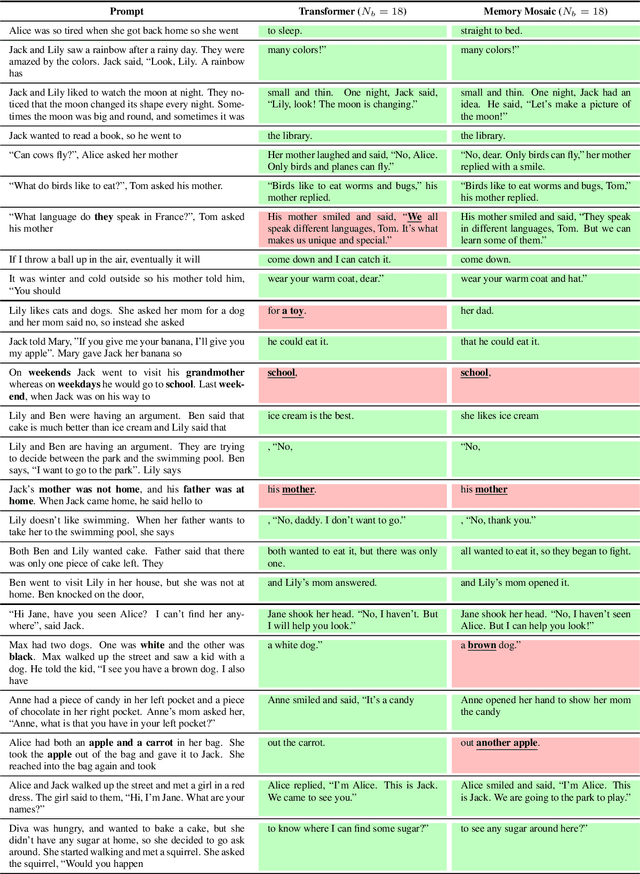


Memory Mosaics are networks of associative memories working in concert to achieve a prediction task of interest. Like transformers, memory mosaics possess compositional capabilities and in-context learning capabilities. Unlike transformers, memory mosaics achieve these capabilities in comparatively transparent ways. We demonstrate these capabilities on toy examples and we also show that memory mosaics perform as well or better than transformers on medium-scale language modeling tasks.