 Add to Chrome
 Add to Firefox
 Add to Edge
Unlocking Cognitive Capabilities and Analyzing the Perception-Logic Trade-off
Feb 27, 2026
Recent advancements in Multimodal Large Language Models (MLLMs) pursue omni-perception capabilities, yet integrating robust sensory grounding with complex reasoning remains a challenge, particularly for underrepresented regions. In this report, we introduce the research preview of MERaLiON2-Omni (Alpha), a 10B-parameter multilingual omni-perception tailored for Southeast Asia (SEA). We present a progressive training pipeline that explicitly decouples and then integrates "System 1" (Perception) and "System 2" (Reasoning) capabilities. First, we establish a robust Perception Backbone by aligning region-specific audio-visual cues (e.g., Singlish code-switching, local cultural landmarks) with a multilingual LLM through orthogonal modality adaptation. Second, to inject cognitive capabilities without large-scale supervision, we propose a cost-effective Generate-Judge-Refine pipeline. By utilizing a Super-LLM to filter hallucinations and resolve conflicts via a consensus mechanism, we synthesize high-quality silver data that transfers textual Chain-of-Thought reasoning to multimodal scenarios. Comprehensive evaluation on our newly introduced SEA-Omni Benchmark Suite reveals an Efficiency-Stability Paradox: while reasoning acts as a non-linear amplifier for abstract tasks (boosting mathematical and instruction-following performance significantly), it introduces instability in low-level sensory processing. Specifically, we identify Temporal Drift in long-context audio, where extended reasoning desynchronizes the model from acoustic timestamps, and Visual Over-interpretation, where logic overrides pixel-level reality. This report details the architecture, the data-efficient training recipe, and a diagnostic analysis of the trade-offs between robust perception and structured reasoning.

MERaLiON-SER: Robust Speech Emotion Recognition Model for English and SEA Languages
Nov 12, 2025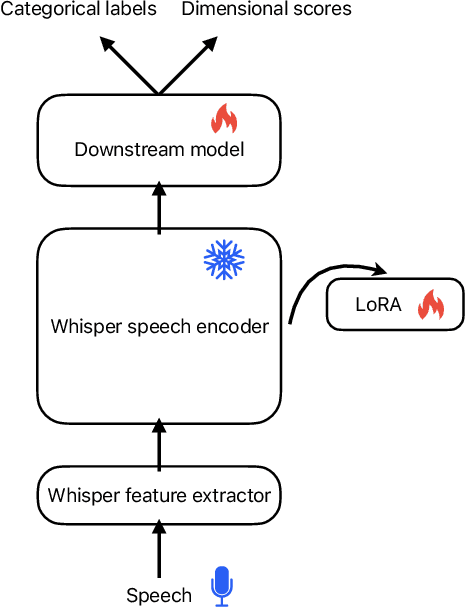
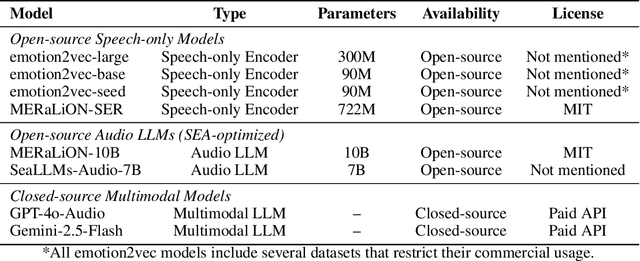
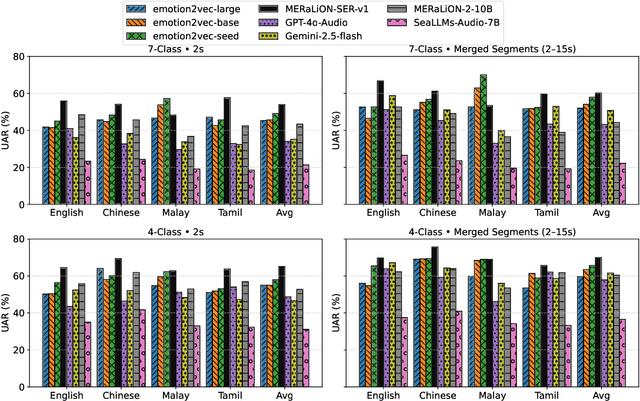
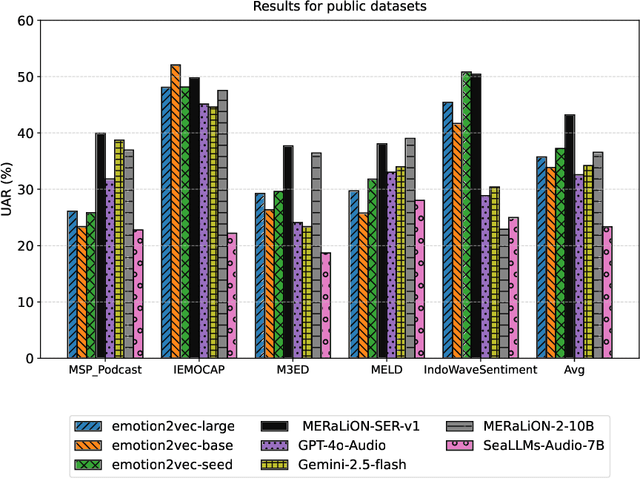
We present MERaLiON-SER, a robust speech emotion recognition model designed for English and Southeast Asian languages. The model is trained using a hybrid objective combining weighted categorical cross-entropy and Concordance Correlation Coefficient (CCC) losses for joint discrete and dimensional emotion modelling. This dual approach enables the model to capture both the distinct categories of emotion (like happy or angry) and the fine-grained, such as arousal (intensity), valence (positivity/negativity), and dominance (sense of control), leading to a more comprehensive and robust representation of human affect. Extensive evaluations across multilingual Singaporean languages (English, Chinese, Malay, and Tamil ) and other public benchmarks show that MERaLiON-SER consistently surpasses both open-source speech encoders and large Audio-LLMs. These results underscore the importance of specialised speech-only models for accurate paralinguistic understanding and cross-lingual generalisation. Furthermore, the proposed framework provides a foundation for integrating emotion-aware perception into future agentic audio systems, enabling more empathetic and contextually adaptive multimodal reasoning.