 Add to Chrome
 Add to Firefox
 Add to Edge
Unified Multimodal Autoregressive Modeling with Shared Context-Visual Tokenizer is Key to Unification
Jun 17, 2026
Unified Multimodal Modeling aims to integrate visual understanding and generation within a single system. However, existing approaches typically rely on two disparate visual tokenizers, which splits the representation space and hinders truly unified modeling. We propose UniAR, a unified autoregressive framework where a single discrete visual tokenizer serves as the key bridge between understanding and generation, enabling a shared context in which the model can directly interpret its own generated visual tokens without additional re-encoding. UniAR adapts a pretrained vision encoder with multi-level feature fusion and a lookup-free bitwise quantization scheme, preserving both high-level semantics and low-level details while scaling the effective visual vocabulary at minimal cost. Building on this, the unified autoregressive model adopts parallel-bitwise-prediction to jointly predict spatially grouped, multi-level visual codes, substantially reducing visual sequence length and accelerating generation. Finally, a diffusion-based visual decoder operates on discrete visual tokens to decode high-fidelity images. Through large-scale pre-training, followed by supervised fine-tuning and reinforcement learning, UniAR achieves state-of-the-art performance on image generation and image editing while remaining competitive on multimodal understanding benchmarks. The project page is available at https://sharelab-sii.github.io/uniar-web.

Qwen-VLA: Unifying Vision-Language-Action Modeling across Tasks, Environments, and Robot Embodiments
May 28, 2026Embodied intelligence is often studied through specialized models for individual tasks such as manipulation or navigation, resulting in fragmented capabilities and limited generalization across tasks, environments, and robot embodiments. In this work, we study whether heterogeneous embodied decision-making problems can be unified within a single vision-language-action model. We present Qwen-VLA, a unified embodied foundation model that extends Qwen's vision-language modeling stack from perception, understanding, and reasoning to continuous action and trajectory generation through a DiT-based action decoder. Qwen-VLA is trained with a large-scale joint pretraining recipe over diverse data sources, including robotics manipulation trajectories, human egocentric demonstrations, synthetic simulation data, vision-and-language navigation data, trajectory-centric supervision, and auxiliary vision-language data. To support multiple robot platforms, we introduce embodiment-aware prompt conditioning, where robot-specific textual descriptions specify the current embodiment and control convention. We further cast manipulation, navigation, and trajectory prediction into a unified action-and-trajectory prediction framework, enabling transferable visual grounding, spatial reasoning, and continuous action generation across robot morphologies, task families, and environments. Experiments on manipulation, navigation, and trajectory-centric benchmarks show consistent multi-task performance and out-of-distribution generalization under variations in scene layout, background, lighting, object configuration, and robot embodiment. Qwen-VLA-Instruct achieves 97.9% on LIBERO, 73.7% on Simpler-WidowX, 86.1%/87.2% on RoboTwin-Easy/Hard, 69.0% OSR on R2R, 59.6% SR on RxR, 76.9% average OOD success in real-world ALOHA experiments, and 26.6% zero-shot success on DOMINO dynamic manipulation.
Compositional Text-to-Image Generation Via Region-aware Bimodal Direct Preference Optimization
May 27, 2026Despite the rapid progress of text-to-image (T2I) models, generating images that accurately reflect complex compositional prompts (covering attribute bindings, object relationships, counting) still remains challenging. To address this, we propose BiDPO, a framework to enhance T2I model's capability of compositional text-to-image generation. We begin by introducing an carefully designed pipeline to construct a large-scale preference dataset, BiComp, with strictly quality control. Then, we extend Diffusion DPO to jointly optimize image and text preferences, which is shown to greatly effective in improving the models to follow complex text prompt in generation. To further enhance the models for fine-grained alignment, we employ a region-level guidance method to focus on regions relevant to compositional concepts. Experimental results demonstrate that our BiDPO substantially improves compositional fidelity, consistently outperforming prior methods across multiple benchmarks. Our approach highlights the potential of preference-based fine-tuning for complex text-to-image tasks, offering a flexible and scalable alternative to existing techniques.
CoMP: Continual Multimodal Pre-training for Vision Foundation Models
Mar 24, 2025Pre-trained Vision Foundation Models (VFMs) provide strong visual representations for a wide range of applications. In this paper, we continually pre-train prevailing VFMs in a multimodal manner such that they can effortlessly process visual inputs of varying sizes and produce visual representations that are more aligned with language representations, regardless of their original pre-training process. To this end, we introduce CoMP, a carefully designed multimodal pre-training pipeline. CoMP uses a Continual Rotary Position Embedding to support native resolution continual pre-training, and an Alignment Loss between visual and textual features through language prototypes to align multimodal representations. By three-stage training, our VFMs achieve remarkable improvements not only in multimodal understanding but also in other downstream tasks such as classification and segmentation. Remarkably, CoMP-SigLIP achieves scores of 66.7 on ChartQA and 75.9 on DocVQA with a 0.5B LLM, while maintaining an 87.4% accuracy on ImageNet-1K and a 49.5 mIoU on ADE20K under frozen chunk evaluation.
Inst-IT: Boosting Multimodal Instance Understanding via Explicit Visual Prompt Instruction Tuning
Dec 04, 2024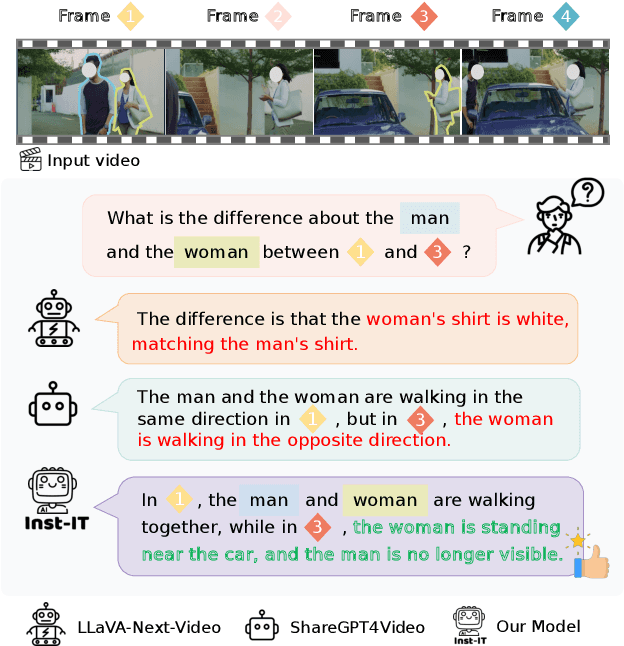
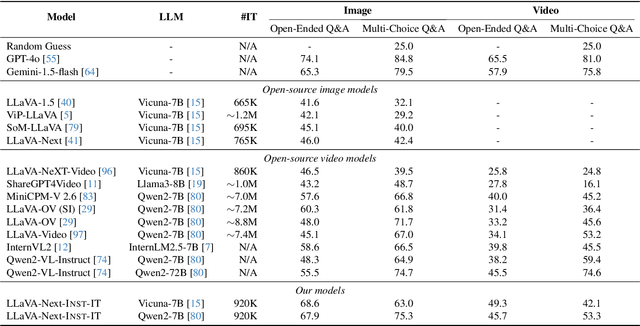
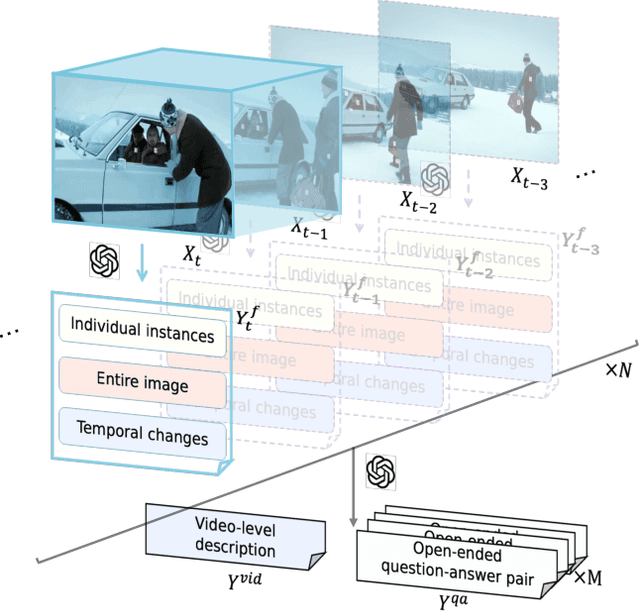
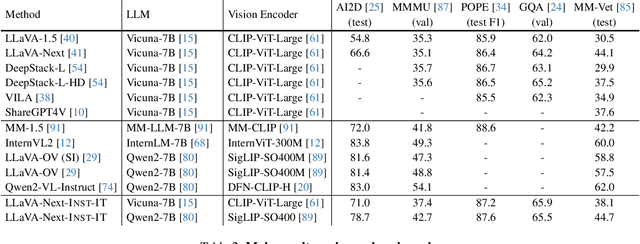
Large Multimodal Models (LMMs) have made significant breakthroughs with the advancement of instruction tuning. However, while existing models can understand images and videos at a holistic level, they still struggle with instance-level understanding that requires a more nuanced comprehension and alignment. Instance-level understanding is crucial, as it focuses on the specific elements that we are most interested in. Excitingly, existing works find that the state-of-the-art LMMs exhibit strong instance understanding capabilities when provided with explicit visual cues. Motivated by this, we introduce an automated annotation pipeline assisted by GPT-4o to extract instance-level information from images and videos through explicit visual prompting for instance guidance. Building upon this pipeline, we proposed Inst-IT, a solution to enhance LMMs in Instance understanding via explicit visual prompt Instruction Tuning. Inst-IT consists of a benchmark to diagnose multimodal instance-level understanding, a large-scale instruction-tuning dataset, and a continuous instruction-tuning training paradigm to effectively enhance spatial-temporal instance understanding capabilities of existing LMMs. Experimental results show that, with the boost of Inst-IT, our models not only achieve outstanding performance on Inst-IT Bench but also demonstrate significant improvements across various generic image and video understanding benchmarks. This highlights that our dataset not only boosts instance-level understanding but also strengthens the overall capabilities of generic image and video comprehension.
Synthesize, Diagnose, and Optimize: Towards Fine-Grained Vision-Language Understanding
Nov 30, 2023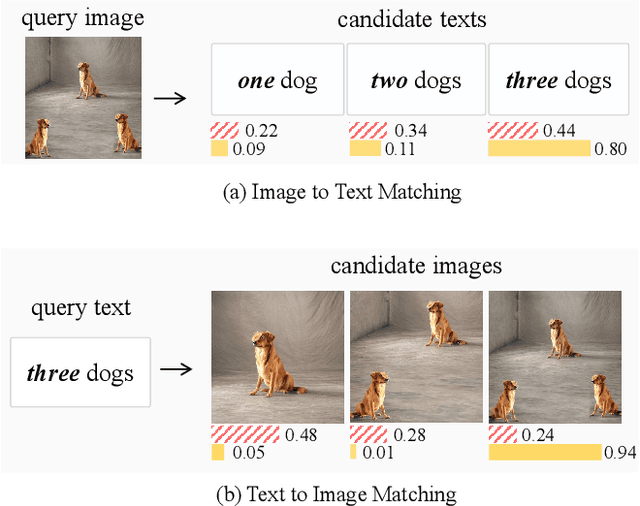
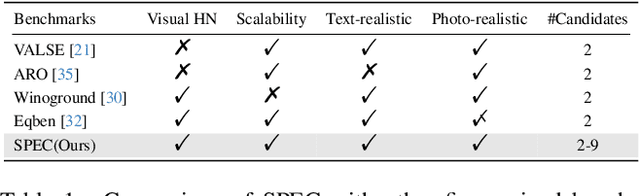
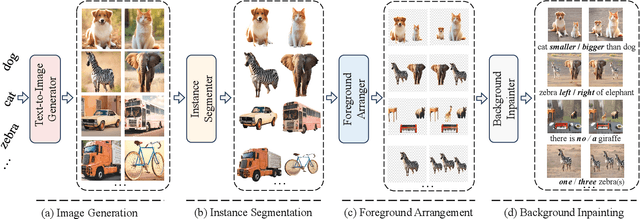
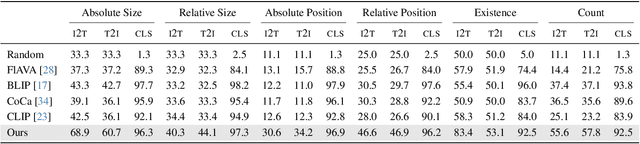
Vision language models (VLM) have demonstrated remarkable performance across various downstream tasks. However, understanding fine-grained visual-linguistic concepts, such as attributes and inter-object relationships, remains a significant challenge. While several benchmarks aim to evaluate VLMs in finer granularity, their primary focus remains on the linguistic aspect, neglecting the visual dimension. Here, we highlight the importance of evaluating VLMs from both a textual and visual perspective. We introduce a progressive pipeline to synthesize images that vary in a specific attribute while ensuring consistency in all other aspects. Utilizing this data engine, we carefully design a benchmark, SPEC, to diagnose the comprehension of object size, position, existence, and count. Subsequently, we conduct a thorough evaluation of four leading VLMs on SPEC. Surprisingly, their performance is close to random guess, revealing significant limitations. With this in mind, we propose a simply yet effective approach to optimize VLMs in fine-grained understanding, achieving significant improvements on SPEC without compromising the zero-shot performance. Results on two additional fine-grained benchmarks also show consistent improvements, further validating the transferability of our approach.
Building an Open-Vocabulary Video CLIP Model with Better Architectures, Optimization and Data
Oct 08, 2023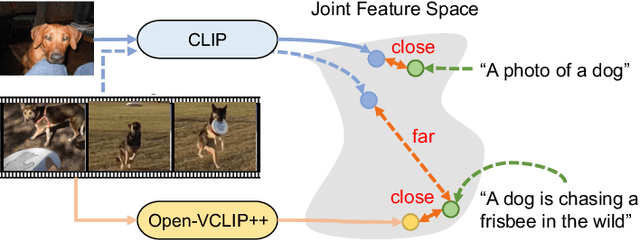
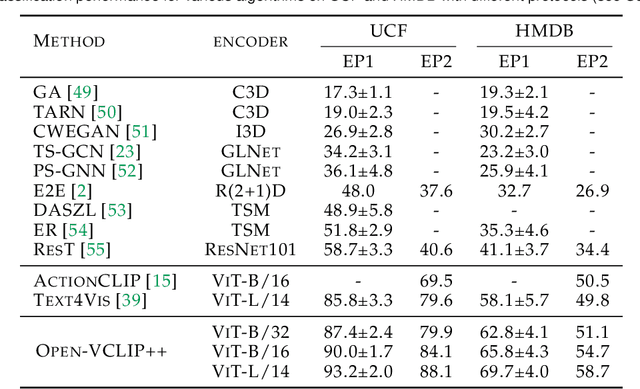
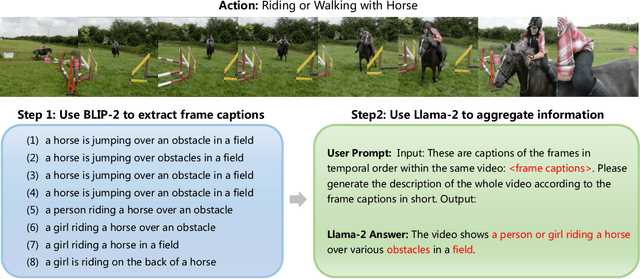
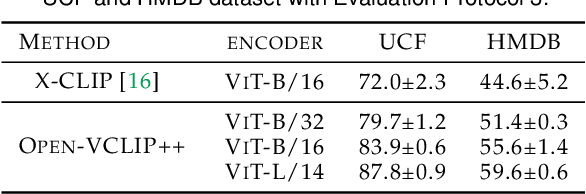
Despite significant results achieved by Contrastive Language-Image Pretraining (CLIP) in zero-shot image recognition, limited effort has been made exploring its potential for zero-shot video recognition. This paper presents Open-VCLIP++, a simple yet effective framework that adapts CLIP to a strong zero-shot video classifier, capable of identifying novel actions and events during testing. Open-VCLIP++ minimally modifies CLIP to capture spatial-temporal relationships in videos, thereby creating a specialized video classifier while striving for generalization. We formally demonstrate that training Open-VCLIP++ is tantamount to continual learning with zero historical data. To address this problem, we introduce Interpolated Weight Optimization, a technique that leverages the advantages of weight interpolation during both training and testing. Furthermore, we build upon large language models to produce fine-grained video descriptions. These detailed descriptions are further aligned with video features, facilitating a better transfer of CLIP to the video domain. Our approach is evaluated on three widely used action recognition datasets, following a variety of zero-shot evaluation protocols. The results demonstrate that our method surpasses existing state-of-the-art techniques by significant margins. Specifically, we achieve zero-shot accuracy scores of 88.1%, 58.7%, and 81.2% on UCF, HMDB, and Kinetics-600 datasets respectively, outpacing the best-performing alternative methods by 8.5%, 8.2%, and 12.3%. We also evaluate our approach on the MSR-VTT video-text retrieval dataset, where it delivers competitive video-to-text and text-to-video retrieval performance, while utilizing substantially less fine-tuning data compared to other methods. Code is released at https://github.com/wengzejia1/Open-VCLIP.
BMB: Balanced Memory Bank for Imbalanced Semi-supervised Learning
May 22, 2023Exploring a substantial amount of unlabeled data, semi-supervised learning (SSL) boosts the recognition performance when only a limited number of labels are provided. However, traditional methods assume that the data distribution is class-balanced, which is difficult to achieve in reality due to the long-tailed nature of real-world data. While the data imbalance problem has been extensively studied in supervised learning (SL) paradigms, directly transferring existing approaches to SSL is nontrivial, as prior knowledge about data distribution remains unknown in SSL. In light of this, we propose Balanced Memory Bank (BMB), a semi-supervised framework for long-tailed recognition. The core of BMB is an online-updated memory bank that caches historical features with their corresponding pseudo labels, and the memory is also carefully maintained to ensure the data therein are class-rebalanced. Additionally, an adaptive weighting module is introduced to work jointly with the memory bank so as to further re-calibrate the biased training process. We conduct experiments on multiple datasets and demonstrate, among other things, that BMB surpasses state-of-the-art approaches by clear margins, for example 8.2$\%$ on the 1$\%$ labeled subset of ImageNet127 (with a resolution of 64$\times$64) and 4.3$\%$ on the 50$\%$ labeled subset of ImageNet-LT.