 Add to Chrome
 Add to Firefox
 Add to Edge
4D-WAM: 4D Consistent World Modeling for Autonomous Driving
Aug 10, 2026
Emerging World-Action Models (WAMs) have demonstrated promising performance in autonomous driving by jointly modeling future driving scene evolution and trajectory planning. However, existing WAMs are typically trained with video data, which is only 2D projections of the underlying 4D driving scene. Consequently, WAMs fail to understand and capture the structure of 4D scenes and thus generate visually plausible yet 4D inconsistent future predictions that mislead downstream planning. To alleviate this issue, we present 4D-WAM, a model that leverages geometric foundation models for training-time supervision to enable 4D consistent world modeling. Specifically, we feed WAM-predicted future frames into a geometric foundation model, and use 4D-aware responses to define a 4D consistency loss. This loss encourages the model to understand, represent, and predict physically consistent 4D scenes during training, without additional inference cost. Moreover, we identify an early-decision phenomenon in WAMs and propose a decision-oriented timestep sampling strategy that emphasizes supervision at early, high-noise stages, where driving decisions are primarily formed. By propagating 4D supervision to this critical decision-formation phase, the proposed strategy further improves trajectory planning. Extensive experiments demonstrate that 4D-WAM effectively models 4D consistent scene evolution and achieves state-of-the-art performance on challenging NAVSIM-v1 and NAVSIM-v2 benchmarks.

SUV: Future Scene Understanding as Video Generation for End-to-End Driving
Aug 04, 2026End-to-end driving requires a coherent understanding of future scenes, yet existing methods model these scenes using task-specific heads and output formats, with limited scalability. Can video generation instead provide a shared predictor? We introduce SUV, a unified end-to-end driving framework that casts future Scene Understanding as Video generation using a pretrained video foundation model. SUV models future appearance, semantics, relative depth, and instance-level dynamics as video streams with a shared video expert, without stream-specific visual prediction heads. Through joint video-action attention, the action expert attends to the latent representations of all future streams and generates the ego trajectory. Experiments show that SUV directly predicts all four future streams, while controlled ablations show that structured future supervision and direct future-stream access yield higher trajectory planning scores. With only a single front camera and no candidate-trajectory selection, SUV outperforms a broad set of recent state-of-the-art methods on both NAVSIM-v2 splits, achieving 91.0 EPDMS on navtest and 36.9 on navhard. On the long-tail WOD-E2E benchmark, SUV achieves a competitive RFS of 7.94.
AtomicVLA: Unlocking the Potential of Atomic Skill Learning in Robots
Mar 08, 2026Recent advances in Visual-Language-Action (VLA) models have shown promising potential for robotic manipulation tasks. However, real-world robotic tasks often involve long-horizon, multi-step problem-solving and require generalization for continual skill acquisition, extending beyond single actions or skills. These challenges present significant barriers for existing VLA models, which use monolithic action decoders trained on aggregated data, resulting in poor scalability. To address these challenges, we propose AtomicVLA, a unified planning-and-execution framework that jointly generates task-level plans, atomic skill abstractions, and fine-grained actions. AtomicVLA constructs a scalable atomic skill library through a Skill-Guided Mixture-of-Experts (SG-MoE), where each expert specializes in mastering generic yet precise atomic skills. Furthermore, we introduce a flexible routing encoder that automatically assigns dedicated atomic experts to new skills, enabling continual learning. We validate our approach through extensive experiments. In simulation, AtomicVLA outperforms $π_{0}$ by 2.4\% on LIBERO, 10\% on LIBERO-LONG, and outperforms $π_{0}$ and $π_{0.5}$ by 0.22 and 0.25 in average task length on CALVIN. Additionally, our AtomicVLA consistently surpasses baselines by 18.3\% and 21\% in real-world long-horizon tasks and continual learning. These results highlight the effectiveness of atomic skill abstraction and dynamic expert composition for long-horizon and lifelong robotic tasks. The project page is \href{https://zhanglk9.github.io/atomicvla-web/}{here}.
Fine-Grained Evaluation of Large Vision-Language Models in Autonomous Driving
Mar 27, 2025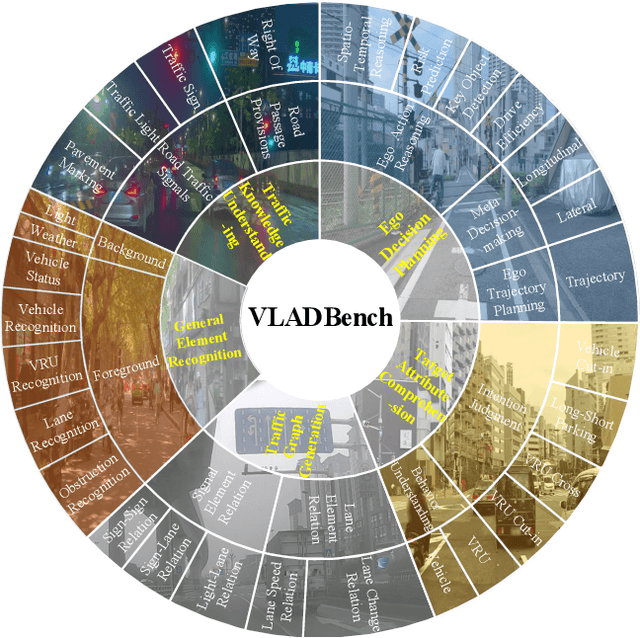
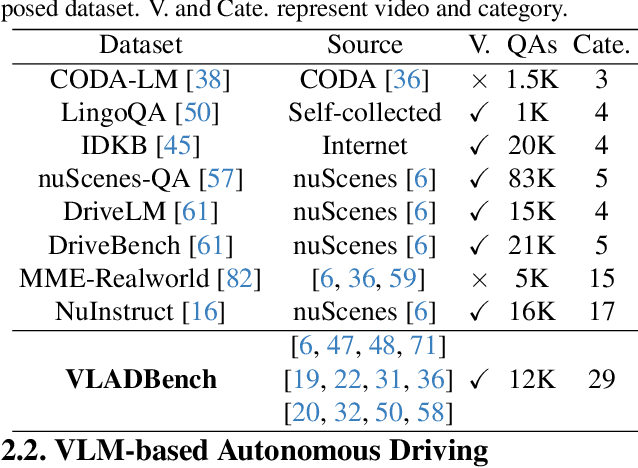
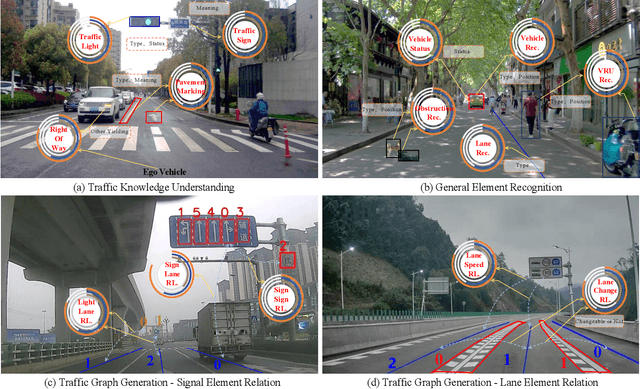
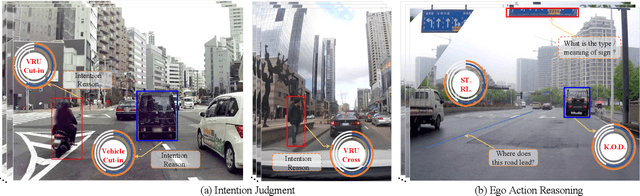
Existing benchmarks for Vision-Language Model (VLM) on autonomous driving (AD) primarily assess interpretability through open-form visual question answering (QA) within coarse-grained tasks, which remain insufficient to assess capabilities in complex driving scenarios. To this end, we introduce $\textbf{VLADBench}$, a challenging and fine-grained dataset featuring close-form QAs that progress from static foundational knowledge and elements to advanced reasoning for dynamic on-road situations. The elaborate $\textbf{VLADBench}$ spans 5 key domains: Traffic Knowledge Understanding, General Element Recognition, Traffic Graph Generation, Target Attribute Comprehension, and Ego Decision-Making and Planning. These domains are further broken down into 11 secondary aspects and 29 tertiary tasks for a granular evaluation. A thorough assessment of general and domain-specific (DS) VLMs on this benchmark reveals both their strengths and critical limitations in AD contexts. To further exploit the cognitive and reasoning interactions among the 5 domains for AD understanding, we start from a small-scale VLM and train the DS models on individual domain datasets (collected from 1.4M DS QAs across public sources). The experimental results demonstrate that the proposed benchmark provides a crucial step toward a more comprehensive assessment of VLMs in AD, paving the way for the development of more cognitively sophisticated and reasoning-capable AD systems.
IC-Mapper: Instance-Centric Spatio-Temporal Modeling for Online Vectorized Map Construction
Mar 05, 2025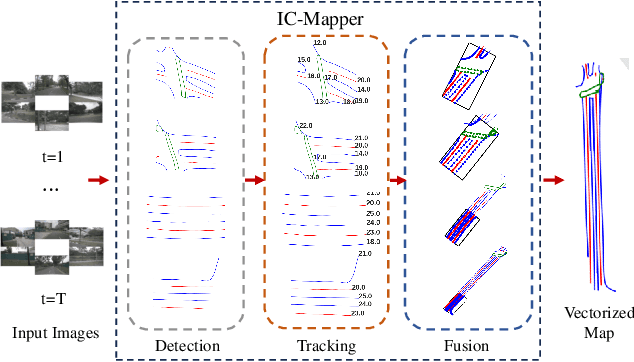
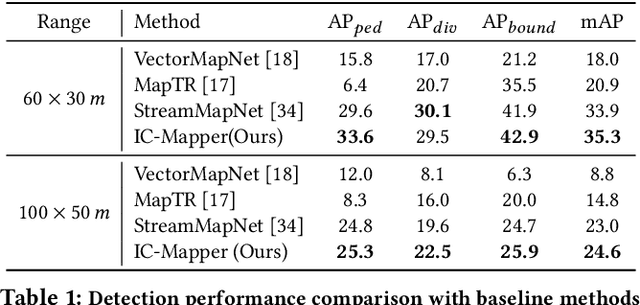
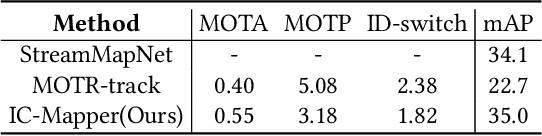
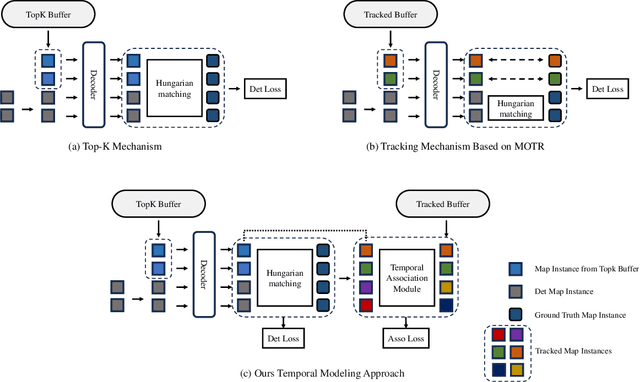
Online vector map construction based on visual data can bypass the processes of data collection, post-processing, and manual annotation required by traditional map construction, which significantly enhances map-building efficiency. However, existing work treats the online mapping task as a local range perception task, overlooking the spatial scalability required for map construction. We propose IC-Mapper, an instance-centric online mapping framework, which comprises two primary components: 1) Instance-centric temporal association module: For the detection queries of adjacent frames, we measure them in both feature and geometric dimensions to obtain the matching correspondence between instances across frames. 2) Instance-centric spatial fusion module: We perform point sampling on the historical global map from a spatial dimension and integrate it with the detection results of instances corresponding to the current frame to achieve real-time expansion and update of the map. Based on the nuScenes dataset, we evaluate our approach on detection, tracking, and global mapping metrics. Experimental results demonstrate the superiority of IC-Mapper against other state-of-the-art methods. Code will be released on https://github.com/Brickzhuantou/IC-Mapper.