 Add to Chrome
 Add to Firefox
 Add to Edge
SportD: Can VLMs Physically Strategize?
Jul 16, 2026
Vision--language models have become increasingly capable of interpreting visual scenes, but it remains unclear whether they can use information to make strategically effective decisions. We investigate this question in soccer, where models observe the seconds preceding an on-ball decision and must choose whether to shoot or pass to a specific teammate. Unlike conventional visual-understanding tasks, soccer enables decisions to be evaluated quantitatively by estimating the value of every available action. We introduce SportD, a benchmark comprising 478 on-ball decisions from the 2022 FIFA World Cup. Each model choice is evaluated against a possession-value model that estimates the action that most increases the attacking team's probability of scoring, allowing us to measure both optimal-action accuracy and the value forfeited by suboptimal decisions. Across three frontier VLMs, the best selects the highest-valued action on 31.4% of events, compared with 38.9% for the professional players, and all models incur significantly greater regret. Further analysis reveals a systematic preference for lower-variance and lower-reward actions: VLMs shoot less often and select substantially less progressive passes than either the optimal policy or the real players. The models also reproduce the player's specific action above chance even when that action is suboptimal, suggesting partial imitation of familiar play patterns rather than consistent evaluation of counterfactual alternatives. SportD provides a value-grounded testbed for measuring physical strategic reasoning in VLMs.

Multimodal Transformer for Sample-Aware Prediction of Metal-Organic Framework Properties
Apr 21, 2026Metal-organic frameworks (MOFs) are a major target of machine-learning-based property prediction, yet most models assume that a single framework representation maps to a single property value. This assumption becomes problematic for experimental MOFs, where samples reported as the same framework can exhibit different properties because of differences in crystallinity, phase purity, defects, and other sample-dependent factors. Here we introduce Experimental X-ray Diffraction Integrated Transformer (EXIT), a multimodal transformer for sample-aware prediction of MOF properties that combines MOFid with X-ray diffraction (XRD). In EXIT, MOFid encodes MOF identity, whereas XRD provides complementary information about the experimentally realized sample state. EXIT is pre-trained on one million hypothetical MOFs with simulated XRD to learn transferable representations, leading to improved downstream performance relative to existing approaches. EXIT is fine-tuned on literature-derived experimental datasets for surface area and pore volume prediction. Incorporating experimental XRD improves predictive performance relative to models without experimental XRD, and attention analysis and sample-level case studies further show that EXIT assigns different predictions to samples sharing the same MOF identity when their XRD patterns differ. These results establish a practical step from framework-aware to sample-aware MOF property prediction and highlight the value of incorporating experimental characterization into porous materials informatics.
SimMOF: AI agent for Automated MOF Simulations
Mar 31, 2026Metal-organic frameworks (MOFs) offer a vast design space, and as such, computational simulations play a critical role in predicting their structural and physicochemical properties. However, MOF simulations remain difficult to access because reliable analysis require expert decisions for workflow construction, parameter selection, tool interoperability, and the preparation of computational ready structures. Here, we introduce SimMOF, a large language model based multi agent framework that automates end-to-end MOF simulation workflows from natural language queries. SimMOF translates user requests into dependency aware plans, generates runnable inputs, orchestrates multiple agents to execute simulations, and summarizes results with analysis aligned to the user query. Through representative case studies, we show that SimMOF enables adaptive and cognitively autonomous workflows that reflect the iterative and decision driven behavior of human researchers and as such provides a scalable foundation for data driven MOF research.
Design Guidelines for Nonlinear Kalman Filters via Covariance Compensation
Mar 24, 2026Nonlinear extensions of the Kalman filter (KF), such as the extended Kalman filter (EKF) and the unscented Kalman filter (UKF), are indispensable for state estimation in complex dynamical systems, yet the conditions for a nonlinear KF to provide robust and accurate estimations remain poorly understood. This work proposes a theoretical framework that identifies the causes of failure and success in certain nonlinear KFs and establishes guidelines for their improvement. Central to our framework is the concept of covariance compensation: the deviation between the covariance predicted by a nonlinear KF and that of the EKF. With this definition and detailed theoretical analysis, we derive three design guidelines for nonlinear KFs: (i) invariance under orthogonal transformations, (ii) sufficient covariance compensation beyond the EKF baseline, and (iii) selection of compensation magnitude that favors underconfidence. Both theoretical analysis and empirical validation confirm that adherence to these principles significantly improves estimation accuracy, whereas fixed parameter choices commonly adopted in the literature are often suboptimal. The codes and the proofs for all the theorems in this paper are available at https://github.com/Shida-Jiang/Guidelines-for-Nonlinear-Kalman-Filters.
Data-driven development of cycle prediction models for lithium metal batteries using multi modal mining
Nov 26, 2024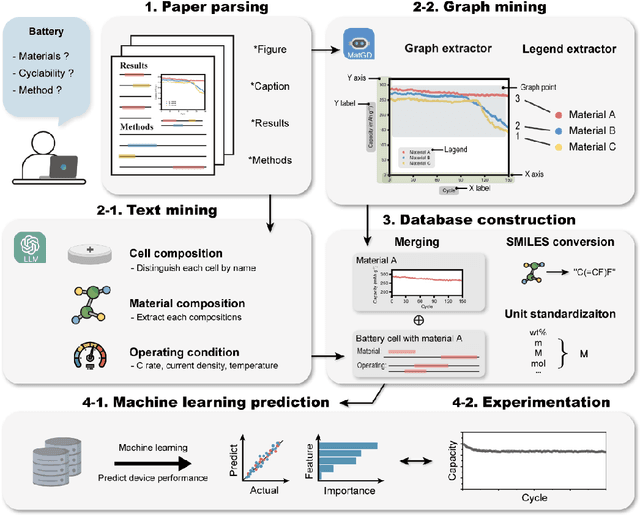
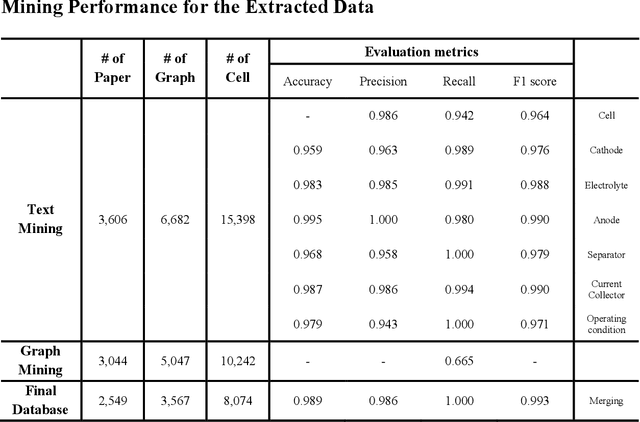
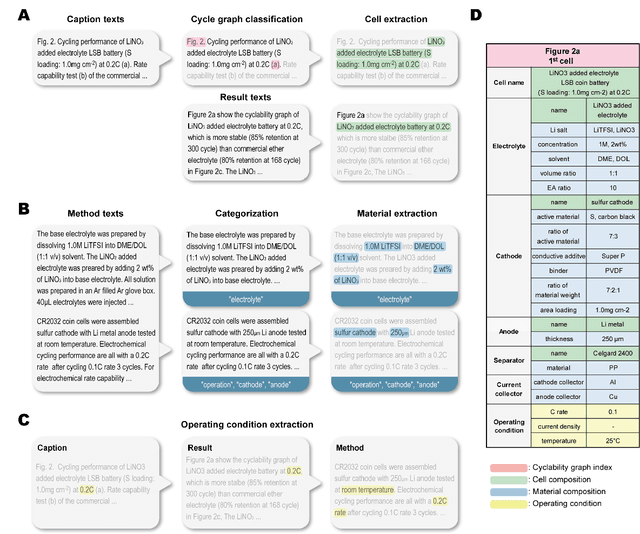
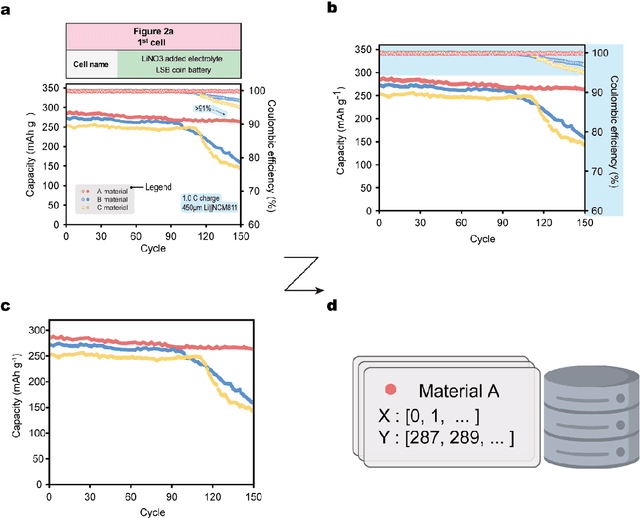
Recent advances in data-driven research have shown great potential in understanding the intricate relationships between materials and their performances. Herein, we introduce a novel multi modal data-driven approach employing an Automatic Battery data Collector (ABC) that integrates a large language model (LLM) with an automatic graph mining tool, Material Graph Digitizer (MatGD). This platform enables state-of-the-art accurate extraction of battery material data and cyclability performance metrics from diverse textual and graphical data sources. From the database derived through the ABC platform, we developed machine learning models that can accurately predict the capacity and stability of lithium metal batteries, which is the first-ever model developed to achieve such predictions. Our models were also experimentally validated, confirming practical applicability and reliability of our data-driven approach.
Text-Conditioned Sampling Framework for Text-to-Image Generation with Masked Generative Models
Apr 04, 2023Token-based masked generative models are gaining popularity for their fast inference time with parallel decoding. While recent token-based approaches achieve competitive performance to diffusion-based models, their generation performance is still suboptimal as they sample multiple tokens simultaneously without considering the dependence among them. We empirically investigate this problem and propose a learnable sampling model, Text-Conditioned Token Selection (TCTS), to select optimal tokens via localized supervision with text information. TCTS improves not only the image quality but also the semantic alignment of the generated images with the given texts. To further improve the image quality, we introduce a cohesive sampling strategy, Frequency Adaptive Sampling (FAS), to each group of tokens divided according to the self-attention maps. We validate the efficacy of TCTS combined with FAS with various generative tasks, demonstrating that it significantly outperforms the baselines in image-text alignment and image quality. Our text-conditioned sampling framework further reduces the original inference time by more than 50% without modifying the original generative model.