 Add to Chrome
 Add to Firefox
 Add to Edge
4D-WAM: 4D Consistent World Modeling for Autonomous Driving
Aug 10, 2026
Emerging World-Action Models (WAMs) have demonstrated promising performance in autonomous driving by jointly modeling future driving scene evolution and trajectory planning. However, existing WAMs are typically trained with video data, which is only 2D projections of the underlying 4D driving scene. Consequently, WAMs fail to understand and capture the structure of 4D scenes and thus generate visually plausible yet 4D inconsistent future predictions that mislead downstream planning. To alleviate this issue, we present 4D-WAM, a model that leverages geometric foundation models for training-time supervision to enable 4D consistent world modeling. Specifically, we feed WAM-predicted future frames into a geometric foundation model, and use 4D-aware responses to define a 4D consistency loss. This loss encourages the model to understand, represent, and predict physically consistent 4D scenes during training, without additional inference cost. Moreover, we identify an early-decision phenomenon in WAMs and propose a decision-oriented timestep sampling strategy that emphasizes supervision at early, high-noise stages, where driving decisions are primarily formed. By propagating 4D supervision to this critical decision-formation phase, the proposed strategy further improves trajectory planning. Extensive experiments demonstrate that 4D-WAM effectively models 4D consistent scene evolution and achieves state-of-the-art performance on challenging NAVSIM-v1 and NAVSIM-v2 benchmarks.

SUV: Future Scene Understanding as Video Generation for End-to-End Driving
Aug 04, 2026End-to-end driving requires a coherent understanding of future scenes, yet existing methods model these scenes using task-specific heads and output formats, with limited scalability. Can video generation instead provide a shared predictor? We introduce SUV, a unified end-to-end driving framework that casts future Scene Understanding as Video generation using a pretrained video foundation model. SUV models future appearance, semantics, relative depth, and instance-level dynamics as video streams with a shared video expert, without stream-specific visual prediction heads. Through joint video-action attention, the action expert attends to the latent representations of all future streams and generates the ego trajectory. Experiments show that SUV directly predicts all four future streams, while controlled ablations show that structured future supervision and direct future-stream access yield higher trajectory planning scores. With only a single front camera and no candidate-trajectory selection, SUV outperforms a broad set of recent state-of-the-art methods on both NAVSIM-v2 splits, achieving 91.0 EPDMS on navtest and 36.9 on navhard. On the long-tail WOD-E2E benchmark, SUV achieves a competitive RFS of 7.94.
$χ_{0}$: Resource-Aware Robust Manipulation via Taming Distributional Inconsistencies
Feb 09, 2026High-reliability long-horizon robotic manipulation has traditionally relied on large-scale data and compute to understand complex real-world dynamics. However, we identify that the primary bottleneck to real-world robustness is not resource scale alone, but the distributional shift among the human demonstration distribution, the inductive bias learned by the policy, and the test-time execution distribution -- a systematic inconsistency that causes compounding errors in multi-stage tasks. To mitigate these inconsistencies, we propose $χ_{0}$, a resource-efficient framework with effective modules designated to achieve production-level robustness in robotic manipulation. Our approach builds off three technical pillars: (i) Model Arithmetic, a weight-space merging strategy that efficiently soaks up diverse distributions of different demonstrations, varying from object appearance to state variations; (ii) Stage Advantage, a stage-aware advantage estimator that provides stable, dense progress signals, overcoming the numerical instability of prior non-stage approaches; and (iii) Train-Deploy Alignment, which bridges the distribution gap via spatio-temporal augmentation, heuristic DAgger corrections, and temporal chunk-wise smoothing. $χ_{0}$ enables two sets of dual-arm robots to collaboratively orchestrate long-horizon garment manipulation, spanning tasks from flattening, folding, to hanging different clothes. Our method exhibits high-reliability autonomy; we are able to run the system from arbitrary initial state for consecutive 24 hours non-stop. Experiments validate that $χ_{0}$ surpasses the state-of-the-art $π_{0.5}$ in success rate by nearly 250%, with only 20-hour data and 8 A100 GPUs. Code, data and models will be released to facilitate the community.
Bias-Conflict Sample Synthesis and Adversarial Removal Debias Strategy for Temporal Sentence Grounding in Video
Jan 19, 2024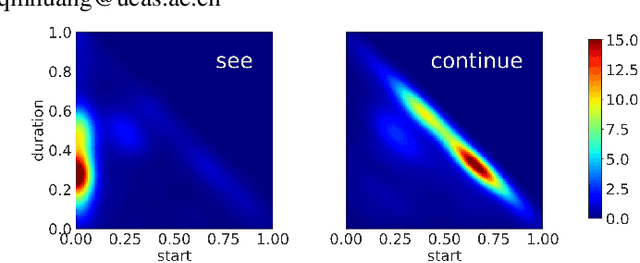
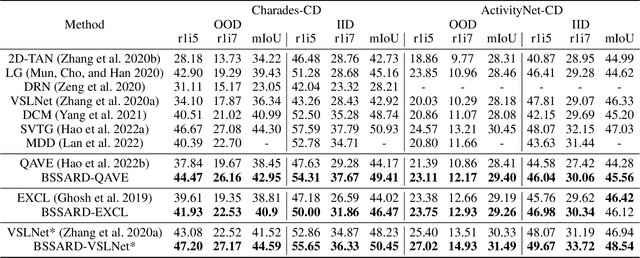

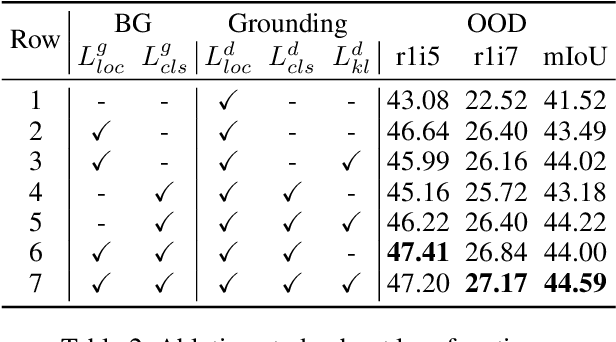
Temporal Sentence Grounding in Video (TSGV) is troubled by dataset bias issue, which is caused by the uneven temporal distribution of the target moments for samples with similar semantic components in input videos or query texts. Existing methods resort to utilizing prior knowledge about bias to artificially break this uneven distribution, which only removes a limited amount of significant language biases. In this work, we propose the bias-conflict sample synthesis and adversarial removal debias strategy (BSSARD), which dynamically generates bias-conflict samples by explicitly leveraging potentially spurious correlations between single-modality features and the temporal position of the target moments. Through adversarial training, its bias generators continuously introduce biases and generate bias-conflict samples to deceive its grounding model. Meanwhile, the grounding model continuously eliminates the introduced biases, which requires it to model multi-modality alignment information. BSSARD will cover most kinds of coupling relationships and disrupt language and visual biases simultaneously. Extensive experiments on Charades-CD and ActivityNet-CD demonstrate the promising debiasing capability of BSSARD. Source codes are available at https://github.com/qzhb/BSSARD.