 Add to Chrome
 Add to Firefox
 Add to Edge
TokenLight: Precise Lighting Control in Images using Attribute Tokens
Apr 16, 2026
This paper presents a method for image relighting that enables precise and continuous control over multiple illumination attributes in a photograph. We formulate relighting as a conditional image generation task and introduce attribute tokens to encode distinct lighting factors such as intensity, color, ambient illumination, diffuse level, and 3D light positions. The model is trained on a large-scale synthetic dataset with ground-truth lighting annotations, supplemented by a small set of real captures to enhance realism and generalization. We validate our approach across a variety of relighting tasks, including controlling in-scene lighting fixtures and editing environment illumination using virtual light sources, on synthetic and real images. Our method achieves state-of-the-art quantitative and qualitative performance compared to prior work. Remarkably, without explicit inverse rendering supervision, the model exhibits an inherent understanding of how light interacts with scene geometry, occlusion, and materials, yielding convincing lighting effects even in traditionally challenging scenarios such as placing lights within objects or relighting transparent materials plausibly. Project page: vrroom.github.io/tokenlight/

LightMover: Generative Light Movement with Color and Intensity Controls
Mar 28, 2026We present LightMover, a framework for controllable light manipulation in single images that leverages video diffusion priors to produce physically plausible illumination changes without re-rendering the scene. We formulate light editing as a sequence-to-sequence prediction problem in visual token space: given an image and light-control tokens, the model adjusts light position, color, and intensity together with resulting reflections, shadows, and falloff from a single view. This unified treatment of spatial (movement) and appearance (color, intensity) controls improves both manipulation and illumination understanding. We further introduce an adaptive token-pruning mechanism that preserves spatially informative tokens while compactly encoding non-spatial attributes, reducing control sequence length by 41% while maintaining editing fidelity. To train our framework, we construct a scalable rendering pipeline that generates large numbers of image pairs across varied light positions, colors, and intensities while keeping the scene content consistent with the original image. LightMover enables precise, independent control over light position, color, and intensity, and achieves high PSNR and strong semantic consistency (DINO, CLIP) across different tasks.
SynthLight: Portrait Relighting with Diffusion Model by Learning to Re-render Synthetic Faces
Jan 16, 2025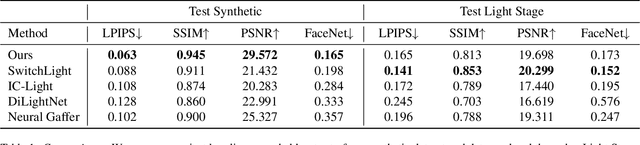
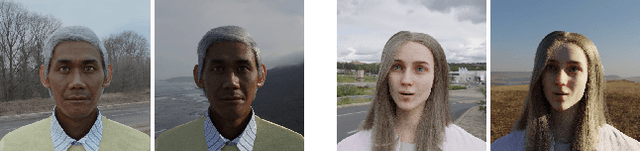
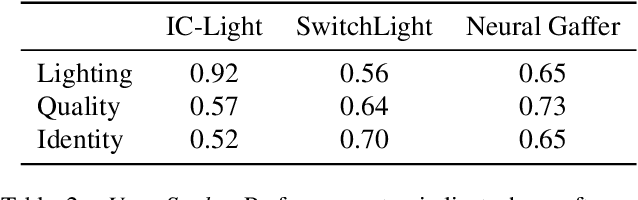
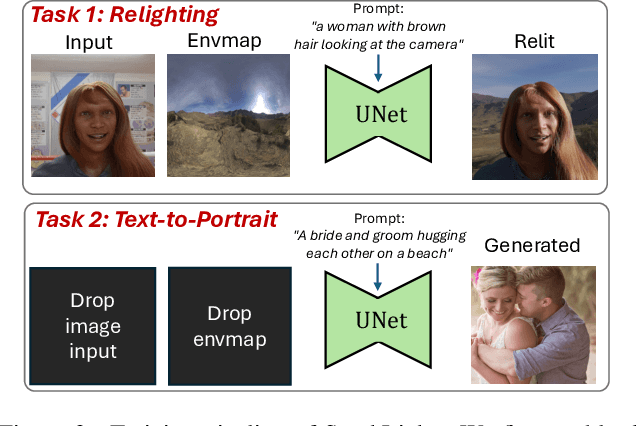
We introduce SynthLight, a diffusion model for portrait relighting. Our approach frames image relighting as a re-rendering problem, where pixels are transformed in response to changes in environmental lighting conditions. Using a physically-based rendering engine, we synthesize a dataset to simulate this lighting-conditioned transformation with 3D head assets under varying lighting. We propose two training and inference strategies to bridge the gap between the synthetic and real image domains: (1) multi-task training that takes advantage of real human portraits without lighting labels; (2) an inference time diffusion sampling procedure based on classifier-free guidance that leverages the input portrait to better preserve details. Our method generalizes to diverse real photographs and produces realistic illumination effects, including specular highlights and cast shadows, while preserving the subject's identity. Our quantitative experiments on Light Stage data demonstrate results comparable to state-of-the-art relighting methods. Our qualitative results on in-the-wild images showcase rich and unprecedented illumination effects. Project Page: \url{https://vrroom.github.io/synthlight/}
ReGroup: Recursive Neural Networks for Hierarchical Grouping of Vector Graphic Primitives
Nov 23, 2021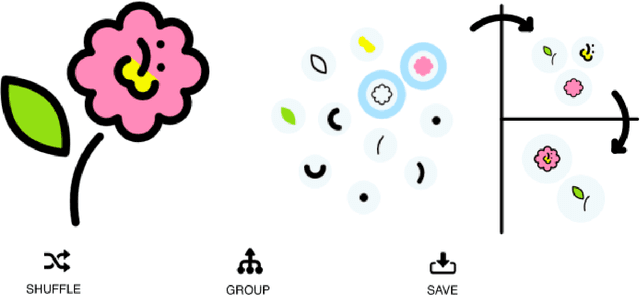
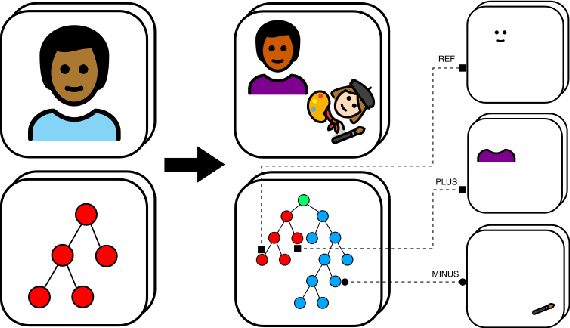
Selection functionality is as fundamental to vector graphics as it is for raster data. But vector selection is quite different: instead of pixel-level labeling, we make a binary decision to include or exclude each vector primitive. In the absence of intelligible metadata, this becomes a perceptual grouping problem. These have previously relied on heuristics derived from empirical principles like Gestalt Theory, but since these are ill-defined and subjective, they often result in ambiguity. Here we take a data-centric approach to the problem. By exploiting the recursive nature of perceptual grouping, we interpret the task as constructing a hierarchy over the primitives of a vector graphic, which is amenable to learning with recursive neural networks with few human annotations. We verify this by building a dataset of these hierarchies on which we train a hierarchical grouping network. We then demonstrate how this can underpin a prototype selection tool.