 Add to Chrome
 Add to Firefox
 Add to Edge
HiPER: Hierarchical Reinforcement Learning with Explicit Credit Assignment for Large Language Model Agents
Feb 18, 2026
Training LLMs as interactive agents for multi-turn decision-making remains challenging, particularly in long-horizon tasks with sparse and delayed rewards, where agents must execute extended sequences of actions before receiving meaningful feedback. Most existing reinforcement learning (RL) approaches model LLM agents as flat policies operating at a single time scale, selecting one action at each turn. In sparse-reward settings, such flat policies must propagate credit across the entire trajectory without explicit temporal abstraction, which often leads to unstable optimization and inefficient credit assignment. We propose HiPER, a novel Hierarchical Plan-Execute RL framework that explicitly separates high-level planning from low-level execution. HiPER factorizes the policy into a high-level planner that proposes subgoals and a low-level executor that carries them out over multiple action steps. To align optimization with this structure, we introduce a key technique called hierarchical advantage estimation (HAE), which carefully assigns credit at both the planning and execution levels. By aggregating returns over the execution of each subgoal and coordinating updates across the two levels, HAE provides an unbiased gradient estimator and provably reduces variance compared to flat generalized advantage estimation. Empirically, HiPER achieves state-of-the-art performance on challenging interactive benchmarks, reaching 97.4\% success on ALFWorld and 83.3\% on WebShop with Qwen2.5-7B-Instruct (+6.6\% and +8.3\% over the best prior method), with especially large gains on long-horizon tasks requiring multiple dependent subtasks. These results highlight the importance of explicit hierarchical decomposition for scalable RL training of multi-turn LLM agents.

Safeguarding Text-to-Image Generation via Inference-Time Prompt-Noise Optimization
Dec 05, 2024

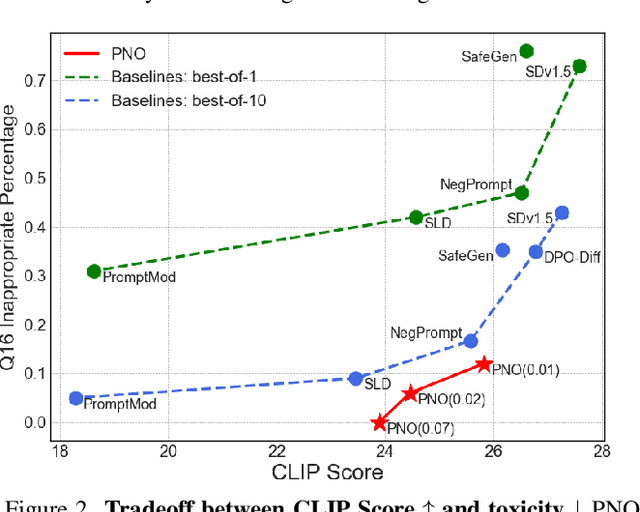

Text-to-Image (T2I) diffusion models are widely recognized for their ability to generate high-quality and diverse images based on text prompts. However, despite recent advances, these models are still prone to generating unsafe images containing sensitive or inappropriate content, which can be harmful to users. Current efforts to prevent inappropriate image generation for diffusion models are easy to bypass and vulnerable to adversarial attacks. How to ensure that T2I models align with specific safety goals remains a significant challenge. In this work, we propose a novel, training-free approach, called Prompt-Noise Optimization (PNO), to mitigate unsafe image generation. Our method introduces a novel optimization framework that leverages both the continuous prompt embedding and the injected noise trajectory in the sampling process to generate safe images. Extensive numerical results demonstrate that our framework achieves state-of-the-art performance in suppressing toxic image generations and demonstrates robustness to adversarial attacks, without needing to tune the model parameters. Furthermore, compared with existing methods, PNO uses comparable generation time while offering the best tradeoff between the conflicting goals of safe generation and prompt-image alignment.
Tuning-Free Alignment of Diffusion Models with Direct Noise Optimization
May 29, 2024In this work, we focus on the alignment problem of diffusion models with a continuous reward function, which represents specific objectives for downstream tasks, such as improving human preference. The central goal of the alignment problem is to adjust the distribution learned by diffusion models such that the generated samples maximize the target reward function. We propose a novel alignment approach, named Direct Noise Optimization (DNO), that optimizes the injected noise during the sampling process of diffusion models. By design, DNO is tuning-free and prompt-agnostic, as the alignment occurs in an online fashion during generation. We rigorously study the theoretical properties of DNO and also propose variants to deal with non-differentiable reward functions. Furthermore, we identify that naive implementation of DNO occasionally suffers from the out-of-distribution reward hacking problem, where optimized samples have high rewards but are no longer in the support of the pretrained distribution. To remedy this issue, we leverage classical high-dimensional statistics theory and propose to augment the DNO loss with certain probability regularization. We conduct extensive experiments on several popular reward functions trained on human feedback data and demonstrate that the proposed DNO approach achieves state-of-the-art reward scores as well as high image quality, all within a reasonable time budget for generation.