 Add to Chrome
 Add to Firefox
 Add to Edge
Controlling Text-to-Image Diffusion by Orthogonal Finetuning
Jun 12, 2023
Large text-to-image diffusion models have impressive capabilities in generating photorealistic images from text prompts. How to effectively guide or control these powerful models to perform different downstream tasks becomes an important open problem. To tackle this challenge, we introduce a principled finetuning method -- Orthogonal Finetuning (OFT), for adapting text-to-image diffusion models to downstream tasks. Unlike existing methods, OFT can provably preserve hyperspherical energy which characterizes the pairwise neuron relationship on the unit hypersphere. We find that this property is crucial for preserving the semantic generation ability of text-to-image diffusion models. To improve finetuning stability, we further propose Constrained Orthogonal Finetuning (COFT) which imposes an additional radius constraint to the hypersphere. Specifically, we consider two important finetuning text-to-image tasks: subject-driven generation where the goal is to generate subject-specific images given a few images of a subject and a text prompt, and controllable generation where the goal is to enable the model to take in additional control signals. We empirically show that our OFT framework outperforms existing methods in generation quality and convergence speed.

A Survey on Time-Series Pre-Trained Models
May 18, 2023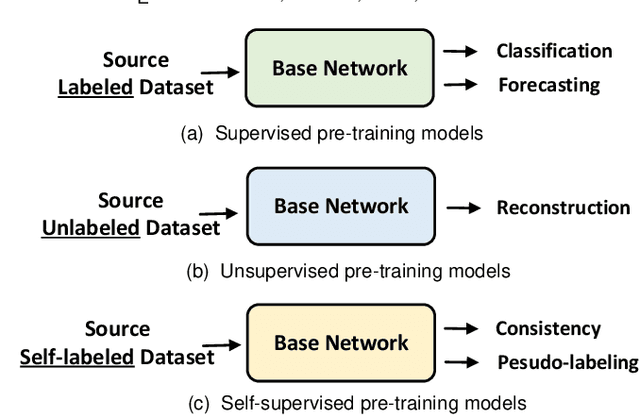

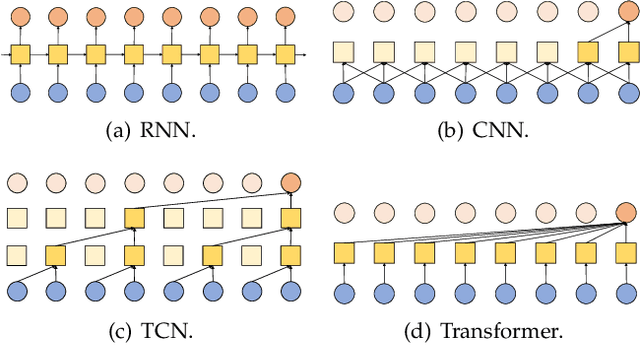

Time-Series Mining (TSM) is an important research area since it shows great potential in practical applications. Deep learning models that rely on massive labeled data have been utilized for TSM successfully. However, constructing a large-scale well-labeled dataset is difficult due to data annotation costs. Recently, Pre-Trained Models have gradually attracted attention in the time series domain due to their remarkable performance in computer vision and natural language processing. In this survey, we provide a comprehensive review of Time-Series Pre-Trained Models (TS-PTMs), aiming to guide the understanding, applying, and studying TS-PTMs. Specifically, we first briefly introduce the typical deep learning models employed in TSM. Then, we give an overview of TS-PTMs according to the pre-training techniques. The main categories we explore include supervised, unsupervised, and self-supervised TS-PTMs. Further, extensive experiments are conducted to analyze the advantages and disadvantages of transfer learning strategies, Transformer-based models, and representative TS-PTMs. Finally, we point out some potential directions of TS-PTMs for future work.
Boosting Convolutional Neural Networks with Middle Spectrum Grouped Convolution
Apr 13, 2023This paper proposes a novel module called middle spectrum grouped convolution (MSGC) for efficient deep convolutional neural networks (DCNNs) with the mechanism of grouped convolution. It explores the broad "middle spectrum" area between channel pruning and conventional grouped convolution. Compared with channel pruning, MSGC can retain most of the information from the input feature maps due to the group mechanism; compared with grouped convolution, MSGC benefits from the learnability, the core of channel pruning, for constructing its group topology, leading to better channel division. The middle spectrum area is unfolded along four dimensions: group-wise, layer-wise, sample-wise, and attention-wise, making it possible to reveal more powerful and interpretable structures. As a result, the proposed module acts as a booster that can reduce the computational cost of the host backbones for general image recognition with even improved predictive accuracy. For example, in the experiments on ImageNet dataset for image classification, MSGC can reduce the multiply-accumulates (MACs) of ResNet-18 and ResNet-50 by half but still increase the Top-1 accuracy by more than 1%. With 35% reduction of MACs, MSGC can also increase the Top-1 accuracy of the MobileNetV2 backbone. Results on MS COCO dataset for object detection show similar observations. Our code and trained models are available at https://github.com/hellozhuo/msgc.
Locate Then Generate: Bridging Vision and Language with Bounding Box for Scene-Text VQA
Apr 04, 2023
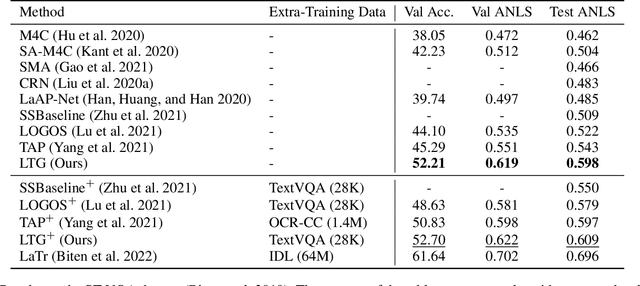
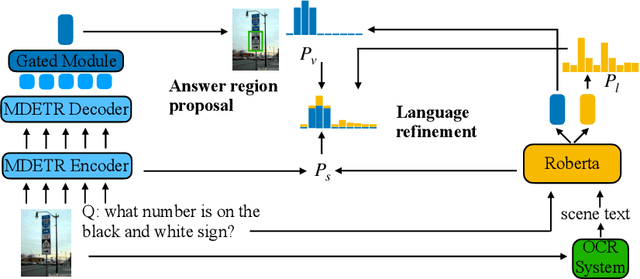
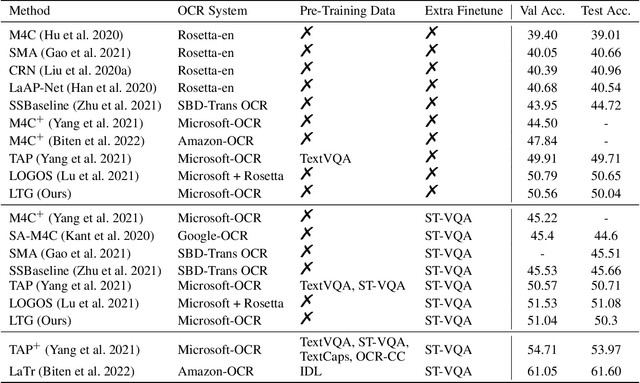
In this paper, we propose a novel multi-modal framework for Scene Text Visual Question Answering (STVQA), which requires models to read scene text in images for question answering. Apart from text or visual objects, which could exist independently, scene text naturally links text and visual modalities together by conveying linguistic semantics while being a visual object in an image simultaneously. Different to conventional STVQA models which take the linguistic semantics and visual semantics in scene text as two separate features, in this paper, we propose a paradigm of "Locate Then Generate" (LTG), which explicitly unifies this two semantics with the spatial bounding box as a bridge connecting them. Specifically, at first, LTG locates the region in an image that may contain the answer words with an answer location module (ALM) consisting of a region proposal network and a language refinement network, both of which can transform to each other with one-to-one mapping via the scene text bounding box. Next, given the answer words selected by ALM, LTG generates a readable answer sequence with an answer generation module (AGM) based on a pre-trained language model. As a benefit of the explicit alignment of the visual and linguistic semantics, even without any scene text based pre-training tasks, LTG can boost the absolute accuracy by +6.06% and +6.92% on the TextVQA dataset and the ST-VQA dataset respectively, compared with a non-pre-training baseline. We further demonstrate that LTG effectively unifies visual and text modalities through the spatial bounding box connection, which is underappreciated in previous methods.
Disorder-invariant Implicit Neural Representation
Apr 03, 2023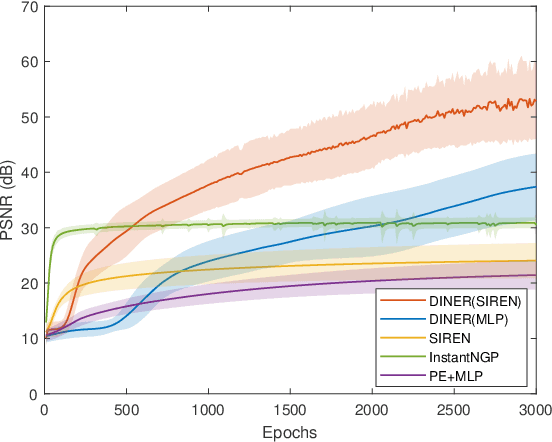
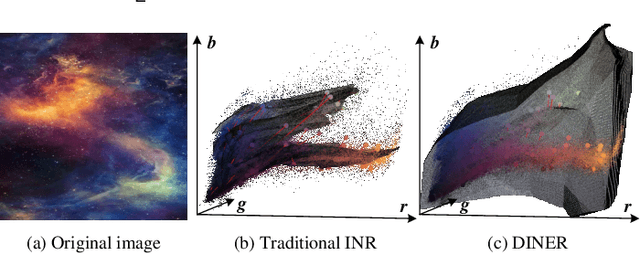
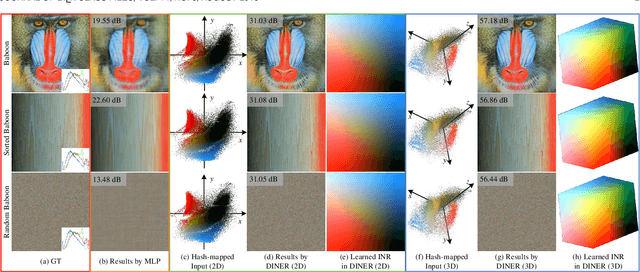
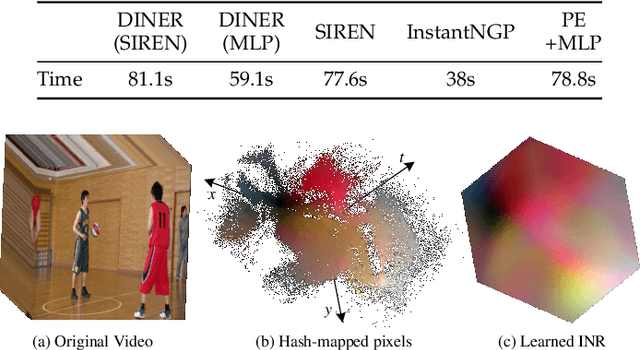
Implicit neural representation (INR) characterizes the attributes of a signal as a function of corresponding coordinates which emerges as a sharp weapon for solving inverse problems. However, the expressive power of INR is limited by the spectral bias in the network training. In this paper, we find that such a frequency-related problem could be greatly solved by re-arranging the coordinates of the input signal, for which we propose the disorder-invariant implicit neural representation (DINER) by augmenting a hash-table to a traditional INR backbone. Given discrete signals sharing the same histogram of attributes and different arrangement orders, the hash-table could project the coordinates into the same distribution for which the mapped signal can be better modeled using the subsequent INR network, leading to significantly alleviated spectral bias. Furthermore, the expressive power of the DINER is determined by the width of the hash-table. Different width corresponds to different geometrical elements in the attribute space, \textit{e.g.}, 1D curve, 2D curved-plane and 3D curved-volume when the width is set as $1$, $2$ and $3$, respectively. More covered areas of the geometrical elements result in stronger expressive power. Experiments not only reveal the generalization of the DINER for different INR backbones (MLP vs. SIREN) and various tasks (image/video representation, phase retrieval, refractive index recovery, and neural radiance field optimization) but also show the superiority over the state-of-the-art algorithms both in quality and speed. \textit{Project page:} \url{https://ezio77.github.io/DINER-website/}
MeshDiffusion: Score-based Generative 3D Mesh Modeling
Mar 14, 2023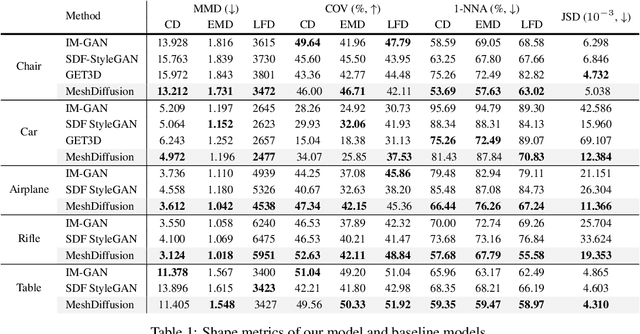
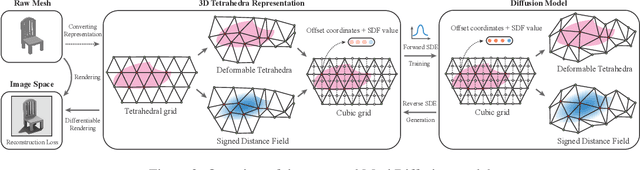

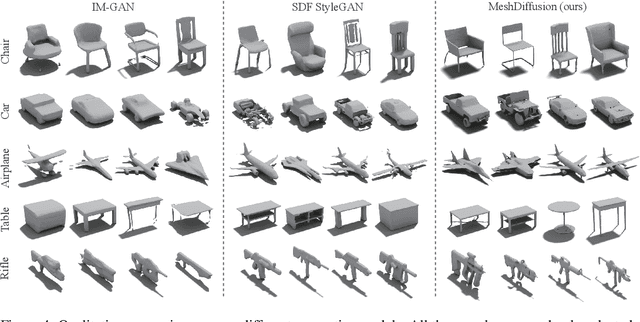
We consider the task of generating realistic 3D shapes, which is useful for a variety of applications such as automatic scene generation and physical simulation. Compared to other 3D representations like voxels and point clouds, meshes are more desirable in practice, because (1) they enable easy and arbitrary manipulation of shapes for relighting and simulation, and (2) they can fully leverage the power of modern graphics pipelines which are mostly optimized for meshes. Previous scalable methods for generating meshes typically rely on sub-optimal post-processing, and they tend to produce overly-smooth or noisy surfaces without fine-grained geometric details. To overcome these shortcomings, we take advantage of the graph structure of meshes and use a simple yet very effective generative modeling method to generate 3D meshes. Specifically, we represent meshes with deformable tetrahedral grids, and then train a diffusion model on this direct parametrization. We demonstrate the effectiveness of our model on multiple generative tasks.
Minimum Latency Deep Online Video Stabilization
Dec 05, 2022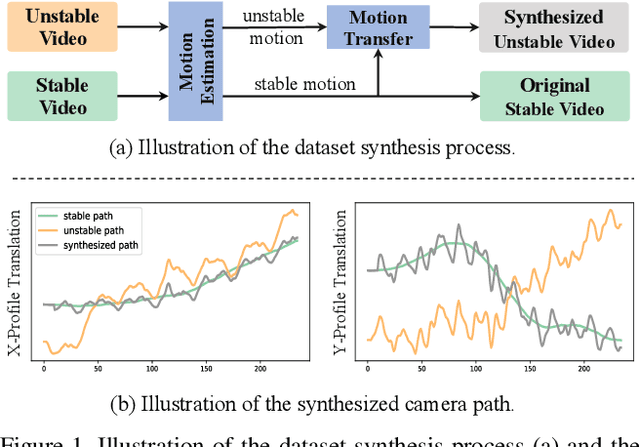
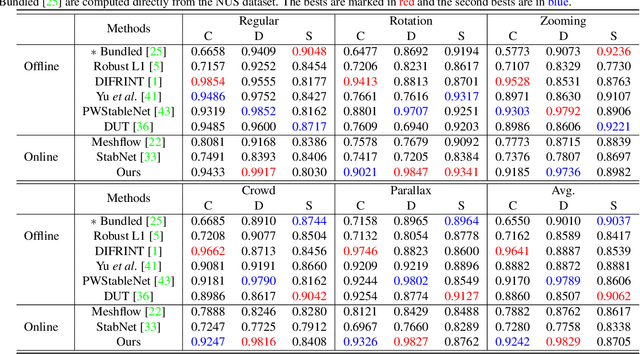
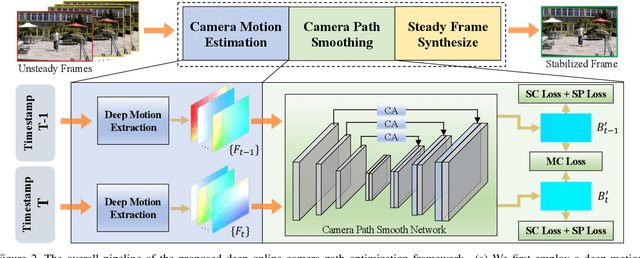
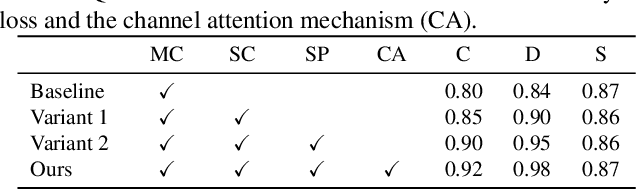
We present a novel camera path optimization framework for the task of online video stabilization. Typically, a stabilization pipeline consists of three steps: motion estimating, path smoothing, and novel view rendering. Most previous methods concentrate on motion estimation, proposing various global or local motion models. In contrast, path optimization receives relatively less attention, especially in the important online setting, where no future frames are available. In this work, we adopt recent off-the-shelf high-quality deep motion models for the motion estimation to recover the camera trajectory and focus on the latter two steps. Our network takes a short 2D camera path in a sliding window as input and outputs the stabilizing warp field of the last frame in the window, which warps the coming frame to its stabilized position. A hybrid loss is well-defined to constrain the spatial and temporal consistency. In addition, we build a motion dataset that contains stable and unstable motion pairs for the training. Extensive experiments demonstrate that our approach significantly outperforms state-of-the-art online methods both qualitatively and quantitatively and achieves comparable performance to offline methods.
Remote estimation of geologic composition using interferometric synthetic-aperture radar in California's Central Valley
Dec 04, 2022California's Central Valley is the national agricultural center, producing 1/4 of the nation's food. However, land in the Central Valley is sinking at a rapid rate (as much as 20 cm per year) due to continued groundwater pumping. Land subsidence has a significant impact on infrastructure resilience and groundwater sustainability. In this study, we aim to identify specific regions with different temporal dynamics of land displacement and find relationships with underlying geological composition. Then, we aim to remotely estimate geologic composition using interferometric synthetic aperture radar (InSAR)-based land deformation temporal changes using machine learning techniques. We identified regions with different temporal characteristics of land displacement in that some areas (e.g., Helm) with coarser grain geologic compositions exhibited potentially reversible land deformation (elastic land compaction). We found a significant correlation between InSAR-based land deformation and geologic composition using random forest and deep neural network regression models. We also achieved significant accuracy with 1/4 sparse sampling to reduce any spatial correlations among data, suggesting that the model has the potential to be generalized to other regions for indirect estimation of geologic composition. Our results indicate that geologic composition can be estimated using InSAR-based land deformation data. In-situ measurements of geologic composition can be expensive and time consuming and may be impractical in some areas. The generalizability of the model sheds light on high spatial resolution geologic composition estimation utilizing existing measurements.
DINER: Disorder-Invariant Implicit Neural Representation
Nov 15, 2022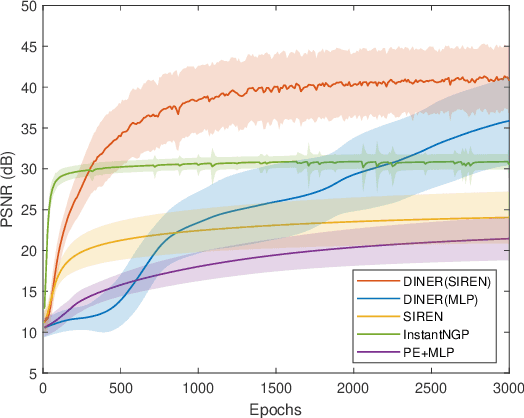
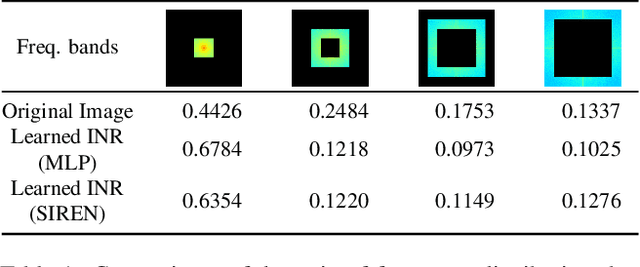

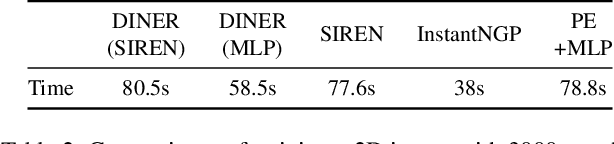
Implicit neural representation (INR) characterizes the attributes of a signal as a function of corresponding coordinates which emerges as a sharp weapon for solving inverse problems. However, the capacity of INR is limited by the spectral bias in the network training. In this paper, we find that such a frequency-related problem could be largely solved by re-arranging the coordinates of the input signal, for which we propose the disorder-invariant implicit neural representation (DINER) by augmenting a hash-table to a traditional INR backbone. Given discrete signals sharing the same histogram of attributes and different arrangement orders, the hash-table could project the coordinates into the same distribution for which the mapped signal can be better modeled using the subsequent INR network, leading to significantly alleviated spectral bias. Experiments not only reveal the generalization of the DINER for different INR backbones (MLP vs. SIREN) and various tasks (image/video representation, phase retrieval, and refractive index recovery) but also show the superiority over the state-of-the-art algorithms both in quality and speed.
Iterative Teaching by Data Hallucination
Oct 31, 2022


We consider the problem of iterative machine teaching, where a teacher sequentially provides examples based on the status of a learner under a discrete input space (i.e., a pool of finite samples), which greatly limits the teacher's capability. To address this issue, we study iterative teaching under a continuous input space where the input example (i.e., image) can be either generated by solving an optimization problem or drawn directly from a continuous distribution. Specifically, we propose data hallucination teaching (DHT) where the teacher can generate input data intelligently based on labels, the learner's status and the target concept. We study a number of challenging teaching setups (e.g., linear/neural learners in omniscient and black-box settings). Extensive empirical results verify the effectiveness of DHT.