 Add to Chrome
 Add to Firefox
 Add to Edge
Hierarchical Residual Policy Optimization for Generative Recommendations
Aug 01, 2026
Generative recommenders select items by autoregressively decoding semantic identifiers (SIDs), whose token positions induce a coarse-to-fine hierarchy over the item space. In practice, SID decoders are trained via supervised next-token prediction, which imitates logged trajectories rather than directly optimizing downstream utility. This motivates post-training with outcome feedback to guide decoding toward higher utility. However, logged feedback is only observed for the final exposed item, causing most post-training methods to operate at the item level and broadcast the same terminal signal across all SID tokens. As a result, token-level credit assignment becomes sparse, high-variance, and layer-dependent. To this end, we propose Hierarchical Residual Policy Optimization (HRPO), a post-training framework that converts item-level outcomes into dense, token-aligned learning signals for conservative token-wise improvement. Specifically, HRPO first estimates SID prefix-level utilities via group-wise reward smoothing over feature-based user clusters. It then decomposes these utilities into residual token credits and accumulates them into credit-to-go signals. Finally, Residual-Return Policy Optimization (RRPO) optimizes the residual credits using clipped updates, group-normalized advantages, and KL regularization to preserve stability. Experiments on a public dataset and an online A/B test in a large-scale commercial system show consistent gains in session-level utility and key business metrics. Source code and the archived artifact are available for reproduction.

End-to-End Word-Level Pronunciation Assessment with MASK Pre-training
Jun 05, 2023

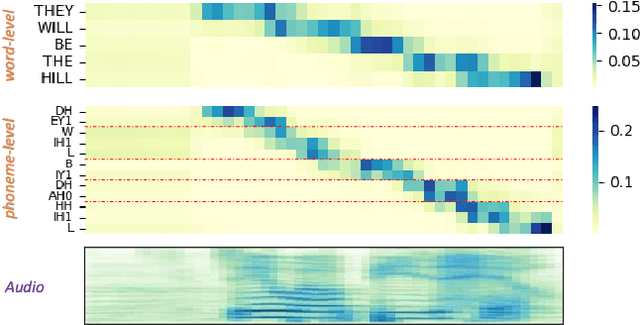

Pronunciation assessment is a major challenge in the computer-aided pronunciation training system, especially at the word (phoneme)-level. To obtain word (phoneme)-level scores, current methods usually rely on aligning components to obtain acoustic features of each word (phoneme), which limits the performance of assessment to the accuracy of alignments. Therefore, to address this problem, we propose a simple yet effective method, namely \underline{M}asked pre-training for \underline{P}ronunciation \underline{A}ssessment (MPA). Specifically, by incorporating a mask-predict strategy, our MPA supports end-to-end training without leveraging any aligning components and can solve misalignment issues to a large extent during prediction. Furthermore, we design two evaluation strategies to enable our model to conduct assessments in both unsupervised and supervised settings. Experimental results on SpeechOcean762 dataset demonstrate that MPA could achieve better performance than previous methods, without any explicit alignment. In spite of this, MPA still has some limitations, such as requiring more inference time and reference text. They expect to be addressed in future work.
Locate Then Generate: Bridging Vision and Language with Bounding Box for Scene-Text VQA
Apr 04, 2023
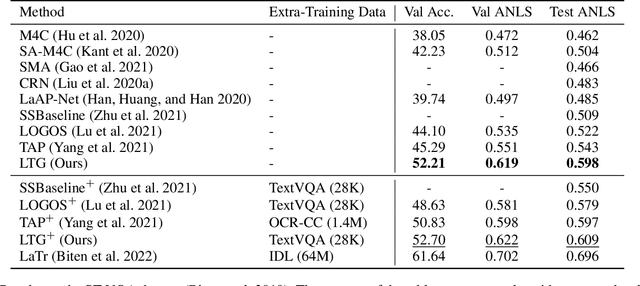
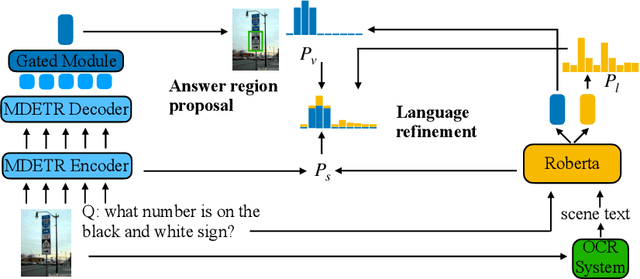
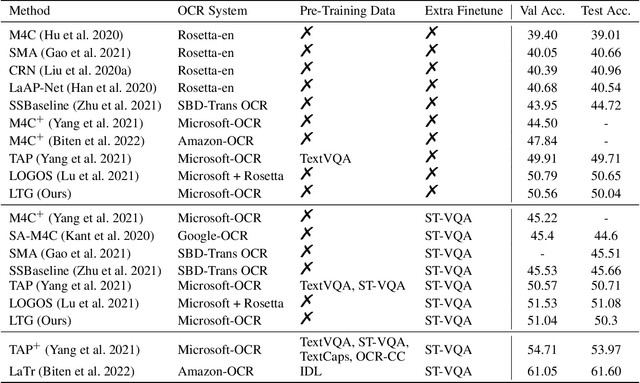
In this paper, we propose a novel multi-modal framework for Scene Text Visual Question Answering (STVQA), which requires models to read scene text in images for question answering. Apart from text or visual objects, which could exist independently, scene text naturally links text and visual modalities together by conveying linguistic semantics while being a visual object in an image simultaneously. Different to conventional STVQA models which take the linguistic semantics and visual semantics in scene text as two separate features, in this paper, we propose a paradigm of "Locate Then Generate" (LTG), which explicitly unifies this two semantics with the spatial bounding box as a bridge connecting them. Specifically, at first, LTG locates the region in an image that may contain the answer words with an answer location module (ALM) consisting of a region proposal network and a language refinement network, both of which can transform to each other with one-to-one mapping via the scene text bounding box. Next, given the answer words selected by ALM, LTG generates a readable answer sequence with an answer generation module (AGM) based on a pre-trained language model. As a benefit of the explicit alignment of the visual and linguistic semantics, even without any scene text based pre-training tasks, LTG can boost the absolute accuracy by +6.06% and +6.92% on the TextVQA dataset and the ST-VQA dataset respectively, compared with a non-pre-training baseline. We further demonstrate that LTG effectively unifies visual and text modalities through the spatial bounding box connection, which is underappreciated in previous methods.