 Add to Chrome
 Add to Firefox
 Add to Edge
ReLATE: Reliability-Guided Evidence Fusion for Robust UAV--Satellite cross-view Geo-Localization
Jul 28, 2026
Unmanned aerial vehicle (UAV)-satellite cross-view geo-localization matches UAV images against satellite imagery and has achieved impressive accuracy on clean (non-degraded) image benchmarks. In real-world flights, however, UAV observations are frequently affected by adverse weather, illumination changes, platform motion, sensor noise, and compression, while the robustness of existing methods under such degradations remains largely unexamined. In this paper, we present UAVSat-Deg, a large-scale robustness benchmark for degraded UAV-satellite geo-localization, comprising University-1652-Deg and SUES-200-Deg. UAVSat-Deg covers 27 corruption types, including 19 core and 8 compound corruptions, at three severity levels, supports bidirectional drone-to-satellite and satellite-to-drone retrieval as well as multi-height UAV acquisition, and contains more than 11.7 million pre-generated corrupted test images. Benchmarking representative methods under this protocol reveals substantial robustness gaps, particularly under severe and compound corruptions. To address this problem, we propose ReLATE, a Reliable Evidence Learning framework with Adaptive Token Evidence Regulation, which realizes reliability-adaptive feature fusion during descriptor construction. ReLATE estimates a structure-smoothed reliability field over visual tokens, aggregates trustworthy local evidence, and adaptively integrates it into query-derived representations; the regulated query representations are then combined with the CLS-token and GeM-pooled branches to form the final cross-view descriptor. Across both test sets and retrieval directions, ReLATE achieves the best average corrupted-test performance among the compared methods while maintaining competitive accuracy on clean images. The code and dataset will be available at https://github.com/JHC626/ReLATE.

When Does Learning to Stop Help? A Cost-Aware Study of Early Exits in Reasoning Models
Jun 29, 2026Reasoning models spend different amounts of useful computation across instances, but it remains unclear when a learned stopping rule improves over simple confidence or convergence thresholds. We study this question with LearnStop, a hidden-state-free checkpoint stopper for reasoning language models. At fixed budget checkpoints, LearnStop probes a short answer from the current reasoning prefix and predicts prefix correctness from online features such as answer confidence, entropy, prefix vote share, answer stability, and backtracking-marker density. Across 18 task-model settings spanning GSM8K, MATH-500, MMLU-Pro, AIME-90, GPQA, Qwen3, and DeepSeek-R1 distillations, the answer is task-dependent. On free-form math, learned multi-feature stopping improves the fixed-budget frontier and often beats scalar exits: on GSM8K with Qwen3-32B, the empirical frontier reaches a post-hoc peak adapt gain of +0.157, validation-selected operating points preserve positive gains, and the paired gain over the strongest scalar baseline is +0.028. On multiple-choice and very hard settings, scalar confidence, entropy, or stability rules are competitive or stronger. We therefore frame learned stopping not as a universal replacement for scalar exits, but as a tool whose value depends on trajectory structure. We further provide validation-selected operating points, paired bootstrap tests, finite-grid lost-correct risk calibration, cost accounting under KV-fork, prefix-cache, and black-box regimes, H100 serving profiles, checkpoint-schedule sweeps, transfer analyses, and robustness checks. The main practical finding is that learned stopping is useful when many questions become correct before full budget but do not exhibit a single reliable scalar stopping signal; its benefits largely disappear when confidence or answer convergence already solves the stopping problem.
Diagnosing and Mitigating Retrieval Bottlenecks in LLM-Based Cold-Start Recommendation
Jun 29, 2026Large language models (LLMs) are increasingly used as rerankers in recommender systems, with the expectation that semantic understanding will help in cold-start and long-tail regimes. We test this assumption with a five-domain benchmark that explicitly separates reranking quality from retrieval coverage. In a positive-controlled regime where the gold item is guaranteed present, calibrated LLM rerankers fail to consistently outperform strong collaborative and content baselines under natural traffic, and within-family scaling from Qwen3-8B to Qwen3-32B narrows but does not close the gap on most domains. In a retrieval-realistic regime where the gold item is not injected, the bottleneck is more severe: standard single retrievers place the gold item in a 200-item pool only 4.6-22.9% of the time, largely because 32-91% of cold-start targets are brand-new items with no training interactions. We introduce LHF, a validation-trained learned hybrid fusion layer over a multi-retriever union pool, as a retrieval-side realizability baseline. LHF is the only combiner we test that beats every single retriever on all five domains and recovers 17-61% of oracle coverage headroom on content-rich domains, but only 5-7% on collaboratively strong domains. End-to-end experiments reveal the remaining mismatch: learned non-LLM ranking exploits the LHF pool, while prompt-level LLM reranking often degrades it. LLMs exhibit pockets of semantic cold-start advantage, especially in text-rich domains when the item is already present, but this advantage is largely unreachable in current retrieve-then-rerank pipelines. We release the benchmark protocol, splits, prompts, evaluation tooling, and archived reproducibility artifacts: data at https://doi.org/10.5281/zenodo.20991039 and code at https://doi.org/10.5281/zenodo.20993306.
Know Before You Fetch: Calibrated Retrieval-Budget Allocation for Retrieval-Augmented Generation
Jun 29, 2026Retrieval-augmented generation (RAG) typically retrieves a fixed number of passages for every query. This is wasteful when the reader already knows the answer, and it can be harmful when irrelevant or partially relevant passages distract the reader. We formulate adaptive RAG as calibrated retrieval-budget allocation: given a query, decide whether to answer closed-book, retrieve a compact context (k=1), retrieve a full context (k=5), or abstain. The contribution is a probability interface rather than a new raw uncertainty signal. We calibrate sequence log-probability and prefix-logit uncertainty signals into probabilities of correctness, then use these probabilities for graded context selection, selective abstention, and explicit latency/token trade-offs. Across core QA experiments on TriviaQA, Natural Questions, and MS MARCO, with auxiliary PopQA motivation and Qwen/Llama family checks, diagnostic out-of-fold calibration improves probability quality dramatically: for sequence log-probability, ECE drops from 0.275 to 0.062 on TriviaQA, 0.643 to 0.009 on NQ, and 0.711 to 0.031 on MS MARCO. Graded retrieval improves full-context and passage-budget frontiers for both our signal and TARG-style prefix entropy/margin, while retrieval-call AUC remains essentially tied with binary gating because k=1 is still a retrieval call. Held-out train/validation/test threshold experiments report deployable operating points. At matched-accuracy frontier operating points, a measured cost model reveals that gating is not universally faster: it increases latency by about 27% on Qwen3-8B but saves about 8% on Qwen3-32B. These results support a nuanced view of adaptive RAG: calibrated confidence is best understood as a reusable interface for allocating retrieval budget under task and system constraints.
ERNIE 5.0 Technical Report
Feb 04, 2026In this report, we introduce ERNIE 5.0, a natively autoregressive foundation model desinged for unified multimodal understanding and generation across text, image, video, and audio. All modalities are trained from scratch under a unified next-group-of-tokens prediction objective, based on an ultra-sparse mixture-of-experts (MoE) architecture with modality-agnostic expert routing. To address practical challenges in large-scale deployment under diverse resource constraints, ERNIE 5.0 adopts a novel elastic training paradigm. Within a single pre-training run, the model learns a family of sub-models with varying depths, expert capacities, and routing sparsity, enabling flexible trade-offs among performance, model size, and inference latency in memory- or time-constrained scenarios. Moreover, we systematically address the challenges of scaling reinforcement learning to unified foundation models, thereby guaranteeing efficient and stable post-training under ultra-sparse MoE architectures and diverse multimodal settings. Extensive experiments demonstrate that ERNIE 5.0 achieves strong and balanced performance across multiple modalities. To the best of our knowledge, among publicly disclosed models, ERNIE 5.0 represents the first production-scale realization of a trillion-parameter unified autoregressive model that supports both multimodal understanding and generation. To facilitate further research, we present detailed visualizations of modality-agnostic expert routing in the unified model, alongside comprehensive empirical analysis of elastic training, aiming to offer profound insights to the community.
CroBIM-U: Uncertainty-Driven Referring Remote Sensing Image Segmentation
Jan 07, 2026Referring remote sensing image segmentation aims to localize specific targets described by natural language within complex overhead imagery. However, due to extreme scale variations, dense similar distractors, and intricate boundary structures, the reliability of cross-modal alignment exhibits significant \textbf{spatial non-uniformity}. Existing methods typically employ uniform fusion and refinement strategies across the entire image, which often introduces unnecessary linguistic perturbations in visually clear regions while failing to provide sufficient disambiguation in confused areas. To address this, we propose an \textbf{uncertainty-guided framework} that explicitly leverages a pixel-wise \textbf{referring uncertainty map} as a spatial prior to orchestrate adaptive inference. Specifically, we introduce a plug-and-play \textbf{Referring Uncertainty Scorer (RUS)}, which is trained via an online error-consistency supervision strategy to interpretably predict the spatial distribution of referential ambiguity. Building on this prior, we design two plug-and-play modules: 1) \textbf{Uncertainty-Gated Fusion (UGF)}, which dynamically modulates language injection strength to enhance constraints in high-uncertainty regions while suppressing noise in low-uncertainty ones; and 2) \textbf{Uncertainty-Driven Local Refinement (UDLR)}, which utilizes uncertainty-derived soft masks to focus refinement on error-prone boundaries and fine details. Extensive experiments demonstrate that our method functions as a unified, plug-and-play solution that significantly improves robustness and geometric fidelity in complex remote sensing scenes without altering the backbone architecture.
EarthMapper: Visual Autoregressive Models for Controllable Bidirectional Satellite-Map Translation
Apr 28, 2025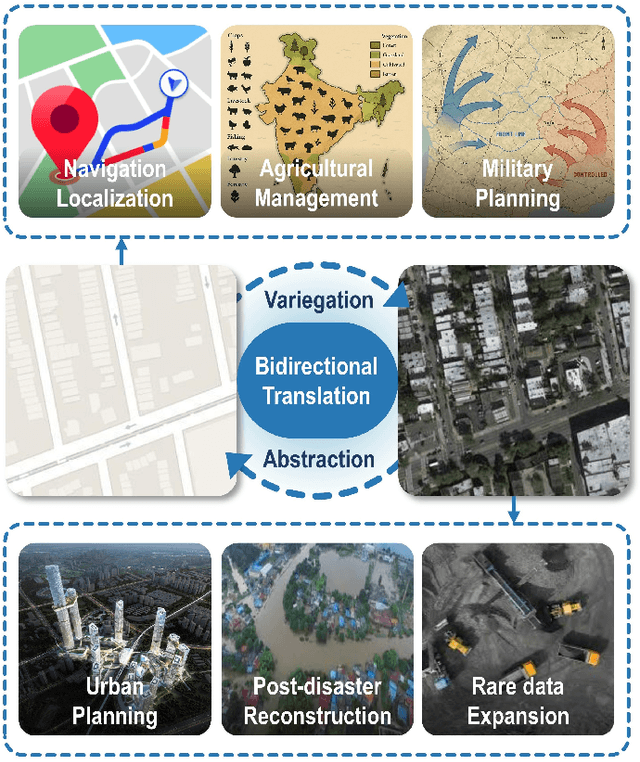
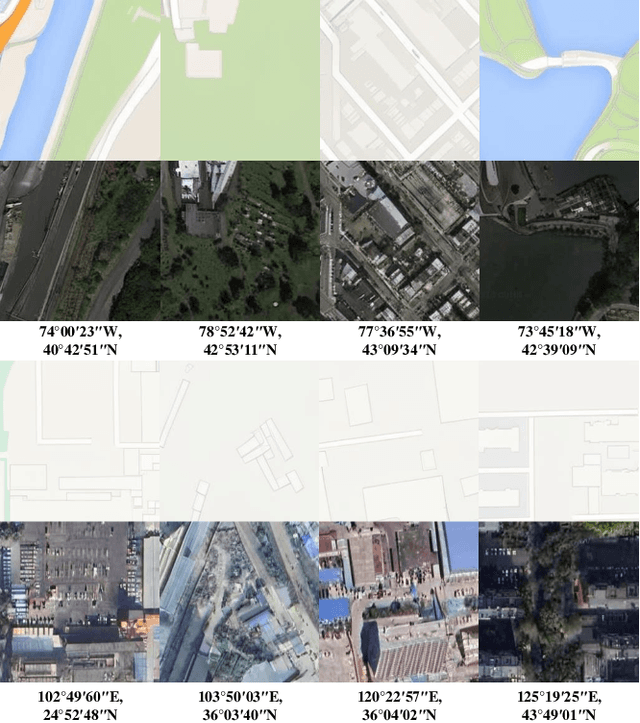
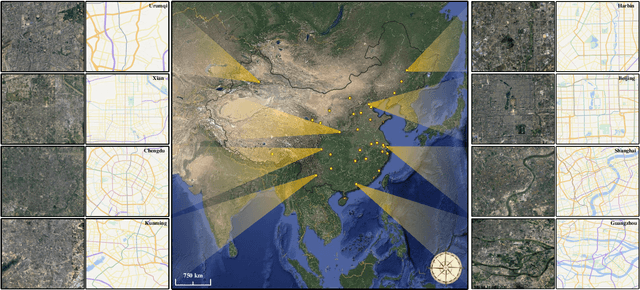
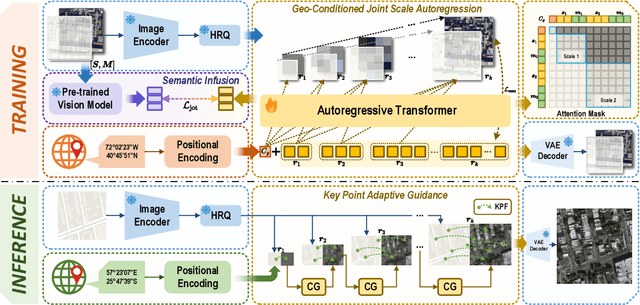
Satellite imagery and maps, as two fundamental data modalities in remote sensing, offer direct observations of the Earth's surface and human-interpretable geographic abstractions, respectively. The task of bidirectional translation between satellite images and maps (BSMT) holds significant potential for applications in urban planning and disaster response. However, this task presents two major challenges: first, the absence of precise pixel-wise alignment between the two modalities substantially complicates the translation process; second, it requires achieving both high-level abstraction of geographic features and high-quality visual synthesis, which further elevates the technical complexity. To address these limitations, we introduce EarthMapper, a novel autoregressive framework for controllable bidirectional satellite-map translation. EarthMapper employs geographic coordinate embeddings to anchor generation, ensuring region-specific adaptability, and leverages multi-scale feature alignment within a geo-conditioned joint scale autoregression (GJSA) process to unify bidirectional translation in a single training cycle. A semantic infusion (SI) mechanism is introduced to enhance feature-level consistency, while a key point adaptive guidance (KPAG) mechanism is proposed to dynamically balance diversity and precision during inference. We further contribute CNSatMap, a large-scale dataset comprising 302,132 precisely aligned satellite-map pairs across 38 Chinese cities, enabling robust benchmarking. Extensive experiments on CNSatMap and the New York dataset demonstrate EarthMapper's superior performance, achieving significant improvements in visual realism, semantic consistency, and structural fidelity over state-of-the-art methods. Additionally, EarthMapper excels in zero-shot tasks like in-painting, out-painting and coordinate-conditional generation, underscoring its versatility.
Encoder-Decoder Gemma: Improving the Quality-Efficiency Trade-Off via Adaptation
Apr 08, 2025While decoder-only large language models (LLMs) have shown impressive results, encoder-decoder models are still widely adopted in real-world applications for their inference efficiency and richer encoder representation. In this paper, we study a novel problem: adapting pretrained decoder-only LLMs to encoder-decoder, with the goal of leveraging the strengths of both approaches to achieve a more favorable quality-efficiency trade-off. We argue that adaptation not only enables inheriting the capability of decoder-only LLMs but also reduces the demand for computation compared to pretraining from scratch. We rigorously explore different pretraining objectives and parameter initialization/optimization techniques. Through extensive experiments based on Gemma 2 (2B and 9B) and a suite of newly pretrained mT5-sized models (up to 1.6B), we demonstrate the effectiveness of adaptation and the advantage of encoder-decoder LLMs. Under similar inference budget, encoder-decoder LLMs achieve comparable (often better) pretraining performance but substantially better finetuning performance than their decoder-only counterpart. For example, Gemma 2B-2B outperforms Gemma 2B by $\sim$7\% after instruction tuning. Encoder-decoder adaptation also allows for flexible combination of different-sized models, where Gemma 9B-2B significantly surpasses Gemma 2B-2B by $>$3\%. The adapted encoder representation also yields better results on SuperGLUE. We will release our checkpoints to facilitate future research.
Gemini Embedding: Generalizable Embeddings from Gemini
Mar 10, 2025In this report, we introduce Gemini Embedding, a state-of-the-art embedding model leveraging the power of Gemini, Google's most capable large language model. Capitalizing on Gemini's inherent multilingual and code understanding capabilities, Gemini Embedding produces highly generalizable embeddings for text spanning numerous languages and textual modalities. The representations generated by Gemini Embedding can be precomputed and applied to a variety of downstream tasks including classification, similarity, clustering, ranking, and retrieval. Evaluated on the Massive Multilingual Text Embedding Benchmark (MMTEB), which includes over one hundred tasks across 250+ languages, Gemini Embedding substantially outperforms prior state-of-the-art models, demonstrating considerable improvements in embedding quality. Achieving state-of-the-art performance across MMTEB's multilingual, English, and code benchmarks, our unified model demonstrates strong capabilities across a broad selection of tasks and surpasses specialized domain-specific models.
Adapting Decoder-Based Language Models for Diverse Encoder Downstream Tasks
Mar 04, 2025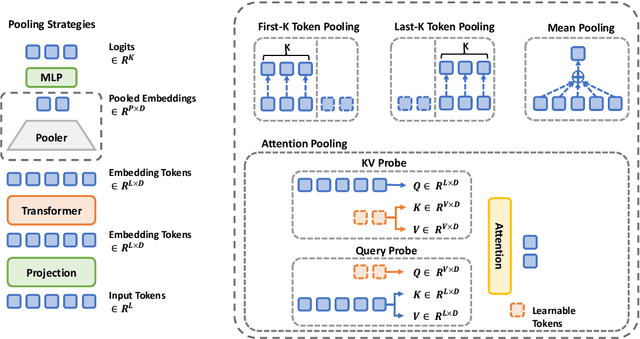
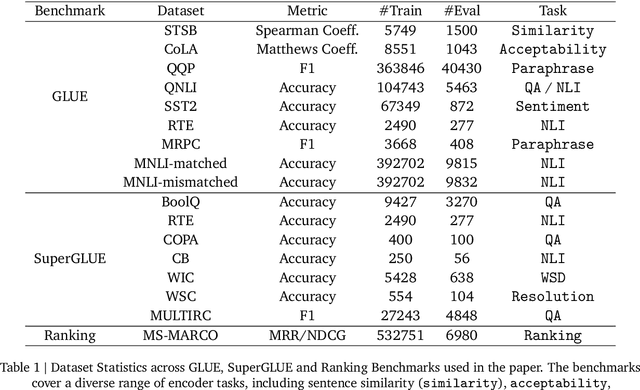
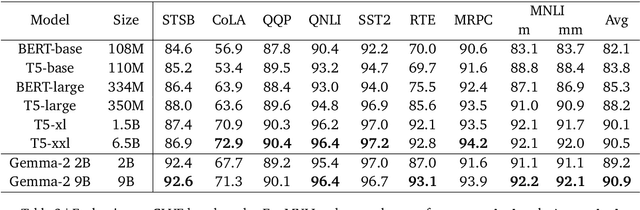
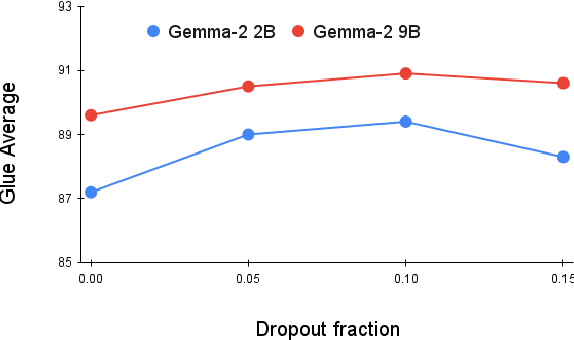
Decoder-based transformers, while revolutionizing language modeling and scaling to immense sizes, have not completely overtaken encoder-heavy architectures in natural language processing. Specifically, encoder-only models remain dominant in tasks like classification, regression, and ranking. This is primarily due to the inherent structure of decoder-based models, which limits their direct applicability to these tasks. In this paper, we introduce Gemma Encoder, adapting the powerful Gemma decoder model to an encoder architecture, thereby unlocking its potential for a wider range of non-generative applications. To optimize the adaptation from decoder to encoder, we systematically analyze various pooling strategies, attention mechanisms, and hyperparameters (e.g., dropout rate). Furthermore, we benchmark Gemma Encoder against established approaches on the GLUE benchmarks, and MS MARCO ranking benchmark, demonstrating its effectiveness and versatility.