 Add to Chrome
 Add to Firefox
 Add to Edge
ReLATE: Reliability-Guided Evidence Fusion for Robust UAV--Satellite cross-view Geo-Localization
Jul 28, 2026
Unmanned aerial vehicle (UAV)-satellite cross-view geo-localization matches UAV images against satellite imagery and has achieved impressive accuracy on clean (non-degraded) image benchmarks. In real-world flights, however, UAV observations are frequently affected by adverse weather, illumination changes, platform motion, sensor noise, and compression, while the robustness of existing methods under such degradations remains largely unexamined. In this paper, we present UAVSat-Deg, a large-scale robustness benchmark for degraded UAV-satellite geo-localization, comprising University-1652-Deg and SUES-200-Deg. UAVSat-Deg covers 27 corruption types, including 19 core and 8 compound corruptions, at three severity levels, supports bidirectional drone-to-satellite and satellite-to-drone retrieval as well as multi-height UAV acquisition, and contains more than 11.7 million pre-generated corrupted test images. Benchmarking representative methods under this protocol reveals substantial robustness gaps, particularly under severe and compound corruptions. To address this problem, we propose ReLATE, a Reliable Evidence Learning framework with Adaptive Token Evidence Regulation, which realizes reliability-adaptive feature fusion during descriptor construction. ReLATE estimates a structure-smoothed reliability field over visual tokens, aggregates trustworthy local evidence, and adaptively integrates it into query-derived representations; the regulated query representations are then combined with the CLS-token and GeM-pooled branches to form the final cross-view descriptor. Across both test sets and retrieval directions, ReLATE achieves the best average corrupted-test performance among the compared methods while maintaining competitive accuracy on clean images. The code and dataset will be available at https://github.com/JHC626/ReLATE.

Learn Temporal Consistency For Robust Satellite Video Detector
Jun 13, 2026Satellite video object detection (SVOD) for oriented and fine-grained objects plays an important role in satellite applications. Most existing SVOD methods only focus on one or a few coarse-grained categories of moving objects and represent objects with horizontal bounding boxes. They have difficulty extracting complete, accurate, and consistent information about objects in whole satellite videos. In this paper, we propose a satellite video object detection framework based on Temporal Consistency Learning (TCL). TCL adeptly detects oriented and fine-grained objects by leveraging the rich temporal contexts within satellite videos. The framework integrates three key modules: temporal and fine-grained feature aggregation (TFA), structure encoding (SE), and temporal consistency constraint (TCC). TFA and TCC modules facilitate consistent representation learning across frames, while the SE module encodes both appearance and structural information for precise fine-grained recognition. Experimental results on the SAT-MTB benchmark dataset demonstrate TCL's superior performance, achieving a new state-of-the-art oriented and fine-grained detection accuracy of 47.7% mAP--a 4.8% improvement over the baseline. Furthermore, our TCL framework readily accommodates existing image-based detectors, leading to enhanced detection accuracies.
PF-Trans: Physics-Embedded Frequency-Aware Transformer for Spectral Reconstruction
Jun 09, 2026Snapshot Broadband Filter Array (BFA) imaging provides high light throughput for spectral reconstruction but introduces severe spectral aliasing due to complex modulation. Current deep learning approaches, limited to spatial denoising, often fail to address the global frequency-specific degradations caused by the mask structure. To address this, we propose a Physics-embedded Frequency-aware Transformer (PF-Trans) for high-fidelity remote sensing spectral reconstruction. Our method explicitly integrates the physical sensing model through mask injection and a gray-scale consistency loss to ensure physical fidelity. Furthermore, we introduce a Dual-domain Block with a parallel Fast Fourier Transform (FFT) branch, enabling the network to perceive and suppress aliasing artifacts in the frequency domain. Extensive experiments on multiple datasets demonstrate that PF-Trans achieves state-of-the-art performance, achieving a Peak Signal-to-Noise Ratio (PSNR) of up to 48.50 dB on the GF-5 Shanghai dataset, significantly outperforming comparison methods.
CAMF-Det: Closure-Aware Multimodal Fusion for LiDAR-Camera 3D Object Detection on UAV Platforms
Jun 08, 2026Multimodal 3D object detection based on LiDAR and cameras has demonstrated excellent performance in ground-vehicle scenarios, but has not been explored for Unmanned Aerial Vehicle (UAV) platforms. In UAV top-down scenes, frequent groundobject occlusion dominated by tree canopies causes spatially varying and modality-dependent information degradation. Existing multimodal fusion frameworks neither explicitly model such ground-object occlusion nor embed occlusion awareness into the detection pipeline, limiting their performance in occluded UAV scenes. To address these challenges, we propose CAMF-Det, a closure-aware multimodal fusion framework for LiDAR-camera 3D object detection on UAV platforms, which derives dual-modal occlusion intensity through physics-inspired modeling and embeds them as priors throughout the detection pipeline. First, a dual-modal closure modeling module explicitly constructs occlusion intensity ground truth for both modalities offline via a Beer-Lambert-inspired formulation and building-mask correction. Second, using these ground-truth maps as supervision, a dual-modal prediction network converts the offline modeling results into online occlusion intensity predictions under single-frame inference. Third, both ground-truth and predicted occlusion intensity are injected into data augmentation, feature encoding, multimodal fusion, and detection head, enabling adaptive detection under spatially varying and modality-dependent information degradation. Experiments on two self-built UAV-based multimodal datasets, SI3D-DI and SI3D-DII, demonstrate that CAMF-Det achieves the best performance across all difficulty levels, with hard-level mAP$_{\mathrm{BEV}}$ improvements of 9.43% and 4.88% over the best competing methods, respectively. These results confirm the effectiveness of explicit occlusion prior modeling and exploitation for robust multimodal 3D detection in UAV scenes.
An Enhanced Geometric-Spectral Feature Learning Framework for Airborne Multispectral Point Cloud Classification
Jun 08, 2026Multispectral point cloud (MPC) is composed of 3D spatial-spectral information, which holds tremendous potential for accurate land-cover classification. However, the representation power of classification models is limited by inherent high-dimensional and heterogeneous spatial-spectral information, unbalanced sample distribution, and inter-class spectral similarity of airborne MPCs. We build two MPC datasets and propose an enhanced geometric-spectral feature learning framework based on attentions for airborne MPC classification. A key component in our model is a two-stream feature fusion method with attention mechanisms, which enhances the representation capability of spatial-spectral features from high-dimensional heterogeneous MPCs. The first stream aims to extract position-encoded global spectral features with fusion self-attention, and the second stream comprises a multikernel point convolution and feature aggregation attention to extract spectral-guided geometric features. We then develop a residual attention fusion block to integrate the most informative geometric-spectral features from the two parallel streams. Another important contribution of this work is a joint loss function to improve the learning ability on unbalanced and interclass similar samples. Experimental results on two airborne MPC datasets demonstrate the effectiveness of the proposed method compared with the state-of-the-art methods. Furthermore, the codes and datasets used in this paper will be made available freely at https://github.com/HITlixian/TGRS_GSFF.
Illumination-Invariant Anomaly Detection for Sub-Canopy UAV Multispectral Point Clouds
Jun 08, 2026Unmanned Aerial Vehicle (UAV) multispectral point clouds (MPC) provide high-dimensional spatial-spectral data for sub-canopy target detection; however, their efficacy is significantly compromised by severe illumination heterogeneity caused by vegetation shadows. To address this, we propose a prior-free anomaly detection framework capable of robustly handling lighting variations. First, we formulate solar angle estimation as an inverse optimization problem. By coupling spectral indices with a ray-tracing model, this strategy achieves Prior-Free Shadow Extraction without relying on flight metadata, effectively distinguishing dark objects from true shadows. Second, to mitigate spectral distortions, we introduce an Illumination-Consistent Sparse Representation mechanism. Unlike standard reconstruction methods, we construct a background dictionary strictly from neighbors sharing the same illumination state. This constraint effectively disentangles spectral reflectance from lighting variations, ensuring that targets are represented solely by physically consistent background points. Experimental results indicate that the proposed method significantly improves the separability between anomalies and background in complex forest environments, demonstrating superior performance over state-of-the-art baselines. This framework is particularly suited for identifying camouflaged military targets, mapping fallen tree trunks, and uncovering archaeological ruins hidden beneath dense foliage.
Sub-Footprint Effect Correction in FW-LiDAR Point Clouds via Intra-Footprint Target Unmixing
May 11, 2026Sub-footprint target mixing within a laser footprint significantly increases LiDAR intensity uncertainty, especially in complex environments where heterogeneous materials inside one footprint cause nonlinear distortions that impair intensity-based applications. However, the forward mixing inherent to the single-pixel detection mode of LiDAR systems blurs sub-footprint contributions, making sub-footprint effects difficult to address effectively in existing studies. To address this issue, we introduce a novel, physics-based framework that explicitly resolves sub-footprint intensity correction in full-waveform LiDAR (FW-LiDAR) point clouds. The key innovation is to make the otherwise implicit intra-footprint mixing process explicit: we first develop a spatiotemporal laser-beam distribution model to physically characterize within-footprint forward mixing of multi-target returns. Building on this formulation, we incorporate ancillary information including waveform parameters and surface geometry as constraints to pose a well-defined inverse unmixing problem and decompose each footprint into fractional contributions from multiple sub-targets. We then recover sub-footprint-corrected intensities by inverting the observed mixtures through a unified combination of parametric and model-driven approaches. To the best of our knowledge, few prior studies explicitly establish sub-footprint inversion and correction within a single laser footprint, and our framework offers a principled, physics-grounded solution. Experiments on both controlled and real-world LiDAR datasets demonstrate that the proposed method significantly enhances semantic separability across heterogeneous targets and intensity consistency across homogeneous targets.
CroBIM-U: Uncertainty-Driven Referring Remote Sensing Image Segmentation
Jan 07, 2026Referring remote sensing image segmentation aims to localize specific targets described by natural language within complex overhead imagery. However, due to extreme scale variations, dense similar distractors, and intricate boundary structures, the reliability of cross-modal alignment exhibits significant \textbf{spatial non-uniformity}. Existing methods typically employ uniform fusion and refinement strategies across the entire image, which often introduces unnecessary linguistic perturbations in visually clear regions while failing to provide sufficient disambiguation in confused areas. To address this, we propose an \textbf{uncertainty-guided framework} that explicitly leverages a pixel-wise \textbf{referring uncertainty map} as a spatial prior to orchestrate adaptive inference. Specifically, we introduce a plug-and-play \textbf{Referring Uncertainty Scorer (RUS)}, which is trained via an online error-consistency supervision strategy to interpretably predict the spatial distribution of referential ambiguity. Building on this prior, we design two plug-and-play modules: 1) \textbf{Uncertainty-Gated Fusion (UGF)}, which dynamically modulates language injection strength to enhance constraints in high-uncertainty regions while suppressing noise in low-uncertainty ones; and 2) \textbf{Uncertainty-Driven Local Refinement (UDLR)}, which utilizes uncertainty-derived soft masks to focus refinement on error-prone boundaries and fine details. Extensive experiments demonstrate that our method functions as a unified, plug-and-play solution that significantly improves robustness and geometric fidelity in complex remote sensing scenes without altering the backbone architecture.
EarthMapper: Visual Autoregressive Models for Controllable Bidirectional Satellite-Map Translation
Apr 28, 2025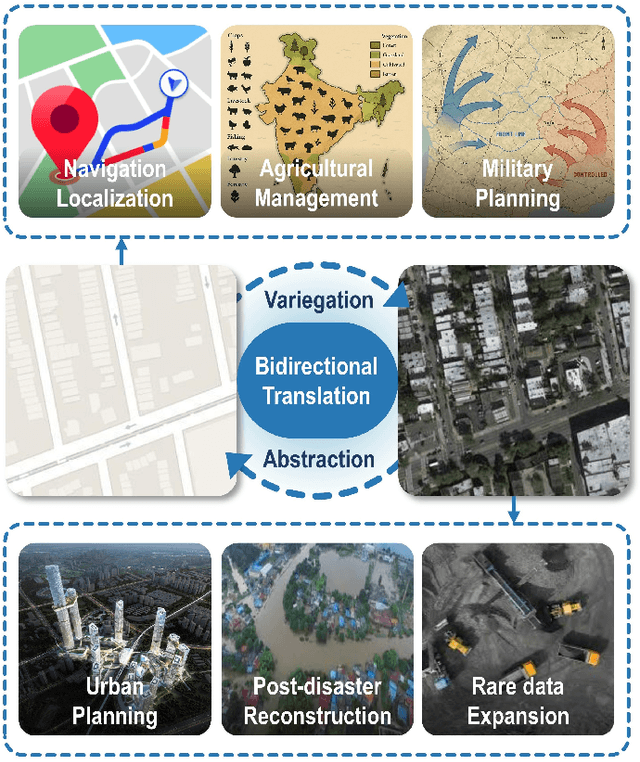
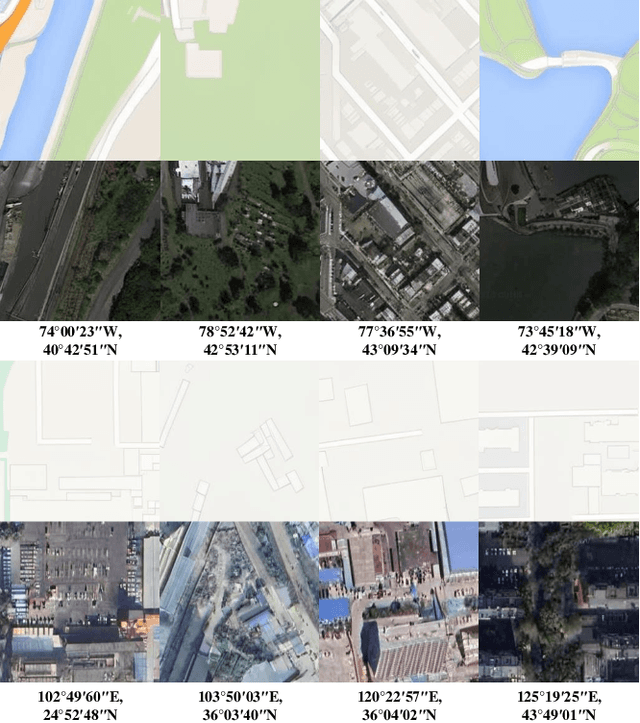
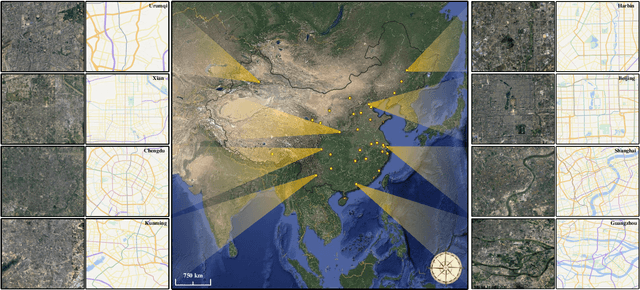
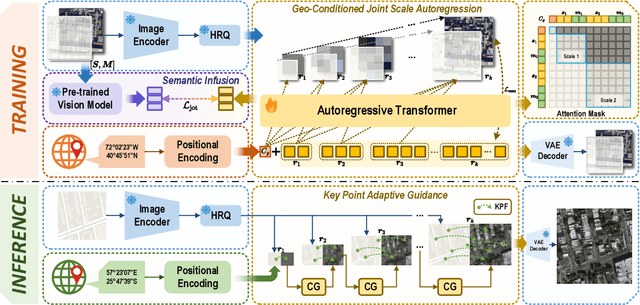
Satellite imagery and maps, as two fundamental data modalities in remote sensing, offer direct observations of the Earth's surface and human-interpretable geographic abstractions, respectively. The task of bidirectional translation between satellite images and maps (BSMT) holds significant potential for applications in urban planning and disaster response. However, this task presents two major challenges: first, the absence of precise pixel-wise alignment between the two modalities substantially complicates the translation process; second, it requires achieving both high-level abstraction of geographic features and high-quality visual synthesis, which further elevates the technical complexity. To address these limitations, we introduce EarthMapper, a novel autoregressive framework for controllable bidirectional satellite-map translation. EarthMapper employs geographic coordinate embeddings to anchor generation, ensuring region-specific adaptability, and leverages multi-scale feature alignment within a geo-conditioned joint scale autoregression (GJSA) process to unify bidirectional translation in a single training cycle. A semantic infusion (SI) mechanism is introduced to enhance feature-level consistency, while a key point adaptive guidance (KPAG) mechanism is proposed to dynamically balance diversity and precision during inference. We further contribute CNSatMap, a large-scale dataset comprising 302,132 precisely aligned satellite-map pairs across 38 Chinese cities, enabling robust benchmarking. Extensive experiments on CNSatMap and the New York dataset demonstrate EarthMapper's superior performance, achieving significant improvements in visual realism, semantic consistency, and structural fidelity over state-of-the-art methods. Additionally, EarthMapper excels in zero-shot tasks like in-painting, out-painting and coordinate-conditional generation, underscoring its versatility.
Pillar-Voxel Fusion Network for 3D Object Detection in Airborne Hyperspectral Point Clouds
Apr 13, 2025Hyperspectral point clouds (HPCs) can simultaneously characterize 3D spatial and spectral information of ground objects, offering excellent 3D perception and target recognition capabilities. Current approaches for generating HPCs often involve fusion techniques with hyperspectral images and LiDAR point clouds, which inevitably lead to geometric-spectral distortions due to fusion errors and obstacle occlusions. These adverse effects limit their performance in downstream fine-grained tasks across multiple scenarios, particularly in airborne applications. To address these issues, we propose PiV-AHPC, a 3D object detection network for airborne HPCs. To the best of our knowledge, this is the first attempt at this HPCs task. Specifically, we first develop a pillar-voxel dual-branch encoder, where the former captures spectral and vertical structural features from HPCs to overcome spectral distortion, while the latter emphasizes extracting accurate 3D spatial features from point clouds. A multi-level feature fusion mechanism is devised to enhance information interaction between the two branches, achieving neighborhood feature alignment and channel-adaptive selection, thereby organically integrating heterogeneous features and mitigating geometric distortion. Extensive experiments on two airborne HPCs datasets demonstrate that PiV-AHPC possesses state-of-the-art detection performance and high generalization capability.