 Add to Chrome
 Add to Firefox
 Add to Edge
Multi-Label Node Classification with Label Influence Propagation
Jul 01, 2026
Graphs are a complex and versatile data structure used across various domains, with possibly multi-label nodes playing a particularly crucial role. Examples include proteins in PPI networks with multiple functions and users in social or e-commerce networks exhibiting diverse interests. Tackling multi-label node classification (MLNC) on graphs has led to the development of various approaches. Some methods leverage graph neural networks (GNNs) to exploit label co-occurrence correlations, while others incorporate label embeddings to capture label proximity. However, these approaches fail to account for the intricate influences between labels in non-Euclidean graph data. To address this issue, we decompose the message passing process in GNNs into two operations: propagation and transformation. We then conduct a comprehensive analysis and quantification of the influence correlations between labels in each operation. Building on these insights, we propose a novel model, Label Influence Propagation (LIP). Specifically, we construct a label influence graph based on the integrated label correlations. Then, we propagate high-order influences through this graph, dynamically adjusting the learning process by amplifying labels with positive contributions and mitigating those with negative influence. Finally, our framework is evaluated on comprehensive benchmark datasets, consistently outperforming SOTA methods across various settings, demonstrating its effectiveness on MLNC tasks.

Audited Conformal Prediction for Classification under Unknown Distribution Shift
Jun 12, 2026We consider the problem of uncertainty quantification for a pretrained classification model deployed under unknown distribution shift. We propose Audited Conformal Prediction (ACP), a method that leverages a small labeled dataset from the target population to train an auxiliary audit model identifying inputs where the legacy model is likely to fail. By integrating the audit model's outputs into the conformal prediction framework, ACP produces prediction sets that guarantee marginal coverage while achieving substantially higher conditional coverage in practice than existing approaches. We develop and analyze two complementary integration strategies -- one targeting marginal coverage with improved conditional performance, the other providing explicit group-conditional coverage guarantees -- and establish theoretical guarantees for both. Experiments on synthetic and real-world datasets validate the method and illustrate trade-offs between prediction set size and conditional coverage.
The Hidden Bias of Process Reward Models:PRISM for Rewarding the Right Reasoning
Jun 08, 2026Process Reward Models (PRMs) improve credit assignment for reasoning by providing step-level feedback. However, we identify a hidden bias in PRMs caused by severe imbalance in step-level training data. Standard cross-entropy training amplifies this bias, causing PRMs to overcredit plausible but incorrect steps and produce high false-positive rates. We show that these false positives have an asymmetric downstream effect: false negatives mainly slow exploration, whereas false positives actively steer Best-of-N selection, guided decoding, and policy optimization toward flawed reasoning. This suggests that PRM training should shift from pointwise label fitting to reliable relative comparisons. To address this, we propose PRISM (Precision Ranking for Improved Step Modeling), a policy-aware PRM training framework that learns from contrastive step-level comparisons and hard negatives generated by a temporal lookahead strategy, requiring no new human labels. We further use a difficulty-aware curriculum to optimize the contrastive step margin. Across PRMBench and ProcessBench, PRISM substantially reduces false positives (22% on PRMBench) and improves macro F1 over strong discriminative PRMs. When applied to policy optimization and search tasks, including guided decoding and Best-of-N selection, it consistently improves accuracy (up to 22% for guided decoding and 33% for Best-of-N) and robustness. More broadly, trustworthy process supervision is not just about assigning high rewards, but about rewarding the right reasoning for the right reasons.
When Graph Tokens Sink: A Mechanistic Analysis of Graph Language Models
Jun 02, 2026Graph Language Models (GLMs) have become a promising direction for adapting Large Language Models (LLMs) to graph learning tasks. By transforming graph topology and node information into graph tokens, GLMs allow LLMs to jointly process structured graph inputs and textual instructions. Yet, it remains unclear how LLMs internally interpret these graph tokens and whether graph tokens act as meaningful carriers of graph structure. In this work, we analyze how LLMs process graph information through graph-token behavior in representative GLM architectures. Findings. We find that the internal saliency of graph tokens in GLMs is not equivalent to graph information utilization. Graph sink tokens consistently emerge as activation-level outliers: they can be identified by massive activation values along a small set of hidden-state dimensions and are biased toward early graph-token positions. However, this activation-level saliency does not imply that these tokens are the main carriers of graph information. Unlike classical attention sinks in language and vision-language models, graph sink tokens do not necessarily attract the largest attention weights from query tokens. Through pruning, repositioning, and swapping interventions, we show that graph sink tokens are not the most important semantic or structural tokens for downstream prediction. Implications. Together, these results suggest that after current GLMs map graph structure into the LLM token space, the resulting graph-token representations do not naturally form a fully usable topology-aware internal representation; instead, they exhibit a decoupling between activation-level saliency and graph-semantic utility. This decoupling points to limitations in existing graph-token construction, placement, and alignment mechanisms.
Partitioning Message Passing for Graph Fraud Detection
Nov 16, 2024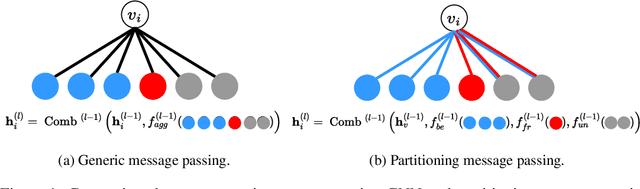
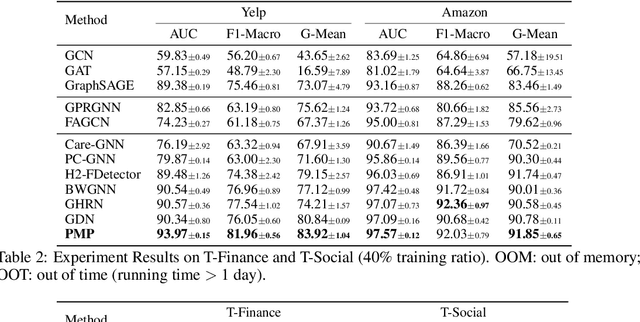
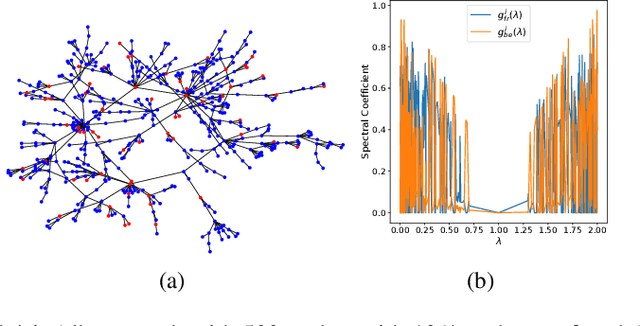
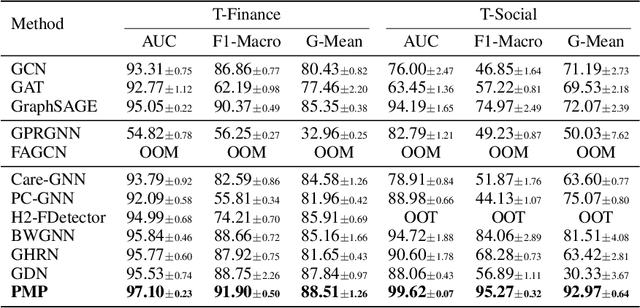
Label imbalance and homophily-heterophily mixture are the fundamental problems encountered when applying Graph Neural Networks (GNNs) to Graph Fraud Detection (GFD) tasks. Existing GNN-based GFD models are designed to augment graph structure to accommodate the inductive bias of GNNs towards homophily, by excluding heterophilic neighbors during message passing. In our work, we argue that the key to applying GNNs for GFD is not to exclude but to {\em distinguish} neighbors with different labels. Grounded in this perspective, we introduce Partitioning Message Passing (PMP), an intuitive yet effective message passing paradigm expressly crafted for GFD. Specifically, in the neighbor aggregation stage of PMP, neighbors with different classes are aggregated with distinct node-specific aggregation functions. By this means, the center node can adaptively adjust the information aggregated from its heterophilic and homophilic neighbors, thus avoiding the model gradient being dominated by benign nodes which occupy the majority of the population. We theoretically establish a connection between the spatial formulation of PMP and spectral analysis to characterize that PMP operates an adaptive node-specific spectral graph filter, which demonstrates the capability of PMP to handle heterophily-homophily mixed graphs. Extensive experimental results show that PMP can significantly boost the performance on GFD tasks.
Fairness for Robust Learning to Rank
Dec 12, 2021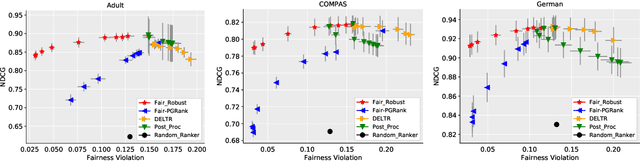

While conventional ranking systems focus solely on maximizing the utility of the ranked items to users, fairness-aware ranking systems additionally try to balance the exposure for different protected attributes such as gender or race. To achieve this type of group fairness for ranking, we derive a new ranking system based on the first principles of distributional robustness. We formulate a minimax game between a player choosing a distribution over rankings to maximize utility while satisfying fairness constraints against an adversary seeking to minimize utility while matching statistics of the training data. We show that our approach provides better utility for highly fair rankings than existing baseline methods.
AP-Perf: Incorporating Generic Performance Metrics in Differentiable Learning
Dec 02, 2019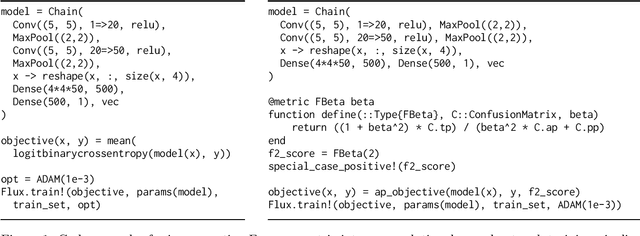
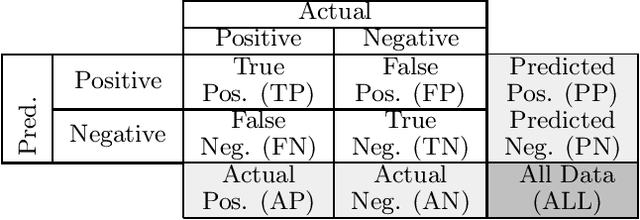

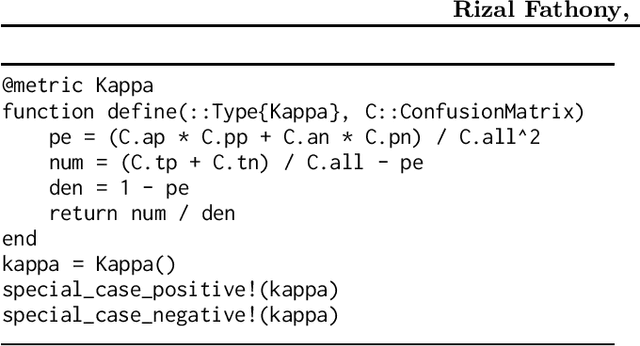
We propose a method that enables practitioners to conveniently incorporate custom non-decomposable performance metrics into differentiable learning pipelines, notably those based upon deep learning architectures. Our approach is based on the recently-developed adversarial prediction framework, a distributionally robust approach that optimizes a metric in the worst case given the statistical summary of the empirical distribution. We formulate a marginal distribution technique to reduce the complexity of optimizing the adversarial prediction formulation over a vast range of non-decomposable metrics. We demonstrate how easy it is to write and incorporate complex custom metrics using our provided tool. Finally, we show the effectiveness of our approach for image classification tasks using MNIST and Fashion-MNIST datasets as well as classification task on tabular data using UCI repository and benchmark datasets.
Fair Logistic Regression: An Adversarial Perspective
Mar 19, 2019
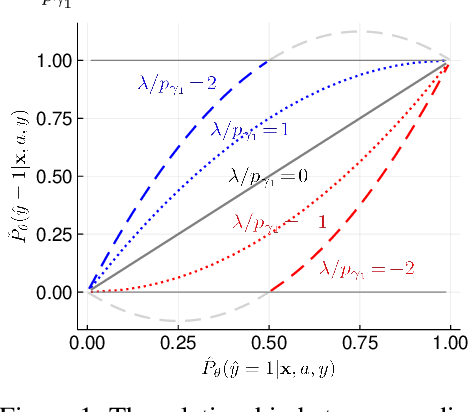
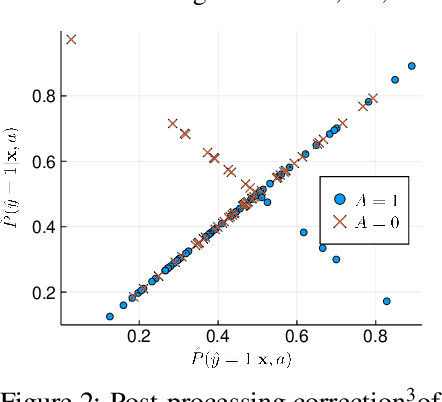
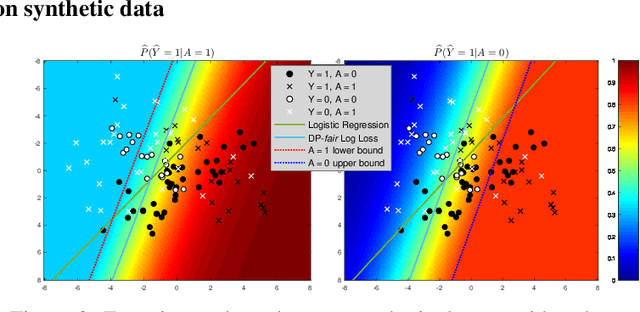
Fair prediction methods have primarily been built around existing classification techniques using pre-processing methods, post-hoc adjustments, reduction-based constructions, or deep learning procedures. We investigate a new approach to fair data-driven decision making by designing predictors with fairness requirements integrated into their core formulations. We augment a game-theoretic construction of the logistic regression model with fairness constraints, producing a novel prediction model that robustly and fairly minimizes the logarithmic loss. We demonstrate the advantages of our approach on a range of benchmark datasets for fairness.
Consistent Robust Adversarial Prediction for General Multiclass Classification
Dec 18, 2018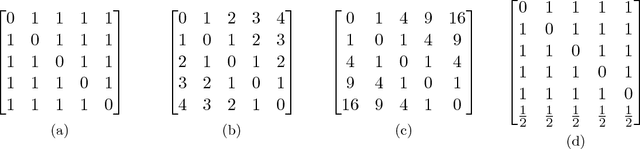
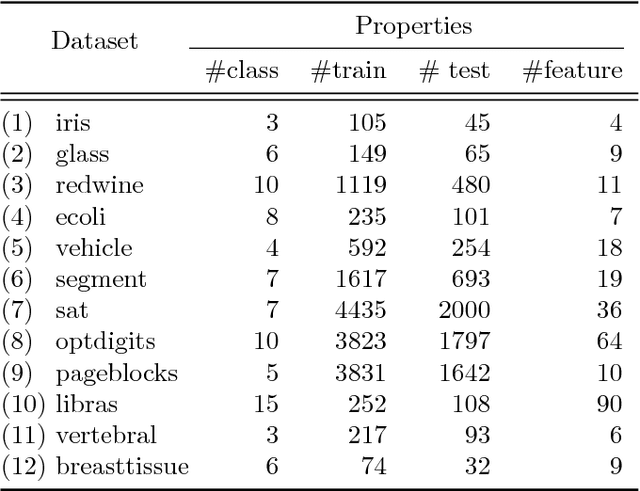
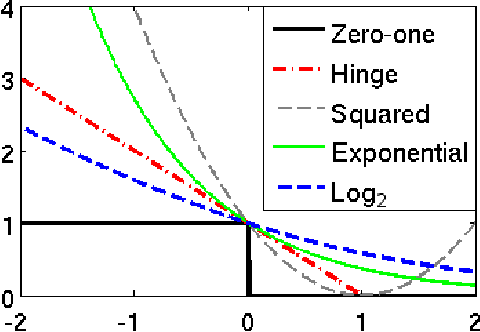
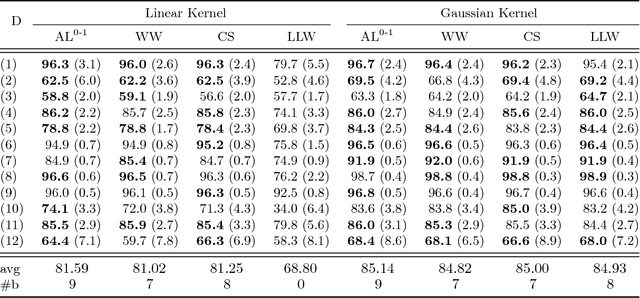
We propose a robust adversarial prediction framework for general multiclass classification. Our method seeks predictive distributions that robustly optimize non-convex and non-continuous multiclass loss metrics against the worst-case conditional label distributions (the adversarial distributions) that (approximately) match the statistics of the training data. Although the optimized loss metrics are non-convex and non-continuous, the dual formulation of the framework is a convex optimization problem that can be recast as a risk minimization model with a prescribed convex surrogate loss we call the adversarial surrogate loss. We show that the adversarial surrogate losses fill an existing gap in surrogate loss construction for general multiclass classification problems, by simultaneously aligning better with the original multiclass loss, guaranteeing Fisher consistency, enabling a way to incorporate rich feature spaces via the kernel trick, and providing competitive performance in practice.
Distributionally Robust Graphical Models
Nov 07, 2018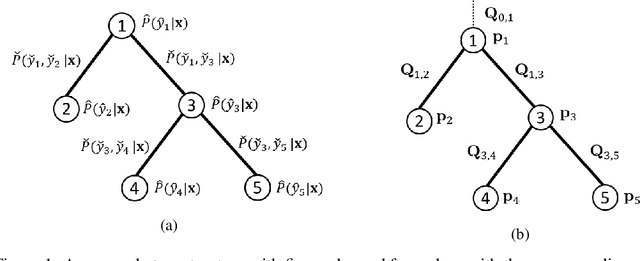
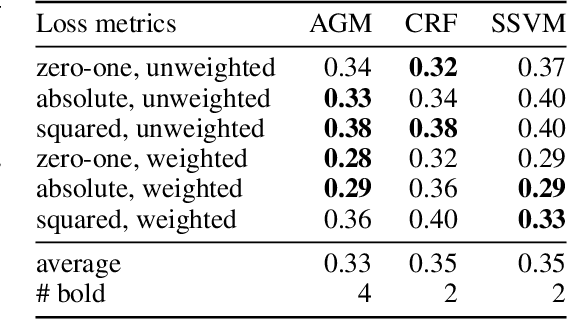
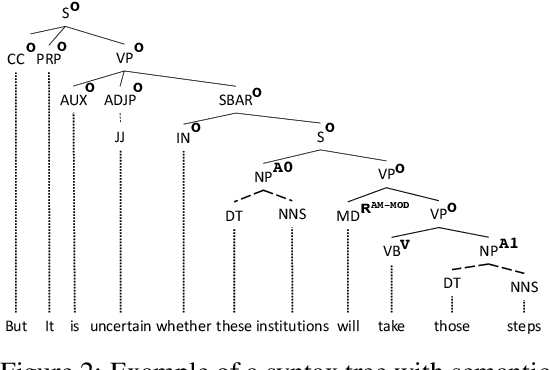
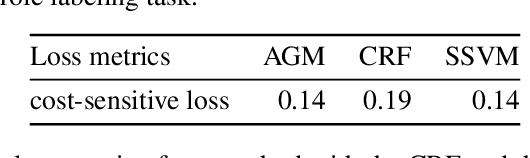
In many structured prediction problems, complex relationships between variables are compactly defined using graphical structures. The most prevalent graphical prediction methods---probabilistic graphical models and large margin methods---have their own distinct strengths but also possess significant drawbacks. Conditional random fields (CRFs) are Fisher consistent, but they do not permit integration of customized loss metrics into their learning process. Large-margin models, such as structured support vector machines (SSVMs), have the flexibility to incorporate customized loss metrics, but lack Fisher consistency guarantees. We present adversarial graphical models (AGM), a distributionally robust approach for constructing a predictor that performs robustly for a class of data distributions defined using a graphical structure. Our approach enjoys both the flexibility of incorporating customized loss metrics into its design as well as the statistical guarantee of Fisher consistency. We present exact learning and prediction algorithms for AGM with time complexity similar to existing graphical models and show the practical benefits of our approach with experiments.