 Add to Chrome
 Add to Firefox
 Add to Edge
Slides2MindMap: Reconstructing Cognitively Efficient Knowledge Hierarchies from Lecture Slides
Aug 01, 2026
Generating mind maps from lecture slides can help learners efficiently assimilate fragmented knowledge, promising substantial benefits for intelligent education. However, dedicated automatic generation and evaluation frameworks remain underexplored and challenging, requiring a global-local knowledge focus balance and handling large-scale, heterogeneous slides. We formulate the Slides2MindMap task, which aims to reconstruct cognitively efficient knowledge hierarchies from a course's slide deck collection. For systematic evaluation, we introduce S2M-Bench, a benchmark comprising 12,774 slide pages with expert-annotated mind maps spanning 24 university courses. S2M-Bench includes a cognitive-science-grounded evaluation framework that integrates ground-truth-based comparison, structure conformity analysis, and VLM-as-a-Judge. To address this task, we propose AutoMindMap, an agentic framework inspired by the Structure Building Framework. AutoMindMap comprises Skeleton Laying for global scaffold anchoring, Iterative Knowledge Integration augmented by context-aware summarization, and Dual-Stage Refinement with a local-global decoupling mechanism. The framework reconciles local knowledge faithfulness with global coherence, and adapts to slide-specific features. Experiments on S2M-Bench demonstrate that AutoMindMap outperforms baselines and achieves superior robustness across different models and scenarios, underscoring its pedagogical application value.

Kimi K3: Open Frontier Intelligence
Jul 27, 2026We introduce Kimi K3, a 2.8T parameter Mixture-of-Experts model with 104 billion activated parameters, native vision capabilities, and a 1-million-token context window. Kimi K3 is built on Kimi Delta Attention and Attention Residuals, which improve information flow across sequence length and model depth. Together with Stable LatentMoE, which effectively activates 16 of 896 routed experts per token, and refined training and data recipes, these advances yield an approximately 2.5x improvement in overall scaling efficiency over Kimi K2. Post-training highlights reinforcement learning across general, agentic, and coding domains and multiple reasoning-effort levels, enabling compositional generalization and robust long-horizon execution. At 2.8T scale, Kimi K3 is supported by infrastructure advances in multiple areas: algorithm-system co-design for KDA, perfectly balanced expert-parallel training with efficient memory management, million-token agentic RL with persistent rollout and sandbox states, and deployment innovations. Extensive evaluations show that Kimi K3 achieves frontier-level performance across long-horizon coding, agentic, knowledge, reasoning, and vision tasks. While its overall performance still trails the most powerful proprietary models, namely Claude Fable 5 and GPT-5.6 Sol, Kimi K3 consistently outperforms other open and proprietary models evaluated in our suite. We release the full Kimi K3 model weights to facilitate future research and accelerate the broader deployment and adoption of frontier intelligence.
Attention Residuals
Mar 16, 2026Residual connections with PreNorm are standard in modern LLMs, yet they accumulate all layer outputs with fixed unit weights. This uniform aggregation causes uncontrolled hidden-state growth with depth, progressively diluting each layer's contribution. We propose Attention Residuals (AttnRes), which replaces this fixed accumulation with softmax attention over preceding layer outputs, allowing each layer to selectively aggregate earlier representations with learned, input-dependent weights. To address the memory and communication overhead of attending over all preceding layer outputs for large-scale model training, we introduce Block AttnRes, which partitions layers into blocks and attends over block-level representations, reducing the memory footprint while preserving most of the gains of full AttnRes. Combined with cache-based pipeline communication and a two-phase computation strategy, Block AttnRes becomes a practical drop-in replacement for standard residual connections with minimal overhead. Scaling law experiments confirm that the improvement is consistent across model sizes, and ablations validate the benefit of content-dependent depth-wise selection. We further integrate AttnRes into the Kimi Linear architecture (48B total / 3B activated parameters) and pre-train on 1.4T tokens, where AttnRes mitigates PreNorm dilution, yielding more uniform output magnitudes and gradient distribution across depth, and improves downstream performance across all evaluated tasks.
Kimi K2.5: Visual Agentic Intelligence
Feb 02, 2026We introduce Kimi K2.5, an open-source multimodal agentic model designed to advance general agentic intelligence. K2.5 emphasizes the joint optimization of text and vision so that two modalities enhance each other. This includes a series of techniques such as joint text-vision pre-training, zero-vision SFT, and joint text-vision reinforcement learning. Building on this multimodal foundation, K2.5 introduces Agent Swarm, a self-directed parallel agent orchestration framework that dynamically decomposes complex tasks into heterogeneous sub-problems and executes them concurrently. Extensive evaluations show that Kimi K2.5 achieves state-of-the-art results across various domains including coding, vision, reasoning, and agentic tasks. Agent Swarm also reduces latency by up to $4.5\times$ over single-agent baselines. We release the post-trained Kimi K2.5 model checkpoint to facilitate future research and real-world applications of agentic intelligence.
Kimi Linear: An Expressive, Efficient Attention Architecture
Oct 30, 2025We introduce Kimi Linear, a hybrid linear attention architecture that, for the first time, outperforms full attention under fair comparisons across various scenarios -- including short-context, long-context, and reinforcement learning (RL) scaling regimes. At its core lies Kimi Delta Attention (KDA), an expressive linear attention module that extends Gated DeltaNet with a finer-grained gating mechanism, enabling more effective use of limited finite-state RNN memory. Our bespoke chunkwise algorithm achieves high hardware efficiency through a specialized variant of the Diagonal-Plus-Low-Rank (DPLR) transition matrices, which substantially reduces computation compared to the general DPLR formulation while remaining more consistent with the classical delta rule. We pretrain a Kimi Linear model with 3B activated parameters and 48B total parameters, based on a layerwise hybrid of KDA and Multi-Head Latent Attention (MLA). Our experiments show that with an identical training recipe, Kimi Linear outperforms full MLA with a sizeable margin across all evaluated tasks, while reducing KV cache usage by up to 75% and achieving up to 6 times decoding throughput for a 1M context. These results demonstrate that Kimi Linear can be a drop-in replacement for full attention architectures with superior performance and efficiency, including tasks with longer input and output lengths. To support further research, we open-source the KDA kernel and vLLM implementations, and release the pre-trained and instruction-tuned model checkpoints.
Kimi K2: Open Agentic Intelligence
Jul 28, 2025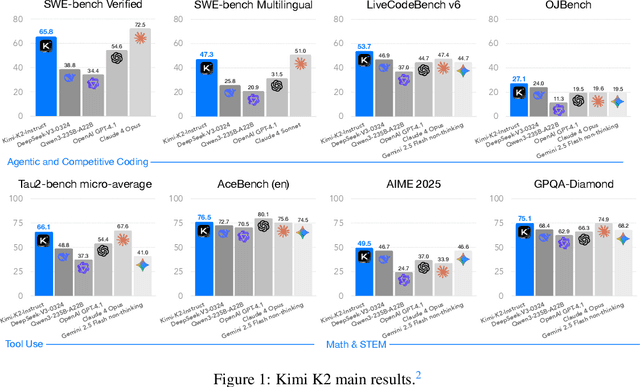
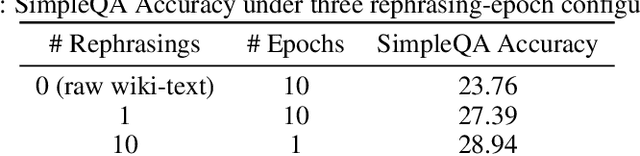
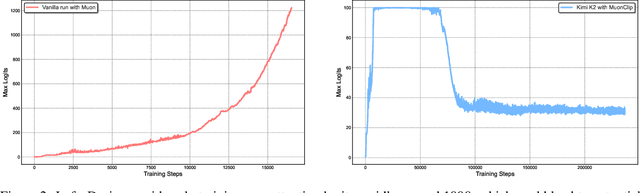
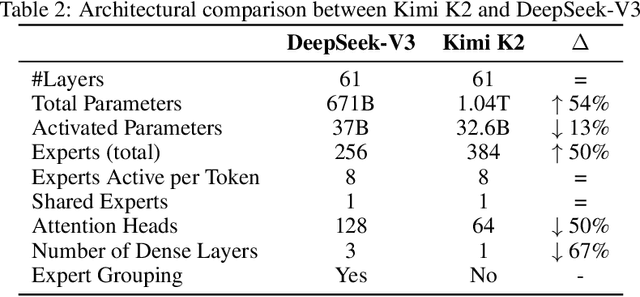
We introduce Kimi K2, a Mixture-of-Experts (MoE) large language model with 32 billion activated parameters and 1 trillion total parameters. We propose the MuonClip optimizer, which improves upon Muon with a novel QK-clip technique to address training instability while enjoying the advanced token efficiency of Muon. Based on MuonClip, K2 was pre-trained on 15.5 trillion tokens with zero loss spike. During post-training, K2 undergoes a multi-stage post-training process, highlighted by a large-scale agentic data synthesis pipeline and a joint reinforcement learning (RL) stage, where the model improves its capabilities through interactions with real and synthetic environments. Kimi K2 achieves state-of-the-art performance among open-source non-thinking models, with strengths in agentic capabilities. Notably, K2 obtains 66.1 on Tau2-Bench, 76.5 on ACEBench (En), 65.8 on SWE-Bench Verified, and 47.3 on SWE-Bench Multilingual -- surpassing most open and closed-sourced baselines in non-thinking settings. It also exhibits strong capabilities in coding, mathematics, and reasoning tasks, with a score of 53.7 on LiveCodeBench v6, 49.5 on AIME 2025, 75.1 on GPQA-Diamond, and 27.1 on OJBench, all without extended thinking. These results position Kimi K2 as one of the most capable open-source large language models to date, particularly in software engineering and agentic tasks. We release our base and post-trained model checkpoints to facilitate future research and applications of agentic intelligence.
Kimi-Audio Technical Report
Apr 25, 2025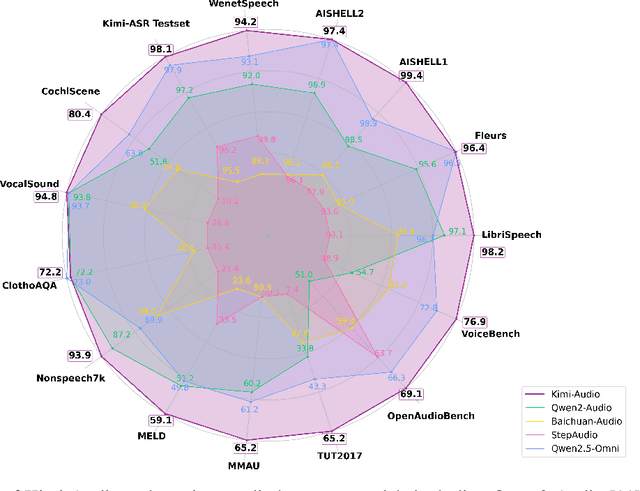
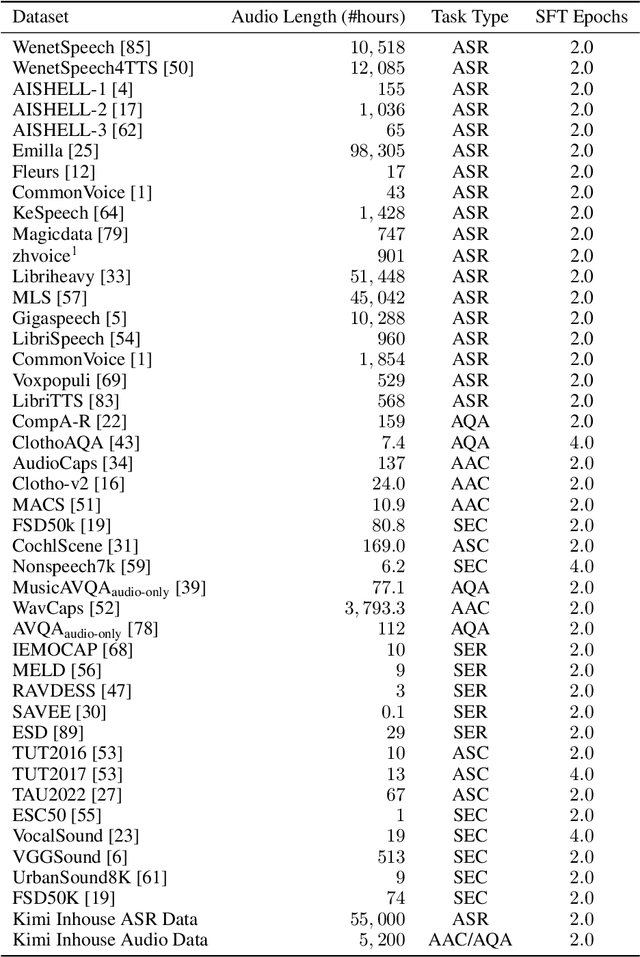
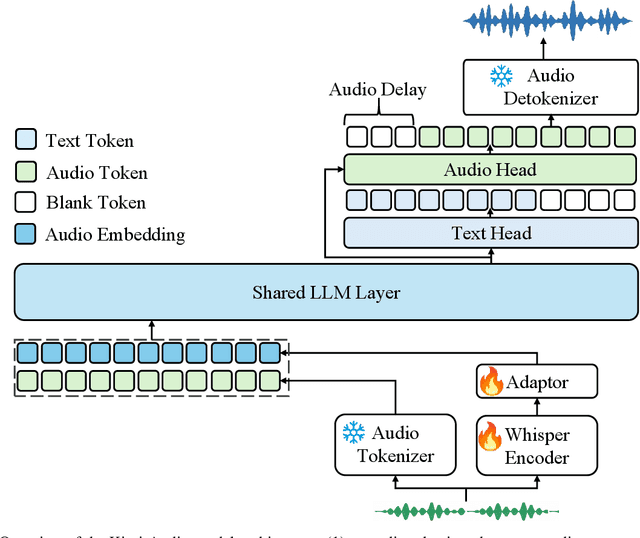
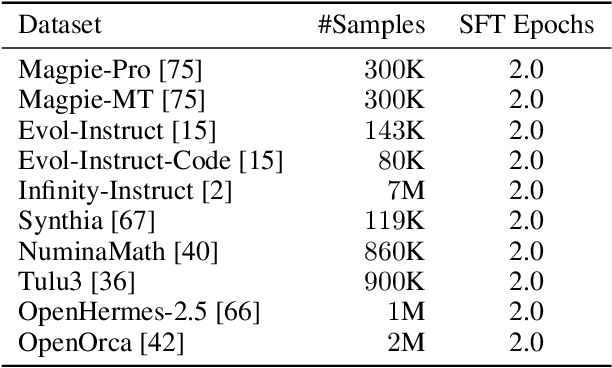
We present Kimi-Audio, an open-source audio foundation model that excels in audio understanding, generation, and conversation. We detail the practices in building Kimi-Audio, including model architecture, data curation, training recipe, inference deployment, and evaluation. Specifically, we leverage a 12.5Hz audio tokenizer, design a novel LLM-based architecture with continuous features as input and discrete tokens as output, and develop a chunk-wise streaming detokenizer based on flow matching. We curate a pre-training dataset that consists of more than 13 million hours of audio data covering a wide range of modalities including speech, sound, and music, and build a pipeline to construct high-quality and diverse post-training data. Initialized from a pre-trained LLM, Kimi-Audio is continual pre-trained on both audio and text data with several carefully designed tasks, and then fine-tuned to support a diverse of audio-related tasks. Extensive evaluation shows that Kimi-Audio achieves state-of-the-art performance on a range of audio benchmarks including speech recognition, audio understanding, audio question answering, and speech conversation. We release the codes, model checkpoints, as well as the evaluation toolkits in https://github.com/MoonshotAI/Kimi-Audio.
Kimi-VL Technical Report
Apr 10, 2025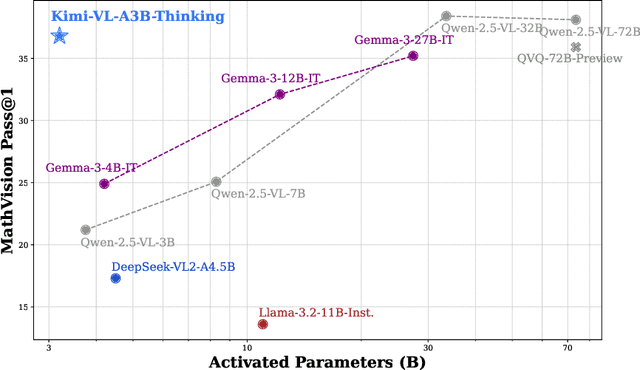
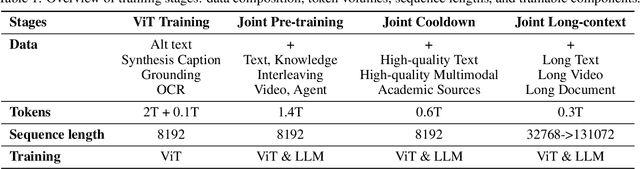
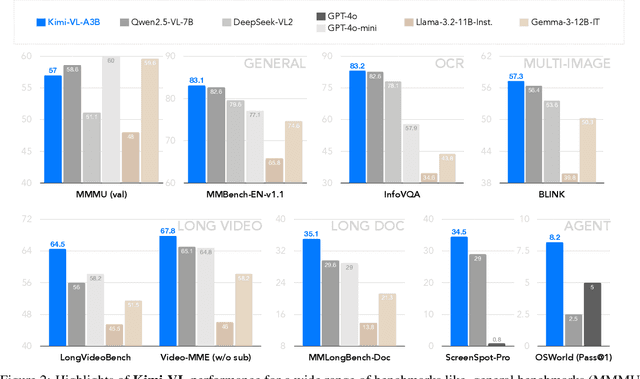

We present Kimi-VL, an efficient open-source Mixture-of-Experts (MoE) vision-language model (VLM) that offers advanced multimodal reasoning, long-context understanding, and strong agent capabilities - all while activating only 2.8B parameters in its language decoder (Kimi-VL-A3B). Kimi-VL demonstrates strong performance across challenging domains: as a general-purpose VLM, Kimi-VL excels in multi-turn agent tasks (e.g., OSWorld), matching flagship models. Furthermore, it exhibits remarkable capabilities across diverse challenging vision language tasks, including college-level image and video comprehension, OCR, mathematical reasoning, and multi-image understanding. In comparative evaluations, it effectively competes with cutting-edge efficient VLMs such as GPT-4o-mini, Qwen2.5-VL-7B, and Gemma-3-12B-IT, while surpassing GPT-4o in several key domains. Kimi-VL also advances in processing long contexts and perceiving clearly. With a 128K extended context window, Kimi-VL can process diverse long inputs, achieving impressive scores of 64.5 on LongVideoBench and 35.1 on MMLongBench-Doc. Its native-resolution vision encoder, MoonViT, further allows it to see and understand ultra-high-resolution visual inputs, achieving 83.2 on InfoVQA and 34.5 on ScreenSpot-Pro, while maintaining lower computational cost for common tasks. Building upon Kimi-VL, we introduce an advanced long-thinking variant: Kimi-VL-Thinking. Developed through long chain-of-thought (CoT) supervised fine-tuning (SFT) and reinforcement learning (RL), this model exhibits strong long-horizon reasoning capabilities. It achieves scores of 61.7 on MMMU, 36.8 on MathVision, and 71.3 on MathVista while maintaining the compact 2.8B activated LLM parameters, setting a new standard for efficient multimodal thinking models. Code and models are publicly accessible at https://github.com/MoonshotAI/Kimi-VL.
Muon is Scalable for LLM Training
Feb 24, 2025Recently, the Muon optimizer based on matrix orthogonalization has demonstrated strong results in training small-scale language models, but the scalability to larger models has not been proven. We identify two crucial techniques for scaling up Muon: (1) adding weight decay and (2) carefully adjusting the per-parameter update scale. These techniques allow Muon to work out-of-the-box on large-scale training without the need of hyper-parameter tuning. Scaling law experiments indicate that Muon achieves $\sim\!2\times$ computational efficiency compared to AdamW with compute optimal training. Based on these improvements, we introduce Moonlight, a 3B/16B-parameter Mixture-of-Expert (MoE) model trained with 5.7T tokens using Muon. Our model improves the current Pareto frontier, achieving better performance with much fewer training FLOPs compared to prior models. We open-source our distributed Muon implementation that is memory optimal and communication efficient. We also release the pretrained, instruction-tuned, and intermediate checkpoints to support future research.
MoBA: Mixture of Block Attention for Long-Context LLMs
Feb 18, 2025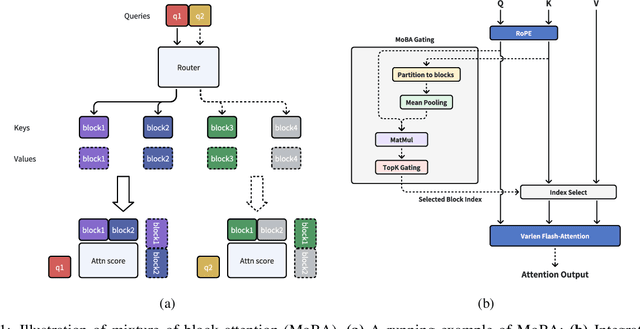
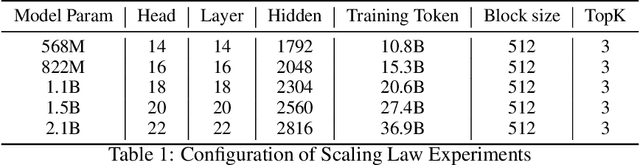
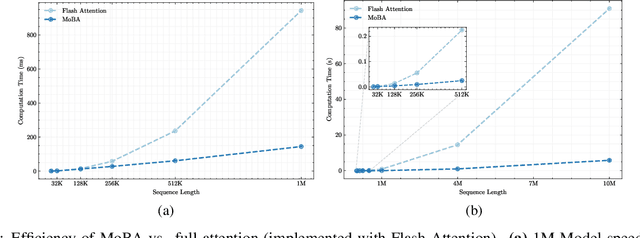
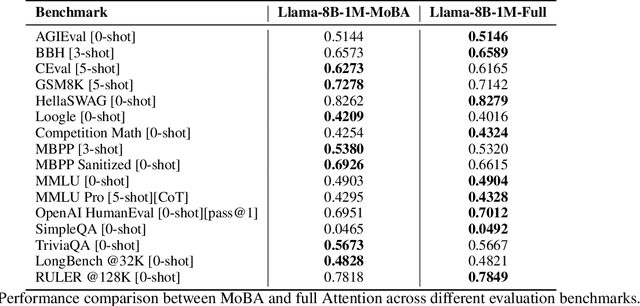
Scaling the effective context length is essential for advancing large language models (LLMs) toward artificial general intelligence (AGI). However, the quadratic increase in computational complexity inherent in traditional attention mechanisms presents a prohibitive overhead. Existing approaches either impose strongly biased structures, such as sink or window attention which are task-specific, or radically modify the attention mechanism into linear approximations, whose performance in complex reasoning tasks remains inadequately explored. In this work, we propose a solution that adheres to the ``less structure'' principle, allowing the model to determine where to attend autonomously, rather than introducing predefined biases. We introduce Mixture of Block Attention (MoBA), an innovative approach that applies the principles of Mixture of Experts (MoE) to the attention mechanism. This novel architecture demonstrates superior performance on long-context tasks while offering a key advantage: the ability to seamlessly transition between full and sparse attention, enhancing efficiency without the risk of compromising performance. MoBA has already been deployed to support Kimi's long-context requests and demonstrates significant advancements in efficient attention computation for LLMs. Our code is available at https://github.com/MoonshotAI/MoBA.