 Add to Chrome
 Add to Firefox
 Add to Edge
GeoRelight: Learning Joint Geometrical Relighting and Reconstruction with Flexible Multi-Modal Diffusion Transformers
Apr 22, 2026
Relighting a person from a single photo is an attractive but ill-posed task, as a 2D image ambiguously entangles 3D geometry, intrinsic appearance, and illumination. Current methods either use sequential pipelines that suffer from error accumulation, or they do not explicitly leverage 3D geometry during relighting, which limits physical consistency. Since relighting and estimation of 3D geometry are mutually beneficial tasks, we propose a unified Multi-Modal Diffusion Transformer (DiT) that jointly solves for both: GeoRelight. We make this possible through two key technical contributions: isotropic NDC-Orthographic Depth (iNOD), a distortion-free 3D representation compatible with latent diffusion models; and a strategic mixed-data training method that combines synthetic and auto-labeled real data. By solving geometry and relighting jointly, GeoRelight achieves better performance than both sequential models and previous systems that ignored geometry.

GenLCA: 3D Diffusion for Full-Body Avatars from In-the-Wild Videos
Apr 09, 2026We present GenLCA, a diffusion-based generative model for generating and editing photorealistic full-body avatars from text and image inputs. The generated avatars are faithful to the inputs, while supporting high-fidelity facial and full-body animations. The core idea is a novel paradigm that enables training a full-body 3D diffusion model from partially observable 2D data, allowing the training dataset to scale to millions of real-world videos. This scalability contributes to the superior photorealism and generalizability of GenLCA. Specifically, we scale up the dataset by repurposing a pretrained feed-forward avatar reconstruction model as an animatable 3D tokenizer, which encodes unstructured video frames into structured 3D tokens. However, most real-world videos only provide partial observations of body parts, resulting in excessive blurring or transparency artifacts in the 3D tokens. To address this, we propose a novel visibility-aware diffusion training strategy that replaces invalid regions with learnable tokens and computes losses only over valid regions. We then train a flow-based diffusion model on the token dataset, inherently maintaining the photorealism and animatability provided by the pretrained avatar reconstruction model. Our approach effectively enables the use of large-scale real-world video data to train a diffusion model natively in 3D. We demonstrate the efficacy of our method through diverse and high-fidelity generation and editing results, outperforming existing solutions by a large margin. The project page is available at https://onethousandwu.com/GenLCA-Page.
Large-scale Codec Avatars: The Unreasonable Effectiveness of Large-scale Avatar Pretraining
Apr 02, 2026High-quality 3D avatar modeling faces a critical trade-off between fidelity and generalization. On the one hand, multi-view studio data enables high-fidelity modeling of humans with precise control over expressions and poses, but it struggles to generalize to real-world data due to limited scale and the domain gap between the studio environment and the real world. On the other hand, recent large-scale avatar models trained on millions of in-the-wild samples show promise for generalization across a wide range of identities, yet the resulting avatars are often of low-quality due to inherent 3D ambiguities. To address this, we present Large-Scale Codec Avatars (LCA), a high-fidelity, full-body 3D avatar model that generalizes to world-scale populations in a feedforward manner, enabling efficient inference. Inspired by the success of large language models and vision foundation models, we present, for the first time, a pre/post-training paradigm for 3D avatar modeling at scale: we pretrain on 1M in-the-wild videos to learn broad priors over appearance and geometry, then post-train on high-quality curated data to enhance expressivity and fidelity. LCA generalizes across hair styles, clothing, and demographics while providing precise, fine-grained facial expressions and finger-level articulation control, with strong identity preservation. Notably, we observe emergent generalization to relightability and loose garment support to unconstrained inputs, and zero-shot robustness to stylized imagery, despite the absence of direct supervision.
CamLit: Unified Video Diffusion with Explicit Camera and Lighting Control
Mar 15, 2026We present CamLit, the first unified video diffusion model that jointly performs novel view synthesis (NVS) and relighting from a single input image. Given one reference image, a user-defined camera trajectory, and an environment map, CamLit synthesizes a video of the scene from new viewpoints under the specified illumination. Within a single generative process, our model produces temporally coherent and spatially aligned outputs, including relit novel-view frames and corresponding albedo frames, enabling high-quality control of both camera pose and lighting. Qualitative and quantitative experiments demonstrate that CamLit achieves high-fidelity outputs on par with state-of-the-art methods in both novel view synthesis and relighting, without sacrificing visual quality in either task. We show that a single generative model can effectively integrate camera and lighting control, simplifying the video generation pipeline while maintaining competitive performance and consistent realism.
FactorPortrait: Controllable Portrait Animation via Disentangled Expression, Pose, and Viewpoint
Dec 12, 2025We introduce FactorPortrait, a video diffusion method for controllable portrait animation that enables lifelike synthesis from disentangled control signals of facial expressions, head movement, and camera viewpoints. Given a single portrait image, a driving video, and camera trajectories, our method animates the portrait by transferring facial expressions and head movements from the driving video while simultaneously enabling novel view synthesis from arbitrary viewpoints. We utilize a pre-trained image encoder to extract facial expression latents from the driving video as control signals for animation generation. Such latents implicitly capture nuanced facial expression dynamics with identity and pose information disentangled, and they are efficiently injected into the video diffusion transformer through our proposed expression controller. For camera and head pose control, we employ Plücker ray maps and normal maps rendered from 3D body mesh tracking. To train our model, we curate a large-scale synthetic dataset containing diverse combinations of camera viewpoints, head poses, and facial expression dynamics. Extensive experiments demonstrate that our method outperforms existing approaches in realism, expressiveness, control accuracy, and view consistency.
GeomHair: Reconstruction of Hair Strands from Colorless 3D Scans
May 08, 2025We propose a novel method that reconstructs hair strands directly from colorless 3D scans by leveraging multi-modal hair orientation extraction. Hair strand reconstruction is a fundamental problem in computer vision and graphics that can be used for high-fidelity digital avatar synthesis, animation, and AR/VR applications. However, accurately recovering hair strands from raw scan data remains challenging due to human hair's complex and fine-grained structure. Existing methods typically rely on RGB captures, which can be sensitive to the environment and can be a challenging domain for extracting the orientation of guiding strands, especially in the case of challenging hairstyles. To reconstruct the hair purely from the observed geometry, our method finds sharp surface features directly on the scan and estimates strand orientation through a neural 2D line detector applied to the renderings of scan shading. Additionally, we incorporate a diffusion prior trained on a diverse set of synthetic hair scans, refined with an improved noise schedule, and adapted to the reconstructed contents via a scan-specific text prompt. We demonstrate that this combination of supervision signals enables accurate reconstruction of both simple and intricate hairstyles without relying on color information. To facilitate further research, we introduce Strands400, the largest publicly available dataset of hair strands with detailed surface geometry extracted from real-world data, which contains reconstructed hair strands from the scans of 400 subjects.
Joker: Conditional 3D Head Synthesis with Extreme Facial Expressions
Oct 21, 2024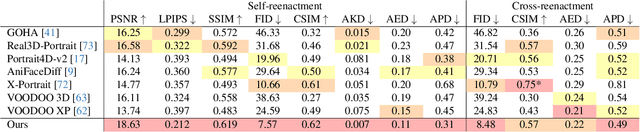
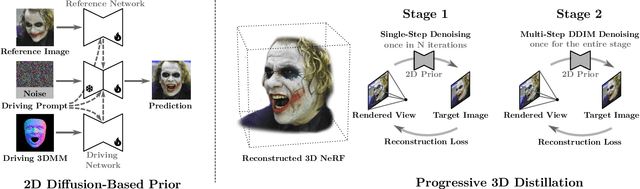
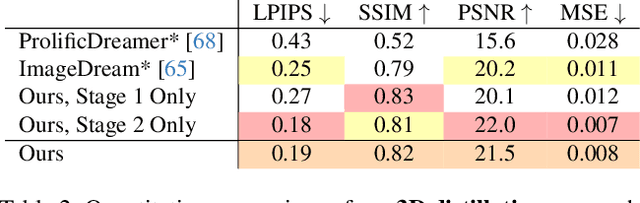
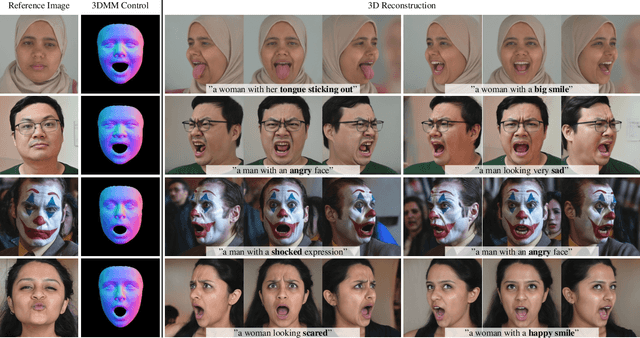
We introduce Joker, a new method for the conditional synthesis of 3D human heads with extreme expressions. Given a single reference image of a person, we synthesize a volumetric human head with the reference identity and a new expression. We offer control over the expression via a 3D morphable model (3DMM) and textual inputs. This multi-modal conditioning signal is essential since 3DMMs alone fail to define subtle emotional changes and extreme expressions, including those involving the mouth cavity and tongue articulation. Our method is built upon a 2D diffusion-based prior that generalizes well to out-of-domain samples, such as sculptures, heavy makeup, and paintings while achieving high levels of expressiveness. To improve view consistency, we propose a new 3D distillation technique that converts predictions of our 2D prior into a neural radiance field (NeRF). Both the 2D prior and our distillation technique produce state-of-the-art results, which are confirmed by our extensive evaluations. Also, to the best of our knowledge, our method is the first to achieve view-consistent extreme tongue articulation.
VOODOO XP: Expressive One-Shot Head Reenactment for VR Telepresence
May 28, 2024We introduce VOODOO XP: a 3D-aware one-shot head reenactment method that can generate highly expressive facial expressions from any input driver video and a single 2D portrait. Our solution is real-time, view-consistent, and can be instantly used without calibration or fine-tuning. We demonstrate our solution on a monocular video setting and an end-to-end VR telepresence system for two-way communication. Compared to 2D head reenactment methods, 3D-aware approaches aim to preserve the identity of the subject and ensure view-consistent facial geometry for novel camera poses, which makes them suitable for immersive applications. While various facial disentanglement techniques have been introduced, cutting-edge 3D-aware neural reenactment techniques still lack expressiveness and fail to reproduce complex and fine-scale facial expressions. We present a novel cross-reenactment architecture that directly transfers the driver's facial expressions to transformer blocks of the input source's 3D lifting module. We show that highly effective disentanglement is possible using an innovative multi-stage self-supervision approach, which is based on a coarse-to-fine strategy, combined with an explicit face neutralization and 3D lifted frontalization during its initial training stage. We further integrate our novel head reenactment solution into an accessible high-fidelity VR telepresence system, where any person can instantly build a personalized neural head avatar from any photo and bring it to life using the headset. We demonstrate state-of-the-art performance in terms of expressiveness and likeness preservation on a large set of diverse subjects and capture conditions.
HAAR: Text-Conditioned Generative Model of 3D Strand-based Human Hairstyles
Dec 18, 2023We present HAAR, a new strand-based generative model for 3D human hairstyles. Specifically, based on textual inputs, HAAR produces 3D hairstyles that could be used as production-level assets in modern computer graphics engines. Current AI-based generative models take advantage of powerful 2D priors to reconstruct 3D content in the form of point clouds, meshes, or volumetric functions. However, by using the 2D priors, they are intrinsically limited to only recovering the visual parts. Highly occluded hair structures can not be reconstructed with those methods, and they only model the ''outer shell'', which is not ready to be used in physics-based rendering or simulation pipelines. In contrast, we propose a first text-guided generative method that uses 3D hair strands as an underlying representation. Leveraging 2D visual question-answering (VQA) systems, we automatically annotate synthetic hair models that are generated from a small set of artist-created hairstyles. This allows us to train a latent diffusion model that operates in a common hairstyle UV space. In qualitative and quantitative studies, we demonstrate the capabilities of the proposed model and compare it to existing hairstyle generation approaches.
VOODOO 3D: Volumetric Portrait Disentanglement for One-Shot 3D Head Reenactment
Dec 07, 2023
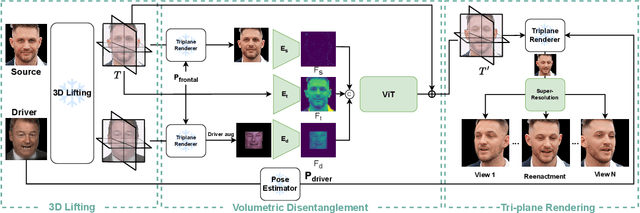


We present a 3D-aware one-shot head reenactment method based on a fully volumetric neural disentanglement framework for source appearance and driver expressions. Our method is real-time and produces high-fidelity and view-consistent output, suitable for 3D teleconferencing systems based on holographic displays. Existing cutting-edge 3D-aware reenactment methods often use neural radiance fields or 3D meshes to produce view-consistent appearance encoding, but, at the same time, they rely on linear face models, such as 3DMM, to achieve its disentanglement with facial expressions. As a result, their reenactment results often exhibit identity leakage from the driver or have unnatural expressions. To address these problems, we propose a neural self-supervised disentanglement approach that lifts both the source image and driver video frame into a shared 3D volumetric representation based on tri-planes. This representation can then be freely manipulated with expression tri-planes extracted from the driving images and rendered from an arbitrary view using neural radiance fields. We achieve this disentanglement via self-supervised learning on a large in-the-wild video dataset. We further introduce a highly effective fine-tuning approach to improve the generalizability of the 3D lifting using the same real-world data. We demonstrate state-of-the-art performance on a wide range of datasets, and also showcase high-quality 3D-aware head reenactment on highly challenging and diverse subjects, including non-frontal head poses and complex expressions for both source and driver.