 Add to Chrome
 Add to Firefox
 Add to Edge
LiveLight: Real-time Streaming Video Relighting with Interactive Control
Aug 03, 2026
We present LiveLight, the first diffusion-based framework for real-time streaming video relighting with interactive 3D lighting control. Achieving this is non-trivial, as it requires overcoming three critical challenges: effectively injecting dynamic 3D lighting into a diffusion model, maintaining high-fidelity generation under an extremely low NFE (Number of Function Evaluations) budget for real-time speed, and facilitating continuous streaming for interactive control. To address these pain points, we propose three key designs. First, for accurate lighting injection, we propose a lightweight adapter that feeds Multi-Plane Light Irradiance (MPLI) conditions-depth-aware irradiance maps encoding 3D lighting geometry-directly into the diffusion backbone. Second, to prevent rendering quality degradation at low NFEs towards real-time distillation, we introduce a geometry-guided feedback branch. This training-time constraint leverages a frozen geometry estimator to enforce depth- and normal-consistent relighting, ensuring geometrically plausible shading without adding inference overhead. Finally, to enable streaming interaction, we develop a progressive rolling-window strategy that maintains a denoising ladder of latent chunks at varying noise levels. By propagating intermediate states, this strategy guarantees temporal coherence and supports arbitrarily long video relighting with per-frame reference refresh. Extensive experiments on real-world and synthetic benchmarks demonstrate that LiveLight achieves state-of-the-art relighting quality while running at real-time speed, significantly outperforming offline baselines in temporal stability, lighting controllability, and user preference. To foster real-time interactive relighting research, we will publicly release our models, training data, and synthetic data generator.

GeoEdit: Geometry-Aware Object Editing via Dual-Branch Denoising
Jun 29, 2026Precisely manipulating objects in a single photograph (translation, rotation, scaling) while obeying 3D physical constraints remains unsolved for diffusion-based editors. Current 2D methods lack spatial awareness and produce perspective violations. Forcing structural proxies into the latent space also disrupts variance homogeneity, and the resulting self-attention leakage leads to ghosting and background blur. The core difficulty is asymmetric: the relocated object must follow a rigid geometry, yet the uncovered background needs freedom to synthesize plausible content. We present GeoEdit, a training-free Lift-Manipulate-Render-Denoise pipeline that satisfies both constraints. We decouple scene and object in 3D, align them through point correspondence, and render a geometry-aligned proxy with a structural depth map. A Dual-Branch Denoising stage then refines this proxy: a video diffusion backbone preserves object identity, while 3D constraints are injected into the foreground within a narrow denoising window at matching noise variance (variance-homogeneous injection). The background denoises freely. Because the injected signal matches the native latent statistics, self-attention stays undisturbed. We also introduce GeoEditBench, a pose-aware benchmark covering object translation, object rotation, and camera movement with pose-aware evaluation metrics. Experiments confirm consistent gains in geometric accuracy, identity fidelity, and background quality. Our codes are available at https://github.com/Heey731/GeoEdit.
Effort: Efficient Orthogonal Modeling for Generalizable AI-Generated Image Detection
Nov 23, 2024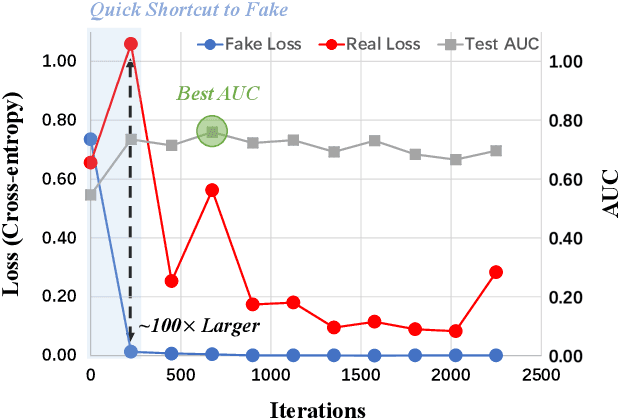
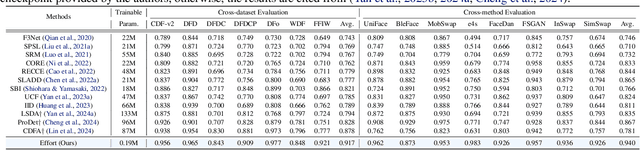
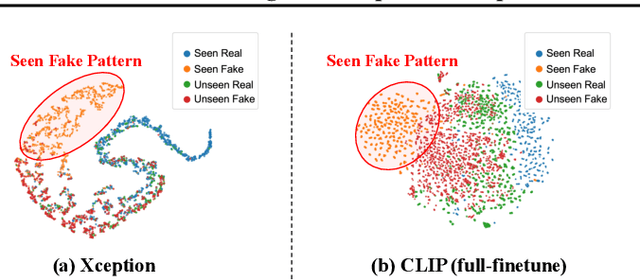
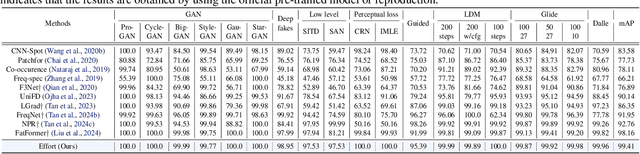
Existing AI-generated image (AIGI) detection methods often suffer from limited generalization performance. In this paper, we identify a crucial yet previously overlooked asymmetry phenomenon in AIGI detection: during training, models tend to quickly overfit to specific fake patterns in the training set, while other information is not adequately captured, leading to poor generalization when faced with new fake methods. A key insight is to incorporate the rich semantic knowledge embedded within large-scale vision foundation models (VFMs) to expand the previous discriminative space (based on forgery patterns only), such that the discrimination is decided by both forgery and semantic cues, thereby reducing the overfitting to specific forgery patterns. A straightforward solution is to fully fine-tune VFMs, but it risks distorting the well-learned semantic knowledge, pushing the model back toward overfitting. To this end, we design a novel approach called Effort: Efficient orthogonal modeling for generalizable AIGI detection. Specifically, we employ Singular Value Decomposition (SVD) to construct the orthogonal semantic and forgery subspaces. By freezing the principal components and adapting the residual components ($\sim$0.19M parameters), we preserve the original semantic subspace and use its orthogonal subspace for learning forgeries. Extensive experiments on AIGI detection benchmarks demonstrate the superior effectiveness of our approach.
Mutual Information Guided Optimal Transport for Unsupervised Visible-Infrared Person Re-identification
Jul 17, 2024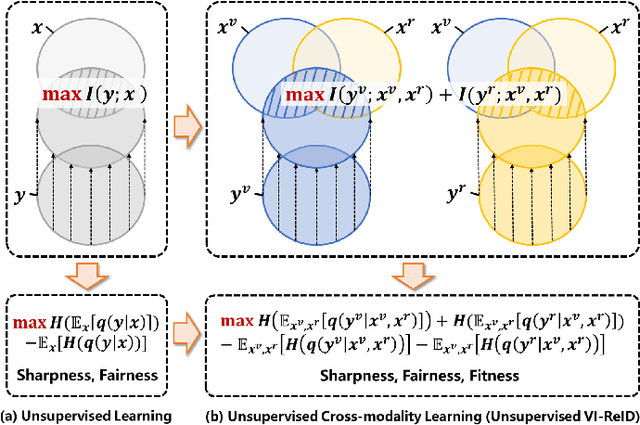
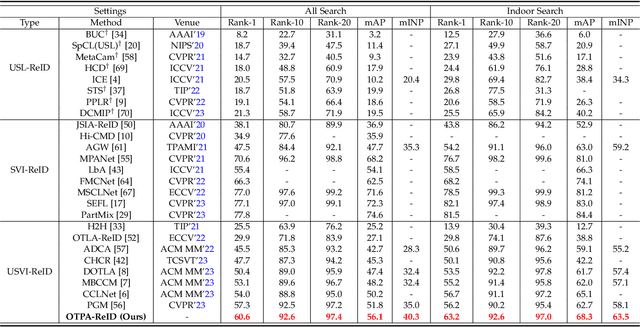
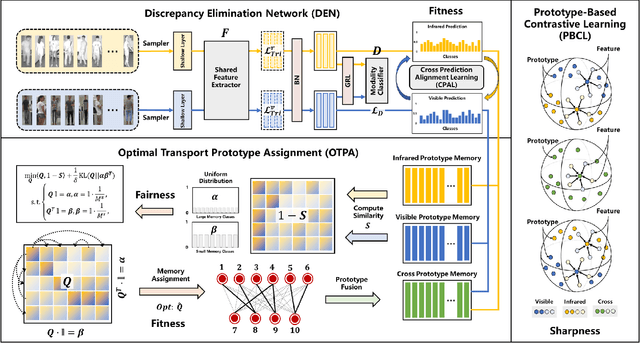
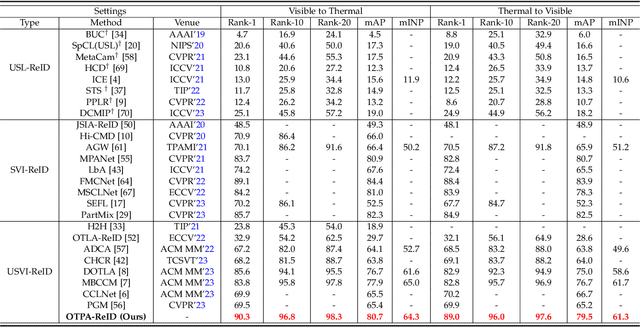
Unsupervised visible infrared person re-identification (USVI-ReID) is a challenging retrieval task that aims to retrieve cross-modality pedestrian images without using any label information. In this task, the large cross-modality variance makes it difficult to generate reliable cross-modality labels, and the lack of annotations also provides additional difficulties for learning modality-invariant features. In this paper, we first deduce an optimization objective for unsupervised VI-ReID based on the mutual information between the model's cross-modality input and output. With equivalent derivation, three learning principles, i.e., "Sharpness" (entropy minimization), "Fairness" (uniform label distribution), and "Fitness" (reliable cross-modality matching) are obtained. Under their guidance, we design a loop iterative training strategy alternating between model training and cross-modality matching. In the matching stage, a uniform prior guided optimal transport assignment ("Fitness", "Fairness") is proposed to select matched visible and infrared prototypes. In the training stage, we utilize this matching information to introduce prototype-based contrastive learning for minimizing the intra- and cross-modality entropy ("Sharpness"). Extensive experimental results on benchmarks demonstrate the effectiveness of our method, e.g., 60.6% and 90.3% of Rank-1 accuracy on SYSU-MM01 and RegDB without any annotations.