 Add to Chrome
 Add to Firefox
 Add to Edge
CamLit: Unified Video Diffusion with Explicit Camera and Lighting Control
Mar 15, 2026
We present CamLit, the first unified video diffusion model that jointly performs novel view synthesis (NVS) and relighting from a single input image. Given one reference image, a user-defined camera trajectory, and an environment map, CamLit synthesizes a video of the scene from new viewpoints under the specified illumination. Within a single generative process, our model produces temporally coherent and spatially aligned outputs, including relit novel-view frames and corresponding albedo frames, enabling high-quality control of both camera pose and lighting. Qualitative and quantitative experiments demonstrate that CamLit achieves high-fidelity outputs on par with state-of-the-art methods in both novel view synthesis and relighting, without sacrificing visual quality in either task. We show that a single generative model can effectively integrate camera and lighting control, simplifying the video generation pipeline while maintaining competitive performance and consistent realism.

HairWeaver: Few-Shot Photorealistic Hair Motion Synthesis with Sim-to-Real Guided Video Diffusion
Feb 11, 2026We present HairWeaver, a diffusion-based pipeline that animates a single human image with realistic and expressive hair dynamics. While existing methods successfully control body pose, they lack specific control over hair, and as a result, fail to capture the intricate hair motions, resulting in stiff and unrealistic animations. HairWeaver overcomes this limitation using two specialized modules: a Motion-Context-LoRA to integrate motion conditions and a Sim2Real-Domain-LoRA to preserve the subject's photoreal appearance across different data domains. These lightweight components are designed to guide a video diffusion backbone while maintaining its core generative capabilities. By training on a specialized dataset of dynamic human motion generated from a CG simulator, HairWeaver affords fine control over hair motion and ultimately learns to produce highly realistic hair that responds naturally to movement. Comprehensive evaluations demonstrate that our approach sets a new state of the art, producing lifelike human hair animations with dynamic details.
High-Res Facial Appearance Capture from Polarized Smartphone Images
Dec 02, 2022
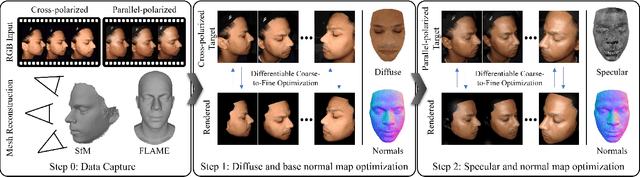
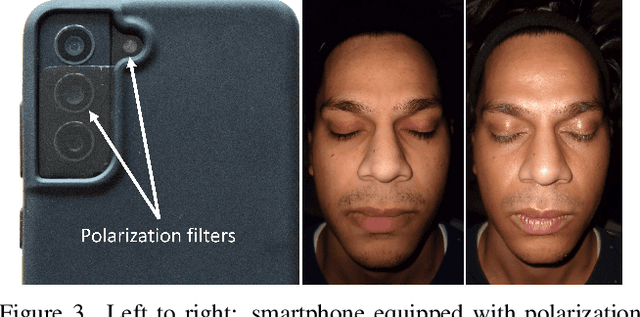
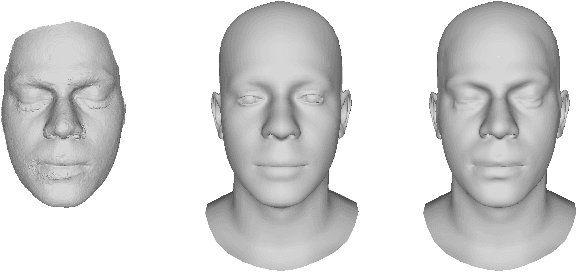
We propose a novel method for high-quality facial texture reconstruction from RGB images using a novel capturing routine based on a single smartphone which we equip with an inexpensive polarization foil. Specifically, we turn the flashlight into a polarized light source and add a polarization filter on top of the camera. Leveraging this setup, we capture the face of a subject with cross-polarized and parallel-polarized light. For each subject, we record two short sequences in a dark environment under flash illumination with different light polarization using the modified smartphone. Based on these observations, we reconstruct an explicit surface mesh of the face using structure from motion. We then exploit the camera and light co-location within a differentiable renderer to optimize the facial textures using an analysis-by-synthesis approach. Our method optimizes for high-resolution normal textures, diffuse albedo, and specular albedo using a coarse-to-fine optimization scheme. We show that the optimized textures can be used in a standard rendering pipeline to synthesize high-quality photo-realistic 3D digital humans in novel environments.