 Add to Chrome
 Add to Firefox
 Add to Edge
EgoAVU: Egocentric Audio-Visual Understanding
Feb 05, 2026
Understanding egocentric videos plays a vital role for embodied intelligence. Recent multi-modal large language models (MLLMs) can accept both visual and audio inputs. However, due to the challenge of obtaining text labels with coherent joint-modality information, whether MLLMs can jointly understand both modalities in egocentric videos remains under-explored. To address this problem, we introduce EgoAVU, a scalable data engine to automatically generate egocentric audio-visual narrations, questions, and answers. EgoAVU enriches human narrations with multimodal context and generates audio-visual narrations through cross-modal correlation modeling. Token-based video filtering and modular, graph-based curation ensure both data diversity and quality. Leveraging EgoAVU, we construct EgoAVU-Instruct, a large-scale training dataset of 3M samples, and EgoAVU-Bench, a manually verified evaluation split covering diverse tasks. EgoAVU-Bench clearly reveals the limitations of existing MLLMs: they bias heavily toward visual signals, often neglecting audio cues or failing to correspond audio with the visual source. Finetuning MLLMs on EgoAVU-Instruct effectively addresses this issue, enabling up to 113% performance improvement on EgoAVU-Bench. Such benefits also transfer to other benchmarks such as EgoTempo and EgoIllusion, achieving up to 28% relative performance gain. Code will be released to the community.

VideoAuto-R1: Video Auto Reasoning via Thinking Once, Answering Twice
Jan 08, 2026Chain-of-thought (CoT) reasoning has emerged as a powerful tool for multimodal large language models on video understanding tasks. However, its necessity and advantages over direct answering remain underexplored. In this paper, we first demonstrate that for RL-trained video models, direct answering often matches or even surpasses CoT performance, despite CoT producing step-by-step analyses at a higher computational cost. Motivated by this, we propose VideoAuto-R1, a video understanding framework that adopts a reason-when-necessary strategy. During training, our approach follows a Thinking Once, Answering Twice paradigm: the model first generates an initial answer, then performs reasoning, and finally outputs a reviewed answer. Both answers are supervised via verifiable rewards. During inference, the model uses the confidence score of the initial answer to determine whether to proceed with reasoning. Across video QA and grounding benchmarks, VideoAuto-R1 achieves state-of-the-art accuracy with significantly improved efficiency, reducing the average response length by ~3.3x, e.g., from 149 to just 44 tokens. Moreover, we observe a low rate of thinking-mode activation on perception-oriented tasks, but a higher rate on reasoning-intensive tasks. This suggests that explicit language-based reasoning is generally beneficial but not always necessary.
ParetoQ: Scaling Laws in Extremely Low-bit LLM Quantization
Feb 04, 2025The optimal bit-width for achieving the best trade-off between quantized model size and accuracy has been a subject of ongoing debate. While some advocate for 4-bit quantization, others propose that 1.58-bit offers superior results. However, the lack of a cohesive framework for different bits has left such conclusions relatively tenuous. We present ParetoQ, the first unified framework that facilitates rigorous comparisons across 1-bit, 1.58-bit, 2-bit, 3-bit, and 4-bit quantization settings. Our findings reveal a notable learning transition between 2 and 3 bits: For 3-bits and above, the fine-tuned models stay close to their original pre-trained distributions, whereas for learning 2-bit networks or below, the representations change drastically. By optimizing training schemes and refining quantization functions, ParetoQ surpasses all previous methods tailored to specific bit widths. Remarkably, our ParetoQ ternary 600M-parameter model even outperforms the previous SoTA ternary 3B-parameter model in accuracy, using only one-fifth of the parameters. Extensive experimentation shows that ternary, 2-bit, and 3-bit quantization maintains comparable performance in the size-accuracy trade-off and generally exceeds 4-bit and binary quantization. Considering hardware constraints, 2-bit quantization offers promising potential for memory reduction and speedup.
EdgeTAM: On-Device Track Anything Model
Jan 13, 2025On top of Segment Anything Model (SAM), SAM 2 further extends its capability from image to video inputs through a memory bank mechanism and obtains a remarkable performance compared with previous methods, making it a foundation model for video segmentation task. In this paper, we aim at making SAM 2 much more efficient so that it even runs on mobile devices while maintaining a comparable performance. Despite several works optimizing SAM for better efficiency, we find they are not sufficient for SAM 2 because they all focus on compressing the image encoder, while our benchmark shows that the newly introduced memory attention blocks are also the latency bottleneck. Given this observation, we propose EdgeTAM, which leverages a novel 2D Spatial Perceiver to reduce the computational cost. In particular, the proposed 2D Spatial Perceiver encodes the densely stored frame-level memories with a lightweight Transformer that contains a fixed set of learnable queries. Given that video segmentation is a dense prediction task, we find preserving the spatial structure of the memories is essential so that the queries are split into global-level and patch-level groups. We also propose a distillation pipeline that further improves the performance without inference overhead. As a result, EdgeTAM achieves 87.7, 70.0, 72.3, and 71.7 J&F on DAVIS 2017, MOSE, SA-V val, and SA-V test, while running at 16 FPS on iPhone 15 Pro Max.
MetaMorph: Multimodal Understanding and Generation via Instruction Tuning
Dec 18, 2024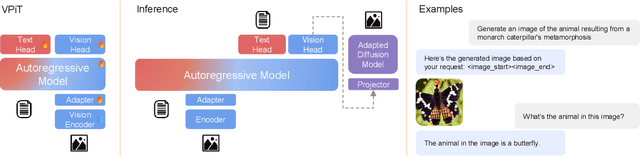
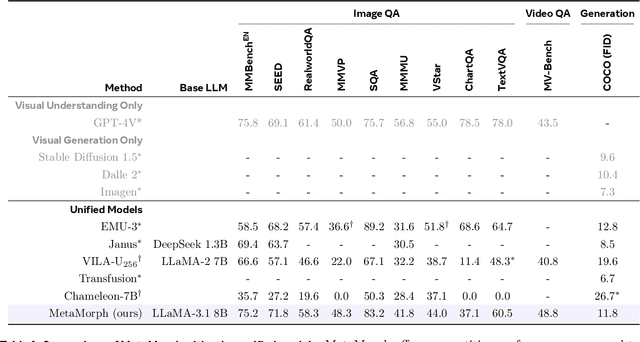
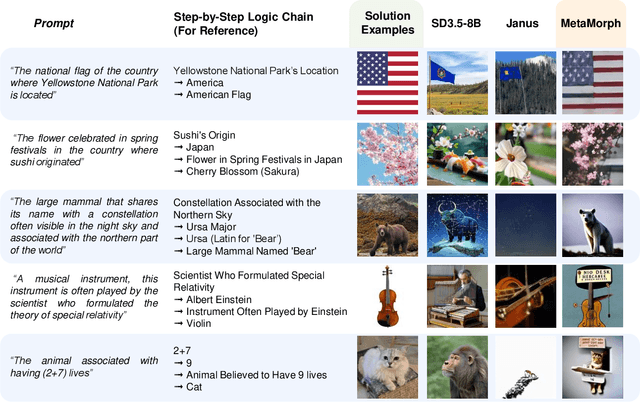
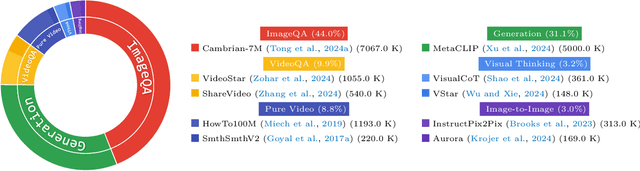
In this work, we propose Visual-Predictive Instruction Tuning (VPiT) - a simple and effective extension to visual instruction tuning that enables a pretrained LLM to quickly morph into an unified autoregressive model capable of generating both text and visual tokens. VPiT teaches an LLM to predict discrete text tokens and continuous visual tokens from any input sequence of image and text data curated in an instruction-following format. Our empirical investigation reveals several intriguing properties of VPiT: (1) visual generation ability emerges as a natural byproduct of improved visual understanding, and can be unlocked efficiently with a small amount of generation data; (2) while we find understanding and generation to be mutually beneficial, understanding data contributes to both capabilities more effectively than generation data. Building upon these findings, we train our MetaMorph model and achieve competitive performance on both visual understanding and generation. In visual generation, MetaMorph can leverage the world knowledge and reasoning abilities gained from LLM pretraining, and overcome common failure modes exhibited by other generation models. Our results suggest that LLMs may have strong "prior" vision capabilities that can be efficiently adapted to both visual understanding and generation with a relatively simple instruction tuning process.
Efficient Track Anything
Nov 28, 2024Segment Anything Model 2 (SAM 2) has emerged as a powerful tool for video object segmentation and tracking anything. Key components of SAM 2 that drive the impressive video object segmentation performance include a large multistage image encoder for frame feature extraction and a memory mechanism that stores memory contexts from past frames to help current frame segmentation. The high computation complexity of multistage image encoder and memory module has limited its applications in real-world tasks, e.g., video object segmentation on mobile devices. To address this limitation, we propose EfficientTAMs, lightweight track anything models that produce high-quality results with low latency and model size. Our idea is based on revisiting the plain, nonhierarchical Vision Transformer (ViT) as an image encoder for video object segmentation, and introducing an efficient memory module, which reduces the complexity for both frame feature extraction and memory computation for current frame segmentation. We take vanilla lightweight ViTs and efficient memory module to build EfficientTAMs, and train the models on SA-1B and SA-V datasets for video object segmentation and track anything tasks. We evaluate on multiple video segmentation benchmarks including semi-supervised VOS and promptable video segmentation, and find that our proposed EfficientTAM with vanilla ViT perform comparably to SAM 2 model (HieraB+SAM 2) with ~2x speedup on A100 and ~2.4x parameter reduction. On segment anything image tasks, our EfficientTAMs also perform favorably over original SAM with ~20x speedup on A100 and ~20x parameter reduction. On mobile devices such as iPhone 15 Pro Max, our EfficientTAMs can run at ~10 FPS for performing video object segmentation with reasonable quality, highlighting the capability of small models for on-device video object segmentation applications.
LongVU: Spatiotemporal Adaptive Compression for Long Video-Language Understanding
Oct 22, 2024


Multimodal Large Language Models (MLLMs) have shown promising progress in understanding and analyzing video content. However, processing long videos remains a significant challenge constrained by LLM's context size. To address this limitation, we propose LongVU, a spatiotemporal adaptive compression mechanism thats reduces the number of video tokens while preserving visual details of long videos. Our idea is based on leveraging cross-modal query and inter-frame dependencies to adaptively reduce temporal and spatial redundancy in videos. Specifically, we leverage DINOv2 features to remove redundant frames that exhibit high similarity. Then we utilize text-guided cross-modal query for selective frame feature reduction. Further, we perform spatial token reduction across frames based on their temporal dependencies. Our adaptive compression strategy effectively processes a large number of frames with little visual information loss within given context length. Our LongVU consistently surpass existing methods across a variety of video understanding benchmarks, especially on hour-long video understanding tasks such as VideoMME and MLVU. Given a light-weight LLM, our LongVU also scales effectively into a smaller size with state-of-the-art video understanding performance.
Agent-as-a-Judge: Evaluate Agents with Agents
Oct 14, 2024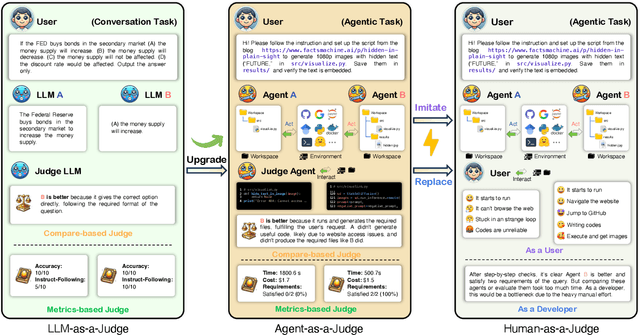

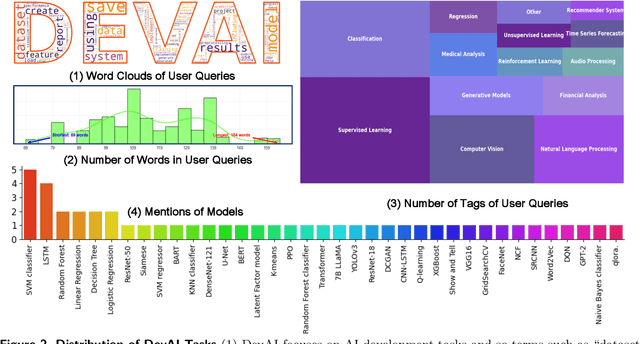

Contemporary evaluation techniques are inadequate for agentic systems. These approaches either focus exclusively on final outcomes -- ignoring the step-by-step nature of agentic systems, or require excessive manual labour. To address this, we introduce the Agent-as-a-Judge framework, wherein agentic systems are used to evaluate agentic systems. This is an organic extension of the LLM-as-a-Judge framework, incorporating agentic features that enable intermediate feedback for the entire task-solving process. We apply the Agent-as-a-Judge to the task of code generation. To overcome issues with existing benchmarks and provide a proof-of-concept testbed for Agent-as-a-Judge, we present DevAI, a new benchmark of 55 realistic automated AI development tasks. It includes rich manual annotations, like a total of 365 hierarchical user requirements. We benchmark three of the popular agentic systems using Agent-as-a-Judge and find it dramatically outperforms LLM-as-a-Judge and is as reliable as our human evaluation baseline. Altogether, we believe that Agent-as-a-Judge marks a concrete step forward for modern agentic systems -- by providing rich and reliable reward signals necessary for dynamic and scalable self-improvement.
An Introduction to Vision-Language Modeling
May 27, 2024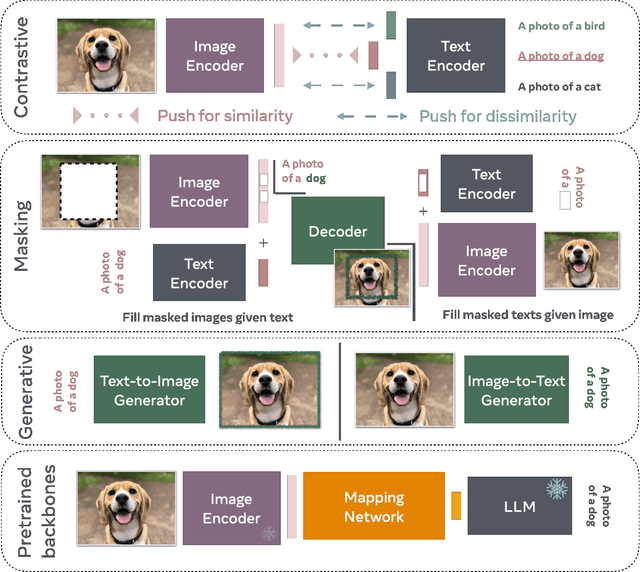
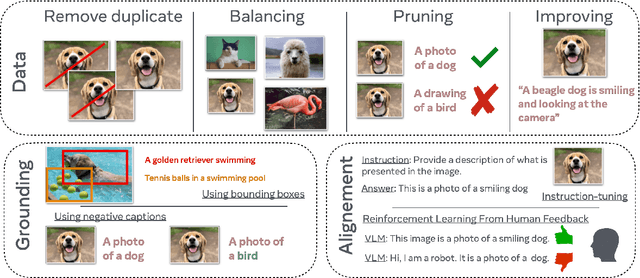

Following the recent popularity of Large Language Models (LLMs), several attempts have been made to extend them to the visual domain. From having a visual assistant that could guide us through unfamiliar environments to generative models that produce images using only a high-level text description, the vision-language model (VLM) applications will significantly impact our relationship with technology. However, there are many challenges that need to be addressed to improve the reliability of those models. While language is discrete, vision evolves in a much higher dimensional space in which concepts cannot always be easily discretized. To better understand the mechanics behind mapping vision to language, we present this introduction to VLMs which we hope will help anyone who would like to enter the field. First, we introduce what VLMs are, how they work, and how to train them. Then, we present and discuss approaches to evaluate VLMs. Although this work primarily focuses on mapping images to language, we also discuss extending VLMs to videos.
MobileLLM: Optimizing Sub-billion Parameter Language Models for On-Device Use Cases
Feb 22, 2024This paper addresses the growing need for efficient large language models (LLMs) on mobile devices, driven by increasing cloud costs and latency concerns. We focus on designing top-quality LLMs with fewer than a billion parameters, a practical choice for mobile deployment. Contrary to prevailing belief emphasizing the pivotal role of data and parameter quantity in determining model quality, our investigation underscores the significance of model architecture for sub-billion scale LLMs. Leveraging deep and thin architectures, coupled with embedding sharing and grouped-query attention mechanisms, we establish a strong baseline network denoted as MobileLLM, which attains a remarkable 2.7%/4.3% accuracy boost over preceding 125M/350M state-of-the-art models. Additionally, we propose an immediate block-wise weight sharing approach with no increase in model size and only marginal latency overhead. The resultant models, denoted as MobileLLM-LS, demonstrate a further accuracy enhancement of 0.7%/0.8% than MobileLLM 125M/350M. Moreover, MobileLLM model family shows significant improvements compared to previous sub-billion models on chat benchmarks, and demonstrates close correctness to LLaMA-v2 7B in API calling tasks, highlighting the capability of small models for common on-device use cases.