 Add to Chrome
 Add to Firefox
 Add to Edge
Short Data, Long Context: Distilling Positional Knowledge in Transformers
Apr 07, 2026
Extending the context window of language models typically requires expensive long-context pre-training, posing significant challenges for both training efficiency and data collection. In this paper, we present evidence that long-context retrieval capabilities can be transferred to student models through logit-based knowledge distillation, even when training exclusively on packed short-context samples within a long-context window. We provide comprehensive insights through the lens of Rotary Position Embedding (RoPE) and establish three key findings. First, consistent with prior work, we show that phase-wise RoPE scaling, which maximizes rotational spectrum utilization at each training stage, also achieves the best long-context performance in knowledge distillation setups. Second, we demonstrate that logit-based knowledge distillation can directly enable positional information transfer. Using an experimental setup with packed repeated token sequences, we trace the propagation of positional perturbations from query and key vectors through successive transformer layers to output logits, revealing that positional information systematically influences the teacher's output distribution and, in turn, the distillation signal received by the student model. Third, our analysis uncovers structured update patterns in the query state during long-context extension, with distinct parameter spans exhibiting strong sensitivity to long-context training.

MobileLLM-Flash: Latency-Guided On-Device LLM Design for Industry Scale
Mar 16, 2026Real-time AI experiences call for on-device large language models (OD-LLMs) optimized for efficient deployment on resource-constrained hardware. The most useful OD-LLMs produce near-real-time responses and exhibit broad hardware compatibility, maximizing user reach. We present a methodology for designing such models using hardware-in-the-loop architecture search under mobile latency constraints. This system is amenable to industry-scale deployment: it generates models deployable without custom kernels and compatible with standard mobile runtimes like Executorch. Our methodology avoids specialized attention mechanisms and instead uses attention skipping for long-context acceleration. Our approach jointly optimizes model architecture (layers, dimensions) and attention pattern. To efficiently evaluate candidates, we treat each as a pruned version of a pretrained backbone with inherited weights, thereby achieving high accuracy with minimal continued pretraining. We leverage the low cost of latency evaluation in a staged process: learning an accurate latency model first, then searching for the Pareto-frontier across latency and quality. This yields MobileLLM-Flash, a family of foundation models (350M, 650M, 1.4B) for efficient on-device use with strong capabilities, supporting up to 8k context length. MobileLLM-Flash delivers up to 1.8x and 1.6x faster prefill and decode on mobile CPUs with comparable or superior quality. Our analysis of Pareto-frontier design choices offers actionable principles for OD-LLM design.
The Path Not Taken: RLVR Provably Learns Off the Principals
Nov 11, 2025Reinforcement Learning with Verifiable Rewards (RLVR) reliably improves the reasoning performance of large language models, yet it appears to modify only a small fraction of parameters. We revisit this paradox and show that sparsity is a surface artifact of a model-conditioned optimization bias: for a fixed pretrained model, updates consistently localize to preferred parameter regions, highly consistent across runs and largely invariant to datasets and RL recipes. We mechanistically explain these dynamics with a Three-Gate Theory: Gate I (KL Anchor) imposes a KL-constrained update; Gate II (Model Geometry) steers the step off principal directions into low-curvature, spectrum-preserving subspaces; and Gate III (Precision) hides micro-updates in non-preferred regions, making the off-principal bias appear as sparsity. We then validate this theory and, for the first time, provide a parameter-level characterization of RLVR's learning dynamics: RLVR learns off principal directions in weight space, achieving gains via minimal spectral drift, reduced principal-subspace rotation, and off-principal update alignment. In contrast, SFT targets principal weights, distorts the spectrum, and even lags RLVR. Together, these results provide the first parameter-space account of RLVR's training dynamics, revealing clear regularities in how parameters evolve. Crucially, we show that RL operates in a distinct optimization regime from SFT, so directly adapting SFT-era parameter-efficient fine-tuning (PEFT) methods can be flawed, as evidenced by our case studies on advanced sparse fine-tuning and LoRA variants. We hope this work charts a path toward a white-box understanding of RLVR and the design of geometry-aware, RLVR-native learning algorithms, rather than repurposed SFT-era heuristics.
MobileLLM-Pro Technical Report
Nov 10, 2025Efficient on-device language models around 1 billion parameters are essential for powering low-latency AI applications on mobile and wearable devices. However, achieving strong performance in this model class, while supporting long context windows and practical deployment remains a significant challenge. We introduce MobileLLM-Pro, a 1-billion-parameter language model optimized for on-device deployment. MobileLLM-Pro achieves state-of-the-art results across 11 standard benchmarks, significantly outperforming both Gemma 3-1B and Llama 3.2-1B, while supporting context windows of up to 128,000 tokens and showing only minor performance regressions at 4-bit quantization. These improvements are enabled by four core innovations: (1) implicit positional distillation, a novel technique that effectively instills long-context capabilities through knowledge distillation; (2) a specialist model merging framework that fuses multiple domain experts into a compact model without parameter growth; (3) simulation-driven data mixing using utility estimation; and (4) 4-bit quantization-aware training with self-distillation. We release our model weights and code to support future research in efficient on-device language models.
Llama Guard 3-1B-INT4: Compact and Efficient Safeguard for Human-AI Conversations
Nov 18, 2024This paper presents Llama Guard 3-1B-INT4, a compact and efficient Llama Guard model, which has been open-sourced to the community during Meta Connect 2024. We demonstrate that Llama Guard 3-1B-INT4 can be deployed on resource-constrained devices, achieving a throughput of at least 30 tokens per second and a time-to-first-token of 2.5 seconds or less on a commodity Android mobile CPU. Notably, our experiments show that Llama Guard 3-1B-INT4 attains comparable or superior safety moderation scores to its larger counterpart, Llama Guard 3-1B, despite being approximately 7 times smaller in size (440MB).
DεpS: Delayed ε-Shrinking for Faster Once-For-All Training
Jul 08, 2024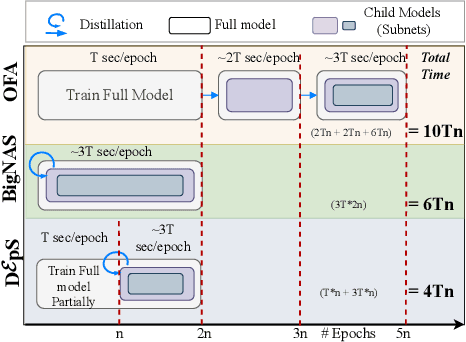

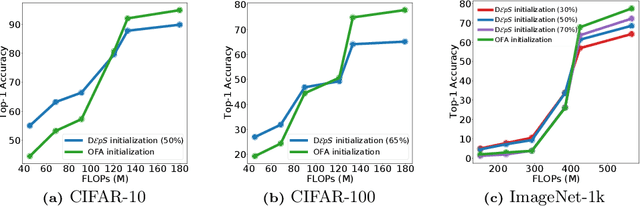

CNNs are increasingly deployed across different hardware, dynamic environments, and low-power embedded devices. This has led to the design and training of CNN architectures with the goal of maximizing accuracy subject to such variable deployment constraints. As the number of deployment scenarios grows, there is a need to find scalable solutions to design and train specialized CNNs. Once-for-all training has emerged as a scalable approach that jointly co-trains many models (subnets) at once with a constant training cost and finds specialized CNNs later. The scalability is achieved by training the full model and simultaneously reducing it to smaller subnets that share model weights (weight-shared shrinking). However, existing once-for-all training approaches incur huge training costs reaching 1200 GPU hours. We argue this is because they either start the process of shrinking the full model too early or too late. Hence, we propose Delayed $\epsilon$-Shrinking (D$\epsilon$pS) that starts the process of shrinking the full model when it is partially trained (~50%) which leads to training cost improvement and better in-place knowledge distillation to smaller models. The proposed approach also consists of novel heuristics that dynamically adjust subnet learning rates incrementally (E), leading to improved weight-shared knowledge distillation from larger to smaller subnets as well. As a result, DEpS outperforms state-of-the-art once-for-all training techniques across different datasets including CIFAR10/100, ImageNet-100, and ImageNet-1k on accuracy and cost. It achieves 1.83% higher ImageNet-1k top1 accuracy or the same accuracy with 1.3x reduction in FLOPs and 2.5x drop in training cost (GPU*hrs)
SpinQuant: LLM quantization with learned rotations
May 28, 2024


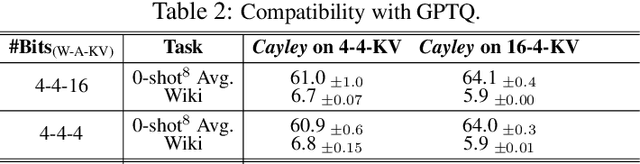
Post-training quantization (PTQ) techniques applied to weights, activations, and the KV cache greatly reduce memory usage, latency, and power consumption of Large Language Models (LLMs), but may lead to large quantization errors when outliers are present. Recent findings suggest that rotating activation or weight matrices helps remove outliers and benefits quantization. In this work, we identify a collection of applicable rotation parameterizations that lead to identical outputs in full-precision Transformer architectures, and find that some random rotations lead to much better quantization than others, with an up to 13 points difference in downstream zero-shot reasoning performance. As a result, we propose SpinQuant that optimizes (or learns) the rotation matrices with Cayley optimization on a small validation set. With 4-bit quantization of weight, activation, and KV-cache, SpinQuant narrows the accuracy gap on zero-shot reasoning tasks with full precision to merely 2.9 points on the LLaMA-2 7B model, surpassing LLM-QAT by 19.1 points and SmoothQuant by 25.0 points. SpinQuant also outperforms concurrent work QuaRot, which applies random rotations to remove outliers. In particular, for LLaMA-2 7B/LLaMA-3 8B models that are hard to quantize, SpinQuant reduces the gap to full precision by 30.2%/34.1% relative to QuaRot.
MobileLLM: Optimizing Sub-billion Parameter Language Models for On-Device Use Cases
Feb 22, 2024This paper addresses the growing need for efficient large language models (LLMs) on mobile devices, driven by increasing cloud costs and latency concerns. We focus on designing top-quality LLMs with fewer than a billion parameters, a practical choice for mobile deployment. Contrary to prevailing belief emphasizing the pivotal role of data and parameter quantity in determining model quality, our investigation underscores the significance of model architecture for sub-billion scale LLMs. Leveraging deep and thin architectures, coupled with embedding sharing and grouped-query attention mechanisms, we establish a strong baseline network denoted as MobileLLM, which attains a remarkable 2.7%/4.3% accuracy boost over preceding 125M/350M state-of-the-art models. Additionally, we propose an immediate block-wise weight sharing approach with no increase in model size and only marginal latency overhead. The resultant models, denoted as MobileLLM-LS, demonstrate a further accuracy enhancement of 0.7%/0.8% than MobileLLM 125M/350M. Moreover, MobileLLM model family shows significant improvements compared to previous sub-billion models on chat benchmarks, and demonstrates close correctness to LLaMA-v2 7B in API calling tasks, highlighting the capability of small models for common on-device use cases.
SiGeo: Sub-One-Shot NAS via Information Theory and Geometry of Loss Landscape
Nov 22, 2023Neural Architecture Search (NAS) has become a widely used tool for automating neural network design. While one-shot NAS methods have successfully reduced computational requirements, they often require extensive training. On the other hand, zero-shot NAS utilizes training-free proxies to evaluate a candidate architecture's test performance but has two limitations: (1) inability to use the information gained as a network improves with training and (2) unreliable performance, particularly in complex domains like RecSys, due to the multi-modal data inputs and complex architecture configurations. To synthesize the benefits of both methods, we introduce a "sub-one-shot" paradigm that serves as a bridge between zero-shot and one-shot NAS. In sub-one-shot NAS, the supernet is trained using only a small subset of the training data, a phase we refer to as "warm-up." Within this framework, we present SiGeo, a proxy founded on a novel theoretical framework that connects the supernet warm-up with the efficacy of the proxy. Extensive experiments have shown that SiGeo, with the benefit of warm-up, consistently outperforms state-of-the-art NAS proxies on various established NAS benchmarks. When a supernet is warmed up, it can achieve comparable performance to weight-sharing one-shot NAS methods, but with a significant reduction ($\sim 60$\%) in computational costs.
Rankitect: Ranking Architecture Search Battling World-class Engineers at Meta Scale
Nov 14, 2023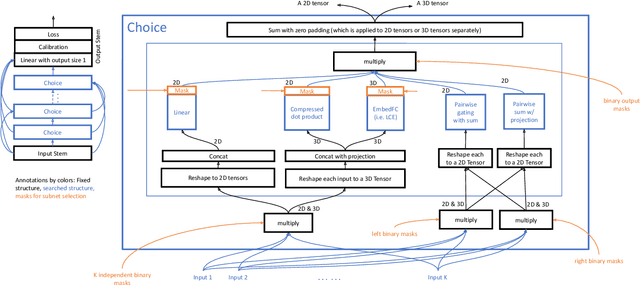

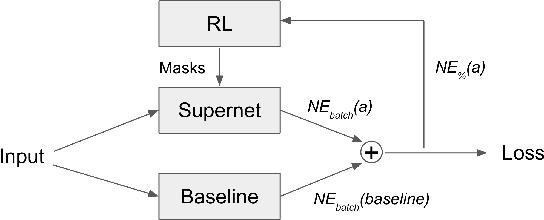
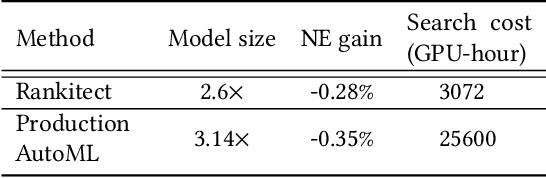
Neural Architecture Search (NAS) has demonstrated its efficacy in computer vision and potential for ranking systems. However, prior work focused on academic problems, which are evaluated at small scale under well-controlled fixed baselines. In industry system, such as ranking system in Meta, it is unclear whether NAS algorithms from the literature can outperform production baselines because of: (1) scale - Meta ranking systems serve billions of users, (2) strong baselines - the baselines are production models optimized by hundreds to thousands of world-class engineers for years since the rise of deep learning, (3) dynamic baselines - engineers may have established new and stronger baselines during NAS search, and (4) efficiency - the search pipeline must yield results quickly in alignment with the productionization life cycle. In this paper, we present Rankitect, a NAS software framework for ranking systems at Meta. Rankitect seeks to build brand new architectures by composing low level building blocks from scratch. Rankitect implements and improves state-of-the-art (SOTA) NAS methods for comprehensive and fair comparison under the same search space, including sampling-based NAS, one-shot NAS, and Differentiable NAS (DNAS). We evaluate Rankitect by comparing to multiple production ranking models at Meta. We find that Rankitect can discover new models from scratch achieving competitive tradeoff between Normalized Entropy loss and FLOPs. When utilizing search space designed by engineers, Rankitect can generate better models than engineers, achieving positive offline evaluation and online A/B test at Meta scale.