 Add to Chrome
 Add to Firefox
 Add to Edge
LycheeCluster: Efficient Long-Context Inference with Structure-Aware Chunking and Hierarchical KV Indexing
Mar 09, 2026
The quadratic complexity of the attention mechanism and the substantial memory footprint of the Key-Value (KV) cache present severe computational and memory challenges for Large Language Models (LLMs) processing long contexts. Existing retrieval-based methods often compromise semantic integrity through fixed-size chunking and suffer from inefficient linear scanning. In this paper, we propose LycheeCluster, a novel method for efficient KV cache management. LycheeCluster preserves local semantic coherence via boundary-aware chunking and constructs a recursive hierarchical index rooted in the triangle inequality. This design transforms cache retrieval from a linear scan into a theoretically bounded, logarithmic-time pruning process, while a lazy update strategy supports efficient streaming generation. Experiments demonstrate that LycheeCluster achieves up to a 3.6x end-to-end inference speedup with negligible degradation in model performance, outperforming state-of-the-art KV cache management methods (e.g., Quest, ClusterKV). We will release our code and kernels after publication.

LycheeDecode: Accelerating Long-Context LLM Inference via Hybrid-Head Sparse Decoding
Feb 04, 2026The proliferation of long-context large language models (LLMs) exposes a key bottleneck: the rapidly expanding key-value cache during decoding, which imposes heavy memory and latency costs. While recent approaches attempt to alleviate this by sharing a single set of crucial tokens across layers, such coarse-grained sharing undermines model performance by neglecting the functional diversity of attention heads. To address this, we propose LycheeDecode, an efficient decoding method centered on a fine-grained hybrid-head attention mechanism that employs a hardware-efficient top-k selection strategy. Specifically, the novel HardKuma-based mechanism partitions attention heads into a small subset of retrieval heads that dynamically identify crucial tokens and a majority of sparse heads that reuse them for efficient computation. Through extensive experiments on leading models like Llama3 and Qwen3 across diverse benchmarks for long-context understanding (e.g., LongBench, RULER) and complex reasoning (e.g., AIME24, OlympiadBench), we demonstrate that LycheeDecode achieves generative quality comparable to, and at times surpassing even the full-attention baseline. Crucially, this is accomplished with up to a 2.7x speedup at a 128K context length. By preserving the functional diversity of attention heads, our fine-grained strategy overcomes the performance bottlenecks of existing methods, providing a powerful and validated pathway to both efficient and high-quality long-context LLM inference.
Leveraging Logical Rules in Knowledge Editing: A Cherry on the Top
May 27, 2024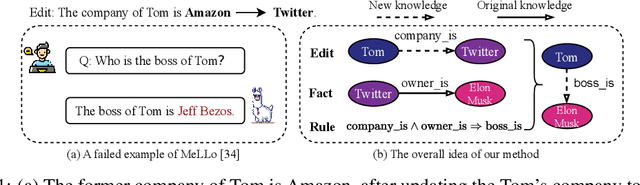
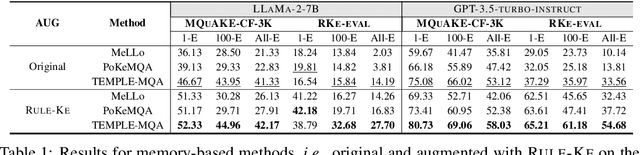
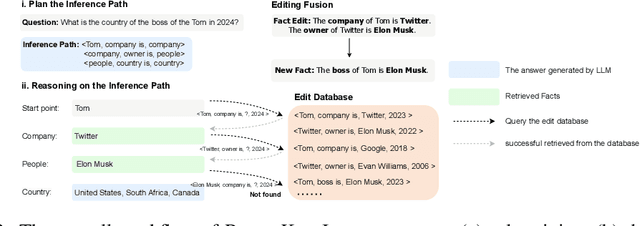
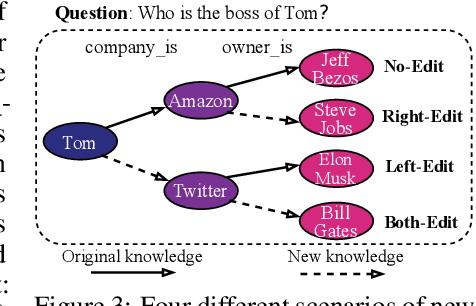
Multi-hop Question Answering (MQA) under knowledge editing (KE) is a key challenge in Large Language Models (LLMs). While best-performing solutions in this domain use a plan and solve paradigm to split a question into sub-questions followed by response generation, we claim that this approach is sub-optimal as it fails for hard to decompose questions, and it does not explicitly cater to correlated knowledge updates resulting as a consequence of knowledge edits. This has a detrimental impact on the overall consistency of the updated knowledge. To address these issues, in this paper, we propose a novel framework named RULE-KE, i.e., RULE based Knowledge Editing, which is a cherry on the top for augmenting the performance of all existing MQA methods under KE. Specifically, RULE-KE leverages rule discovery to discover a set of logical rules. Then, it uses these discovered rules to update knowledge about facts highly correlated with the edit. Experimental evaluation using existing and newly curated datasets (i.e., RKE-EVAL) shows that RULE-KE helps augment both performances of parameter-based and memory-based solutions up to 92% and 112.9%, respectively.
Multi-hop Question Answering under Temporal Knowledge Editing
Mar 30, 2024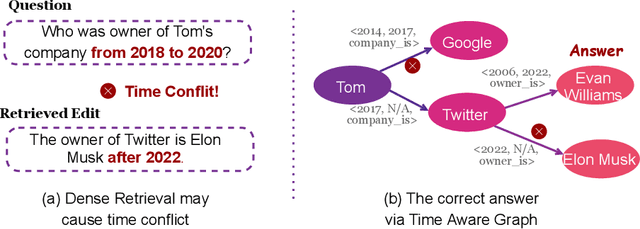
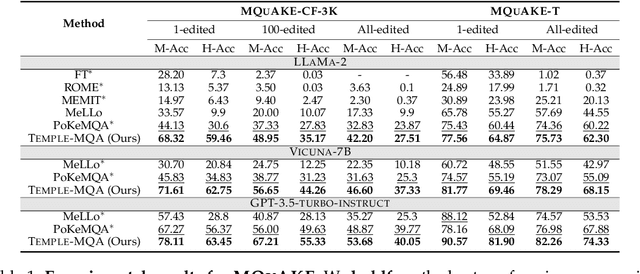
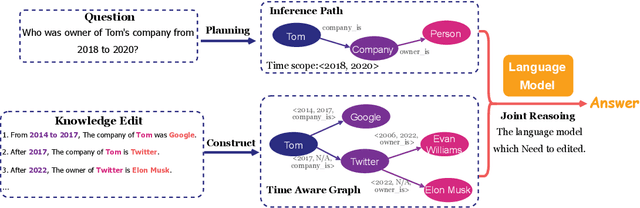
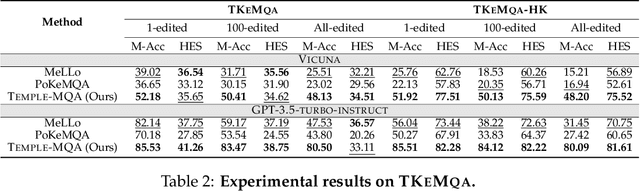
Multi-hop question answering (MQA) under knowledge editing (KE) has garnered significant attention in the era of large language models. However, existing models for MQA under KE exhibit poor performance when dealing with questions containing explicit temporal contexts. To address this limitation, we propose a novel framework, namely TEMPoral knowLEdge augmented Multi-hop Question Answering (TEMPLE-MQA). Unlike previous methods, TEMPLE-MQA first constructs a time-aware graph (TAG) to store edit knowledge in a structured manner. Then, through our proposed inference path, structural retrieval, and joint reasoning stages, TEMPLE-MQA effectively discerns temporal contexts within the question query. Experiments on benchmark datasets demonstrate that TEMPLE-MQA significantly outperforms baseline models. Additionally, we contribute a new dataset, namely TKEMQA, which serves as the inaugural benchmark tailored specifically for MQA with temporal scopes.