 Add to Chrome
 Add to Firefox
 Add to Edge
Closing the Loop in Humanoid VLA: Persistent 3D Object Tokens for Verifiable Loco-Manipulation
Jul 20, 2026
Vision-language-action policies are a promising foundation for general robot control, but long-horizon humanoid loco-manipulation requires the robot to treat task objects as persistent physical entities across movement, contact, occlusion, and recovery. We study this problem as object-state divergence: the object state used to condition a whole-body action can differ from the state used to decide whether the action achieved the intended physical relation. We propose \emph{Persistent Object Tokenization} (POT), which maintains role-indexed 3D object records from RGB-D observations and converts them into object tokens for a whole-body action expert. Instantiated as \emph{POT-VLA}, the same object records condition action generation and support geometric predicate checks, yielding a closed-loop execution system in which object state is both actionable and verifiable. On a Unitree G1, POT-VLA improves a matched direct GR00T-N1.7 baseline from 39/80 to 71/80 successes over eight real-world task families. In an external Being-0-aligned reference, POT-VLA achieves 44/50 successes on aligned service tasks, compared with the 37/50 success reported by the Being-0 paper. The largest gains occur on tasks requiring maintained 3D relations, suggesting that persistent object-centered state is a useful abstraction for verifiable humanoid VLA execution.

EgoPriMo: Egocentric Motion Generation for Interactive Humanoid Control
Jun 07, 2026Humanoid robots require whole-body motions that adapt to scene context, task requirements, and user intent. Motion tracking reproduces specified trajectories, and humanoid vision-language-action systems provide semantic interfaces, but neither offers a scalable and interactive prior for broad full-body behavior. We introduce EgoPriMo (Egocentric Motion Prior for Humanoid Robots), a unified framework that learns such priors from egocentric human demonstrations. Given egocentric observations and a text prompt, EgoPriMo reconstructs, generates, and forecasts SMPL-based full-body motion. Language is used as a high-level control signal rather than a complete motion specification. At the core of EgoPriMo is a Triple-stream DiT that jointly models body dynamics, egocentric visual context, and text; task-conditioning masks route different tasks and missing-modality data through the same checkpoint. Experiments on Nymeria and EgoExo4D show that one checkpoint improves egocentric motion generation over UniEgoMotion while supporting reconstruction and forecasting; the generated SMPL motions can also be executed by a Unitree humanoid controller. These results indicate a practical path from scalable egocentric observations to generalizable and interactive humanoid motion priors.
IMPose: Interactive Multi-person Pose Estimation with Dynamic Correction Propagation
Jun 03, 2026High-quality dynamic human pose annotation equips AI with precise motion kinematics to enable human behavior mastery, yet remains labor-intensive and time-consuming. Current annotation tools either lack temporal correction propagation or fail in multi-person scenarios, necessitating excessive manual intervention. In this paper, we introduce IMPose, an interactive tool for multi-person dynamic pose annotation. It features a dual-level tracking mechanism that propagates one-frame multi-person pose corrections from annotators across entire videos. The keypoint-level ensures corrections temporal propagation via sequential modeling, while the instance-level employs keypoint-aware embedding with relative positional encoding to maintain multi-person cross-frame consistency. To further improve robustness, IMPose maintains historical pose and instance cues in a trajectory bank, which enhances long-range temporal association and stabilizes annotation in challenging cases such as occlusion and motion blur. By converting sparse human corrections into dense and coherent pose trajectories, our framework significantly reduces repeated manual refinement across frames. Extensive experiments show that IMPose consistently achieves a strong accuracy efficiency trade off under different interaction budgets, demonstrating particular advantages in low click annotation settings. IMPose achieves high precision annotation with high efficiency, requiring only 27 clicks per 1,050 frame video on 3DPW and 3 clicks per tracklet per 84-frame on PoseTrack21. We further expand PoseTrack21 with 188K pose instances (3.55M keypoints) at a minimal cost of 10 annotators in 10 hours. The annotation tool, codes, and extended dataset will be open-sourced.
CyboRacket: A Perception-to-Action Framework for Humanoid Racket Sports
Mar 15, 2026Dynamic ball-interaction tasks remain challenging for robots because they require tight perception-action coupling under limited reaction time. This challenge is especially pronounced in humanoid racket sports, where successful interception depends on accurate visual tracking, trajectory prediction, coordinated stepping, and stable whole-body striking. Existing robotic racket-sport systems often rely on external motion capture for state estimation or on task-specific low-level controllers that must be retrained across tasks and platforms. We present CyboRacket, a hierarchical perception-to-action framework for humanoid racket sports that integrates onboard visual perception, physics-based trajectory prediction, and large-scale pre-trained whole-body control. The framework uses onboard cameras to track the incoming object, predicts its future trajectory, and converts the estimated interception state into target end-effector and base-motion commands for whole-body execution by SONIC on the Unitree G1 humanoid robot. We evaluate the proposed framework in a vision-based humanoid tennis-hitting task. Experimental results demonstrate real-time visual tracking, trajectory prediction, and successful striking using purely onboard sensing.
Cybo-Waiter: A Physical Agentic Framework for Humanoid Whole-Body Locomotion-Manipulation
Mar 11, 2026Robots are increasingly expected to execute open ended natural language requests in human environments, which demands reliable long horizon execution under partial observability. This is especially challenging for humanoids because locomotion and manipulation are tightly coupled through stance, reachability, and balance. We present a humanoid agent framework that turns VLM plans into verifiable task programs and closes the loop with multi object 3D geometric supervision. A VLM planner compiles each instruction into a typed JSON sequence of subtasks with explicit predicate based preconditions and success conditions. Using SAM3 and RGB-D, we ground all task relevant entities in 3D, estimate object centroids and extents, and evaluate predicates over stable frames to obtain condition level diagnostics. The supervisor uses these diagnostics to verify subtask completion and to provide condition-level feedback for progression and replanning. We execute each subtask by coordinating humanoid locomotion and whole-body manipulation, selecting feasible motion primitives under reachability and balance constraints. Experiments on tabletop manipulation and long horizon humanoid loco manipulation tasks show improved robustness from multi object grounding, temporal stability, and recovery driven replanning.
LPSNet: End-to-End Human Pose and Shape Estimation with Lensless Imaging
Apr 08, 2024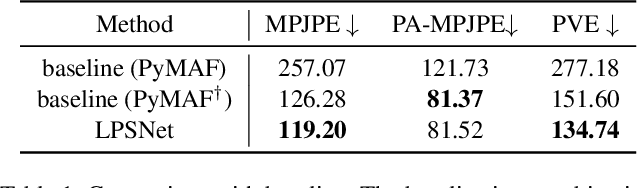
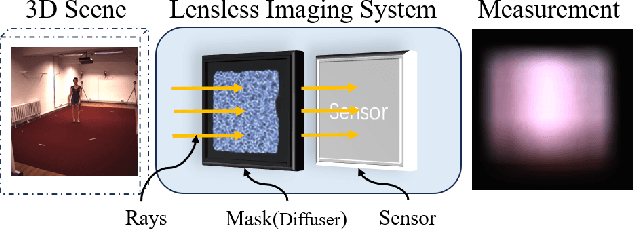
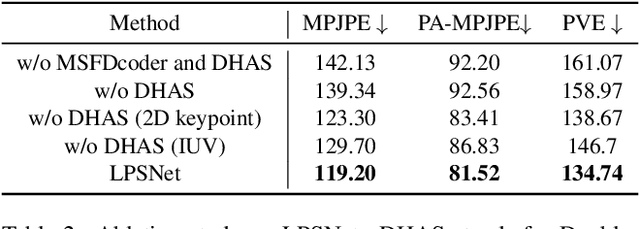
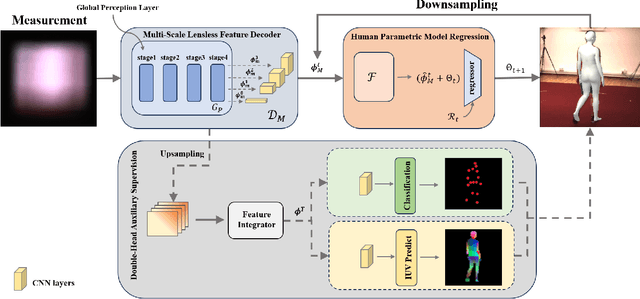
Human pose and shape (HPS) estimation with lensless imaging is not only beneficial to privacy protection but also can be used in covert surveillance scenarios due to the small size and simple structure of this device. However, this task presents significant challenges due to the inherent ambiguity of the captured measurements and lacks effective methods for directly estimating human pose and shape from lensless data. In this paper, we propose the first end-to-end framework to recover 3D human poses and shapes from lensless measurements to our knowledge. We specifically design a multi-scale lensless feature decoder to decode the lensless measurements through the optically encoded mask for efficient feature extraction. We also propose a double-head auxiliary supervision mechanism to improve the estimation accuracy of human limb ends. Besides, we establish a lensless imaging system and verify the effectiveness of our method on various datasets acquired by our lensless imaging system.