 Add to Chrome
 Add to Firefox
 Add to Edge
Closing the Loop in Humanoid VLA: Persistent 3D Object Tokens for Verifiable Loco-Manipulation
Jul 20, 2026
Vision-language-action policies are a promising foundation for general robot control, but long-horizon humanoid loco-manipulation requires the robot to treat task objects as persistent physical entities across movement, contact, occlusion, and recovery. We study this problem as object-state divergence: the object state used to condition a whole-body action can differ from the state used to decide whether the action achieved the intended physical relation. We propose \emph{Persistent Object Tokenization} (POT), which maintains role-indexed 3D object records from RGB-D observations and converts them into object tokens for a whole-body action expert. Instantiated as \emph{POT-VLA}, the same object records condition action generation and support geometric predicate checks, yielding a closed-loop execution system in which object state is both actionable and verifiable. On a Unitree G1, POT-VLA improves a matched direct GR00T-N1.7 baseline from 39/80 to 71/80 successes over eight real-world task families. In an external Being-0-aligned reference, POT-VLA achieves 44/50 successes on aligned service tasks, compared with the 37/50 success reported by the Being-0 paper. The largest gains occur on tasks requiring maintained 3D relations, suggesting that persistent object-centered state is a useful abstraction for verifiable humanoid VLA execution.

CyboRacket: A Perception-to-Action Framework for Humanoid Racket Sports
Mar 15, 2026Dynamic ball-interaction tasks remain challenging for robots because they require tight perception-action coupling under limited reaction time. This challenge is especially pronounced in humanoid racket sports, where successful interception depends on accurate visual tracking, trajectory prediction, coordinated stepping, and stable whole-body striking. Existing robotic racket-sport systems often rely on external motion capture for state estimation or on task-specific low-level controllers that must be retrained across tasks and platforms. We present CyboRacket, a hierarchical perception-to-action framework for humanoid racket sports that integrates onboard visual perception, physics-based trajectory prediction, and large-scale pre-trained whole-body control. The framework uses onboard cameras to track the incoming object, predicts its future trajectory, and converts the estimated interception state into target end-effector and base-motion commands for whole-body execution by SONIC on the Unitree G1 humanoid robot. We evaluate the proposed framework in a vision-based humanoid tennis-hitting task. Experimental results demonstrate real-time visual tracking, trajectory prediction, and successful striking using purely onboard sensing.
Cybo-Waiter: A Physical Agentic Framework for Humanoid Whole-Body Locomotion-Manipulation
Mar 11, 2026Robots are increasingly expected to execute open ended natural language requests in human environments, which demands reliable long horizon execution under partial observability. This is especially challenging for humanoids because locomotion and manipulation are tightly coupled through stance, reachability, and balance. We present a humanoid agent framework that turns VLM plans into verifiable task programs and closes the loop with multi object 3D geometric supervision. A VLM planner compiles each instruction into a typed JSON sequence of subtasks with explicit predicate based preconditions and success conditions. Using SAM3 and RGB-D, we ground all task relevant entities in 3D, estimate object centroids and extents, and evaluate predicates over stable frames to obtain condition level diagnostics. The supervisor uses these diagnostics to verify subtask completion and to provide condition-level feedback for progression and replanning. We execute each subtask by coordinating humanoid locomotion and whole-body manipulation, selecting feasible motion primitives under reachability and balance constraints. Experiments on tabletop manipulation and long horizon humanoid loco manipulation tasks show improved robustness from multi object grounding, temporal stability, and recovery driven replanning.
PanoDP: Learning Collision-Free Navigation with Panoramic Depth and Differentiable Physics
Mar 08, 2026Autonomous collision-free navigation in cluttered environments requires safe decision-making under partial observability with both static structure and dynamic obstacles. We present \textbf{PanoDP}, a communication-free learning framework that combines four-view panoramic depth perception with differentiable-physics-based training signals. PanoDP encodes panoramic depth using a lightweight CNN and optimizes policies with dense differentiable collision and motion-feasibility terms, improving training stability beyond sparse terminal collisions. We evaluate PanoDP on a controlled ring-to-center benchmark with systematic sweeps over agent count, obstacle density/layout, and dynamic behaviors, and further test out-of-distribution generalization in an external simulator (e.g., AirSim). Across settings, PanoDP increases collision-free and completion rates over single-view and non-physics-guided baselines under matched training budgets, and ablations (view masking, rotation augmentation) confirm the policy leverages 360-degree information. Code will be open source upon acceptance.
Learning Off-policy with Model-based Intrinsic Motivation For Active Online Exploration
Mar 31, 2024
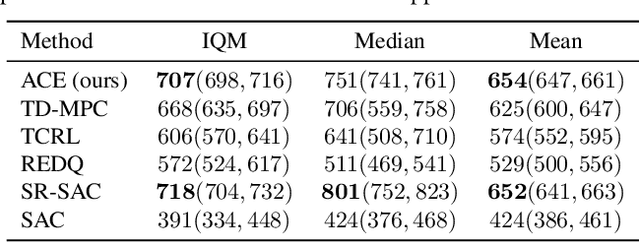
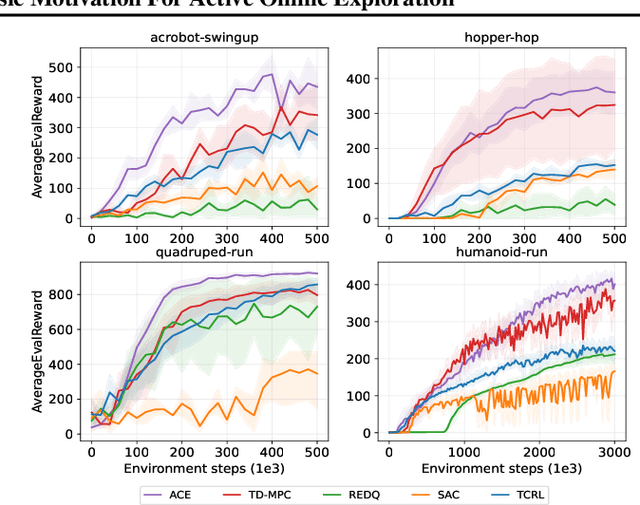
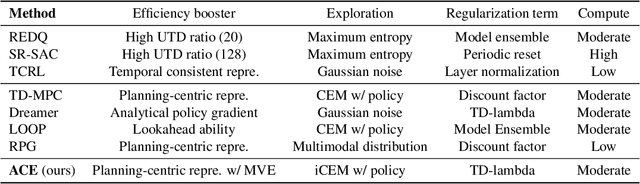
Recent advancements in deep reinforcement learning (RL) have demonstrated notable progress in sample efficiency, spanning both model-based and model-free paradigms. Despite the identification and mitigation of specific bottlenecks in prior works, the agent's exploration ability remains under-emphasized in the realm of sample-efficient RL. This paper investigates how to achieve sample-efficient exploration in continuous control tasks. We introduce an RL algorithm that incorporates a predictive model and off-policy learning elements, where an online planner enhanced by a novelty-aware terminal value function is employed for sample collection. Leveraging the forward predictive error within a latent state space, we derive an intrinsic reward without incurring parameters overhead. This reward establishes a solid connection to model uncertainty, allowing the agent to effectively overcome the asymptotic performance gap. Through extensive experiments, our method shows competitive or even superior performance compared to prior works, especially the sparse reward cases.